How to Study Textbook: how to study textbook for retention and mastery
Discover how to study textbook effectively with proven strategies for active reading, note-taking, and long-term retention.
Let's be honest, staring down a dense, 500-page textbook can feel like trying to climb a mountain in flip-flops. It’s overwhelming. But the secret to conquering that mountain isn't just about reading every single word—it's about having the right gear and a solid plan.
The most common mistake I see is students treating their textbooks like novels, reading passively from front to back and hoping something sticks. This approach, along with mindlessly highlighting half the page, only creates an illusion of learning. The real key is a more active, three-phase system: prime your brain before you read, engage with the material as you go, and solidify your knowledge afterward.
Your Blueprint for Textbook Mastery
What if you had a reliable system to dismantle any textbook, pull out its core concepts, and actually remember them for the exam and beyond? Instead of falling into the trap of inefficient rereading, which cognitive science has repeatedly shown to be a poor use of time, you can adopt a proven framework that turns reading from a passive chore into an active investigation.
It all boils down to a simple, memorable process. This flowchart gives you a bird's-eye view of the entire system.
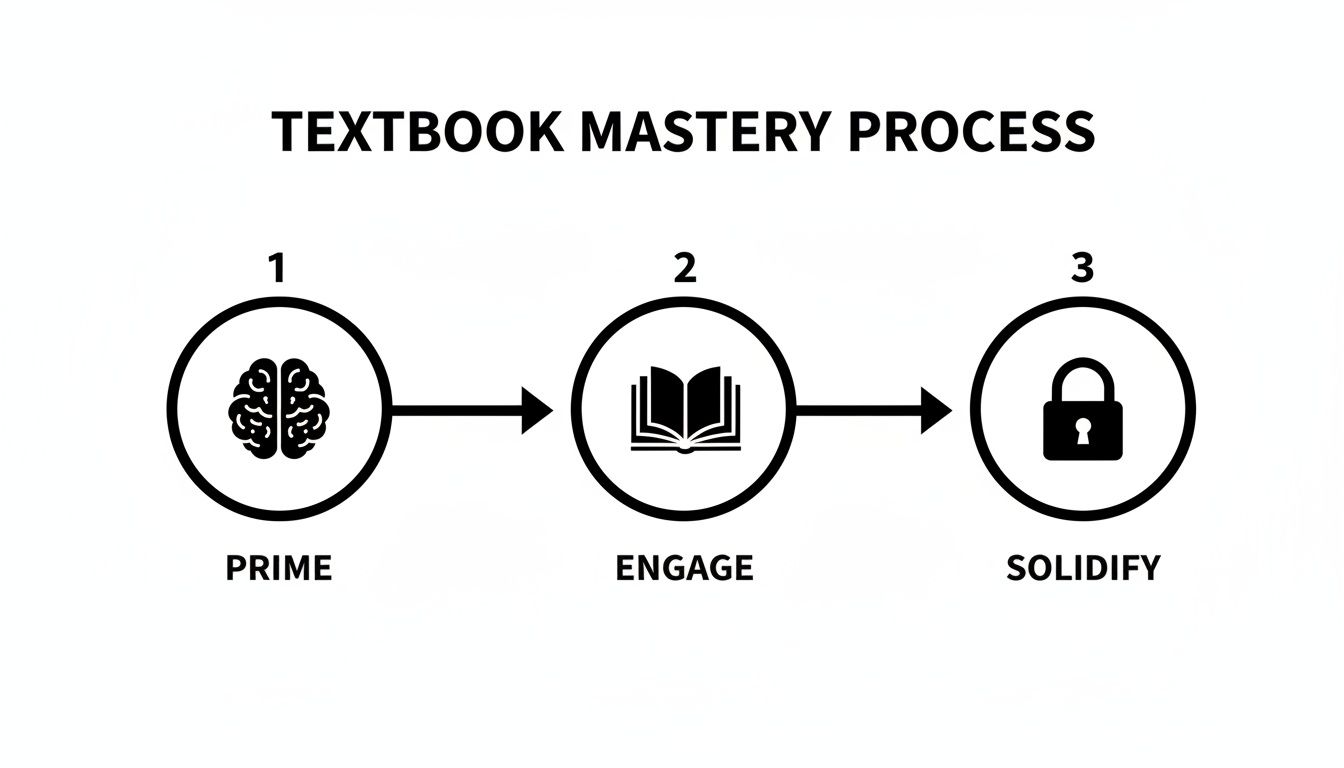
As you can see, the path flows logically from preparation (Prime), through active learning (Engage), and finally to long-term retention (Solidify). Each step builds on the last, creating a powerful loop that makes learning stick.
Here's a quick overview of the framework we'll be diving into.
The 3-Phase Textbook Mastery Framework
| Phase | Objective | Key Actions |
|---|---|---|
| 1. Prime | Prepare your brain for learning | Skim the chapter, review summaries, and formulate questions before reading. |
| 2. Engage | Actively extract and understand information | Read with purpose, take smart notes, and interact with the text. |
| 3. Solidify | Lock in knowledge for long-term recall | Practice with problems, self-test, and use spaced repetition. |
This structured approach is a game-changer, especially for students who want to stop wasting time and start seeing better results.
The Foundation of Effective Study
This guide is your practical roadmap to turning any textbook from a source of stress into your most powerful tool for success. The methods we’ll cover aren't just random tips; they're grounded in well-established learning principles.
Take the famous SQ3R method—Survey, Question, Read, Recite, Review. It’s been around for decades for a reason. One 2018 study found students using it scored 25% higher on comprehension tests. Why? Because simply surveying a chapter first (looking at headings, images, and summaries) activates your prior knowledge and gives your brain a mental map to place new information on. It makes a huge difference.
The biggest mistake is treating a textbook like a novel you read from cover to cover. Instead, treat it like a database you strategically extract information from. Your goal is efficiency and understanding, not completion.
By shifting your mindset, you ensure you’re not just consuming words on a page but actually building a durable mental framework for complex topics. Throughout this guide, we'll unpack each of these phases with concrete, actionable steps you can start using today. You’ll learn exactly how to:
- Prime: Prepare your brain so you know what to look for before you even read the first sentence.
- Engage: Interact with the text in a way that builds deep, meaningful comprehension.
- Solidify: Use powerful techniques to lock that new knowledge in for good, so it’s there when you need it.
Phase One: Priming Your Brain for Learning
What’s the single biggest mistake students make when tackling a textbook? They just dive right in.
Think about it. You wouldn't try to build a complex Lego set without at least glancing at the box art and the instruction manual. You'd end up frustrated, with a pile of mismatched bricks. The same thing happens when you jump into a dense chapter cold. You’re setting yourself up for a struggle.
Real learning starts before you read the first sentence. This initial phase is all about building a mental scaffold. By taking just a few minutes to get the lay of the land, you give your brain the context it needs to file away new information correctly. This isn't deep reading; it's a strategic flyover.
Conduct a Five-Minute Chapter Reconnaissance
Okay, before you even think about highlighting anything, set a timer for five minutes. That’s all you need. In those five minutes, you’re going to do a quick, strategic scan of the entire chapter.
This isn’t cheating—it's priming your brain. You’re activating what you already know and creating a mental map of what's coming. It’s like watching a movie trailer; you get a feel for the plot, meet the main characters, and know what to watch for.
During this quick scan, here's what you should focus on:
- Chapter Title and Introduction: Read the main title and the first paragraph or two. The author almost always lays out the chapter's big idea right there.
- Headings and Subheadings: Your eyes should fly over every single heading. This is your chapter outline, handed to you on a silver platter. It shows you the flow of the argument.
- Visuals and Captions: Look at every chart, graph, diagram, and picture. Don't skip the captions—they often contain a nugget of gold that summarizes a key concept.
- Bolded Terms: Scan the pages for any bold or italicized words. These are the vocabulary words the author is flagging as crucial. You don't have to know them yet, just notice them.
- Summary and Review Questions: Yep, jump straight to the end. The chapter summary is the author telling you, "If you learn nothing else, learn this." The questions show you exactly what you're supposed to be able to answer by the end.
After this five-minute exercise, you’re no longer a passive reader. You're an active navigator. You have a framework, and as you start to read for real, every piece of information will have a place to slot into.
Transform Headings into Questions
With your mental map sketched out, it's time to spark some curiosity. This is a simple but incredibly powerful trick that flips your brain from a passive "reception" mode to an active "search" mode.
Go back to those headings and subheadings you just scanned. Your job now is to turn each one into a question.
Why does this work? A statement like "The Role of Mitochondria" is easy to skim over. But a question demands an answer. Your brain instinctively wants to find the solution, which forces you to engage with the text on a completely different level.
For example, a heading like "The Role of Mitochondria in Cellular Respiration" becomes, "What exactly do mitochondria do during cellular respiration?" See the difference? That little tweak turns reading into a mission.
Here’s how it looks in practice:
| Original Heading | Your Active Question |
|---|---|
| Causes of the Great Depression | What were the main economic and social factors that actually caused the Great Depression? |
| Newton's Laws of Motion | What are Newton's three laws of motion, and how do they show up in the real world? |
| Photosynthesis Light-Dependent Reactions | What happens during the light-dependent reactions of photosynthesis? What goes in, and what comes out? |
This isn't just a gimmick to keep you awake. It gives your reading a clear purpose. You’re not just trudging through pages anymore; you’re on a hunt for specific answers, which makes the information stick in your memory way more effectively.
Phase Two: Active Reading and Smart Annotation
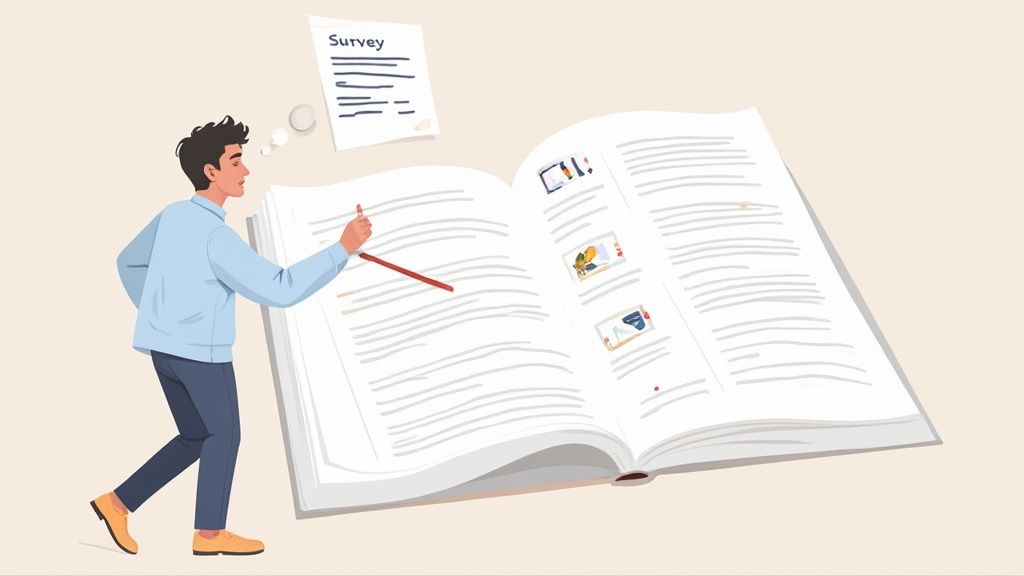
This is where the real work—and the real learning—begins. With the questions you prepared in the first phase, reading is no longer a passive chore. It's a mission. Your job is to hunt down the answers and truly engage with the material, building a solid foundation of knowledge that actually sticks.
It’s time to ditch the mindless highlighting. You know, the kind that coats your page in neon yellow but leaves your brain completely empty. Effective studying is a conversation with the author. You question their points, connect ideas across chapters, and put their arguments into your own words. This is what active reading is all about, and it's the only way to move information from the page into your long-term memory.
Read with Purpose
Your main goal here is simple: answer the questions you came up with earlier. Keep them front and center—scribble them on a sticky note or have a document open right next to your textbook. When you read this way, your brain is actively scanning for specific information, which makes it much easier to stay focused.
Don’t just let your eyes glide over the words. After each paragraph or section, pause and ask yourself, "What was the main point here?" If you can't answer it easily, you haven't really understood it yet. This quick self-check is your best defense against a wandering mind.
Remember, this isn't a race. A single, focused 30-minute session of active reading is infinitely more valuable than two hours of passively flipping pages while you're thinking about something else. This kind of deep engagement is also one of the best ways to start improving your reading comprehension skills, as it forces you to process what you’re seeing instead of just letting it wash over you.
Master the Art of Smart Annotation
Good annotation is so much more than underlining. It’s the physical record of your conversation with the text. This is how you make the textbook yours, layering your own thoughts and connections directly onto the page. The goal isn’t to make it look pretty; it’s to make it useful.
Here are a few practical techniques that blow basic highlighting out of the water:
- Summarize in the Margins: After a dense paragraph, try to boil it down to one simple sentence in the margin. This forces you to find the core idea.
- Draw Connections: Use arrows to link related concepts, even if they're chapters apart. See a term from Chapter 3 pop up again in Chapter 7? Draw a quick arrow and jot down "See p. 142" in the margin.
- Log Your Questions: If something is confusing or sparks a new question, write it down right then and there. "Why is this true?" or "How does this relate to Topic X?" are powerful notes to leave for yourself.
- Define Key Terms: When you hit a bolded vocabulary word, write a simple definition in your own words right beside it.
Mindless highlighting is a trap. It feels productive, but it usually just means you haven’t figured out what’s actually important. If everything on the page looks important, you haven't separated the main ideas from the supporting details yet.
When you annotate this way, your textbook transforms from a static source of information into a dynamic study tool you’ll be glad to have when exams roll around.
Test Your Understanding on the Spot
How do you really know if you understand something? Try to explain it. This simple act is the key to one of the most powerful learning strategies out there, and it fits perfectly into an active reading session.
Known as the Feynman Technique, named after the Nobel Prize-winning physicist Richard Feynman, this method is built on one simple idea: if you can't explain something simply, you don't really get it. It’s surprisingly effective—in fact, some research shows that students using this method can gain 40% deeper insights into the material.
Here’s how to put it into practice. Let’s say you just finished a section on cellular respiration.
- Close the Book. Seriously, turn it over. No peeking.
- Explain It Aloud. Grab a blank piece of paper or just talk to yourself and explain the entire process of cellular respiration in the simplest terms possible. Pretend you're teaching it to a ten-year-old.
- Find the Gaps. You might get to a point where you say, "...and then it enters the Krebs cycle, where... uh... some stuff happens with electrons." That's it. That's your knowledge gap.
- Go Back and Clarify. Open the book and re-read only the part about the Krebs cycle until you can explain it without stumbling.
By constantly testing yourself as you go, you ensure you aren't just memorizing words—you're internalizing the concepts behind them and building real, durable knowledge.
Phase Three: Making Knowledge Stick with Active Recall
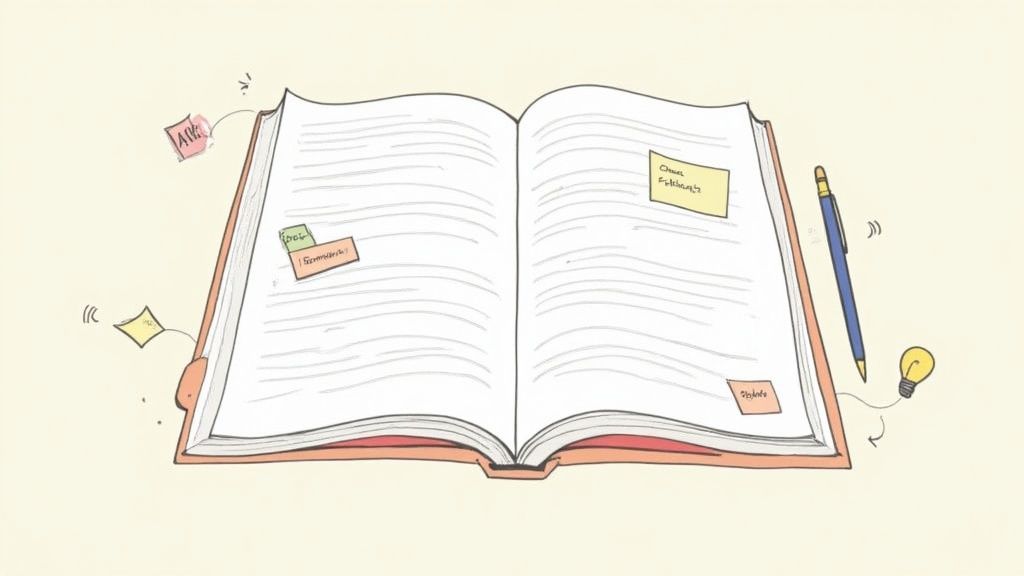
It’s one thing to understand a complex biological process or a historical timeline while you’re reading. It's another thing entirely to pull that information out of your head during a high-pressure exam weeks later. This is where most students stumble, and it's usually because they lean on passive review methods like rereading notes or highlighted passages.
This next phase is all about locking in that knowledge for the long haul. The secret weapon here is a powerful principle from cognitive science called active recall.
Simply put, active recall is the act of deliberately pulling information out of your brain. It's a completely different mental exercise than passively shoving it back in by rereading. Think of it like a muscle: rereading is like watching someone else lift weights, but active recall is you doing the heavy lifting yourself. Every time you force your brain to retrieve a fact, formula, or concept without looking, you strengthen the neural pathways to that memory.
The Power of Retrieval Practice
Cognitive psychology is crystal clear on this: the act of retrieving information is one of the most effective ways to learn it. This isn't just a theory; the data is overwhelming. Active recall consistently beats passive techniques, sometimes cutting study time by 50% while doubling retention.
In fact, a major 2023 meta-analysis found that students using active recall scored an incredible 35% higher on average in higher education. The technique works because it perfectly mimics what you have to do in an exam—pull answers from memory. Rereading, on the other hand, creates a dangerous "illusion of fluency," where the material feels familiar, but that familiarity doesn't mean you can actually recall it when it counts.
So, how do you actually do this? It's simpler than it sounds.
- Try the "Close the Book" Method: After reading a section, shut the book and try to explain the main points out loud, as if you were teaching a friend.
- Generate Your Own Questions: As you go over your notes, turn them into potential exam questions. Later, try to answer them from memory.
- Use Flashcards (The Right Way): Don't just mindlessly flip them over. Force yourself to say the answer aloud or write it down before you check. This creates that crucial retrieval effort.
Passive vs. Active Study Techniques
The difference in results between passive and active studying is stark. Choosing the right approach is critical, and seeing them side-by-side makes the decision pretty obvious.
| Technique | Effectiveness for Long-Term Memory | Example |
|---|---|---|
| Active Recall | High: Strengthens neural pathways, making knowledge durable and accessible under pressure. | Closing your textbook and trying to solve a practice problem from scratch before checking the solution. |
| Passive Review | Low: Creates a temporary feeling of familiarity but does little to build strong, lasting memories. | Rereading your highlighted notes multiple times, hoping the information will sink in through sheer repetition. |
By prioritizing active methods, you stop being a passive consumer of information and become an active participant in your own learning. The difference is game-changing.
Beat the Forgetting Curve with Spaced Repetition
Even with active recall, you can't just review something once and expect it to stick forever. Our brains are designed to forget things over time—a concept known as the "forgetting curve." To fight this natural tendency, you need to pair active recall with another powerful strategy: spaced repetition.
Spaced repetition is simply the practice of reviewing information at increasing intervals. You might review a new concept right after learning it, then again a day later, then a few days after that, then a week later, and so on. Each time you successfully recall it, you can push the next review session further into the future.
The most efficient time to review information is right before you're about to forget it. Spaced repetition systems help you do this systematically, targeting your weakest areas without wasting time on what you already know.
This combination of active recall and strategic spacing is the ultimate one-two punch for long-term retention. It transforms studying from a frantic, last-minute cram session into a manageable, ongoing process. For a deeper dive into building this into your routine, check out our complete guide on how to study efficiently for exams. Mastering these techniques will make every minute you spend with your textbook count.
Supercharge Your Studies with Feen AI
Alright, you’ve got the study framework down. That’s the hard part, and it’s the foundation for really learning how to study a textbook. But let’s be real—we can use modern tools to work smarter, not just harder. Think of a tool like Feen AI as an accelerator, helping you move through those study phases faster and with more confidence.
It’s not about replacing your effort; it’s about augmenting it. Instead of getting bogged down for an hour on a dense chapter, you can get a running start. These AI features are like having a personal tutor on standby, ready to clear up confusion or quiz you on what you just read. Let’s look at how you can weave this into your routine.
Streamline the Priming Phase with Instant Summaries
Remember that five-minute recon mission from Phase One? The whole point is to build a mental map before you dive into the details. Feen AI’s summarization tool can make this step even more effective.
Before you even start your own skim-through, upload the chapter PDF. In seconds, you'll get a high-level overview of the main arguments, key terms, and the author's final point. This doesn't replace the "Survey" step—it supercharges it.
Think of this initial AI summary as an expert-level "movie trailer" for the chapter. It shows you the main plot points, so when you do your own manual scan, you’ll instantly recognize the most important headings and ideas.
This primes your brain way more efficiently. You're walking into the reading session already knowing the destination, which makes the journey much more focused. For a deeper dive on this, you can explore the details of our PDF summarizer.
Deepen Engagement with Interactive Q&A
Phase Two is all about digging in, asking questions, and making notes. But you know that feeling when you hit a single paragraph or a complex idea that just stops you in your tracks? Normally, you'd be stuck until you could ask a professor or a TA.
With Feen AI, you can get that clarification instantly. Just copy the confusing text or type your question straight into the chat.
- Clarify Complex Ideas: "Can you explain the difference between mitosis and meiosis in simpler terms?"
- Define Jargon: "What exactly is 'osmotic pressure' in the context of this biology chapter?"
- Generate Practice Questions: "Based on this section about the Krebs cycle, create three multiple-choice questions to test my understanding."
That last one is a game-changer for the "Recite" part of your study system. The AI becomes a study partner, generating an endless stream of practice questions. This forces you to actively pull the information from your memory, which is exactly what strengthens those neural pathways.
Master Problem-Solving with Worked Solutions
For any STEM-related subject—physics, chemistry, calculus—knowing the theory is just step one. The real test is applying it to solve messy, multi-step problems. We’ve all been there: staring at a problem set, not even knowing where to begin. It's frustrating.
This is where worked solutions are a lifesaver. When you upload a problem from your book (either as a quick screenshot or part of the PDF), Feen AI does more than just spit out the answer. It shows its work.
You get a full, step-by-step breakdown of the entire process. You’ll see exactly how a formula was used, why a certain variable was isolated, and the logic that gets you from the question to the solution. This is perfect for figuring out precisely where you went wrong in your own attempt and, more importantly, for internalizing the right way to approach it next time. It turns frustrating homework into a genuine learning opportunity.
Common Textbook Study Pitfalls to Avoid
Knowing the right way to study a textbook is only half the battle. You also have to recognize the bad habits that quietly sabotage all your hard work. So many students feel like they're putting in the hours, only to be disappointed by their grades. More often than not, it's because they've fallen into one of these common traps.
The number one culprit? Passive rereading. Your eyes glaze over the same sentences again and again, which creates a false sense of familiarity. This isn't learning; it's just recognizing. Real learning happens when you have to actively pull information out of your brain, not just passively scan it on a page.
The Illusion of Productivity
Another trap is getting too happy with the highlighter. It feels incredibly productive to paint your pages bright yellow or pink, but it quickly becomes a mindless activity. If you've highlighted more than 10-15% of a page, you've probably failed to separate the truly important ideas from the background noise.
And then there's the all-night cramming session. We've all done it. It might get you through a quiz the next day, but that information vanishes almost as quickly as it came. Research on the "forgetting curve" is brutal—it shows that without spaced review, your knowledge retention drops off a cliff. Your brain needs time and repetition to build strong memories, something marathon sessions just don't allow.
Don’t confuse activity with achievement. Spending three hours highlighting a chapter feels like work, but if you aren't actively processing and recalling the information, it’s mostly wasted time.
Ditching Passive Habits for Active Ones
Making your study time count really comes down to one thing: engagement. Are you just letting the information wash over you, or are you wrestling with it? Here are a few more passive habits to watch out for:
- Mindless Note-Taking: Copying sentences word-for-word from the book into your notebook is just transcription, not learning. The goal is to process the ideas and put them into your own words.
- Skipping the Practice Problems: Those questions at the end of the chapter aren't just filler. They are your single best tool for testing whether you can actually apply what you just read.
- Ignoring the Big Picture: If you don't connect new concepts to what you already know, the information stays isolated and is much harder to remember. Always be asking, "How does this relate to last week's topic?"
At the root of many of these issues is good old-fashioned procrastination. When you put things off, you're forced into cramming and other desperate, ineffective habits. Learning how to overcome procrastination is a critical step in building a truly effective study routine. By sidestepping these common pitfalls, you can finally make sure every minute you spend studying actually counts.
Frequently Asked Questions
Even with the best study system in place, you're bound to hit a few snags. It happens to everyone. Here are some quick, practical answers to the questions I hear most often from students trying to get the most out of their textbooks.
How Long Should I Spend Studying One Chapter?
Honestly, there’s no magic number here. A dense chapter in organic chemistry is going to take a lot longer than an introductory chapter in sociology. It all comes down to the subject's difficulty and how comfortable you already are with the material.
Instead of just watching the clock, focus on working through the process. I always recommend using focused study blocks, maybe 45 to 60 minutes at a time with short breaks in between.
For a standard 20-30 page chapter, you could break it down like this:
- Session 1: Get the lay of the land (the "Survey" and "Question" steps).
- Sessions 2-3: Dive in for active reading and making your notes.
- Session 4: Circle back to review and tackle practice problems.
The real goal is consistency, not trying to cram it all in at once. Splitting the work up makes it feel less daunting and helps the information actually stick.
What if My Textbook Is Really Boring?
Let's be real—some textbooks are just dry. It’s a common problem. The trick is to shift your mindset: you don't have to enjoy the book to learn from it. Your mission is to pull out the essential information as efficiently as possible.
An active study method is your best weapon against boredom. When you force yourself to turn headings into questions, you're giving your brain a puzzle to solve, which is way more engaging than just letting your eyes glaze over the page.
You can also bring in other resources to liven things up. Find a great YouTube explainer on the topic, or use Feen AI to summarize a particularly dense section or explain a concept in simpler terms. Think of the textbook as just one tool in your learning kit, not the only one.
Is It Better to Take Digital or Handwritten Notes?
This is the classic debate, and both sides have a point. There's good research showing that the physical act of writing notes by hand helps you understand concepts on a deeper level. It forces you to process and rephrase things, not just copy them word-for-word.
On the other hand, you can't beat digital notes for organization and searchability. Being able to quickly find a keyword or paste in a helpful diagram is a huge advantage.
I’ve found a hybrid approach works wonders for most students. Scribble your initial, messy notes by hand while you read. This helps lock in the concepts. A day or two later, type those notes up into a clean, organized digital file. That act of re-typing and organizing is an incredibly powerful review session in itself.
Ready to make your study sessions more efficient? Let Feen AI help you summarize dense chapters, clarify confusing concepts, and get step-by-step solutions to tough problems. Try it now and see the difference.
Relevant articles

Master how to study for biology exam with proven methods: active recall, spaced repetition, and practice questions to boost mastery and scores.
Discover how to study efficiently for exams with proven, science-backed techniques, smarter planning, and tools that boost memory and reduce stress.
Discover how to study a textbook with active recall, smart notes, and proven strategies to boost memory and ace exams.