How to Study Efficiently for Exams Using Science-Backed Methods
Discover how to study efficiently for exams with proven, science-backed techniques, smarter planning, and tools that boost memory and reduce stress.
When it comes to studying for exams, it’s not about how long you study—it’s about how you study. The best approach isn't a secret; it’s a system built on three solid pillars: strategic planning to focus your energy, active learning to actually engage your brain, and consistent review to make sure what you learn sticks.
This guide will break down this entire science-backed system, step by step.
The Real Foundation of Efficient Exam Prep
So many students I've worked with struggle with exams not because they're lazy, but because they're using the wrong tools for the job. They spend hours passively re-reading notes or going over textbook chapters with a highlighter, which creates this dangerous illusion of knowing the material. The reality? This rarely builds the deep, lasting knowledge you need to ace an exam.
It’s a frustrating cycle that leads to burnout and disappointing grades, and it reinforces the myth that getting a good score just means putting in more time. That's simply not true.
The real key is to shift your mindset from just "studying" to actively "practicing." Instead of just taking information in, you need to be constantly pulling it out and applying it. That's what this guide is all about—moving past vague advice to give you real strategies that are actually backed by cognitive science.
Your Blueprint for Smarter Studying
The system I'm about to show you is a simple, repeatable process that keeps you focused on what will actually make a difference on exam day. To really get the most out of it, it's worth exploring some proven strategies to study better in college and boost your grades that complement this framework.
Here's what we'll cover:
- Plan Strategically: Pinpoint the most important topics and build a realistic schedule that gets you away from last-minute cramming for good.
- Learn Actively: Use proven techniques like self-quizzing and spaced repetition to lock information into your long-term memory.
- Review Consistently: Create a review routine that reinforces what you've learned over time, so it's second nature by the time you sit down for the test.
The pressure to do well is universal. The global exam prep market was valued at around $50 billion in 2023, a number that's only expected to grow. This tells you one thing: everyone is looking for better ways to study that actually work.
The biggest mistake students make is confusing familiarity with mastery. Re-reading feels productive, but active recall is what actually builds the strong neural pathways needed to excel on exams.
This simple flowchart breaks down the powerful three-stage approach that forms the core of an effective study system.
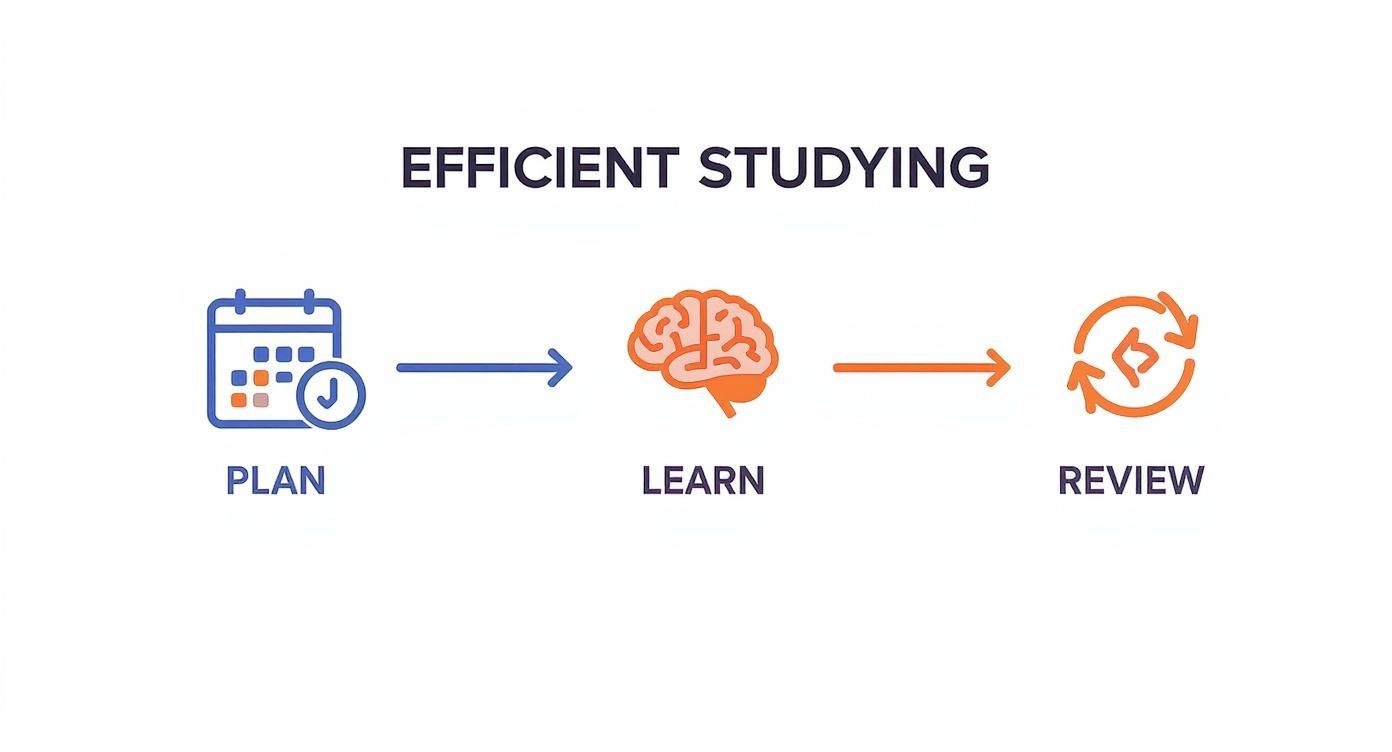
Each of these steps builds on the last, creating a powerful cycle. It transforms your study sessions from a passive chore into a targeted, active practice. Now, let’s dive into the details, starting with how to build your strategic plan.
How to Build a Smarter Study Plan
A solid study plan is your best defense against the all-too-familiar cycle of burnout and last-minute cramming. Without one, you're basically just hoping for the best, reacting to deadlines instead of controlling them. The goal isn't to micromanage every second of your day, but to make smart, deliberate choices about where your precious time and energy should go.
Think of yourself as a detective. Your syllabus and old exam papers are the crime scene, and you're looking for clues. Comb through them to spot the high-yield topics—the concepts that show up year after year or carry the most weight in your final grade. This simple audit is the first step away from "I need to study everything" and toward "I need to study what matters most."
Prioritize Your Topics Like a Pro
Once you've identified what's important, you have to decide what to hit first. Let's be real, not all topics are created equal. Some are foundational building blocks, while others are complex beasts that will eat up your time. This is where a simple prioritization framework can be a game-changer.
A fantastic tool for this is the Eisenhower Matrix. It sounds fancy, but it's just a simple grid that helps you sort tasks by how urgent and important they are.
- Urgent & Important: Do these now. This is the assignment on a core topic that's due tomorrow. No excuses.
- Important & Not Urgent: Schedule these. This quadrant is where most of your real, effective studying happens. Think reviewing key concepts from last month's lectures or working through practice problems for the final.
- Urgent & Not Important: Minimize or delegate. These are the noisy group chat notifications and low-priority emails that feel urgent but don't actually move the needle on your grades.
- Not Urgent & Not Important: Just get rid of them. Mindless social media scrolling, re-watching lectures you already aced—these are your time thieves.
By dropping your study topics into this matrix, you instantly create a clear game plan. It stops you from getting sidetracked by busywork and keeps your focus locked on the tasks that will have the biggest impact.
Block Your Time for Maximum Focus
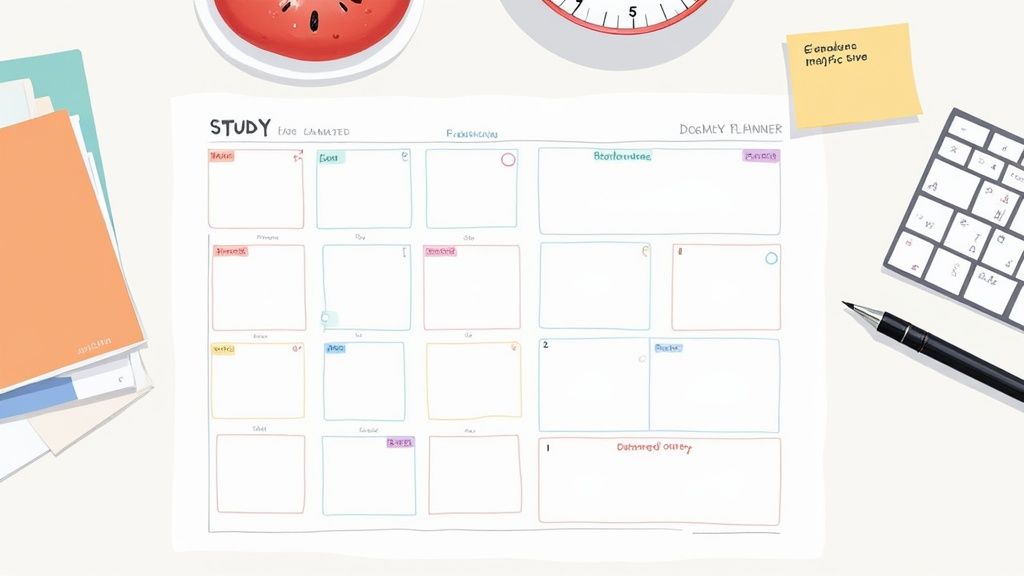
With your priorities straight, it's time to build a schedule that you can actually stick to. This is where time blocking comes in. Instead of a vague to-do list that just stares back at you, you assign every task a specific time slot in your calendar. It's a simple psychological trick that forces you to be realistic about how long things take and helps build a sustainable rhythm.
A typical weekly schedule might look something like this:
| Time | Monday | Tuesday | Wednesday |
|---|---|---|---|
| 9-11 AM | Review Chemistry Ch. 3 | Calculus Practice Problems | Write History Essay Outline |
| 11-12 PM | BREAK | BREAK | BREAK |
| 12-2 PM | Biology Lab Report | Chemistry Ch. 4 Notes | History Research |
| 2-4 PM | Free Time / Errands | Gym | Free Time / Errands |
A good study plan isn’t just about the grind; it’s about scheduling your downtime with the same intention. Breaks, exercise, and hanging out with friends aren't rewards—they're critical parts of a system designed to keep you sharp and prevent mental fatigue.
Master Your Minutes with Proven Techniques
Scheduling the time is one thing; how you use that time is another. A couple of powerful time management techniques can completely change your ability to focus during those study blocks.
The Pomodoro Technique is a classic for a reason. It's perfect for chipping away at those huge, intimidating tasks. You just work in a hyper-focused, 25-minute sprint, then take a 5-minute break. After four of these "Pomodoros," you take a longer break, maybe 15-30 minutes. This rhythm keeps your brain fresh and makes it way easier to get started on subjects you might be dreading.
Another great strategy is task batching. This is all about grouping similar activities together to get into a state of flow. Instead of jumping from writing an essay to solving math problems to making flashcards, you’d set aside a single block of time just for making flashcards for all your subjects. You reduce the mental whiplash of constantly switching gears, which saves a surprising amount of energy. For a subject like math, you can really level up by combining task batching with targeted learning strategies; our guide on how to study math effectively dives deeper into that.
Ultimately, building a smarter study plan isn't a one-and-done task. It’s an active process of diagnosing what you need, being ruthless with your priorities, and managing your time with intention. That upfront effort pays off big time, replacing chaos and anxiety with a sense of control and confidence that sets you up for real learning.
Active Learning Techniques That Actually Build Memory
A great study plan gets you to your desk, but what you do there is what really matters. It's the difference between information sticking or vanishing an hour later. This is where we have to move beyond those old, passive habits most of us learned—things like re-reading notes or highlighting half the textbook.
Those activities feel productive, but they create a dangerous "illusion of fluency." You start to recognize the material, so you trick yourself into thinking you actually know it. True learning, the kind that shows up on exam day, demands active engagement.
Active learning forces your brain to do the heavy lifting. Instead of just letting information wash over you, you have to actively retrieve it, connect it to other ideas, and make it make sense. That effort is precisely what builds strong, lasting memories. Let's break down the most powerful, evidence-backed techniques that will completely change how you study.
Embrace Active Recall to Strengthen Memory
At its core, active recall (or retrieval practice) is the simple act of pulling information out of your brain instead of just trying to cram it in. Think of it like this: every time you force yourself to remember a concept without looking, you strengthen the neural pathway to that information. It’s like walking the same path in a forest—eventually, it becomes a well-worn trail that's easy to follow.
There are a ton of ways to do this, but the key is consistent self-quizzing.
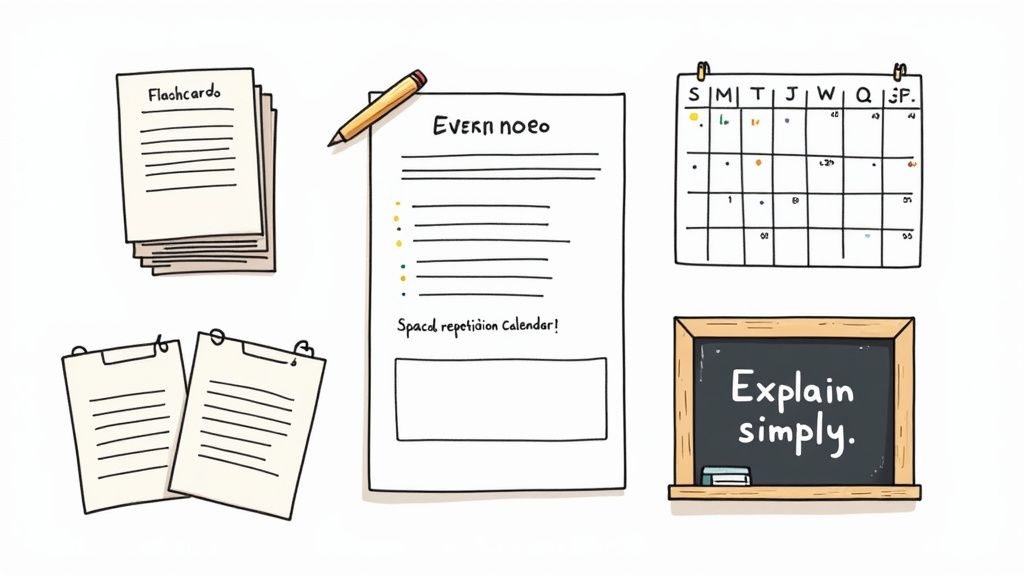
- Flashcards (The Right Way): Don't just flip and read. Actually say the answer out loud before you check the back. For more complex stuff, use digital tools like Anki or Quizlet that let you add images and detailed explanations.
- The Cornell Note-Taking Method: This system is practically built for active recall. After taking your main notes, you write questions in the side column. To study, just cover up the notes and try to answer your own questions.
- Brain Dumps: This is a fantastic reality check. Grab a blank piece of paper and just write down everything you can possibly remember about a topic. No notes, no books. Afterward, compare what you wrote to the source material. You'll instantly see where the gaps are.
Use Spaced Repetition to Learn for the Long Term
Here’s a hard truth: your brain is designed to forget. If you don't revisit information, your brain eventually decides it's not important and gets rid of it. Spaced repetition is a clever way to hack this system. It involves reviewing information at increasing intervals, right around the time you’d normally start to forget it.
This process essentially tells your brain, "Hey, pay attention! This is important. Keep it around."
The combination of active recall and spaced repetition is arguably the most powerful duo for efficient studying. It moves information from fragile short-term memory to robust long-term storage, which is exactly what you need for final exams.
You don't need a complicated system to get started:
- Manual System: A simple calendar works, as does a "Leitner box" with physical flashcards. Cards you get right move to a box that gets reviewed less often, while the ones you struggle with stay in the daily review pile.
- Digital Tools: This is where apps like Anki really shine. They use an algorithm to show you specific flashcards at the perfect moment for maximum memory reinforcement, taking all the guesswork out of it for you.
To see why this matters so much, it helps to contrast these active methods with the passive ones most students default to.
Active vs Passive Study Techniques Comparison
Here's a quick look at how different study methods stack up. Notice how the most common techniques are often the least effective for long-term learning.
| Technique | Type | Effectiveness | Example |
|---|---|---|---|
| Practice Testing | Active | Very High | Doing a full-length mock exam under timed conditions. |
| Active Recall | Active | Very High | Using flashcards or explaining a concept from memory. |
| Spaced Repetition | Active | Very High | Using an app like Anki to review material over time. |
| Teaching Others | Active | High | Explaining the Krebs cycle to a classmate. |
| Summarizing | Passive/Active | Moderate | Writing a one-paragraph summary after reading a chapter. |
| Highlighting | Passive | Very Low | Using a highlighter on key sentences in a textbook. |
| Re-reading | Passive | Very Low | Reading your notes or the textbook chapter over and over. |
The takeaway is clear: the methods that feel harder and require more mental effort are the ones that actually build lasting knowledge.
Make Practice Testing Your Gold Standard
If you only have time to commit to one new study technique, make it this one. Practice testing is the ultimate form of active recall because it forces you to use what you know under the same conditions as the real exam.
Working through practice questions does more than just tell you what you know; it’s a powerful learning tool in itself. It identifies your weak spots with brutal honesty and helps you get comfortable with the exam's format, timing, and question style, which goes a long way in calming those test-day nerves.
But don't just do a practice test and check your score. The real learning happens when you dig into your mistakes. For every question you got wrong, ask yourself why. Was it a simple calculation error? A deeper misunderstanding of the concept? Did you just run out of time? This analysis turns every practice test into a personalized study guide.
Truly Understand with the Feynman Technique
Ever feel like you can recite a definition but don't really get what it means? The Feynman Technique, named after Nobel Prize-winning physicist Richard Feynman, is a genius-level simple method for exposing those gaps. The entire process boils down to one idea: explain a concept in the simplest terms you can, as if you were teaching it to a kid.
Here’s how it works:
- Pick a Concept: Write the name of the topic at the top of a blank page.
- Explain It Simply: Write out an explanation as if you were teaching it to someone completely new to the subject. Avoid jargon. Use simple analogies.
- Find Your Gaps: Any time you get stuck, have to use complicated language, or feel your explanation is fuzzy, that’s your weak spot. Go back to your notes or textbook and clarify that specific point.
- Refine and Simplify: Go back to your explanation and make it even simpler. The goal is a clear, concise summary that anyone could pick up and understand.
This method forces you to break down complex ideas into their fundamental parts, ensuring you've mastered them on a much deeper level. If you're struggling to pull these core concepts from dense material in the first place, our guide on how to study a textbook can be a huge help. By making these active strategies your go-to, you shift from being a passive student to an active architect of your own knowledge.
Your Study Co-Pilot: Using Tech the Smart Way
Let's be real: trying to study today without using any modern technology is like insisting on building a house with just a hammer and nails. It’s possible, but it’s unnecessarily hard. Smart tools, when used correctly, can be an incredible co-pilot for your learning journey.
The trick is to think of them as a personal tutor, not a cheat sheet. It's about using technology to understand the why behind an answer, not just to get the answer itself. For instance, instead of just copying the final solution to a tricky physics problem, you could ask an AI assistant to walk you through each step. That’s where the real learning kicks in.
Decode Dense Topics in Minutes
We've all been there—staring at a dense textbook chapter or a jargon-filled academic paper, reading the same paragraph over and over. You can easily burn an hour and still walk away with a fuzzy idea of the main point. This is one of the best places to bring in some tech.
AI-powered tools can cut through the noise and summarize lengthy documents for you, pulling out the core ideas, key terms, and critical arguments.
- Upload a PDF: Drop that 20-page research paper into an AI tool and ask for a bulleted summary of the main findings.
- Clarify a Concept: If a term like "mitochondrial DNA" is tripping you up, ask for a simple explanation or an analogy to help it click.
- Generate Questions: Turn a summary into an instant self-quiz by asking the AI to create practice questions based on the key information.
This approach turns hours of passive, often frustrating, reading into a quick, active learning session. That frees you up to spend more time on what really matters: practice problems and active recall.
Get Instant Feedback on Your Work
Practice testing is a proven winner, but its effectiveness drops if you have to wait days to find out what you got wrong. That delay between doing the work and getting feedback is a missed opportunity for learning. This is where an AI study companion really shines.
You can use it to check your work on practice problems in real time. You get immediate confirmation on what you did right and, more importantly, a clear explanation of where you went wrong. This creates a tight feedback loop that helps you fix misunderstandings right away, before they become bad habits.
This kind of immediate, interactive support helps you stay in the zone, tackling one problem after another without losing momentum.
The market for this kind of blended learning—mixing classic study methods with digital tools—was valued at $66.73 billion in 2019. It’s projected to grow by another $53.84 billion by 2029, a clear sign of how valuable these tools have become for students.
Think of an AI study tool as a patient, 24/7 tutor. It’s always there to guide you through tough spots, check your reasoning, and offer endless practice—giving you complete control over your own learning process.
By using these tools strategically, you can make your study sessions far more productive. If you're looking to explore your options, you might find our breakdown of the best AI study tool helpful. Technology shouldn’t replace the hard work, but it can absolutely make that work smarter, faster, and much more effective.
9. Prime Your Brain and Body for Peak Performance
Let's be honest: all the study hacks in the world mean nothing if you’re running on fumes. Learning is a physical act. Your brain is an organ, and to get it firing on all cylinders, you have to treat your mind and body like the high-performance assets they are.
Ignoring your well-being is like trying to win a race with flat tires and dirty fuel. It just doesn't work. This isn't fluff—it's about creating the biological foundation for your brain to absorb, process, and retrieve everything you're working so hard to learn.
Sleep is Not a Luxury; It’s a Necessity
I get it. The all-nighter feels like a rite of passage, a badge of honor for dedicated students. But it's probably the most counterproductive thing you can do for your grades.
Sleep is when your brain actually does the heavy lifting of memory consolidation. It’s the time when new information moves from your shaky short-term memory into more permanent long-term storage. Skimping on sleep literally sabotages that process. Even one night of bad rest can tank your recall ability the next day.
- Be consistent. Try to get to bed and wake up around the same time, even on weekends. It helps set your body’s internal clock.
- Create a wind-down routine. An hour before bed, ditch the screens and textbooks. Read something for fun, listen to calm music, or just do some light stretching.
- Optimize your sleep space. A dark, cool, and quiet room sends a powerful signal to your brain that it's time to shut down and recharge.
Fuel Your Brain, Don't Just Fill Your Stomach
What you eat directly impacts how well you can focus and remember information. It’s so tempting to grab sugary snacks or down another energy drink for a quick jolt, but that path almost always ends in a productivity-killing crash.
Instead, think about feeding your brain what it actually needs. Complex carbs like oatmeal or whole grains provide slow-release energy that lasts. Lean proteins from chicken or beans keep you alert. And the healthy fats found in avocados, nuts, and fish are crucial for long-term brain health. Don't forget water, either—even slight dehydration can bring on brain fog and kill your motivation.
Your brain is an energy hog, devouring about 20% of your body's total calories. Feeding it nutrient-rich food isn't just about general health; it's a direct academic advantage.
To really dial in your physical and mental state, check out these top tips on hydration, nutrition, exercise, and sleep. These pillars work together, creating a powerful foundation for effective learning.
Get a Handle on Stress Before It Gets a Handle on You
Exam season is stressful. But when stress becomes chronic, it floods your body with cortisol, a hormone that actively interferes with your ability to form and recall memories. It’s hard to focus on complex equations when anxious thoughts are screaming for your attention.
You need simple, effective tools to keep your stress levels in check. Things like mindfulness and taking short breaks aren't indulgences; they are essential for effective studying. Just five minutes of deep breathing can calm your nervous system and pull your focus back to the present moment. A quick walk outside can do wonders to clear your head.
Finally, create a dedicated, distraction-free study zone. When your desk is only for studying, your brain starts to associate that spot with focus. This simple bit of conditioning helps you get into the zone faster, making every single study session more productive from the get-go.
Your Game Plan for Exam Day and Beyond
All that efficient studying comes down to this: how you perform when the clock starts. But the final push isn't just about what happens in the exam room; your execution in the last 24 hours is what sets the stage for success. Let’s be clear—the day before an exam is not for cramming. It’s for consolidation, calm, and confidence.

Think of the night before as your pre-game ritual. Get everything ready: lay out your pens, calculator, student ID, and any other permitted materials. Do one last, light pass over your summary notes or flashcards. The goal here isn't to learn anything new but to remind yourself of what you already know.
Then, shut the books and focus on getting a full night's sleep. This is non-negotiable. Quality sleep is essential for memory recall and keeping a clear head under pressure.
Managing Time and Anxiety During the Test
Once you’re in your seat and the exam begins, strategy is everything. Before you write a single word, take a minute to scan the entire test. This gives you a mental map of what's ahead.
Start by knocking out the easier, low-point questions first. These are your quick wins. Banking those early points builds momentum and does wonders for calming those initial nerves.
For bigger sections, like essays or multi-part problems, be disciplined with your time. If you have 60 minutes for three essays, that’s a strict 20-minute block for each. If you feel that familiar wave of panic starting to rise, take a deep breath and use a grounding technique.
The 4-7-8 breathing method is a surprisingly powerful tool for calming your nervous system right in the middle of a test. Just inhale for 4 seconds, hold for 7, and exhale slowly for 8. A few rounds can completely reset your focus.
Turning Every Exam into a Learning Opportunity
The learning doesn't stop when you hand in your paper. When you get your results back—good or bad—take some time to really dig into your performance.
Look at where you lost points. Was it because you truly didn't grasp a concept? Or was it a careless mistake, like a simple calculation error? Maybe you just ran out of time.
This kind of post-exam analysis is pure gold. It turns every test from a final grade into a diagnostic tool, showing you exactly where your study methods are working and where they need a tune-up for next time. This cycle of review and refinement is the real secret to long-term academic success.
Untangling Common Study Questions
It's one thing to read about study techniques, but it's another to actually put them into practice. When you start revamping your study habits, real-world questions always pop up. Let's get into some of the most common ones I hear from students.
How Many Hours a Day Do I Really Need to Study?
Forget the magic number. The goal isn't to hit a certain number of hours; it's to have productive, focused sessions. Quality will always trounce quantity.
Honestly, you can get more done in 2-3 hours of truly focused work than you can in a full day of distracted, half-hearted review. If you use a system like the Pomodoro Technique (25 minutes on, 5 off), you'll see what I mean. The real win is finding a sustainable pace that mixes deep work with the rest you actually need to function.
Should I Stick to One Subject All Day or Mix It Up?
Definitely mix it up. This strategy is called interleaving, and it's a powerhouse for building long-term memory. When you switch between different subjects, you force your brain to work a little harder to retrieve information, which makes those connections much stronger and more flexible.
Instead of dedicating a whole four-hour block to calculus, try breaking it up. Maybe do an hour of calculus problems, then switch to an hour of biology flashcards. You could even circle back to calculus for a quick review of a concept that was giving you trouble earlier.
It will feel a bit tougher at first, but that mental friction is a good sign—it means you're building knowledge that will actually stick.
If you're really in a time crunch, the single most effective thing you can do is practice testing. It forces active recall, mimics the pressure of the real exam, and instantly shows you where you're weak. It's the highest-leverage activity you have.
When you're short on time, your first move should be to find past papers, online quizzes, or end-of-chapter questions. Do them under timed conditions. It's the fastest, most honest way to figure out what you know and what you think you know.
Stop guessing and start understanding. With Feen AI, you can upload difficult problems, get step-by-step explanations, and summarize dense readings in seconds. Try it for free and make your study sessions smarter, not longer at https://feen.ai.
Relevant articles

Master how to study for biology exam with proven methods: active recall, spaced repetition, and practice questions to boost mastery and scores.

Unlock the best way to study for finals with 10 evidence-based strategies. Our guide covers everything from active recall to using Feen AI for success.

Discover how to improve test taking skills with proven strategies. Learn study techniques, anxiety management, and ways to analyze mistakes for better grades.
Discover how to use AI for studying with proven strategies that actually work. Learn to leverage AI study tools to ace exams and understand complex topics.

Learn how to study for chemistry test with a proven strategy. Master concepts, practice problems, and test-day tips to boost your score.
Discover how to summarize book chapters effectively. Our guide covers proven methods and smart tools to help you retain more information and study smarter.