Mastering Inquiry: A Complete Guide to the 7 Steps of the Scientific Method
Unlock the power of inquiry with our deep dive into the 7 steps of the scientific method. Learn each stage from observation to conclusion with examples.
Have you ever wondered why some plants thrive while others wither, or why certain chemical reactions happen faster than others? The answer isn't magic—it's method. The scientific method is a systematic, logical process that scientists, students, and curious thinkers use to understand the world around them. It's more than just a checklist for lab reports; it's a powerful framework for turning everyday observations into structured, evidence-based knowledge. In fact, its principles are so fundamental that they mirror complex professional problem-solving. To see how scientific principles are applied in real-world professional fields, consider how a clinical reasoning process like differential diagnosis involves observation, hypothesis formation, data collection, and conclusion.
In this comprehensive guide, we'll break down the 7 steps of the scientific method, transforming them from abstract concepts into actionable tools. We'll explore each stage with practical examples, highlight common pitfalls to avoid, and show you how AI assistants can streamline your research, analysis, and writing. Whether you're tackling a school project, preparing for an exam, or simply want to sharpen your critical thinking skills, mastering these steps is your first move toward making sense of the complex world around you.
1. Step 1: Observation
The entire scientific journey begins with a single, crucial action: observation. This foundational step is where curiosity meets the tangible world. It’s the process of carefully noticing and describing events or phenomena in a systematic way, using your senses or scientific instruments. Observation isn't just passive seeing; it's an active process of gathering information that sparks a question. This is the first and arguably most important of the 7 steps of the scientific method, as every subsequent step builds upon the quality and depth of your initial findings.
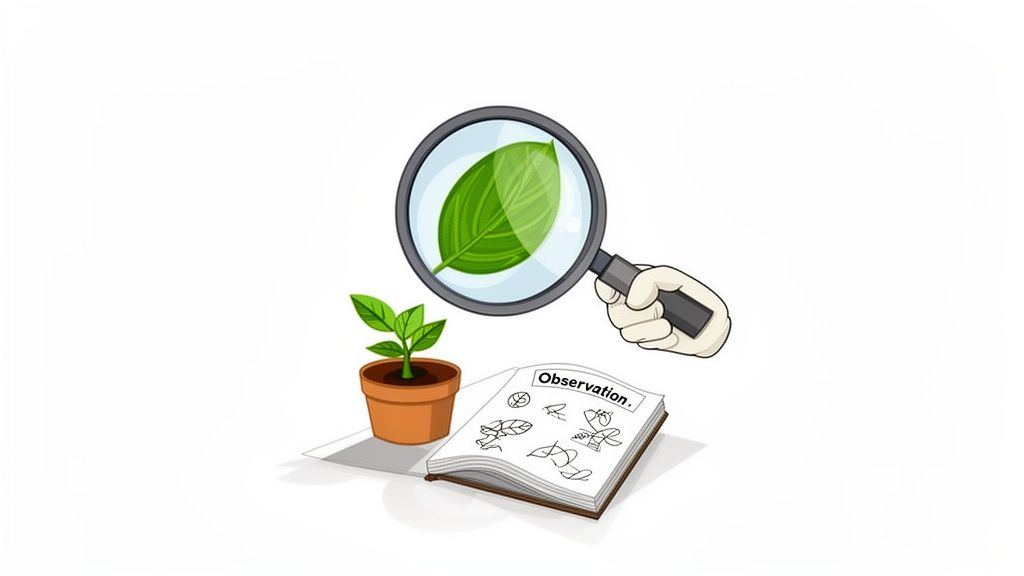
Whether you’re a biology student noticing that plants near a window grow taller than those in a dim corner, or a history student recognizing a recurring pattern of economic decline before major conflicts, you are making an observation. The goal is to collect unbiased data that forms the basis for a question you want to investigate further.
How to Improve Your Observation Skills
Effective observation is a skill that can be sharpened with practice. It involves more than just a quick glance; it requires detailed documentation and critical thinking.
- Keep a Detailed Journal: Document everything you see, hear, or measure. Don't filter anything out. Include sketches, dates, times, and environmental conditions. This creates a rich dataset to analyze later.
- Record Multiple Times: A single observation can be an anomaly. By observing the same phenomenon repeatedly, you can identify consistent patterns and confirm the reliability of your findings.
- Question Everything: Constantly ask "Why?" and "What if?" about what you are seeing. This self-questioning process is the bridge that connects your observation to the next step: forming a question. For instance, instead of just noting "the water boiled faster," ask, "Why did adding salt seem to make the water boil faster?"
- Embrace the Unexpected: Some of the greatest scientific discoveries began with an observation that didn't fit the expected outcome. Don't dismiss these outliers; they often lead to the most groundbreaking questions.
Feen AI in Action: Struggling to make sense of your lab notes? Upload a photo of your experimental setup or a PDF of your field notes to Feen AI. You can then ask it, "What patterns do I notice here?" or "What are the key variables in this observation?" to help you organize your thoughts and identify potential areas for investigation.
2. Step 2: Research & Question Formation
Once an observation sparks your curiosity, the next move is to dive into research and question formation. This crucial step transforms a general observation into a focused, testable inquiry. It involves consulting existing knowledge like textbooks, academic articles, and credible online sources to understand the context of what you've seen. This background research prevents you from "reinventing the wheel" and ensures your question is relevant and informed. This is the second of the 7 steps of the scientific method, acting as the bridge between raw curiosity and structured investigation.
For example, after observing that your toast browns faster on a higher setting, you might research the chemical reactions involved in browning (the Maillard reaction). This background knowledge helps you move from a simple "Why?" to a specific, scientific question like, "How does the temperature of the heating element affect the rate of the Maillard reaction on a slice of white bread?" This well-formulated question sets the entire direction for your experiment.
How to Formulate a Strong Research Question
A great scientific question is the blueprint for your entire investigation. It should be specific, measurable, and testable.
- Be Specific: Avoid vague questions. Instead of "Does light affect plants?" ask, "How does the duration of light exposure per day affect the height of a sunflower plant over a 30-day period?"
- Consult Multiple Sources: Relying on a single source can give you a narrow perspective. Read textbooks, academic papers, and expert articles to get a well-rounded understanding. If you need help, you can learn more about how to read research papers to extract information efficiently.
- Write It Down: Formally write down your final research question. This act solidifies your goal and helps you stay focused, preventing your investigation from becoming too broad or sidetracked.
- Distinguish Question Types: Understand if you are asking a descriptive question ("What is happening?") or a causal one ("Why is it happening?"). This distinction will shape the type of experiment you design next.
Feen AI in Action: Feeling overwhelmed by a dense textbook chapter or a long research article? Upload the PDF to Feen AI and ask, "Summarize the key theories in this document," or "Based on this text, what are three testable questions I could ask about [your topic]?" This helps you quickly grasp essential concepts and formulate a precise, well-informed question.
3. Step 3: Hypothesis Formation
Once you have a focused research question, the next logical step is to propose a potential answer. This is the hypothesis formation stage, where you create a testable prediction based on your initial observations and background research. A hypothesis is not a random guess; it's an educated, specific statement that outlines the expected relationship between variables. It acts as a clear roadmap for your experiment, making it a critical part of the 7 steps of the scientific method.
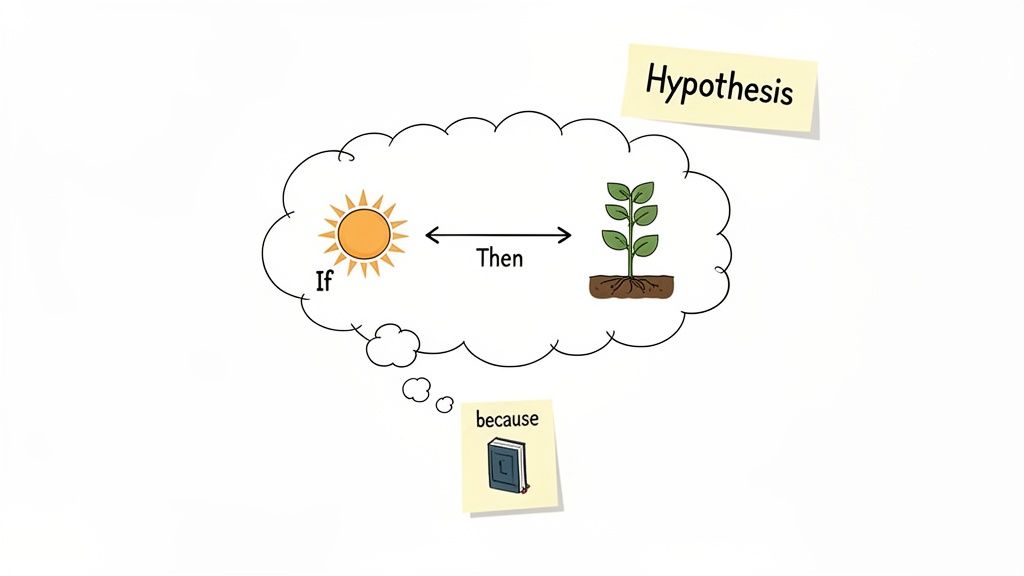
This proposed explanation must be falsifiable, meaning it must be possible to design an experiment that could prove it wrong. For example, a hypothesis like, "If bean plants receive 8 hours of sunlight daily, then they will grow taller than plants receiving 4 hours, because photosynthesis requires light energy," is strong because it's specific, testable, and provides a reason. The process of evaluating this prediction is known as hypothesis testing, which forms the core of your upcoming experiment.
How to Write a Strong Hypothesis
Crafting a clear and testable hypothesis is a skill. It bridges the gap between your question and your experiment, giving your investigation direction and purpose. A well-written hypothesis makes designing your experiment much simpler.
- Use the 'If...then...because' Structure: This format ensures your hypothesis is complete. The "if" part states the change you will make (independent variable), the "then" part predicts the outcome (dependent variable), and the "because" part explains your reasoning.
- Identify Your Variables: Clearly define the independent variable (what you change), the dependent variable (what you measure), and the control variables (what you keep constant). This clarity is essential for a valid experimental design.
- Ensure It Is Testable: Your hypothesis must be something you can prove or disprove through an experiment. A statement like "blue is a better color than red" is an opinion and not testable, whereas "blue-colored objects absorb less heat than red ones" is.
- Ground It in Research: A powerful hypothesis is informed by existing knowledge. It builds on what is already known, extending the line of inquiry rather than starting from a place of pure speculation.
Feen AI in Action: Unsure if your hypothesis is well-formed? Paste it into Feen AI and ask, "Is this a strong, testable hypothesis? What are the independent and dependent variables here?" The AI can help you refine vague ideas into precise, scientific statements ready for experimentation.
4. Step 4: Experimental Design & Planning
Once you have a testable hypothesis, the next crucial step is to design a robust experiment to test it. Experimental design is the systematic planning of a controlled test to investigate your hypothesis. This step involves identifying variables, establishing controls, deciding on measurement methods, and outlining procedures to ensure your results are valid and reliable. A well-designed experiment is a cornerstone of the 7 steps of the scientific method, as it isolates the relationship you want to study from other confounding factors.
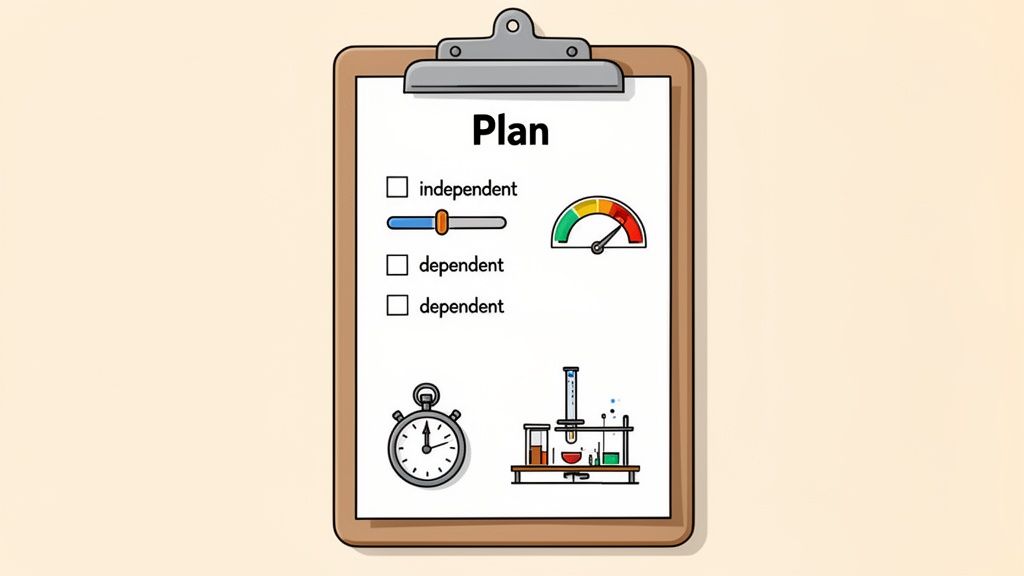
For example, if testing how light wavelengths affect plant growth, your design would specify the exact light color (independent variable), how you will measure height (dependent variable), and how you will keep water, soil, and temperature constant (controlled variables). Strong design includes clear variable definitions, adequate sample sizes, repeated trials, and standardized procedures to ensure anyone could replicate your work. When considering large-scale scientific endeavors, understanding how to approach funders like those offering National Science Foundation grants can be crucial for developing robust experimental designs.
How to Create a Strong Experimental Plan
Careful planning prevents wasted effort and ensures your data is meaningful. Before you touch any equipment, map out your entire process.
- Create a Detailed Protocol: Write down a step-by-step procedure that another person could follow exactly. This includes material lists, measurement techniques, and the sequence of actions.
- Identify and Control Variables: List every factor that could influence your outcome. Decide which one you will change (independent), which one you will measure (dependent), and which ones you must keep the same (controls).
- Plan for Multiple Trials: Don't rely on a single test. Repeating your experiment three or more times helps confirm your results are consistent and not just a fluke.
- Sketch Your Setup: Draw a diagram of your experimental setup or a flowchart of your procedure. This visual aid can help you spot potential problems or logistical issues before you begin.
- Include Safety Considerations: Always plan for safety. Identify potential hazards, necessary precautions, and proper disposal methods for any materials used.
Feen AI in Action: Feeling stuck on your experimental design? Describe your hypothesis to Feen AI and ask, "What variables do I need to control in an experiment about [your topic]?" or "Help me write a step-by-step procedure to test this hypothesis." This can help you think through logistics and refine your plan.
5. Step 5: Experimentation & Data Collection
With a solid hypothesis and a well-designed procedure, it's time to move into the active phase of discovery: experimentation. This step is where you execute your plan, manipulating variables and observing the outcomes to test your prediction. It’s the hands-on heart of the 7 steps of the scientific method, turning theoretical questions into tangible results through meticulous action and systematic data collection.
This is the point where a chemistry student carefully measures reactants and records temperature changes, or a physics student releases a cart down a ramp multiple times, timing its descent. The goal is to gather high-quality, unbiased data that will either support or refute your hypothesis. The validity of your entire investigation hinges on the precision and consistency of your actions during this crucial stage.
How to Conduct Effective Experiments
Successful experimentation requires discipline and attention to detail. The quality of your data directly impacts the strength of your final conclusions.
- Follow Your Protocol Exactly: Consistency is paramount. Adhere strictly to the procedure you designed in the previous step. Any deviation, no matter how small, can introduce errors and compromise your results.
- Record Data Immediately: Don't rely on memory. Write down measurements and observations as they happen. Use organized data tables or spreadsheets to keep your information clear and accessible.
- Document Everything: Beyond the numbers, note any unexpected occurrences. Did the power flicker? Was there a strange noise? These details provide context and can help explain anomalies during analysis.
- Repeat for Reliability: Perform multiple trials of your experiment. This helps ensure your results are not a fluke and allows you to calculate averages, which provides a more accurate representation of the outcome.
Feen AI in Action: Is an unexpected result confusing you mid-experiment? Snap a photo of your setup and ask Feen AI, "My solution turned blue instead of green as expected. What are the possible reasons for this?" or "Can you help me organize this data into a table with columns for Trial, Time, and Temperature?" for immediate troubleshooting and data management support.
6. Step 6: Data Analysis & Interpretation
Once you've collected your data, you enter one of the most exciting phases of the scientific method: data analysis and interpretation. This step is where raw, unorganized numbers and observations are transformed into meaningful insights. Analysis involves applying statistical, logical, or mathematical techniques to describe, illustrate, and evaluate your collected data. It's the process of looking for patterns, relationships, and trends that will help you determine whether your experiment's results support or refute your initial hypothesis.
For a student in physics, this might mean creating a position-versus-time graph to calculate acceleration. For a chemistry student, it could involve calculating the average reaction rate from multiple trials. The goal is to objectively summarize your findings so you can draw a logical conclusion, moving beyond just the raw data to understand what it actually means in the context of your question.
How to Effectively Analyze and Interpret Data
Strong analysis is systematic and honest. It requires organizing your data carefully and choosing the right tools to make sense of it, paving the way for a solid conclusion.
- Organize Your Data: Before any calculations, neatly arrange your raw data in a table or spreadsheet. Clearly label all columns, rows, and units. This simple organizational step prevents errors and makes the data easier to work with.
- Visualize Your Findings: Don't just rely on numbers. Create graphs and charts like bar charts, scatter plots, or line graphs. Visualizations are powerful tools for identifying trends, patterns, and outliers that might be missed in a table of numbers.
- Calculate Key Statistics: Use descriptive statistics to summarize your data. Calculate the mean (average) for each group, but also look at the spread of the data. To do this, you can learn more about how to calculate standard deviation, a key measure of variability.
- Compare to Your Hypothesis: Constantly refer back to your hypothesis. Does the data trend in the direction you predicted? Are the differences between your control and experimental groups significant? This direct comparison is the core of interpretation.
Feen AI in Action: Data analysis can be daunting. Upload your spreadsheet or paste your data table into Feen AI and ask for help. You can request, "Calculate the mean, median, and standard deviation for this dataset," "Create a bar chart comparing my control and experimental groups," or "Explain what this p-value means." Feen AI can perform the calculations and help you interpret the results.
7. Step 7: Conclusions & Communication
The final step of the scientific method brings your investigation full circle: drawing conclusions and communicating your results. This is where you synthesize all your hard work, interpret the data, and share what you've learned. A conclusion isn't just a summary; it’s an evaluation of your hypothesis based on the evidence you've gathered. This step transforms your private experiment into public knowledge, allowing others to learn from, replicate, or build upon your findings. It is the crucial final phase in the 7 steps of the scientific method, where your results contribute to the broader scientific conversation.
Whether you’re writing a lab report concluding that a specific light wavelength accelerated plant growth or preparing a presentation showing how reaction rates increased with temperature, this step is about making sense of your results. The goal is to articulate what your data means, acknowledge any limitations of your study, and suggest directions for future research.
How to Write a Strong Conclusion
An effective conclusion is honest, clear, and directly tied to your data. It provides closure to your investigation while opening doors for new questions.
- Restate Your Hypothesis: Begin by clearly stating your original hypothesis and then declare whether your collected data supported or refuted it. Avoid ambiguous language; be direct.
- Summarize Your Evidence: Briefly recap the key findings from your data analysis. Use specific data points or trends to back up your claim about the hypothesis.
- Discuss Limitations and Implications: No experiment is perfect. Acknowledge any potential sources of error or variables you couldn't control. Discuss what your findings mean in a broader context and suggest what questions could be investigated next.
- Structure for Clarity: Organize your findings logically in a report or presentation. Use clear sections like Introduction, Methods, Results, and Discussion/Conclusion. Visual aids like graphs and charts are essential for communicating complex data effectively.
Feen AI in Action: Finishing a report can be tough. Upload your data and draft conclusion to Feen AI and ask, "Does my conclusion accurately reflect my results?" or "Help me revise this conclusion paragraph for clarity." You can also ask for help structuring your entire lab report to ensure all necessary components are included and well-organized.
7-Step Scientific Method Comparison
| Step | Implementation complexity | Resource requirements | Expected outcomes | Ideal use cases | Key advantages |
|---|---|---|---|---|---|
| Step 1: Observation | Low — simple methods but requires careful attention | Minimal: notebook, camera/phone, time; Feen AI for uploads | Identify phenomena, patterns, initial questions | Early exploration, classroom demos, field notes | Grounds research in real data; builds curiosity and attention |
| Step 2: Research & Question Formation | Moderate — literature scanning and synthesis | Access to textbooks, articles, databases; Feen AI for summaries | Specific, testable research questions; knowledge gaps identified | Framing studies, narrowing scope after observation | Improves focus and credibility; avoids redundant work |
| Step 3: Hypothesis Formation | Low–Moderate — logical reasoning from research | Background knowledge, Feen AI feedback | Clear, falsifiable predictions linking variables | Converting questions into testable statements | Directs experimental design; specifies variables to measure |
| Step 4: Experimental Design & Planning | High — detailed protocol and control strategies | Equipment list, materials, timeline, safety/ethics; Feen AI troubleshooting | Reproducible protocol, controlled variables, sample plan | Planning lab, field, or simulation experiments | Ensures validity and replicability; reduces confounding |
| Step 5: Experimentation & Data Collection | High — precise execution and consistency required | Instruments, materials, trained personnel, time; data recording tools | Primary data, documented observations, trial records | Running experiments, field sampling, lab work | Produces concrete evidence; enables hands-on learning |
| Step 6: Data Analysis & Interpretation | High — statistical and visualization skills needed | Software/spreadsheets, statistical knowledge; Feen AI for calculations/plots | Processed data, statistics, graphs, inference about hypothesis | Post-collection evaluation and hypothesis testing | Converts raw data into objective insights; quantifies confidence |
| Step 7: Conclusions & Communication | Moderate — synthesis and clear reporting | Writing/presentation tools, citation management; Feen AI for drafting | Summarized findings, limitations, suggested next steps | Reporting results to peers, teachers, or publication | Communicates results clearly; situates work within broader context |
Putting It All Together: Your Next Steps in Scientific Thinking
We've journeyed through the 7 steps of the scientific method, from the simple act of noticing something interesting to the structured process of communicating a discovery. This method is more than just a procedural checklist for a science fair project; it is a powerful framework for critical thinking that can be applied to almost any problem you encounter, whether in the lab, in your history class, or in your daily life.
The core takeaway is that this process transforms idle curiosity into verifiable knowledge. It provides a reliable pathway to move beyond assumptions and "gut feelings" by demanding evidence, rigor, and objectivity at every turn. Each of the seven steps we explored, from Observation to Conclusion & Communication, plays a critical role in ensuring that your findings are credible, repeatable, and built on a solid logical foundation.
From Theory to Practice: Embracing the Scientific Mindset
Remember, the scientific method is not a rigid, one-way street. Real-world inquiry is often messy and cyclical. You might analyze data only to realize you need to refine your hypothesis or design a completely new experiment. This is not a failure; it is a fundamental part of the discovery process.
Key Insight: A "failed" experiment that disproves a hypothesis is just as valuable as one that supports it. Both outcomes advance our understanding and push knowledge forward. Negative results narrow the field of possibilities and help future researchers ask better questions.
To truly master the 7 steps of the scientific method, you must actively practice them. Don't wait for a formal assignment. Start small by applying the framework to everyday questions: Why does one brand of battery seem to last longer than another? Does listening to music actually help you study more effectively?
Your Actionable Path Forward
To cement your understanding and begin applying these principles, focus on these next steps:
- Start with Observation: For the next week, keep a small notebook or a note on your phone. Write down one interesting observation you make each day. It could be anything from the way frost forms on a window to a pattern you notice in social media comments.
- Formulate a Testable Question: Pick one of your observations and turn it into a question. Instead of "I wonder why my plant is droopy," ask, "Does my plant's droopiness correlate with the amount of direct sunlight it receives daily?"
- Practice with Tools: Use a tool like Feen AI to practice wording a hypothesis based on your question. See how it can help you outline a simple experimental plan, turning a vague idea into a concrete series of actions. This small, low-stakes practice builds the critical thinking muscles needed for larger, more complex projects.
Ultimately, internalizing the scientific method equips you with a superpower: the ability to systematically and confidently find answers. It teaches you to be skeptical but open-minded, meticulous in your work, and clear in your communication. These are not just academic skills; they are life skills that will empower you to navigate a complex world, solve difficult problems, and contribute your own discoveries, big or small.
Ready to elevate your research and streamline your study process? Move from theory to execution with the help of Feen AI. From refining your hypothesis to analyzing data and drafting your conclusion, Feen AI is the perfect partner to guide you through all 7 steps of the scientific method with precision and clarity.
Recent articles

What is the difference between mitosis and meiosis? This guide provides a clear comparison of purpose, stages, and outcomes for students and curious minds.

What is the difference between speed and velocity? what is the difference between speed and velocity explained in plain terms with helpful examples.

Learn how to solve inequalities step by step. This guide covers linear, absolute value, and quadratic inequalities with clear examples and real-world tips.

Struggling with homework? This guide shows you how to convert units in chemistry with dimensional analysis. Master moles, grams, concentration, and more.

Struggling with 'what is conservation of energy'? This guide breaks down the core law with simple analogies, worked examples, and real-world applications.

Discover what is dimensional analysis in chemistry and master the factor-label method with clear, step-by-step examples.