How to Read Research Papers Without Wasting Time
Learn how to read research papers efficiently with a proven system. This guide breaks down a time-saving method to help you extract key insights fast.
If you're reading research papers from beginning to end, like a novel, you're doing it wrong. And it's probably costing you hours of wasted effort. The key to reading academic literature effectively is to ditch the linear, front-to-back approach and adopt a structured, multi-pass method.
This strategy is all about working smarter, not harder. You'll learn to quickly scan for relevance, then read for genuine comprehension, and finally, dive deep for critical analysis.
Why Your Current Reading Method Is So Slow
Ever get that sinking feeling halfway through a dense paper, realizing it's not quite what you needed? You're not alone. We're taught to read from page one, but for academic articles, that's a recipe for frustration.
This old-school method is wildly inefficient because it doesn't align with how research papers are built or what you, the reader, actually need. You might spend an hour wrestling with a complex methodology section, only to discover the paper’s conclusions are completely irrelevant to your work.
The Problem with Linear Reading
When you just plow through a paper from start to finish, you inevitably hit a few common roadblocks:
- You waste time on the wrong papers. You can't know if a paper is truly valuable until you've already sunk significant time into it.
- You lose the thread of the main argument. It's incredibly easy to get bogged down in technical jargon and completely miss the author's central claim.
- You burn out. The sheer density of academic writing is draining. It's a real phenomenon, and there are good reasons why you can't read long articles anymore without a better strategy.
What you need is a system—one that prioritizes a quick, intelligent assessment before you commit to a deep dive.
This is where a structured, multi-pass framework comes in. It transforms how you approach every single paper.
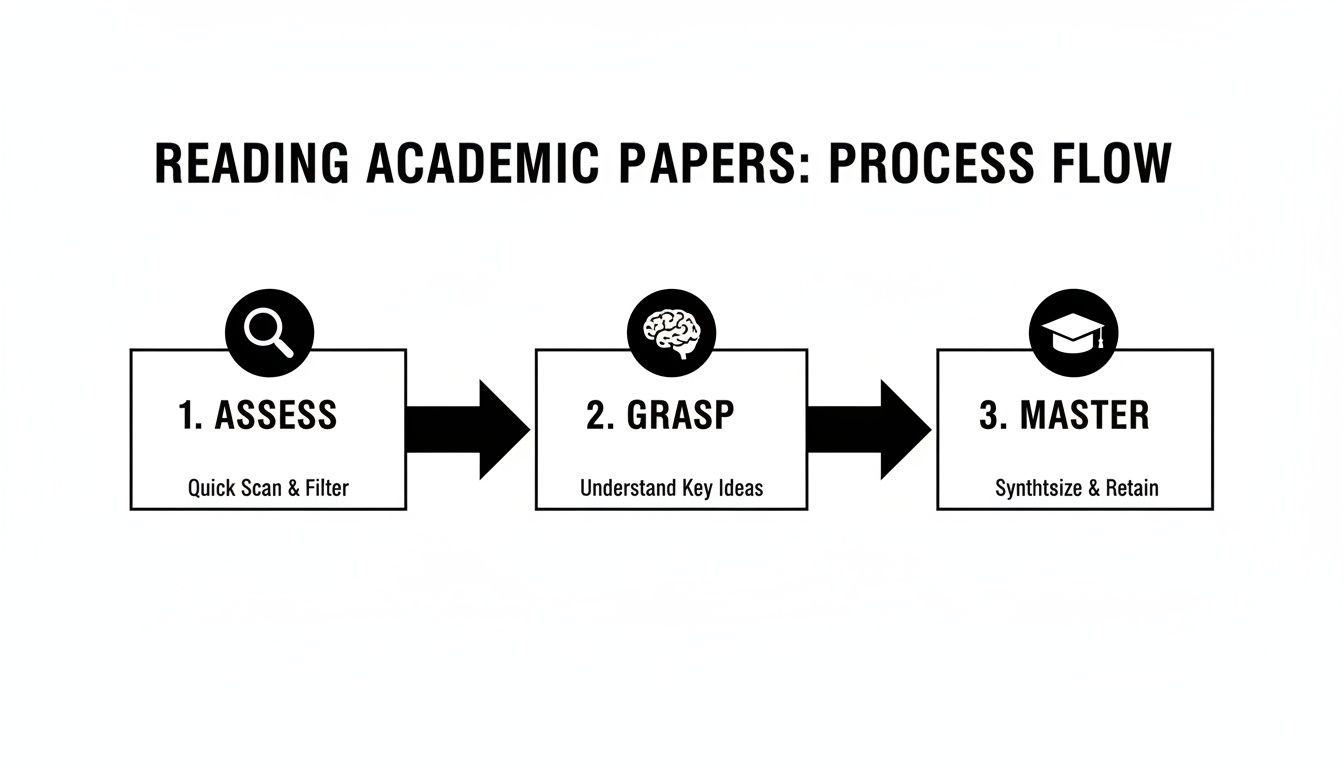
This workflow shows it perfectly: effective reading isn't about raw speed. It's a systematic process to first assess relevance, then grasp the core concepts, and finally master the material.
A Structured Approach Saves Time and Boosts Understanding
Instead of one long, grueling reading session, the best strategy is a "three-pass" approach. Each pass has a clear, distinct objective, moving you from a high-level overview to a detailed critique. This ensures you only invest your precious time in papers that are genuinely useful to you.
The time savings here aren't trivial. Experienced academics often spend 4–6 hours to truly read and annotate a single paper. But shifting to a standardized three-pass strategy can slash that time by 25–40% while keeping comprehension sky-high.
To give you a clearer picture, here’s a quick breakdown of how this approach works.
The Three-Pass Reading Workflow at a Glance
| Pass | Goal | Estimated Time | Key Actions |
|---|---|---|---|
| Pass 1: Skim | Assess relevance & get the gist. | 5–10 mins | Read title, abstract, intro, conclusion. Scan headings and figures. |
| Pass 2: Read | Grasp the core content and evidence. | ~1 hour | Read the paper thoroughly, but skip complex details. Focus on arguments, figures, and results. |
| Pass 3: Analyze | Critically evaluate & synthesize. | 1–4 hours | Re-read with a critical eye. Question assumptions, methods, and interpretations. Recreate the work in your mind. |
This isn’t about speed-reading; it’s about strategic reading. The goal is to extract the maximum value from each paper in the minimum amount of time.
Ultimately, this shift in mindset turns you from a passive reader into an active investigator. You learn to instantly pinpoint a paper's essential components—the research question, the evidence, the conclusion—before you get lost in the weeds. It’s an intentional process that makes academic reading a powerful skill instead of a daunting chore.
The First Pass: A 10-Minute Triage for Relevance
Before you sink hours into a dense academic paper, you need a quick, reliable way to figure out if it’s even worth your time. I think of this as a 10-minute triage—a crucial first step to decide if a paper gets a full, detailed read or goes into the "maybe later" pile. Honestly, mastering this initial scan is the single biggest time-saver you can learn.
It's a disciplined filter. It stops you from getting an hour deep into a complex methodology section only to realize the paper's core findings aren't actually useful for your work. This protects your most valuable asset: your focus.
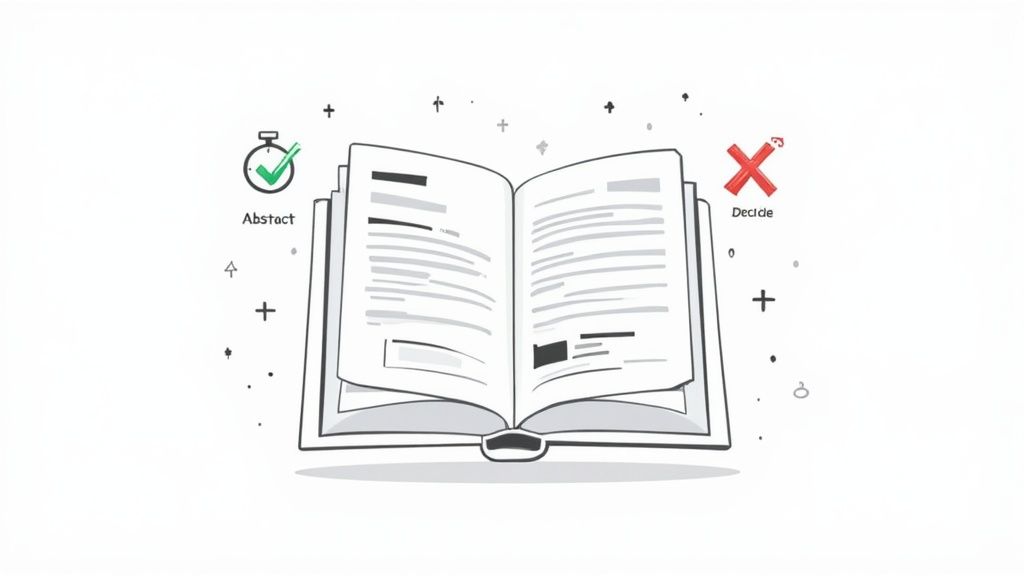
Start with the Bookends: The Title and Abstract
Spend your first minute on just two things: the title and the abstract. The title gives you the topic at a glance, but the abstract is where the real gold is. It’s the entire paper—problem, methods, results, and conclusion—distilled into about 250 words.
Read the abstract with purpose. Can you pinpoint the main research question? Do the findings seem directly connected to your project? A confusing or poorly written abstract is often a major red flag for the rest of the paper.
Pro Tip: Don't just read the abstract once. I find it helpful to circle back to it as I scan the rest of the paper. It acts as an anchor, reorienting you to the main point if you get lost in the weeds of a complex figure or section heading.
If you’re still on the fence after the abstract, an AI-powered PDF summarizer from Feen AI can give you a high-level gist in seconds. It’s a great way to make that final keep-or-discard decision quickly.
Scan the Structure and Headings
Next, take a minute or two to scroll through the entire document and just look at the section headings. Don't read the paragraphs yet. This gives you a mental map of the paper's narrative and how the authors build their case.
You're looking for the classic story structure of a research paper:
- Introduction: Where they set the stage.
- Methods: How they did the work.
- Results: What they discovered.
- Discussion/Conclusion: Why it matters.
Does the flow make sense? Are the headings clear? This structural scan helps you grasp the argument's architecture before you even read a full sentence.
Read the Introduction and Conclusion Next
Now it's time to read a little more closely, but strategically. Jump to the introduction with one goal: find the specific research question or hypothesis. A well-written introduction will state the problem clearly and explain why it's important to solve.
Then, skip everything in the middle and go straight to the conclusion. This section should neatly summarize the key findings and their implications. By reading these two sections back-to-back, you get a powerful snapshot of the paper's promise and its payoff. If the question isn't relevant or the answer seems weak, you can confidently move on.
The Real Story Is Often in the Figures
Finally, spend the last five minutes of your triage on the figures, tables, and graphs. In many scientific fields, these visuals tell the story more directly than the text. Look at each one and read its caption carefully.
For each figure, ask yourself:
- What is this measuring? Check the axes and labels.
- What's the main takeaway here? Look for trends, spikes, or significant differences.
- Does the caption confirm my interpretation?
You don’t need to understand every nuance at this stage. You just need to get the gist of the key findings from the data visualizations. If the figures are a mess or seem to contradict the claims in the abstract, the paper might not be as solid as it first appeared. After this quick 10-minute pass, you'll know for sure whether to invest more time or find a better source.
The Second Pass: Grasping the Core Argument
Alright, so a paper has made it past your initial 10-minute triage. Now it’s time to really dig in. This second pass is where you dedicate a solid hour to understanding what the paper is actually saying. Forget trying to replicate the study for now; your goal is to follow the story the authors are telling.
You're shifting your mindset here. Instead of just asking, "Is this relevant to me?" you're now asking, "What's the evidence?" This requires more focus. You’re no longer just scanning for keywords; you're actively connecting the dots and building a mental map of the research.
Find the Paper’s Central Narrative
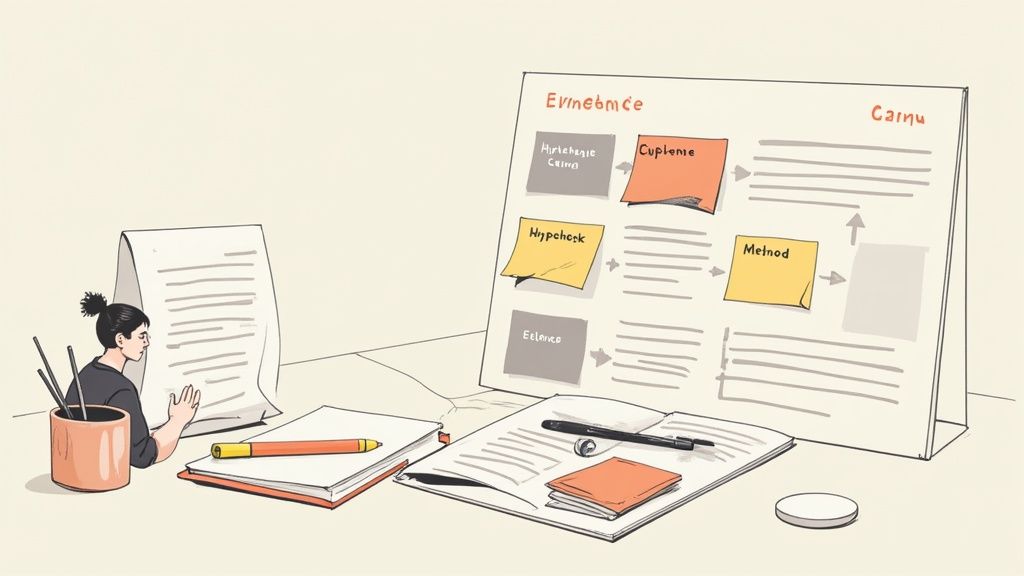
First things first: read the paper from beginning to end, but do it with a mission. Your immediate goal is to lock onto the central research question and the authors' proposed answer—their hypothesis. Think of these as the two main pillars holding up the entire structure.
As you read, actively hunt for the specific sentences where they lay this out. I have a habit of highlighting the research question in one color and the hypothesis in another. It’s a simple trick, but it instantly clarifies the paper’s entire purpose and gives you a lens to interpret everything that follows.
Dissect the Methodology
With the "what" and "why" identified, turn your attention to the "how." Dive into the Methods section. At this stage, you don’t need to become an expert who could run the experiment tomorrow. What you do need is to understand the overall approach and get a gut check on whether it seems sound.
Start asking yourself some pointed questions:
- What was the basic setup? Was this an in-vitro study, a massive computer simulation, a survey, or a clinical trial?
- What were the key variables? What did they measure, and what did they tweak to see what would happen?
- Does this approach even make sense for the question? Does the experiment they designed logically test the hypothesis they proposed?
For instance, if a paper claims a new drug eases anxiety in humans, but you see the experiment was only done on mice, that’s a massive detail to flag. You're looking for the big-picture design, not the precise molar concentration of every reagent.
A solid methodology is the bedrock of any credible research. Once you understand the 'how,' you can confidently trust—or challenge—the 'what.' It's the difference between blindly accepting a conclusion and critically evaluating the evidence behind it.
Pay Close Attention to the Evidence
The Results section is where the authors lay their cards on the table, usually with a mix of text, tables, and figures. This is where you should spend a good chunk of your time on this second pass. Go through every single figure and table, reading the text that explains each one.
Don't just look at them; interpret them. Try to rephrase the main point of each visual in your own words. You might jot down something like, "Figure 3: Group A's scores went up 30% more than Group B's, a statistically significant jump." This forces you to actively process the data, which is a core skill if you’re trying to figure out how to improve your reading comprehension skills.
Engage Actively with Smart Note-Taking
Passive reading is the enemy of understanding. To really master reading research papers, you have to get your hands dirty. As you work through this second pass, keep a notebook (digital or physical) open and ready.
Your notes need to be more than just a list of highlighted sentences. Try these strategies:
- Summarize each part: After you finish the introduction, methods, and results, write a one or two-sentence summary of each section in your own words.
- Build a glossary: Keep a running list of key terms, acronyms, and their definitions.
- Log your questions: Write down anything that feels confusing, unclear, or even contradictory. These questions will be your roadmap for the third and final pass.
This process of summarizing and questioning turns reading from a passive chore into an active conversation with the paper. By the time you're done with this pass, you won’t just have read the paper; you’ll have a real grasp of its main argument, the evidence behind it, and a clear list of questions for a deeper, more critical final read.
The Third Pass: A Critical Deep Dive for Mastery
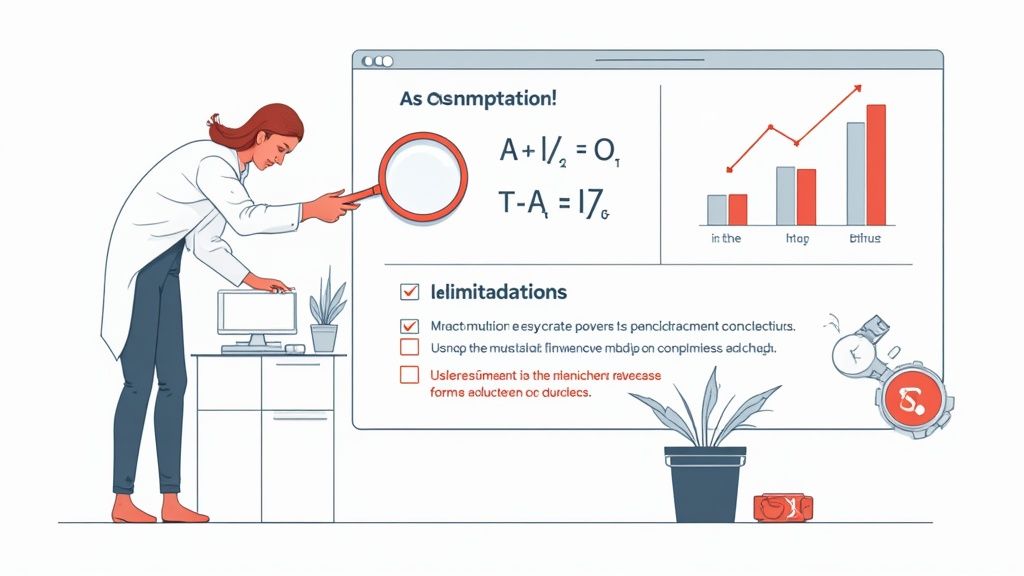
Alright, you’ve made it to the final pass. This is where you stop being a simple reader and start acting like a peer reviewer. Think of this stage as an intense, meticulous deconstruction reserved only for papers that are truly central to your work. Not every article warrants this level of effort, but for the ones that do, this is where genuine expertise is forged.
Your whole mindset needs to shift from comprehension to critique. You’re no longer just asking, "What did the authors find?" Instead, you should be asking, "Can I trust what they found?" This means you'll be actively challenging their assumptions, questioning their methods, and stress-testing how they interpret their own results. It's a tough process, but it’s the only way to build a rock-solid understanding.
Challenge Every Assumption
Go back to the beginning, but this time, read with a skeptical eye. Your goal is almost to try and “break” their argument. Start with the introduction and sniff out every assumption the authors make to frame their research question. Are these spelled out, or are they just implied?
For example, a paper might build its entire premise on the assumption that a specific protein is the main driver of a disease. Your job is to poke at that foundation. Is that really a settled fact in the field, or is there still debate? Could another mechanism explain the background phenomena just as well? Questioning these core ideas can sometimes expose subtle weaknesses in the paper's entire logical structure.
Recreate the Experiment in Your Mind
Next, head to the methodology section with the aim of virtually replicating their work. You need to mentally walk through every single step of the experiment or analysis as if you were the one doing it. This is how you spot the practical gaps and potential pitfalls that a surface-level read would miss entirely.
As you run this mental simulation, keep a few critical questions in mind:
- Could the results be an artifact? Is it possible that equipment malfunction, a contaminated sample, or even a subtle bug in the code could have produced the same outcome?
- Were the controls actually appropriate? Did they include the right control groups to truly isolate the variable they were testing? Are there any other confounding variables they completely failed to account for?
- Is the sample size big enough? In any statistical work, was their sample large enough to give the findings real power? A small n value can be a huge red flag, suggesting the results might just be due to random chance.
This deep dive into the "how" is absolutely essential. A result that seems groundbreaking can completely fall apart if the method used to get there was flawed.
The goal of the third pass isn’t just to understand what the authors did, but to grasp what they could have done differently. This is how you identify a paper’s real limitations and, more importantly, discover opportunities for future research—including your own.
Scrutinize How They Interpret the Results
Now, turn that critical lens to the Results and Discussion sections. Remember, the data is just data; the interpretation is where the story gets told, and it’s also where bias can easily creep in. Do the authors’ big conclusions actually follow logically from the evidence presented in their figures and tables?
Look for any gaps between what the data shows and what the authors claim. A classic mistake is overstatement, where researchers make sweeping conclusions based on limited or noisy data. For instance, a study might show a very weak correlation between two variables, but the discussion section frames it as a strong causal link. That’s a critical distinction you need to be able to catch.
As you pull all this information together, it’s a good time to think about how to organize research notes effectively. The critical analysis you’re doing in this pass is pure gold, so capturing it systematically is key for long-term use.
Pinpoint the Gaps and Future Directions
Finally, bring it all home by synthesizing your critique into a forward-looking summary. By now, you should have a solid list of the paper's strengths, its weaknesses, and its most important limitations. This analysis is incredibly valuable.
Use your findings to answer a few last questions for yourself:
- What important questions does this paper leave unanswered?
- How could I design a new experiment to address one of its key limitations?
- How does this work fundamentally change my own understanding of the field?
By finishing this rigorous third pass, you haven't just read a paper. You've deconstructed it, challenged it, and properly situated it within the broader scientific conversation. This deep, critical engagement is what it really means to read research papers and use them to build your own expertise.
Adapting Your Reading Strategy Across Different Fields
Let's be honest: a dense computer science paper on machine learning reads nothing like a qualitative sociology study or a clinical trial report. While the three-pass method is a great universal framework, its real power comes from knowing how to flex it. Effectively reading a research paper means adapting your focus based on the field’s unique language and structure.
Trying to apply a rigid, one-size-fits-all approach is a recipe for frustration. You'll find yourself hunting for p-values in a humanities paper or searching for a narrative argument in a heavily empirical physics article. The key is to adjust your lens, prioritizing different elements of the paper depending on the discipline. This skill is especially critical when your research pushes you outside your home field.
Navigating Quantitative STEM Papers
In disciplines like engineering, physics, and computer science, the heart of the paper almost always beats in the methodology, results, and figures. These articles are built around a very specific problem, a proposed solution, and the empirical proof that it works.
When you're tackling one of these, tweak your approach:
- First Pass Focus: Zero in on the problem statement in the introduction and the figures/tables in the results section. Can you quickly get a feel for what they built or tested and what happened? The abstract is your best friend here.
- Second Pass Priority: The Methods section is king. You have to understand the experimental setup, the dataset they used, or the model's architecture to have any hope of judging the results.
- Third Pass Critique: Your deep dive should be all about the authors' validation. Are their benchmarks fair? Could the results be a fluke of their specific setup? Is their statistical analysis actually sound?
For instance, when I’m reading a new computer science conference paper, I probably spend 70% of my deep-dive time just picking apart the experimental design and comparing their performance metrics against existing models.
Decoding Qualitative and Humanities Papers
In stark contrast, papers in sociology, history, or literary studies build their case through interpretation, theoretical framing, and narrative argument. The "evidence" here isn't numbers—it's textual analysis, historical documents, or interview transcripts.
The emphasis shifts dramatically:
- First Pass Focus: Hunt for the central thesis or argument. It's usually hiding toward the end of the introduction. Then, jump to the conclusion to see how they wrap it all up. The section headings will give you a roadmap of their argument.
- Second Pass Priority: Spend your time unpacking the theoretical framework and the main body of the argument. How do they use their evidence—like quotes or historical events—to support their main thesis? It’s all about the logic.
- Third Pass Critique: Here, your job is to question the author’s interpretation. Is their reading of the evidence persuasive? Did they ignore other valid interpretations? How does their chosen theoretical lens shape what they "found"?
The core of a humanities paper isn't just what the author concludes, but how they construct the argument to get there. Your reading strategy must prioritize tracing this intellectual journey from premise to conclusion.
This is why learning how to study efficiently for exams often involves similar skills in adapting your approach to different subjects.
Handling Medical and Life Sciences Research
Medical and biological papers are a bit of a hybrid. They're deeply quantitative, but they also have a strong narrative component explaining the biological significance of the findings. They usually follow a rigid structure (often IMRaD: Introduction, Methods, Results, and Discussion), which at least makes them predictable.
Reading these papers is such a critical skill that formal training makes a huge difference. PhD students might spend 18–25% of their research time just reading the literature. And it pays off—studies show that students who get structured training in reading academic work score 15–28% higher on critical appraisal tests. This isn't magic; it's a learnable skill with real benefits.
Ultimately, adapting your reading strategy is about becoming a more agile and effective researcher. Once you recognize the unique language and structure of each field, you can apply the three-pass method with surgical precision and pull out the most important information, no matter the discipline.
Common Questions About Reading Research Papers
Even with a great system in place, you're going to hit a few roadblocks. It's just part of the process. Knowing how to read research papers effectively often comes down to having a few tricks up your sleeve for when you get stuck.
Think of this as your troubleshooting guide. These are the questions that pop up constantly, whether you’re a veteran researcher or just starting your first big literature review.
How Do I Read Papers Outside My Field?
Diving into a new academic discipline can feel like trying to read a foreign language. The jargon is different, the core assumptions are new, and you don't have the context to know what's truly important.
The key is to start broad. Before you even touch a primary research paper, find a good review article or a meta-analysis in that field. These are written specifically to get people up to speed, giving you a map of the territory—the core concepts, the big debates, and the key players. It's the scaffolding you need to build on.
Once you’re ready to tackle an actual paper, tweak your initial approach:
- Live in the introduction and conclusion. These sections are almost always written for a wider audience than the highly technical methods section. Focus your energy there first to get the big-picture story.
- Don't get bogged down in jargon. Keep a running list of terms you don’t recognize, but don’t stop to look up every single one. If you can understand the "what" and the "why," you can circle back to the "how" later.
This strategy lets you get the gist of the paper's contribution without needing a Ph.D. in its specific methodology.
What Are the Best Tools for Organizing Papers?
If you don't have a system for organizing papers, you're going to drown in PDFs. It's not a matter of if, but when. The absolute cornerstone of any serious research workflow is a reference manager.
Your reference manager isn't just a digital bookshelf; it's your second brain. A well-curated library means you can pull up a relevant paper in seconds, handle citations without thinking, and draw connections between ideas you read months apart.
There's a reason everyone uses tools like Zotero, Mendeley, or EndNote. They're the industry standard because they solve real problems. You can:
- Create folders and tags to organize everything.
- Generate citations and bibliographies automatically.
- Attach your notes and highlights right to the PDF.
Lately, many researchers are also adding tools that integrate AI-powered analysis directly into their reading. This can be a huge help for quickly summarizing dense sections or asking specific questions about the paper's content, which makes the whole process feel much less like a slog.
How Do I Stay Focused on a Dense or Boring Paper?
Let's be honest: some papers are just a chore. It happens to all of us. The secret isn't to force yourself to "power through it" but to break the task down into something less intimidating.
Instead of a huge, vague goal like "read this paper," get specific and small. Try this: "My only goal for the next 25 minutes is to understand what Figure 2 is showing." That feels doable. You get a clear, quick win, which builds momentum. Using a timer, like the Pomodoro Technique, is perfect for this kind of focused sprint.
The most powerful trick, though, is to constantly tie the paper back to your own goals. Keep asking, "How does this help my project?" or "What can I learn from their methods?" This simple question shifts your mindset from passive reading to an active, goal-oriented mission. It gives you a reason to care, which can carry you through even the driest material.
Ready to make your study sessions more effective? Feen AI can help you instantly summarize dense PDFs, get clear answers to complex questions, and draft essays faster. Stop struggling and start understanding. Try Feen AI for free today!
Relevant articles
Learn how to read scientific papers more efficiently with practical steps, summaries, and quick takeaways. how to read scientific papers made simple.