How to Improve Problem Solving Skills and Think Like a Genius
Learn how to improve problem solving skills with our guide. Discover actionable techniques, mental models, and daily routines to master any challenge.

If you want to get better at solving problems, you need a system. It's not about having a stroke of genius; it's about having a repeatable process you can rely on. The core of any good system comes down to four key stages: diagnosing the problem accurately, mapping out potential solutions, putting the best one into action, and then circling back to see what happened.
Getting this framework down pat will fundamentally change how you approach just about any challenge that comes your way.
Why Elite Problem-Solving Is Your Most Valuable Skill
In a world that seems to get more complex by the day, being able to tackle tough problems isn't just a "nice-to-have" skill—it's the single most important asset for your career and personal growth. The good news? This isn't something you're born with. It's a muscle you can build with the right approach and a bit of deliberate practice.
Most people, when faced with a problem, panic. They scramble for the first quick fix they can think of, which usually just patches up a symptom instead of fixing the real issue. This almost always leads to wasted time, the same problem popping up again later, and a ton of frustration. There's a better way: a methodical, four-stage framework that brings clarity and confidence to any challenge.
The Four Pillars of Problem Solving
A solid process turns a chaotic mess into a series of manageable steps. It stops you from just guessing and instead helps you make informed decisions from start to finish. Think of it as your mental roadmap, guiding you from a state of confusion to a clear resolution. The goal is to stop reacting to problems and start responding to them with intent.
To give you a clear mental model, I've broken this system down into four essential pillars.
The Four Pillars of Effective Problem Solving
| Pillar | Core Action | Key Question to Ask |
|---|---|---|
| Diagnose | Get to the root cause. | What is really going on here, beyond the obvious symptoms? |
| Strategize | Brainstorm & evaluate solutions. | What are all the possible ways we could fix this, and which is most effective? |
| Implement | Execute the chosen plan. | What are the exact steps needed to put this solution into action? |
| Review | Analyze the outcome & learn. | Did our solution work as expected? What can we learn for next time? |
This structure ensures you're building your solution on a solid foundation. You can’t strategize effectively if you haven’t diagnosed the real problem first.
The following visual lays out this four-step flow in a simple way.
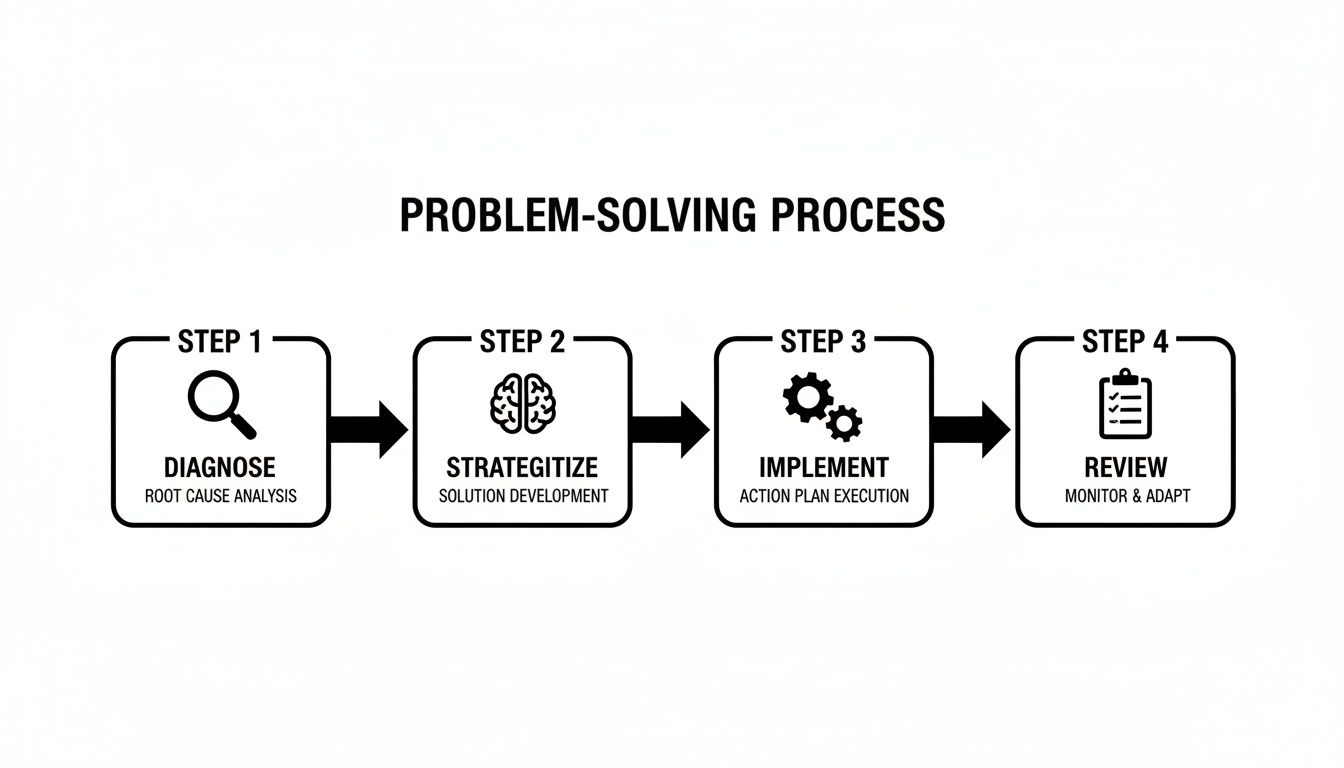
As you can see, the quality of each step depends entirely on the one before it, making that initial diagnosis the most critical part of the entire process.
The Career-Defining Advantage
Getting good at this translates directly into professional value. Companies are desperate for people who can handle ambiguity and deliver results. In fact, analytical thinking—a close cousin of problem-solving—is the number one core skill employers are looking for, with 7 out of 10 companies calling it essential.
What’s more, employers predict that 39% of workers' core skills will be different by 2030, which means the demand for adaptable, clear-thinking problem solvers is only going to grow. You can dive deeper into the data by reading this full report on future job skills.
Adopting a systematic approach to problems doesn't just help you find better answers; it fundamentally changes the quality of the questions you ask. This shift from reactive fixing to proactive inquiry is what separates good problem solvers from great ones.
How to Diagnose Problems Accurately
Have you ever spent weeks wrestling with a problem, only to realize you were just treating a symptom? It’s an incredibly common mistake, and frankly, it's the biggest source of wasted time and energy I see. Before you even think about a solution, you have to get really good at diagnosis. It's the most critical part of the entire process.
The best consultants and engineers I've worked with have a little secret: they spend most of their time just defining the problem, not chasing down solutions. It’s a deliberate, almost forensic approach. They know that by slowing down at the start, they’re ensuring they don't just patch a leak but actually fix the faulty pipe, which saves them a ton of headaches later on.
Look Past the Surface Symptoms
The issue that first gets your attention is almost never the real problem. It's usually just the most obvious symptom. For example, a customer is frustrated because they can’t reset their password. The immediate issue seems to be the password itself.
But a skilled problem-solver looks deeper. They anticipate what the customer is actually trying to do—log in to accomplish a task. So, they don't just fix the password. They go the extra mile to manually reset it, send new login details, and maybe even gently guide the user on how to do it themselves next time.
Truly effective problem-solvers intuit not just what went wrong, but what the person was ultimately trying to achieve. This shift from fixing symptoms to addressing intent is a game-changer.
This mindset is what stops you from playing an endless game of whack-a-mole, where solving one problem only makes another one pop up somewhere else.
Use the 5 Whys to Dig Deeper
One of the most powerful tools for this is the 5 Whys technique. Toyota famously developed it to perfect their manufacturing processes, and it’s brilliantly simple. For any given problem, you just keep asking "Why?" about five times (or as many as it takes) to peel back the layers from the obvious symptom to the hidden root cause. Each answer becomes the starting point for the next question.
Let's walk through a real-world business example.
- Problem: Our latest social media marketing campaign is a total flop.
- 1. Why is it a flop? The engagement rate is 50% lower than our usual benchmark.
- 2. Why is the engagement so low? Well, the click-through rate on the ads is fine, but people are bouncing from the landing page almost immediately.
- 3. Why are they bouncing? The page's headline and hero image don't match the promise we made in the ad copy. It feels like a bait-and-switch.
- 4. Why is there a mismatch? The marketing team wrote the ads, but the web team designed the landing page, and they clearly didn't coordinate their messaging.
- 5. Why didn’t they coordinate? We don't have any kind of established process for a joint creative review before a campaign goes live.
See what happened? We went from a vague problem ("underperforming campaign") to a very specific, actionable root cause ("no joint creative review process"). Fixing the ad is just a patch. Fixing the process is a permanent solution. That’s the power of a proper diagnosis.
Conduct a Thorough Root Cause Analysis
The 5 Whys is actually part of a broader practice called Root Cause Analysis (RCA). The entire goal of RCA is to pinpoint where a problem truly originates so you can put solutions in place that prevent it from ever happening again. Getting the diagnosis right gives you clarity and the confidence that you’re putting your energy where it actually counts.
To do a solid analysis, stick to these principles:
- Gather Data: Stop guessing. Pull the hard evidence, whether it's user feedback, analytics reports, or performance metrics.
- Map the Process: Sketch out the sequence of events that leads to the problem. Drawing it out on a whiteboard often reveals bottlenecks or communication breakdowns you never would have noticed otherwise.
- Consider Multiple Causes: Complex problems rarely stem from a single failure. Be open to exploring different contributing factors and how they might be interacting with each other.
Mastering diagnosis really comes down to changing your default reaction from "How do I fix this?" to "What is really going on here?" Making that mental shift is fundamental to becoming a better problem-solver and ensuring your solutions actually last.
Expand Your Mind with Proven Solution Strategies

Once you've figured out what the problem actually is, the fun part begins. This is where you shift from diagnosing the issue to coming up with smart, effective ways to fix it. It’s more than just a quick brainstorm; it’s about building a toolkit of mental models that literally change how you approach challenges.
A lot of people get stuck here. They keep circling back to the same thought patterns that probably contributed to the problem in the first place. To really get better at solving problems, you have to consciously adopt new ways of thinking.
Visualize Connections with Mind Mapping
Ever feel like a problem is just a tangled mess of ideas in your head? That’s because it often is. A Mind Map is an incredible tool for untangling those threads. You put the core problem in the center of a page and then let ideas, sub-topics, and potential solutions branch out visually.
This approach actually works with your brain’s natural tendency to link ideas, rather than against it. Suddenly, you can see the whole picture at once, and connections between different parts of the problem become obvious.
- Start with the Core Problem: Stick the main challenge right in the middle.
- Branch Out with Key Themes: Create big branches for major areas like "Budget," "Timeline," or "Team Skills."
- Add Sub-Branches for Details: Off of those, add smaller branches for specific ideas, questions, and data points.
Imagine your problem is "low user engagement on our new app feature." Your main branches might be "UI/UX Friction," "Lack of Awareness," and "Feature Value." This structure instantly gives your thoughts order and helps you see where to focus your energy.
Deconstruct Complexity with First-Principles Thinking
Sometimes the biggest roadblock to a great solution is an assumption we don't even realize we're making. First-Principles Thinking is all about tearing a problem down to its most basic, undeniable truths and building your solution up from there. It's the exact opposite of reasoning by analogy, which just sounds like, "Well, we've always done it this way."
This is Elon Musk's famous strategy. Instead of just accepting that batteries were expensive, he asked, "What are batteries actually made of, and what do those raw materials cost on the open market?" By starting from that fundamental truth, he found a drastically cheaper way to build them.
By stripping away all assumptions and focusing only on what you know for sure is true, you open up a space for radically new solutions to emerge. It’s about building a solution from the ground up, not just iterating on what already exists.
To try this yourself, just keep asking: "What are the absolute essential truths of this situation?" It’s a simple question that forces you to challenge the unwritten rules and find genuinely new answers.
Simplify to Understand with the Feynman Technique
You can't fix what you don't understand. The Feynman Technique, named after the brilliant physicist Richard Feynman, is a mental model for getting to the core of any topic. The process is simple: explain the problem and everything around it in the simplest terms you can, as if you were teaching it to a kid.
If you find yourself using jargon or stumbling over an explanation, you've just found a gap in your own knowledge. This forces you to go back and fill that gap. It's especially handy for technical challenges, like when you're trying to wrap your head around the logic needed to solve some of the https://feen.ai/blog/hard-math-problems.
This is a game-changer because it makes you simplify without losing the essence of the problem. It guarantees that whatever solution you come up with is built on a solid foundation. You can also sharpen this kind of strategic thinking in unexpected places—for example, learning how to win at debate forces you to dissect arguments and build solid logic from the ground up.
Cultivate a Growth Mindset
Beyond any specific technique, your mindset is the foundation for everything. Someone with a fixed mindset believes their abilities are set in stone, so they avoid challenges where they might fail. But a growth mindset, a concept from psychologist Carol Dweck, is the belief that you can develop your skills through effort and practice.
Adopting a growth mindset gives you the resilience to stick with a tough problem. Failure isn't a final judgment on your intelligence; it's just a data point on the path to learning. This mental shift is what gives you the courage to try weird ideas and keep going when the answer isn't obvious.
This "soft skill" is becoming a must-have, even in technical fields. In 2024, problem-solving was named the top soft skill for IT professionals, with 21% of them actively working to improve it. And it pays off—63% of people reported that soft skills training, including problem-solving, had a positive impact on their performance.
Build a Daily Practice for Sharper Thinking

Becoming a truly great problem-solver doesn’t happen overnight. There’s no magic bullet. It’s the quiet result of consistent, daily habits that slowly but surely sharpen the way you think. The idea isn't to just "practice more"—it's about building a structured routine that drives real, measurable improvement.
Think of this as your roadmap. By setting aside focused time for specific exercises, you'll see those small, incremental gains stack up into a massive long-term advantage in how you tackle complex challenges.
Design a Structured Weekly Routine
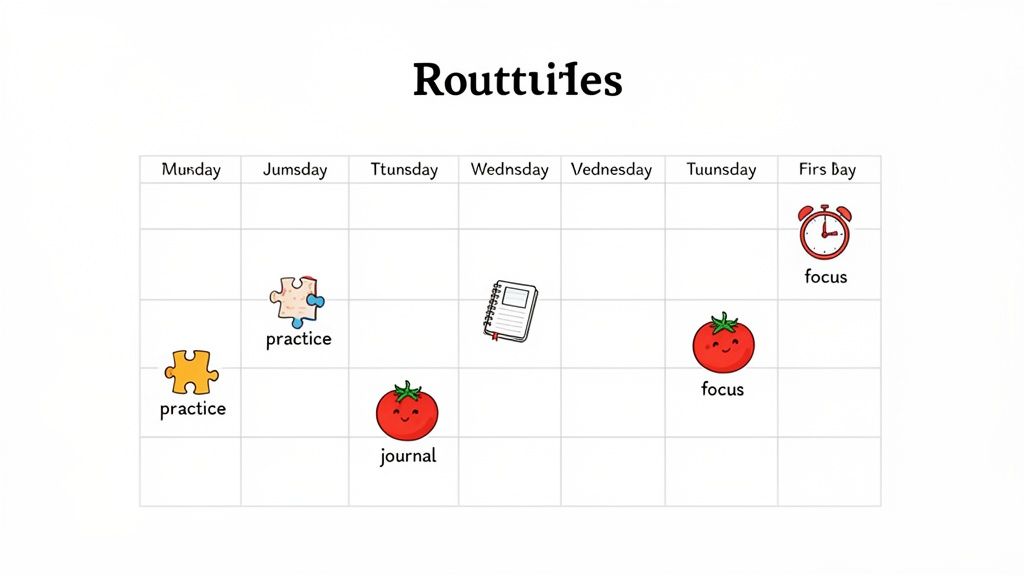
Here's a hard truth: consistency beats intensity every single time. A scattered, reactive approach where you only flex your problem-solving muscles when a crisis hits just won't cut it. What you need is a simple, repeatable weekly schedule that carves out small blocks of time for different kinds of practice.
Here’s a sample structure I’ve seen work wonders. Feel free to adapt it to your own life:
- Logic Puzzles (20 minutes, twice a week): Dedicate two short sessions to Sudoku, crosswords, or logic grids. These are fantastic for training your brain to spot patterns and make sound deductions under pressure.
- Case Study Analysis (30 minutes, once a week): Grab a real-world business case study from your field or an industry you find interesting. Spend 30 minutes breaking down the problem, identifying the key stakeholders, and mapping out how you would have handled it.
- Decision Journaling (10 minutes, daily): This is a game-changer. At the end of each day, jot down one important decision you made. Note the problem, the options you weighed, why you made the final call, and what the immediate result was. You’ll start seeing your own biases and thought patterns in a whole new light.
This mix ensures you’re working on all the different facets of problem-solving, from pure logic to big-picture strategic thinking.
Master Your Focus with Time-Boxing
Your practice sessions are only as effective as the focus you bring to them. Multitasking is the enemy of deep work. To fight back, I highly recommend a time-boxing method like the Pomodoro Technique to create a fortress of concentration.
It’s incredibly straightforward:
- Pick one—and only one—problem-solving task.
- Set a timer for 25 minutes and work on that task without any interruptions. That means no email, no notifications, no "quick" checks of social media.
- When the timer goes off, take a mandatory 5-minute break. Get up, stretch, and give your mind a rest.
- After four of these "pomodoros," take a longer 15-30 minute break.
This technique essentially trains your brain to drop into a state of deep focus on command. Over time, you’ll find your practice sessions become far more productive. In fact, focused work sessions like these can boost your efficiency by as much as 25%.
By creating a distraction-free container for your thoughts, you allow your brain to make deeper connections and explore solution pathways that would otherwise be lost to constant context-switching.
Reinforce Learning with Spaced Repetition
Just as important as practicing new skills is making sure you don't lose them. Spaced repetition is a powerful learning hack where you revisit information at increasing intervals. It's an incredibly effective way to lock new mental models and problem-solving frameworks into your long-term memory.
This is more critical than ever. According to a PwC hopes and fears report, technical skills now have a half-life of just 4 years, a steep drop from 10 years in the 1980s. This makes adaptable skills like problem-solving absolutely essential. Cognitive science backs this up: solving varied problems daily and bumping up their complexity by just 10% each week can lead to a 28% gain in proficiency.
Here’s how to put it into practice:
- Review your decision journal at the end of every week. What patterns do you see?
- A few days after cracking a tough logic or math problem, try solving it again from scratch.
- A week after learning a new mental model (like First-Principles Thinking), try to summarize it in your own words without looking at your notes.
This forces your brain to retrieve the information, which strengthens the neural pathways and makes the knowledge stick. For anyone tackling quantitative subjects, our guide on how to study math effectively has more strategies that pair perfectly with this method.
Use Modern Tools to Your Advantage
Technology doesn't have to be a crutch that just hands you the answers. When used correctly, it can become an incredible partner in sharpening your problem-solving abilities. Think of it less as a calculator that does the work for you and more as a sparring partner that forces you to think harder and more creatively.
This approach creates a powerful, rapid feedback loop that can seriously accelerate your growth. You’re not just looking for solutions; you're simulating complex challenges, getting instant critiques on your logic, and discovering new ways of thinking you might have missed on your own. It's all about building your mental muscles, not replacing them.
Create Custom Practice Scenarios with AI
You get better at solving problems by… well, solving a lot of them. AI assistants are perfect for this, acting as your personal problem generator to create an endless stream of custom challenges on demand. This lets you move past generic brain teasers and focus on scenarios that are actually relevant to your work or studies.
For instance, you could prompt an AI with things like:
- "Generate a business case study about a fictional startup facing declining user retention. Include fake data points for me to analyze."
- "Create a complex logic problem involving three variables and five constraints related to project scheduling."
- "Act as a debate opponent. I will argue for [topic], and you will challenge my arguments with logical fallacies that I must identify."
This gives you a safe space to test your thinking without any real-world consequences. It’s an incredibly efficient way to get your reps in. In the pursuit of efficiency, leveraging AI-powered tools can provide significant advantages, as demonstrated by insights into various effective applications.
Visualize Complexity and Organize Your Action Plan
Complex problems often feel overwhelming because they're a tangled mess of ideas in our heads. Digital mind-mapping and whiteboarding tools like Miro or XMind are fantastic for getting those thoughts out where you can see them. They let you visually organize information, draw connections, and see the entire problem at a glance.
Once you’ve got a potential solution mapped out, you need to break it down into a real plan. This is where project management software shines.
Using a tool like Trello or Asana forces you to translate a high-level strategy into a series of small, manageable, and actionable tasks. This simple act of organization transforms a daunting solution into an achievable project.
This structured approach doesn't just bring clarity; it builds momentum as you start checking off those first few tasks. For students, finding the https://feen.ai/blog/best-ai-study-tool can serve a similar purpose, helping to break down complicated homework problems into understandable parts.
Get Instant Feedback and Refine Your Logic
One of the hardest parts of improving is getting timely feedback on your thought process. AI can be an incredible sounding board, letting you test the strength of your arguments before you take them to your boss, professor, or colleagues.
Try using prompts like these:
- "Here is my proposed solution to [problem]. What are the potential weaknesses or blind spots in my reasoning?"
- "Critique this paragraph for clarity and logical consistency."
This kind of immediate, unbiased feedback helps you spot flaws you might be blind to and sharpen your communication. Used this way, these tools become a personal cognitive coach, available 24/7 to help you build a more rigorous and effective way of solving problems.
Measure Your Growth and Avoid Common Pitfalls
Putting new strategies into practice is great, but how can you be sure you're actually getting better? To really sharpen your problem-solving skills, you need a way to track your progress and stay vigilant against the mental traps that can send you in circles.
Keeping an eye on your growth doesn't need to be some complex, data-heavy project. You can start with a simple log. Just jot down the date, the problem you tackled, and roughly how long it took you to get from "what's going on here?" to a workable solution. This gives you a personal baseline to see how far you've come.
Quantifying Your Progress
If you want to get more specific, you can track a few key metrics that really show how your thinking is evolving.
- Time to Diagnosis: How quickly are you getting to the real root of the problem? If you're using a method like the 5 Whys, are you getting to that final "why" faster than you were a month ago? Shaving time off this initial stage is a massive win.
- Solution Success Rate: Keep a simple tally of your solutions. What percentage actually fixed the issue for good, versus those that needed another patch later on? You're looking for a steady climb in first-time successes.
- Idea Generation: When you're brainstorming, try giving yourself five minutes to see how many different solutions you can come up with. As you get more creative and flexible in your thinking, this number will naturally start to go up.
These numbers give you objective proof that you're not just spinning your wheels—you're genuinely improving.
Measuring progress isn't just about speed. It’s about getting confirmation that your diagnostic instincts and strategic thinking are becoming sharper and more effective. The real goal is deeper understanding, not just a quick fix.
Navigating Common Mental Traps
Even with the best strategies in your toolkit, our own brains can sometimes work against us. Recognizing these common cognitive biases is half the battle.
One of the biggest culprits is Confirmation Bias. This is our natural tendency to look for evidence that supports what we already believe. For example, if you're convinced a problem is a software bug, you might unconsciously ignore all the signs pointing to a simple user error. To break out of this, you have to actively play devil's advocate. Force yourself to find evidence that proves your initial theory wrong.
Then there's the classic Analysis Paralysis. This is where you get so bogged down in gathering information and weighing every single option that you never actually make a decision. The best way to beat this is to give yourself a hard deadline for the analysis phase. At a certain point, you just have to decide on a course of action and move.
Finally, always be on the lookout for the Sunk Cost Fallacy. This is the trap of sticking with a failing solution just because you’ve already poured so much time, energy, or money into it. A great problem solver knows when to cut their losses. You have to learn to evaluate the situation based on where it is now, not on what you've already invested.
Common Questions on the Path to Better Problem Solving
As you start your journey to becoming a better problem-solver, a few questions always seem to come up. Let's tackle them head-on so you can set the right expectations and keep moving forward.
How Long Does It Take to Actually See a Difference?
You can start using techniques like the 5 Whys today and see an immediate benefit. However, for these new ways of thinking to become second nature, you're looking at about two to three months of consistent effort. This isn't about a quick trick; it's about fundamentally rewiring your cognitive habits for the long haul.
The key is to focus on the process itself. Celebrate the small wins, like when you pause to analyze a minor work issue instead of instantly jumping to a fix. Those little moments are the building blocks of real, lasting growth.
What If I’m Just Not a “Natural” at This?
That’s a common worry, but it’s unfounded. Problem-solving is a skill, plain and simple—it's not some innate talent you're either born with or you aren't. While some people might lean more towards analytical thinking from the get-go, the structured methods and mental models we’ve discussed are designed for anyone to learn.
Your starting point doesn't define your potential. Dedication to a structured practice routine is far more important than any perceived natural ability. It's about building the muscle through consistent reps.
What's the Single Best Daily Habit for Sharper Thinking?
If you do just one thing, make it this: spend 15-20 minutes each day diagnosing a small problem without trying to solve it. Pick anything—a recurring personal frustration, a tiny snag in a team project, anything.
Your only goal is to ask "why" over and over again. Push past the obvious symptoms to find what’s really going on underneath. This simple exercise trains your brain to fight the urge for a quick patch and instead default to deeper, more critical analysis. It’s a small investment with a huge payoff.
Ready to accelerate your learning and get instant help with complex homework problems? Feen AI acts as your personal AI tutor, providing clear explanations and step-by-step solutions for subjects like Math, Physics, and Chemistry. Stop getting stuck and start building confidence. Try Feen AI for free and see how it can help you master tough subjects.
Relevant articles
Discover how to improve critical thinking skills with practical exercises, proven frameworks, and strategies for students and professionals.