How to Improve Critical Thinking Skills: Practical Steps That Work
Discover how to improve critical thinking skills with practical exercises, proven frameworks, and strategies for students and professionals.
To really get better at critical thinking, you have to make a habit of it. It’s about constantly questioning assumptions, picking apart evidence, and weighing arguments. This means you stop just memorizing facts and start actively engaging with them, turning learning from a passive activity into an active investigation. Building this mindset helps you reason with clarity and, ultimately, make smarter decisions in school, work, and life.
Why Critical Thinking Is Your Real-World Superpower
Let's get one thing straight: critical thinking isn't some abstract concept you only read about. It’s the practical, everyday skill you use to navigate everything from dense academic papers to tough career choices. It’s what separates someone who just knows a formula from someone who understands why it’s the right tool for a specific physics problem.
The great thing is, you’re not just born with it. Critical thinking is a skill you build through deliberate practice.
And there’s proof it works. A major international study running from 2015 to 2020 found that direct instruction can seriously boost critical thinking. Programs that got students working on performance-based tasks saw scores jump by as much as 15%. This just confirms what 94% of executives already know: critical thinking is a non-negotiable career skill. You can dig into the full findings from the Council for Aid to Education to see the data for yourself.
At its core, improving how you think means strengthening a few key abilities. These are the pillars that hold up your capacity to reason well. Getting a handle on them will fundamentally change how you process information and tackle problems.
I’ve broken down these core components into a simple table to give you a quick overview.
The Core Pillars of Critical Thinking
| Pillar | What It Means | Quick Practice Idea |
|---|---|---|
| Analysis | Breaking down complex information into smaller, manageable parts to see how they connect. | Take a news article and map out the main argument, the evidence used, and any unstated assumptions. |
| Interpretation | Figuring out the actual meaning or significance of information, data, or experiences. | Look at a chart or graph and write down three different conclusions someone could draw from it. |
| Evaluation | Judging the credibility, relevance, and strength of arguments and evidence before you buy in. | Next time you hear a strong claim, ask: "What's the source? Is it biased? Is the evidence solid?" |
| Inference | Drawing logical conclusions from the information you have, essentially "reading between the lines." | Read a short story and predict what might happen next, explaining exactly what clues led you there. |
| Self-Regulation | Being aware of your own thinking process, spotting your personal biases, and course-correcting as you go. | After making a decision, reflect on your thought process. Did emotions play a role? Were you objective? |
Each pillar works with the others. As you build them up, you move from being a passive sponge for information to an active participant in your own learning.
By focusing on these pillars, you’re not just learning what to think, but how to think. This guide is all about giving you the actionable tools to build that foundation, one skill at a time.
Master the Art of Asking Deeper Questions

If you want to make a real shift in your critical thinking, you have to stop taking information at face value. It all starts with learning how to ask better, more probing questions—the kind that pull apart arguments, expose hidden assumptions, and get to the heart of an issue.
It’s the difference between asking, "What's the answer?" and asking, "Why is this the best answer?" The first question is just looking for a fact. The second is a hunt for genuine understanding. This is where real learning truly begins.
A fantastic framework for this is the Socratic method. You don't have to be a philosopher to use it. The idea is simple: use a disciplined line of questioning to explore complex ideas and challenge your own thinking.
Moving Beyond Surface-Level Inquiry
Start by thinking of your questions in layers, not just one at a time. This structured approach is a lot like how a scientist designs an experiment—each step is deliberate and builds on the one before it. If you're interested in that kind of structured thinking, you can read more about it in our guide to the 7 steps of the scientific method.
Here are a few question templates you can adapt to almost anything, from a history chapter to a scientific study.
Questions to Clarify Concepts
- "Could you explain this in a different way?"
- "What's the core message you're trying to get across?"
- "Can you give me a real-world example of this?"
Questions to Challenge Assumptions
- "What are we taking for granted here?"
- "What would happen if this assumption wasn't true?"
- "Why do we believe this assumption is valid?"
Questions to Probe for Evidence
- "What data or evidence backs up this claim?"
- "How can we be sure this source is credible?"
- "Is there any information that contradicts this point?"
This kind of structured questioning forces you to deconstruct information methodically. You’re less likely to miss a crucial detail or get swayed by a weak argument.
By consistently asking these kinds of questions, you train your brain to automatically search for complexity, bias, and underlying logic. It stops being an extra step and becomes a natural part of how you think.
Putting Probing Questions into Practice
Let's see how this works with a common statement. Imagine you read this sentence in an article: "The recent surge in online learning has led to a decline in student engagement."
A passive reader might just nod and move on. A critical thinker immediately starts digging.
- Clarify: First off, what does "student engagement" even mean here? Are we talking about participation in live classes, how many assignments get turned in, or a student's emotional investment?
- Challenge Assumptions: The statement assumes all online learning is the same. Is it possible some formats actually boost engagement for certain students?
- Probe for Evidence: Where's the proof for this "decline"? Is this from a peer-reviewed study or just someone's opinion? Could other factors be at play, like the subject matter or the teacher's style?
- Explore Viewpoints: What would a student say about this? How about a teacher or a school administrator? Would they all agree?
- Consider Consequences: Okay, if this is true, what does that mean for the future of education? What should we do about it?
Notice how that line of questioning blew a simple sentence wide open, turning it into a complex issue ready for real analysis. That's the engine of critical thinking right there.
Your Hands-On Exercise
Now it's your turn. Find a headline from a news site or pull a key argument from a textbook you're reading. Write it down.
Next, come up with at least five probing questions using the categories above. This small exercise, done regularly, builds the mental muscles you need for sharp, rigorous analysis. It's one of the most direct ways to level up your critical thinking skills.
Sharpening Your Analytical and Evaluative Abilities
Asking great questions is a huge step, but it’s really only half the battle. The other, arguably more difficult, half is knowing what to do with the answers you find. This is where you shift gears from just asking questions to making sound judgments. It’s all about learning to dissect arguments and weigh sources with a sharp, critical eye.
Think of analysis as taking apart a clock to see how the gears mesh. You’re not just staring at the face; you’re digging into the mechanics to see the core components, find the hidden patterns, and understand how one idea connects to another.
Evaluation, then, is judging the quality of that clock. Once you see how it’s built, you can ask, "Is this well-made? Are the parts cheap? Does it actually keep good time?" This is where you get into assessing credibility, accuracy, and relevance.
How to Deconstruct Information Like an Expert
One of the biggest mistakes I see learners make is trying to analyze a whole chapter or article in one go. That’s a recipe for feeling overwhelmed, and it usually ends with a simple "I agree" or "I disagree" without much substance behind it.
A much better approach is to be systematic.
Let’s say you’re tackling a dense biology chapter. Instead of just trying to memorize everything, get a quick overview first. Then, dive back in to critically examine the evidence for one specific theory. Was the study they cited actually robust? How big was the sample size? Were there any conflicts of interest?
This is precisely where many people stumble. Data from Insight Assessment shows that learners often have significant weak spots here, demonstrating only 42% proficiency in Interpretation and a mere 39% in Evaluation. But here's the good news: the same data shows that with focused practice, you can see score gains of 20-25% in as little as 8-12 weeks.
This tells us that these skills aren't fixed. They're muscles you can build with the right framework.
A Practical Toolkit for Vetting Information
For a simple yet powerful tool you can use every day, I always recommend the CARS checklist. It’s an easy-to-remember acronym that stands for Credibility, Accuracy, Reasonableness, and Support.
- Credibility: Who’s behind the information? What are their credentials? Can you spot any obvious bias? A peer-reviewed paper from a university is going to carry more weight than an anonymous blog post.
- Accuracy: Is this stuff up-to-date and factually correct? Cross-reference the claims with other sources you already trust. Always look for dates and proper citations.
- Reasonableness: Does the argument actually make sense? Is it presented in a fair and balanced way, or does it feel sensationalized? Be skeptical of emotional language and claims that sound way too good to be true.
- Support: What’s propping up the claims? Is there data, citations, or quotes from recognized experts? An argument without any real support is just someone’s opinion.
By running everything you read through the CARS checklist, you create a crucial buffer between seeing information and blindly accepting it. This one habit is foundational to real critical thinking.
Let’s put it to the test. Imagine you find an online article claiming a new "superfood" can cure a major disease.
- Credibility: The author is a "wellness blogger" with zero scientific credentials. (Big red flag)
- Accuracy: The article is five years old, and there are no links to any medical journals. (Another red flag)
- Reasonableness: The claim that a single food can "cure" a complex disease is pretty extreme. (A third red flag)
- Support: The only "evidence" offered is a handful of personal stories, not hard clinical data. (Final red flag)
The CARS checklist helps you dismantle this weak argument in seconds.
If you need a more rigorous framework for academic or professional work, you can go deeper with a systematic literature review methodology. It’s an incredibly powerful way to sharpen your analytical edge.
By consistently using structured methods like these, you stop treating analysis and evaluation as vague ideas and start using them as concrete, repeatable skills. It’s how you build a reliable filter for judging information and forming conclusions that you can truly stand behind.
Building Your Problem-Solving and Reasoning Frameworks
Being a sharp critical thinker isn't just about poking holes in other people's arguments. It's about building your own sound ones. To do that, you need a structured way to approach problems and sift through complex information.
Without a few go-to mental models, even the brightest mind can get tangled up in the noise of a tricky challenge. Think of these frameworks as blueprints for your thought process. They bring a bit of order to the chaos, helping you move from confusion to clarity with a method you can trust and use again and again.
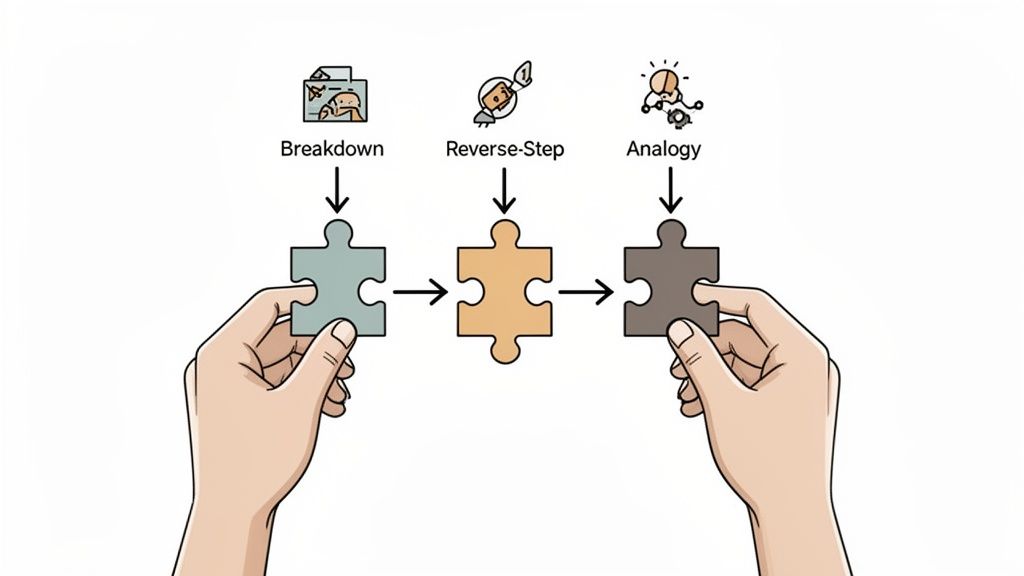
Deconstruct Problems Into Manageable Parts
The best way to tackle an intimidating problem is to make it less intimidating. Big, messy challenges are almost always just a bunch of smaller, simpler problems hiding inside a complicated shell. Your first job is to break them out.
For instance, imagine you're assigned to analyze a major historical event. Trying to grasp everything at once is a recipe for disaster. Instead, break it down:
- What were the key political factors at play?
- What economic pressures were people facing?
- Who were the main individuals involved, and what motivated them?
- What were the immediate effects versus the long-term consequences?
Suddenly, that one massive task becomes a clear, actionable checklist. As you find the answers to these smaller questions, a rich, comprehensive picture of the larger event starts to take shape. For a deeper dive into methods like this, our guide on how to improve problem-solving skills offers more practical techniques.
Use Analogical Reasoning To Transfer Knowledge
Sometimes, the smartest way to solve a new problem is to see how it’s like an old one. This is called analogical reasoning, and it's a powerful shortcut for applying what you already know to something you don't.
Think about it. If you understand how the human circulatory system works—with the heart as a pump and arteries as distribution channels—you can use that knowledge as an analogy. Suddenly, understanding how an electrical grid functions becomes easier: the power plant is the pump, and the power lines are the channels. This mental bridge makes the unfamiliar feel instantly more familiar.
By actively looking for analogies, you build a web of interconnected knowledge. This not only deepens your understanding but also speeds up your ability to find creative solutions when faced with novel problems.
Spotting Common Logical Fallacies
A huge part of building a strong reasoning framework is learning to spot weak ones. Logical fallacies are simply errors in reasoning that make an argument fall apart, even if it sounds convincing at first. They are everywhere—in ads, political debates, and especially in social media comment sections.
Learning to identify these fallacies is like developing a superpower. It helps you see through faulty logic and keeps you from being swayed by manipulative or just plain weak arguments. Getting comfortable with the most common types is a fundamental step toward becoming a more discerning thinker.
Below is a quick reference guide to help you identify flawed reasoning when you encounter it in texts, debates, or online.
Spotting Common Logical Fallacies in Arguments
| Fallacy Type | Explanation | Example |
|---|---|---|
| Straw Man | Misrepresenting someone's argument to make it easier to attack. | Person A: "We should invest more in public transit." Person B: "So you want to ban all cars and force everyone onto buses?" |
| Ad Hominem | Attacking the person making the argument instead of the argument itself. | "You can't trust her opinion on economics; she's never even run a business." |
| Appeal to Authority | Claiming something is true simply because an authority figure said it, without other supporting evidence. | "My favorite celebrity said this diet works, so it must be the best one." |
| False Dichotomy | Presenting only two options as the only possibilities, when in fact more options exist. | "You're either with us or against us." |
| Slippery Slope | Arguing that a small first step will inevitably lead to a chain of negative events. | "If we allow students to retake one test, they'll soon expect to retake every assignment." |
Once you start looking for these, you'll see them everywhere. Make it a daily practice. When you hear or read an argument, just pause and ask: Is the reasoning solid, or is there a sneaky logical shortcut being used here? This habit alone will dramatically sharpen your critical thinking.
Weaving Critical Thinking into Your Daily Routine
Real skill development isn't about cramming; it's about consistency. To genuinely improve your critical thinking, you have to weave it into the very fabric of your daily life until it becomes second nature.
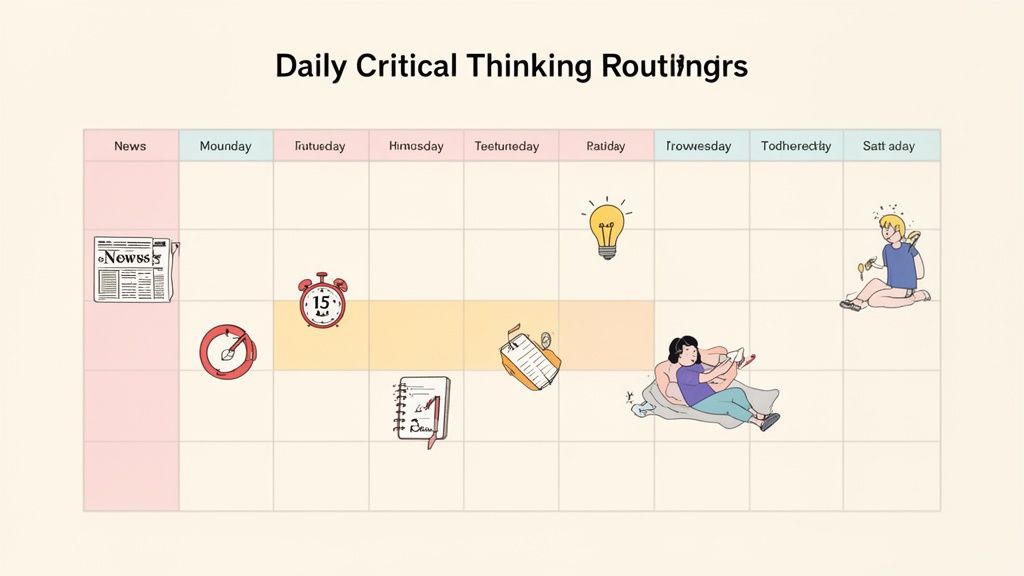
This doesn't mean adding hours to your already packed schedule. It's about changing how you approach the learning you're already doing—shifting your default from passively absorbing information to actively questioning it. The key is to create a simple, repeatable "Critical Thinking Workout" that fits right into your existing study habits.
Designing Your Daily Critical Thinking Workout
Think of this like a gym routine for your mind. You don't need to block out a huge chunk of time to see results. Small, sustainable actions are what build intellectual muscle over time. Consistency always trumps intensity.
Here are a few quick habits you can start integrating today:
- The 15-Minute News Analysis: Pick one news article each day and spend just 15 minutes dissecting it. Don't just read it. Identify the main claim, look at the evidence provided, and actively hunt for potential bias in the language or the source itself.
- Challenge a Textbook Explanation: Next time you're reading a chapter for class, find one core concept and question its explanation. Ask, "Is this the only way to explain this? What assumptions is the author making? Could I explain this better or from a different angle?"
- The Post-Lecture Inquisition: After a lecture, take five minutes to challenge its main arguments instead of just transcribing notes. What was the most convincing point? The weakest? If you had to argue against the professor's thesis, what would you say?
This kind of deliberate practice retrains your brain to automatically engage with information on a much deeper level.
By making these small exercises a non-negotiable part of your routine, you are rewiring your approach to learning. Over time, questioning, analyzing, and evaluating will stop feeling like extra work and become your natural first instinct.
The Power of Starting Early and Staying Consistent
It's no surprise that the push for this kind of thinking in education is getting stronger. A 2020 survey by the Reboot Foundation found that a massive 90% of US adults support making critical thinking courses mandatory in K-12 education. Even more telling, 43% believe that early childhood is the best time to start.
This data underscores a critical point: you develop these skills best by practicing them within the subjects you're already studying, not in some isolated, abstract way. Critical thinking isn't a separate skill you learn in a vacuum; it’s a lens that brings every subject into sharper focus.
As you start integrating these habits, using smart tools can help you manage your time effectively. You might find our guide on https://feen.ai/blog/how-to-use-ai-for-studying useful for carving out more time for this deeper analysis.
Putting It All Together: A Sample Routine
Creating a routine makes your practice intentional. Instead of just hoping you'll remember to think critically, you build a structure that guarantees it.
Here’s what a simple weekly schedule could look like:
| Day | Focus Activity (15-20 Minutes) | Subject |
|---|---|---|
| Monday | Deconstruct a key theory from your textbook reading. | Biology |
| Tuesday | Analyze a news article related to a current event. | Social Studies |
| Wednesday | Identify logical fallacies in online comments or an opinion piece. | General |
| Thursday | Summarize and then critique the main argument of a video lecture. | Physics |
| Friday | Reflect on your own biases in a decision you made this week. | Self-Regulation |
This simple plan ensures you’re flexing different critical thinking muscles throughout the week. For more real-world examples, you can learn How to Build Critical Thinking Skills You Can Actually Use and get even more actionable advice.
The trick is to start small, stay consistent, and appreciate the gradual but powerful shift in how you see and interact with the world.
Got Questions About Critical Thinking? You're Not Alone.
When you first start deliberately working on your critical thinking, a lot of practical questions pop up. It’s one thing to get the theory, but it’s another to actually apply it when you’re staring down a deadline or wrestling with a new topic.
Let's dive into some of the most common questions I hear from students and clear up the confusion.
How Long Does This Actually Take?
This is the big one, and the honest answer is, "it depends." But that's not the whole story. The good news is you can see real, measurable progress faster than you might think. Research suggests that with focused, consistent practice, you can sharpen skills like analysis and evaluation in as little as 8 to 12 weeks.
The secret isn’t just about putting in the hours; it’s about the quality of those hours. A student who spends 15 minutes a day actively challenging what they read in a textbook will improve far more than someone who just passively reads for two hours.
Think of it less like a race with a finish line and more like building a muscle. You’ll notice small wins at first—you'll spot a weak argument in an online comment or ask a better, deeper question in class. Those small victories build on each other.
The goal is progress, not overnight perfection. Start by weaving one or two new habits into your routine, like using the CARS checklist for sources or trying a quick Socratic self-questioning session each day. Once those feel natural, add another.
Is AI a Crutch or a Tool for Critical Thinking?
It’s a valid concern. We've all heard that relying too much on AI could make our brains lazy. And some studies do show a dip in critical thinking scores when people use AI as a shortcut to just get the answer.
But that's not the only way to use it. When you approach AI as a thinking partner instead of an answer machine, it can be an incredible asset.
Here are a few smart ways to use AI to sharpen your mind, not soften it:
- Play Devil's Advocate: Have you formed an opinion? Ask an AI tool to generate the strongest possible counterarguments. This forces you to defend your own position and find the holes in your logic.
- Get New Perspectives: Use it to quickly summarize how different experts, cultures, or even historical figures might look at an issue. It’s a great way to broaden your viewpoint beyond your own assumptions.
- Untangle Complex Ideas: If you’re bogged down by a dense scientific theory, ask AI to "explain this to a high school student" or "give me a real-world analogy." This can give you the mental foothold you need to start your own deep analysis.
The trick is to stay in the driver's seat. Use AI to gather information and challenge your ideas, but never outsource the actual thinking.
What Do I Do When I Feel Totally Stuck?
Feeling overwhelmed is a completely normal—and even expected—part of this journey. It happens when you’re breaking down a huge problem or confronting one of your own hidden biases for the first time.
When you hit that wall, don't try to push through it. Simplify.
If you’re facing a massive research paper, just stop. Pick a single source and run it through a quick evaluation like the CARS checklist. That’s it. If a multi-step physics problem has you frozen, just focus on identifying the very first step. Break the monster problem into tiny, manageable pieces.
Another trick I swear by is simply talking it out. Explain your thought process to a friend, a classmate, or even just to yourself. Vocalizing your reasoning has a funny way of exposing the gaps and leaps in logic you couldn't see when it was all jumbled in your head. It externalizes the problem and turns a mental roadblock into a puzzle you can actually solve.
Hitting a wall with a specific homework problem? Feen AI can be your personal tutor, breaking down tricky concepts in subjects like Math, Physics, and Chemistry. It won't just spit out the answer; it guides you through the why, helping you build the reasoning skills to solve it yourself next time. Try it now at https://feen.ai and turn that confusion into clarity.
Relevant articles
Struggling to absorb what you read? Learn how to improve comprehension skill with actionable reading strategies and smart tools for real, lasting results.
Learn how to improve problem solving skills with our guide. Discover actionable techniques, mental models, and daily routines to master any challenge.

Discover how to summarize book chapters effectively. Our guide covers proven methods and smart tools to help you retain more information and study smarter.