What is gene expression? A Simple Guide to DNA to Protein
What is gene expression? Discover what is gene expression and how genes become proteins with clear, simple steps.
Picture your DNA as a massive, ancient cookbook. It’s filled with every single recipe your body could ever need to grow, function, and survive. Gene expression is simply the process of picking one of those recipes, reading the instructions, and baking the final dish—like a protein that digests your lunch or a pigment that colors your eyes.
This process is absolutely central to life itself.
Your DNA's Recipe Book: From Code to Action
Every single cell in your body, whether it's in your skin or your brain, holds the exact same master cookbook. So, how does a skin cell "know" to make skin proteins, while a brain cell makes neurotransmitters?
It all comes down to which recipes they choose to read. Gene expression is the tightly controlled process that dictates which genes are switched "on" (or expressed) in a specific cell at a specific time.
This isn't a random flip of a switch; it's a highly regulated system. Think of it like a cellular kitchen. A signal, maybe a hormone, acts like a new order coming in. It tells the cell it's time to cook a particular dish (a protein). This is how the abstract code tucked away in your DNA becomes a real, functional molecule that gets the job done.
This journey from genetic information to real-world action is the foundation of biology. It explains how we grow, develop, and adapt to our environment. It's the mechanism that translates the blueprint of life into living, breathing reality.
The discovery that an intermediary molecule carried these instructions out of the nucleus was a huge breakthrough. Back in 1961, scientists figured out that messenger RNA (mRNA) was this crucial go-between—the temporary photocopy of the recipe, taken from the master cookbook to be used in the kitchen.
This idea of starting with the basic components is a common theme in science. Just like you'd approach an organic chemistry study guide by learning the fundamental structures first, getting to know the key players in gene expression is the perfect place to start.
Key Players in the Gene Expression Kitchen
To really get a handle on gene expression, let's stick with our kitchen analogy and meet the main molecular players. This table is your cheat sheet for who's who before we dive into how they all work together.
| Molecule | Cookbook Analogy | Primary Role |
|---|---|---|
| DNA | The Master Cookbook | Securely stores all the genetic "recipes" inside the cell's nucleus. |
| Gene | A Single Recipe | A specific section of DNA that holds the instructions for one final product. |
| mRNA | The Recipe Photocopy | A temporary, disposable copy of a gene that carries the instructions to the kitchen. |
| Ribosome | The Master Chef | The molecular machine that reads the mRNA instructions and assembles the protein. |
| Protein | The Final Dish | The functional molecule that carries out a specific job in the cell. |
Now that you've been introduced to the team, we can start to look at the actual "cooking" process—the stages of transcription and translation where these molecules come together to bring a gene to life.
The Two Main Steps: Transcription and Translation
So, how does a cell actually use the instructions locked away in a gene to build something useful? It’s a beautifully precise, two-part process. You can think of it as a molecular assembly line, one that translates the genetic blueprint into a functional protein. These two core stages are transcription and translation.
Let's use an analogy. Imagine your DNA is a rare, priceless cookbook that must stay protected in a library's main vault (the cell's nucleus). You can't just take it into the kitchen. Instead, you make a temporary, disposable copy of just the recipe you need. That's transcription. Then, you take that copy to the kitchen to actually cook the dish. That's translation.
This flow of information is a fundamental concept in biology.
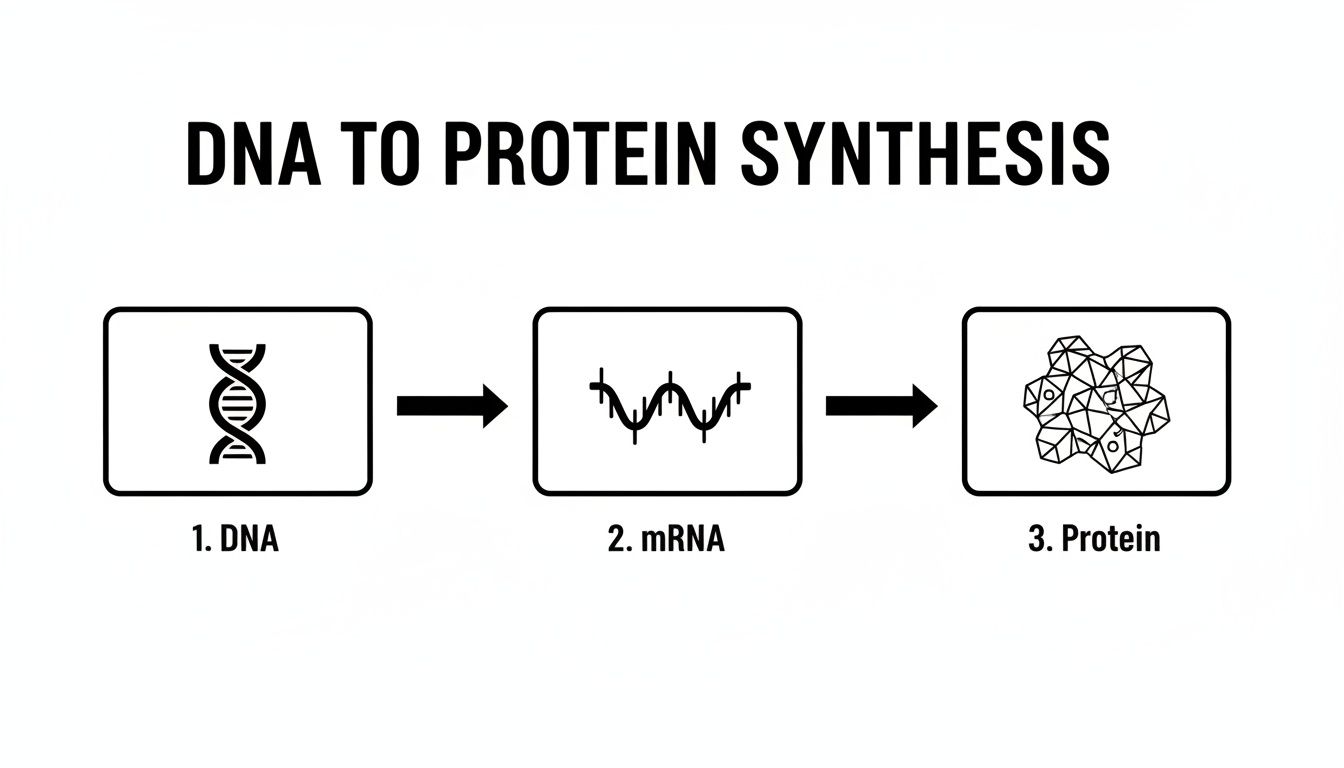
This simple diagram captures the "central dogma" of molecular biology: genetic information flows from DNA, to an RNA middleman, and finally into a protein.
Stage 1: From DNA to mRNA in Transcription
Transcription is all about making that disposable copy, which is called messenger RNA (mRNA). This whole process kicks off inside the nucleus, where the cell’s DNA is kept safe. An amazing enzyme called RNA polymerase gets the party started by latching onto the beginning of a gene.
From there, it zips along the DNA strand, reading the sequence of nucleotide bases (A, T, C, and G) like a high-speed scanner. As it reads, it builds a new, complementary strand of mRNA. This new molecule is almost a perfect mirror image, but with one little twist: instead of thymine (T), RNA uses a base called uracil (U).
Once the entire gene has been copied, this freshly made mRNA molecule detaches. Now this single-stranded message is ready to travel out of the nucleus and into the cell's main workshop, the cytoplasm.
Analogy Checkpoint: Think of transcription as a librarian carefully photocopying one page from a master reference book. The book (DNA) always stays in the library (nucleus), but the mobile photocopy (mRNA) is free to go where it's needed.
Stage 2: From mRNA to Protein in Translation
Now that our mRNA message has been delivered to the cytoplasm, it’s time for translation. This is where the magic really happens—the instructions are finally read and used to build an actual protein. This process unfolds on a tiny molecular machine called a ribosome, which you can picture as the cell's protein-building factory.
The ribosome locks onto the mRNA strand and starts reading its sequence. It doesn't read one letter at a time, though. It reads the bases in groups of three, called codons. Each codon is a specific code word for one of the 20 different amino acids, which are the building blocks of all proteins.
But how do the right amino acids show up at the right time? That’s where another crucial molecule, transfer RNA (tRNA), comes in.
- The Delivery Trucks: Think of tRNA molecules as little delivery trucks. Each one is specialized to carry just one type of amino acid.
- Matching the Code: Every tRNA has a three-letter "anticodon" that perfectly matches an mRNA codon. When the ribosome reads a codon on the mRNA, the corresponding tRNA truck docks and drops off its amino acid cargo.
- Building the Chain: The ribosome then links that amino acid to the previous one, forming a growing chain called a polypeptide. This process repeats over and over until the ribosome hits a "stop" codon. The finished chain then folds up into a complex 3D shape, becoming a functional protein ready to do its job.
This incredible sequence of events—from a silent gene in the nucleus to a bustling protein in the cell—is the very essence of gene expression. It’s happening countless times a second inside your body right now.
How Cells Control Which Genes Are Expressed
So, if every cell has the same DNA cookbook, why isn't every cell making every single protein all the time? It would be total chaos. Imagine a skin cell trying to produce insulin or a brain cell trying to contract like a muscle. It just wouldn't work.
Cells are smarter than that. They have an incredibly sophisticated system for controlling which genes get turned "on" and "off" at any given moment. This entire process is called gene regulation, and it's the reason a muscle cell is different from a nerve cell, even though they share the exact same genetic blueprint.
The Head Chefs and Special Instructions
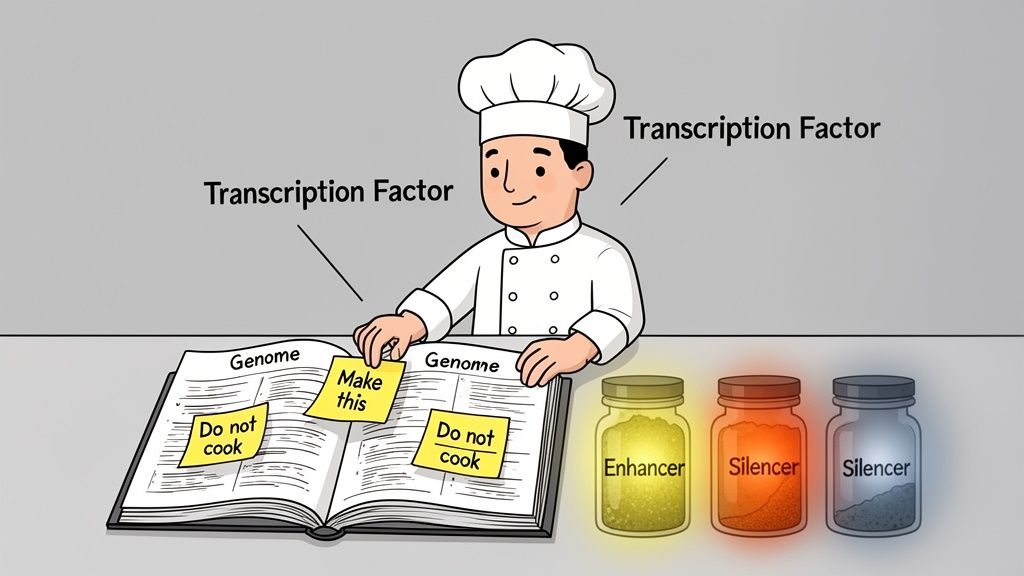
At the center of this control system are special proteins called transcription factors. Think of these as the head chefs in the cell's kitchen. They are the decision-makers, binding to specific spots on the DNA to either kickstart the recipe or put it on hold.
Some transcription factors are activators. They bind to DNA regions called enhancers, which act like a note from the manager saying, “This is the special of the day! Make a lot of it, and make it fast!” These enhancer regions can be surprisingly far away from the actual gene they control, but the DNA can loop around to bring them close.
On the flip side, other transcription factors are repressors. They latch onto DNA sequences called silencers, effectively telling the machinery, "We don't need this dish right now, hold production." This constant push and pull allows cells to adapt on the fly to new signals from their environment. Delving into this is a key part of biology, as you can see in some great student work focusing on Cell Biology for Health Professionals.
Key Takeaway: Gene regulation isn't just a simple on/off switch. Enhancers and silencers fine-tune everything, turning the "volume" of gene expression up or down, almost like adjusting the flame on a stove to get the temperature just right.
Sticky Notes on the Recipe Book
Cells have another layer of control that’s incredibly clever: epigenetics. This is like leaving sticky notes all over the pages of the DNA cookbook. These notes don’t actually rewrite the recipes themselves, but they sure do influence which ones get read.
A chemical tag might act like a big, sticky note that glues two pages together, making a gene impossible to read. Another tag might be like a bright bookmark, flagging a recipe for immediate attention.
These chemical "sticky notes" are attached directly to the DNA or the proteins it's wrapped around. This is a fundamental reason why different cells develop unique identities and stick to them.
It's a multi-layered system of staggering complexity. Consider this: while only 1-2% of our genome’s 3 billion base pairs actually codes for proteins, projects like ENCODE have revealed that over 80% of our genome is biochemically active. A huge chunk of that activity is all about this intricate dance of regulation. This is how a single set of genetic instructions can build and maintain something as complex as a human being.
Why Gene Expression Matters in Health and Disease
Gene expression isn't just some abstract biological concept—it's the engine running in the background of your life, influencing everything from how you feel today to your long-term health. When this system is working as it should, your body is a masterpiece of timing, turning the right genes on and off at exactly the right moments.
Think about the last time you got a paper cut. Instantly, your cells got the message to express genes for clotting factors to stop the bleeding and kickstart the healing process. Or when you fight off a cold, your immune system is busy ramping up the expression of genes that produce antibodies. This constant, dynamic regulation is what keeps us going.
When the System Breaks Down
But what happens when this intricate balance is thrown off? The consequences can be devastating. At their core, many human diseases, from cancer to inherited genetic disorders, are stories of gene expression gone wrong.
Sometimes, a gene that should be off gets stuck in the "on" position. This is a classic scenario in many cancers. Genes that normally tell a cell to grow and divide (proto-oncogenes) can get mutated, causing them to be over-expressed. The result is the uncontrolled cell growth that creates tumors.
On the other hand, a crucial gene might get switched "off" when it needs to be on.
- Tumor Suppressor Genes: Think of these as the brakes on cell growth. If they get silenced by a chemical tag or other error, those brakes fail, and cells can multiply without any checks and balances.
- Genetic Disorders: In a condition like cystic fibrosis, a mutation in the CFTR gene means the cell simply can't produce a working protein. The genetic "recipe" itself is flawed, so the final product never turns out right.
Gene expression is the bridge between your genetic code and your physical health. A healthy body relies on precise genetic regulation, while disease often arises from the chaos of its disruption.
A New Frontier in Medicine
Grasping this deep connection between genes and health has completely changed how we approach medicine. Instead of just managing symptoms, scientists are now figuring out how to fix the source of the problem: the errors in gene expression.
This is the entire basis for revolutionary fields like gene therapy. By using tools like viral vectors in gene therapy, researchers can deliver a correct copy of a gene into a patient's cells.
The ultimate goal is to move beyond treating symptoms and start correcting the fundamental genetic issue. By learning to tweak the instructions our cells are reading, we're opening the door to treatments for conditions once thought to be a life sentence. This shows that gene expression isn't just a topic for a biology exam; it’s a living, breathing field of research that’s changing lives.
How Scientists Measure Gene Expression in the Lab
So, we know what gene expression is in theory. But how do scientists actually peek inside a cell and see which genes are switched on or off at any given moment? It's one thing to have the blueprint; it's another to know which parts are actively being built.
Researchers have some seriously cool tools for this. They can essentially take a snapshot of a cell's activity by measuring the amount of specific mRNA molecules floating around. Think of it like auditing a factory's production line—by counting the number of instruction manuals (mRNA) for a particular product (protein), you get a pretty good idea of what the factory is focused on making.
This is fundamental for everything from comparing healthy cells to cancerous ones to seeing how a cell reacts when you introduce a new drug. Two of the most common and powerful methods scientists use are Quantitative PCR (qPCR) and RNA-Sequencing (RNA-Seq). Each has its own strengths and answers different types of questions.
qPCR: Zooming in on a Single Gene
Imagine you have a hunch that one particular gene—let’s say, one involved in inflammation—is acting up in a disease. You don't need to know what every other gene is doing; you just want to precisely measure the activity of that one specific target.
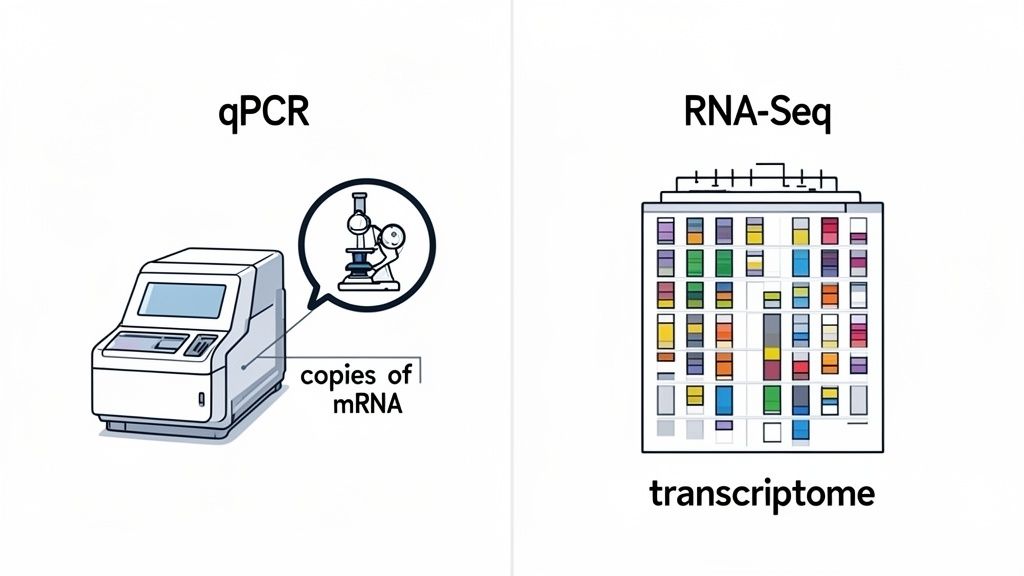
For this kind of focused question, scientists turn to Quantitative Polymerase Chain Reaction, or qPCR. This technique is designed to find and count the copies of a single, specific mRNA molecule with incredible precision. It’s fast, highly sensitive, and relatively cheap, making it perfect for when you already know which gene you want to investigate.
qPCR gives you a clear, quantitative answer to the question: "How much of this specific gene is being expressed right now?"
RNA-Seq: Getting the Big Picture
But what if you don’t have a specific suspect in mind? What if you want to see everything the cell is doing at once—a complete, unbiased inventory of every gene that's active? That’s where RNA-Sequencing (RNA-Seq) comes in.
RNA-Seq is a powerhouse technique that gives you a panoramic view of the entire transcriptome (the full set of RNA molecules). Instead of looking for one specific mRNA, it sequences all of them, telling you which thousands of genes are on, which are off, and exactly how active each one is relative to the others. It’s the ultimate cellular audit.
This approach is perfect for discovery-based research, where you might find that genes you never even suspected are playing a crucial role in a process.
The sheer volume of data from a technique like RNA-Seq can be overwhelming. Making sense of it requires a solid understanding of how to read research papers and interpret complex datasets, a key skill for any aspiring biologist.
To make the choice clearer, let’s break down how these two essential lab techniques stack up against each other.
Comparing qPCR vs RNA-Sequencing
| Feature | qPCR (Quantitative PCR) | RNA-Seq (RNA Sequencing) |
|---|---|---|
| Scope | Targeted. Measures 1 to a few specific genes. | Comprehensive. Measures thousands of genes at once. |
| Primary Use | Validating known gene expression changes or testing a specific hypothesis. | Discovering new genes involved in a process or getting a global view of cellular activity. |
| Data Output | A precise quantity (e.g., Cq value) for each target gene. | A massive list of all expressed genes and their relative expression levels. |
| Cost & Speed | Relatively low cost and fast turnaround. | More expensive and time-consuming. |
| Sensitivity | Extremely high for detecting low-abundance transcripts. | Good, but can struggle with very rare transcripts without deep sequencing. |
| Best For... | You have a clear hypothesis about a specific gene. | You want to explore what's happening across the entire genome without bias. |
Ultimately, the choice between qPCR and RNA-Seq depends entirely on the scientific question you're asking. Do you need a magnifying glass or a wide-angle lens? Both are indispensable tools that allow scientists to see gene expression in action and uncover the molecular secrets of life.
Answering Common Gene Expression Questions
Even after covering the basics, a few tricky questions always seem to come up. Let's walk through some of the most common points of confusion to make sure these concepts really click.
What Is the Difference Between a Gene and a Chromosome?
Think of it like this: your entire genome is a massive encyclopedia set. A chromosome is one of the individual, giant volumes in that set.
So, where does a gene fit in? A gene is just one specific entry or article inside that volume. The chromosome is the huge, tightly coiled structure of DNA that keeps everything organized, while the gene is the specific segment of that DNA carrying the instructions for a single protein or functional RNA.
Can Your Gene Expression Change Over Your Lifetime?
Absolutely. In fact, it's happening all the time. Gene expression is incredibly dynamic, constantly adjusting to your environment, diet, age, and even your stress levels. This flexibility is what allows our bodies to adapt and respond to the world.
For instance, the genes controlling your metabolism can ramp up or down depending on what you had for lunch. When you get sick, your immune-related genes fire up to fight off the infection. It's a constant, lifelong dialogue between your DNA and your experiences, not a fixed script.
This dynamic nature is why understanding the fundamentals is so important. When you hit a roadblock, using effective study methods can make all the difference. For more insights, check out this guide to AI-powered study tools to find new ways to approach complex topics.
If Every Cell Has the Same DNA, Why Are They So Different?
This is one of the most fascinating questions in biology, and the answer is gene regulation. Imagine every cell in your body has the same master cookbook—your DNA.
Even with the same book, a neuron and a muscle cell choose to read completely different recipes. The neuron turns on the genes it needs to send nerve signals, while the muscle cell activates genes for contraction. The vast differences between cell types all come down to which specific genes are switched "on" or "off" in that cell.
Relevant articles

What is the difference between mitosis and meiosis? This guide provides a clear comparison of purpose, stages, and outcomes for students and curious minds.