Using AI to Help with Homework Your Guide to Smarter Studying
Discover how using AI to help with homework can transform your study habits. Learn ethical strategies, practical tips, and how to use AI for real learning.

Yes, absolutely. Using AI to help with homework can be a game-changer for understanding tough subjects and boosting your grades. The trick is to see these tools less as an answer key and more like a personal tutor who’s available 24/7, ready to explain things in a new way until they finally make sense.
Your New 24/7 Study Partner: The Rise of AI Homework Helpers
Picture this: it’s late, you're wrestling with a physics problem, and your teacher logged off hours ago. Instead of getting stuck, you pull up an AI study buddy. You ask your question and instantly get a step-by-step breakdown of the solution, explaining every single formula along the way. This isn't some futuristic fantasy—it's how millions of students are studying right now.
AI homework helpers are built to be incredibly patient and knowledgeable. They're not like a static textbook. If you don't get something, they can rephrase it, give you a helpful analogy, or even create a few practice problems for you on the fly. This turns studying from a passive chore into an active learning session, helping you truly grasp the material instead of just hunting for an answer.
This isn’t just a minor trend, either. It’s a fundamental shift in how students are getting their work done.
A Rapid Shift in Study Habits
The speed at which students have adopted AI for schoolwork is staggering. The numbers paint a clear picture. By May 2025, an incredible 69% of U.S. high school students were already using ChatGPT for their assignments. In the first five months of that year, overall use of generative AI for school jumped from 79% to 84%—a sign of just how fast this is becoming the new normal.
This infographic gives you a snapshot of how students are integrating AI into their study routines.
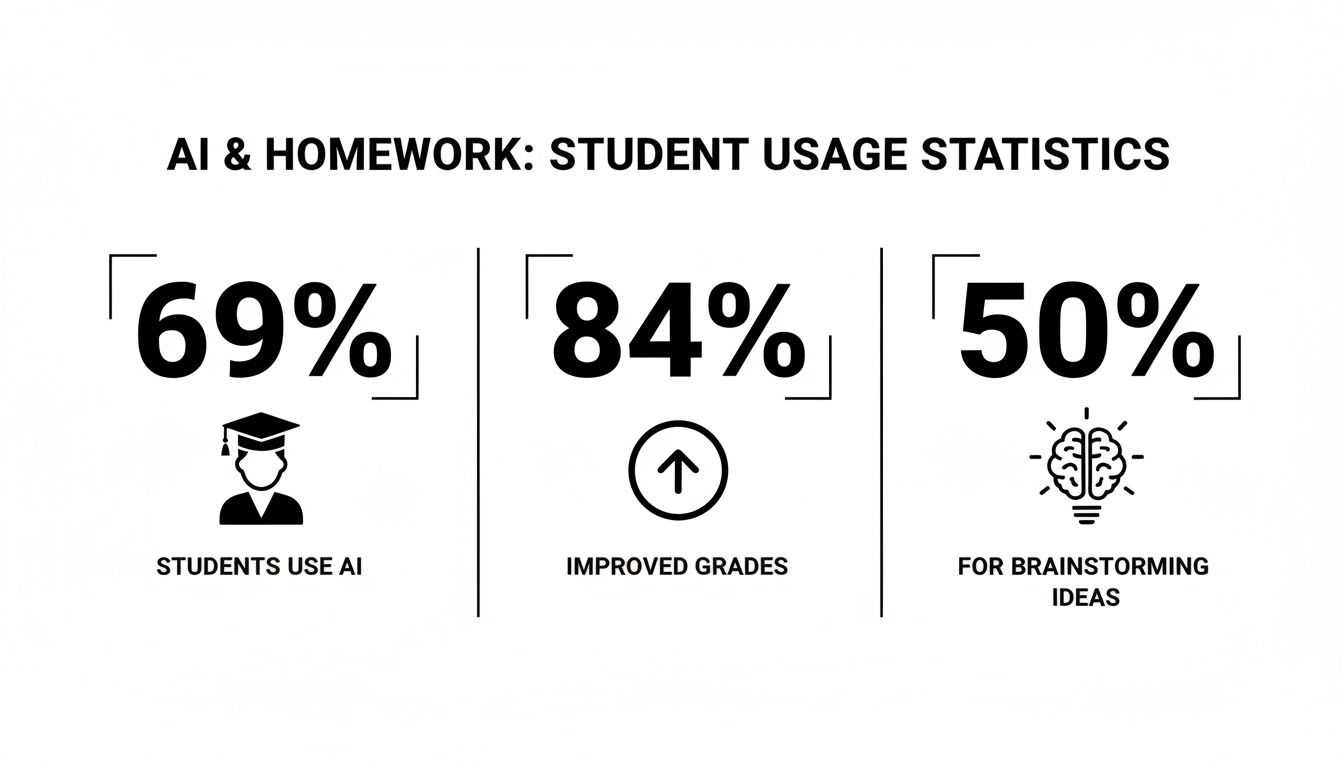
It’s obvious that AI is no longer on the fringes; it's a core study tool for the vast majority of students, with half of them using it for essential tasks like brainstorming ideas.
The goal is no longer just about completing the assignment; it's about mastering the material. When used correctly, AI acts as a guide, illuminating the path to understanding rather than simply providing the destination.
With so many tools out there, finding the right one is key. The best AI homework helper won't just spit out answers; it will walk you through the logic with clear, supportive explanations. As we go on, I’ll show you exactly how to use these tools effectively and responsibly to make every study session count.
How AI Can Help You Master Any Subject
The real magic of using an AI to help with homework isn’t just about getting quick answers. It’s about finally having a tool that helps you build a genuine understanding of any subject. Think of it less like a calculator and more like a personal tutor who can jump from explaining calculus to brainstorming an essay on Shakespeare without missing a beat.
This flexibility is what makes it so powerful. AI doesn't offer a one-size-fits-all solution; it morphs to fit the unique demands of each class. For your science and math courses, it’s a logical guide. For the humanities, it becomes your creative sidekick.

Conquering STEM with Step-by-Step Logic
We've all been there. Staring at a math or physics problem where one wrong move throws the whole thing off. That’s exactly where AI shines. Instead of just spitting out the final answer, a good homework helper will patiently break down complex equations into a series of clear, logical steps. It’s like having someone light up the path from the question to the solution.
This is a lifesaver when you’re facing a problem that feels completely overwhelming. Let's say a student is stuck on a tough physics problem about projectile motion. Instead of just giving up, they can ask an AI to walk them through it.
The conversation might go something like this:
- The Prompt: "Can you help me solve this physics problem? A ball is thrown at a 30-degree angle with an initial velocity of 15 m/s. I need to find its maximum height."
- The AI's Breakdown: First, the AI will pull up the right kinematic equations. But it won't just use them—it'll explain why they're the right tools for the job before solving for each variable, one step at a time.
- The Deeper Dive: The student can then ask follow-up questions like, "Wait, why did you use the sine of the angle for the vertical velocity?" This back-and-forth deepens their grasp of the actual concepts.
This kind of interaction turns homework from a frustrating chore into an active learning session. You stop memorizing formulas and start understanding the logic behind them.
Crafting Compelling Arguments in Writing and Humanities
When it comes to subjects like English, history, or social studies, the AI’s role changes completely. It goes from being a logical problem-solver to a creative brainstorming partner. The blank page is often the biggest enemy for any writer, and an AI can help you conquer it by sparking ideas, structuring your arguments, and even helping you polish your sentences.
Stuck on an essay about the causes of the American Revolution? You could ask an AI to brainstorm five different thesis statements or create a detailed outline covering the key economic, political, and social factors. Suddenly, that daunting assignment becomes a manageable, structured project.
Beyond just outlining, AI is also incredible at summarizing dense reading materials. If you’re facing a 40-page historical document, you can ask the AI for a quick rundown of the key arguments, dates, and figures. This doesn’t replace the reading, but it gives you a roadmap to navigate the text much more efficiently.
The real advantage is efficiency. AI handles the preliminary organizational work, freeing up your mental energy to focus on critical thinking, analysis, and crafting a unique argument in your own voice.
Mastering Languages and New Vocabularies
Learning a new language is all about practice and immersion. AI tools can serve as tireless conversation partners, ready to help you with vocabulary, grammar, and pronunciation whenever you are. You can ask for quick translations, see a word used in different sentences, or even have a full-on text conversation to build your fluency.
For example, you could prompt the AI with: "Let's have a conversation in Spanish about planning a vacation. Please correct my grammar as we go." This creates a safe, no-pressure space to practice and make mistakes without feeling judged.
For a closer look at the technology and benefits, this comprehensive guide to AI language learning is a great resource. This approach helps you build practical, conversational skills that go way beyond just memorizing flashcards.
Getting Started with Feen AI for Homework
Diving into an AI homework helper shouldn't feel like another assignment. The whole point is to make your life easier. With Feen AI, we've focused on closing the gap between your questions and the clear answers you need, getting you there as fast as possible. The entire platform is built around a simple chat interface, so it feels more like texting a smart friend than using a stuffy piece of software.
This conversational style is really the secret sauce. You don't have to learn any weird commands or click through a bunch of confusing menus. Just type your question and the conversation flows from there. Whether you're stuck on a biology concept or just need a hint for the first step of a calculus problem, the AI gives you a response that’s actually easy to understand.
And you're not alone in turning to AI for help. These tools have become a go-to resource for students everywhere. A massive 53% of K-12 students around the world now use AI for homework help, which is the number one reason teens are using this tech. University students are in the same boat, with 51% using AI to get a better handle on their workload. It's clear that AI is fundamentally changing how we study.
Your First Steps with the Chat Interface
The chat window is where the magic happens. Think of it as your personal command center for learning. The thing is, the quality of the answer you get back almost always depends on the quality of the question you ask. Specificity is your best friend here.
So, instead of a vague "help with history" prompt, try getting straight to the point. Something like, "Explain the main economic factors that led to the fall of the Roman Empire," gives the AI the clear direction it needs to pull together a focused and genuinely useful response. The more context you can give, the better the AI can help you out.
Here are a few tips to get your prompts on the right track:
- Be Specific: Always mention the subject, the topic, and exactly what you're stuck on. "Why is the Krebs cycle important in cellular respiration?" will get you much further than just "biology help."
- Ask for Different Formats: Don't be afraid to tell the AI how you want the information. Ask it to "explain this like I'm a beginner" or to "give me a simple analogy" for a tricky concept.
- Request Step-by-Step Solutions: This is a big one for any problem-solving subject. Always ask for the steps. This is how you learn the process instead of just seeing the final answer.
Going Beyond Text with Image and PDF Uploads
Let's be real—sometimes, typing out a long, messy equation or a complicated word problem is a huge pain. This is where Feen AI’s ability to understand images and PDFs becomes a game-changer. You can just snap a quick picture of your worksheet or textbook page and upload it right into the chat.
The AI uses a technology called optical character recognition (OCR) to read all the text and numbers in your image. From there, it can solve the problem directly from the photo and give you the same kind of step-by-step breakdown you'd get if you typed it all out. This feature is a lifesaver for:
- Messy handwritten notes you can't quite decipher.
- Textbook problems you really don't want to retype.
- Complex diagrams from a science lab.
This visual approach just removes all the friction and gets you an answer in seconds. In the same way, you can upload entire PDF documents. Have a dense, 20-page research article you need to get through? Upload it and ask for a summary of the key arguments. This feature, which you can learn more about in our guide to the PDF summarizer tool, is perfect for tackling heavy reading assignments and pulling out the most critical info.
The ability to switch between text, images, and documents in a single chat stream makes your study session seamless. You can follow a conversation about a PDF, ask a follow-up question, and then upload a related image without ever leaving the same window.
This all-in-one approach keeps your study materials and the AI's explanations organized in one spot, making it super easy to go back and review everything later. It’s all about making your study time count.
To give you a clearer picture, here’s a quick breakdown of how Feen AI’s features can help you conquer your homework.
Key Feen AI Features for Homework Success
| Feature | Description | Best Use Case for Homework |
|---|---|---|
| Conversational Chat | A simple, text-based interface for asking questions and getting instant answers. | Asking for definitions, clarifying concepts, or brainstorming essay ideas. |
| Image Uploads | Snap a photo of your homework and upload it for a step-by-step solution. | Solving math problems from a worksheet or deciphering handwritten notes. |
| PDF Uploads | Upload a document (like a research paper or textbook chapter) for summarization or analysis. | Quickly understanding long reading assignments or finding key quotes. |
| Step-by-Step Solutions | AI breaks down complex problems into manageable, easy-to-follow steps. | Learning the process behind math, physics, or chemistry problems. |
Each of these tools is designed to work together, giving you a flexible and powerful way to approach any assignment that comes your way.
Using AI Responsibly to Achieve Real Learning
Having an AI to help with homework is a massive advantage, but it comes with a responsibility to use it ethically. It's easy to blur the line between a powerful study partner and a tool that just does the work for you. Getting that distinction right is what separates genuine learning from taking a shortcut.
Think of it like using a calculator in math class. It’s a fantastic tool for checking your work and speeding up complex calculations. But if you lean on it to solve every single problem without ever learning the formulas behind it, you aren't really learning math. AI helpers work the exact same way.

Simply copying an answer from an AI might get an assignment turned in, but it cheats you out of an education. The real learning happens during the "productive struggle"—that moment you wrestle with a tough concept until it finally clicks. If you skip that process, you miss your chance to build the critical thinking and problem-solving skills you'll need for the rest of your life.
The Fine Line Between Helper and Cheater
The secret to using AI responsibly is to always focus on one thing: genuine understanding. The goal isn't just to hand in a correct assignment; it's to master the material so you can actually use it later. Recent data shows a fascinating, and slightly cautionary, trend.
In early 2025, about 25% of American teenagers were already using ChatGPT specifically for homework. While 72% of these students said they finished assignments 40% faster, less than a quarter felt it actually helped them understand the material better. In fact, some classroom studies found that while completion times dropped, comprehension scores could dip by 10-15%.
The most effective way to use AI is as a guide, not a ghostwriter. Let it illuminate the path to the answer, but make sure you’re the one walking it.
Here’s a practical way to keep your AI use both ethical and effective:
- Understand concepts: If you’re stuck on a topic, ask the AI to explain it differently, give you an analogy, or create a simple example.
- Check your work: Once you’ve solved a problem or written a paragraph, ask the AI to review it for mistakes and suggest improvements.
- Brainstorm ideas: Staring at a blank page? Ask for topic ideas, a possible outline, or different angles to approach an essay prompt.
- Break through a block: If you're stuck on one specific step in a math problem, ask for a small hint to get you moving again, not the whole solution.
This approach keeps you in the driver's seat of your own education.
Protecting Your Privacy and Staying Safe
While academic integrity is key, don't forget about digital safety. AI platforms, like any online service, collect data. To keep yourself safe, you have to be mindful of what you share.
Never, ever type sensitive personal information into an AI chat. This includes your full name, address, phone number, school name, or any passwords. Treat your conversations with an AI as if they're public, and don't share anything you wouldn't want the world to see.
Ultimately, using AI responsibly is all about building good habits. This guide on AI for Learning for Kids: Agency-First Quests to Build Real Skills offers more great insights into how AI can build skills and independence. By setting clear boundaries, you can make sure these tools support your education without undermining it. When you're studying for an exam, you'll be glad you put in the work to truly understand the material. Our guide on https://feen.ai/blog/how-to-study-efficiently-for-exams can give you even more strategies to help you succeed.
Unlocking Advanced AI Strategies for Better Grades
Once you're comfortable using an AI for straightforward questions, you can start digging into more advanced tactics to really deepen your understanding. This is where you make the leap from just getting answers to actively shaping the AI into the exact study partner you need. The secret? It all comes down to learning how to ask smarter questions.
This skill is sometimes called prompt engineering, but don't let the fancy term fool you. It's really just the art of being specific. Instead of tossing out a generic question, you give the AI detailed instructions, a bit of context, and a clear goal. The more precise your request, the more insightful and genuinely helpful the response will be.
The Power of a Well-Crafted Prompt
Think of an AI as a brilliant but very literal assistant. A vague command like "solve this problem" gets you the answer, sure, but it doesn't teach you much. You miss out on that critical "aha!" moment where you connect the dots yourself. The goal is to frame your questions in a way that forces the AI to teach, not just to answer.
A small tweak in how you phrase things can make a world of difference.
Instead of: "What is the Pythagorean theorem?"
Try: "Explain the Pythagorean theorem using a simple analogy, like a ladder leaning against a wall."
Instead of: "Solve this chemistry equation."
Try: "Walk me through the steps to balance this chemistry equation, and explain what the coefficients are doing at each stage."
See the difference? That subtle shift turns the AI from a simple answer machine into a powerful teaching tool. It puts you back in the driver's seat of your own learning, making sure you actually grasp the concepts behind the answer.
Creating Your Own Personalized Study Tools
Beyond just asking better questions, you can actually use AI to create custom study materials from your own notes and readings. This is hands-down one of the most effective ways to prep for exams and make sure the information sticks.
Imagine you've just wrapped up a long week of classes. You can upload a PDF of your lecture notes or a chapter from your e-textbook and ask the AI to whip up a personalized study guide.
This strategy flips passive note-taking into an active review session. When you have the AI reformat and quiz you on your own material, you engage with it on a much deeper level, which is a huge boost for memory retention.
Here are a few advanced strategies you can try right now:
- Generate Practice Quizzes: Upload your notes from a specific unit and prompt the AI with something like: "Create a 10-question multiple-choice quiz from these notes to test my understanding of the key concepts."
- Become a Conversation Partner: This is a game-changer for language classes. You could set up a practice session by saying: "Let's have a conversation in French about my weekend plans. Please act as a native speaker and correct any grammatical mistakes I make."
- Simulate a Debate: Need to prep for a history or English class discussion? Ask the AI to take on a specific role. Try a prompt like: "Act as a historian arguing against the main points in my essay about the Cold War and challenge my thesis."
These techniques get you far away from rote memorization. They push you toward critical thinking, active recall, and a much more dynamic way of engaging with your coursework, turning your AI homework helper into a true partner in your academic success.
Your New Partner in Academic Achievement

As we've seen, using an AI to help with homework is far more than a passing fad. When you use these tools the right way, they can completely reshape how you approach your studies. They turn those moments of frustration into genuine understanding and transform late-night cram sessions into focused, productive work.
You've learned how AI can walk you through tricky math problems, act as a sounding board for essays, and offer personalized help exactly when you get stuck. This isn't about finding shortcuts. It's about building a smarter, more effective way to learn that fits you perfectly. The real magic happens when you stop seeing it as an answer key and start treating it like a study partner.
Paving Your Path to Smarter Studying
The most important thing to remember is that you are still in the driver's seat of your education. By using AI ethically and strategically, you're ensuring it boosts your learning instead of doing the learning for you.
Think of this technology as a partner on your academic journey—one that helps you learn more deeply, not just get work done faster. The goal is to build your own knowledge and skills that will stick with you for a lifetime.
To make it work, stick to these core ideas:
- Focus on the "Why": Don't just grab the answer. Always ask for step-by-step explanations so you truly grasp the process behind it.
- You're in Charge: Use AI to check your work, brainstorm ideas, and get past roadblocks. But always make sure the final submission is a reflection of your own effort and understanding.
- Ask Smarter Questions: The better your prompts, the better the AI's help will be. Be specific and give it plenty of context for the best results.
In the end, your academic success is up to you. With a tool like Feen AI, you simply have a powerful assistant on your side, ready to help you tackle your goals with more confidence than ever before.
Frequently Asked Questions About AI Homework Helpers
Jumping into using AI for homework can feel a bit new, and it's totally normal to have questions. It’s a different way to study, so it’s smart to get a handle on how it works, what the ground rules are, and how to use it without getting into trouble.
Let's walk through some of the biggest questions students (and parents) have about these new tools.
Is It Cheating to Use AI for Homework?
This is the big one, and the honest answer is: it all comes down to how you use it. If you just copy an answer from an AI and paste it into your assignment, then yes, that's 100% cheating. Pretty much every school on the planet would consider that a violation of academic integrity.
But, when you use AI as a study partner? That’s a completely different story. Then it becomes a legitimate and powerful learning tool.
Think of it like this: asking an AI to explain a tough physics concept or check your algebra is no different than asking a tutor for help. The key is that you are still the one doing the real thinking and learning.
Here’s what responsible use looks like:
- Getting Explanations: Asking the AI to break down a topic you're stuck on in a way you can actually understand.
- Checking Your Work: After you've done the work, you can ask the AI to double-check your steps for mistakes.
- Beating Writer's Block: Using it to brainstorm a few ideas or an outline before you dive into writing an essay.
Can My Teacher Tell If I Used AI?
Teachers are getting pretty savvy at spotting work that doesn't feel authentic. Sure, there are AI-detection tools out there, but more importantly, your teacher knows you. They know how you write and how you think. A sudden, massive change in your writing style, vocabulary, or sentence structure is a dead giveaway.
The easiest way to avoid any drama is to make sure the final work is truly yours. Use the AI to get your head around a concept, but always write the final draft in your own words. Your own voice is your best defense.
Will Using AI Make Me Lazy or Hurt My Learning?
That’s a fair concern. If you just ask for answers without thinking, you can definitely become too reliant on it. Real learning often comes from the "productive struggle"—that moment when you wrestle with a tough problem. Just getting the answer in two seconds from an AI skips that whole process.
The trick is to use it actively, not passively. Instead of asking for the final solution to a problem, ask for a hint on the first step. That keeps you in the driver's seat and ensures you’re still building those critical problem-solving skills.
Is It Safe to Use AI for Homework?
Safety first, always. Most well-known AI tools are secure, but you should never, ever share sensitive personal information with them. That's a golden rule for anything you do online.
Here’s what you should never share:
- Your full name, address, or phone number.
- The name of your school or your teacher.
- Any passwords or login details for other accounts.
Basically, treat your chat with an AI like you're posting on a public message board. Stick to the homework questions and keep your personal life private. That way, you can get the help you need without putting your privacy at risk.
Ready to see how an AI study partner can change the game? Get instant, step-by-step help with Feen AI and start building a deeper understanding of any subject today. Explore Feen AI at https://feen.ai.
Relevant articles

Discover how AI powered study tools are changing education. Learn how to choose the right AI helper, use it ethically, and study smarter for any subject.

Find the best AI study tool for your needs. We review 12 top AI helpers for homework, test prep, and writing to help you study smarter in 2025.