Your Guide to AI Powered Study Tools
Discover how AI powered study tools are changing education. Learn how to choose the right AI helper, use it ethically, and study smarter for any subject.

Picture this: it’s late, you're stuck on a brutal calculus problem, and your professor is asleep. What if you had an expert on call, ready to walk you through it? That's exactly what AI powered study tools offer. They're like having a personal academic assistant in your pocket, making learning way more effective and a lot less frustrating.
What Are AI Powered Study Tools Anyway?
At their heart, AI powered study tools are smart apps designed to help you crush your coursework. Forget simple spell-checkers or calculators. These tools are more like a brilliant teaching assistant who actually gets what you're asking. They don’t just spit out answers; they give you step-by-step explanations, untangle confusing ideas, and can even adapt to your personal learning style.

This isn't some futuristic concept, either. It’s happening right now. The market for AI in education is exploding, expected to jump from about $7.5 billion in 2024 to over $10.5 billion in 2025. That kind of growth shows that students and schools are seriously buying in.
How These Smart Tools Actually Work
So, what's going on under the hood? When you type a question or upload a file, these tools use complex algorithms to figure out what you need. Think of it like a GPS calculating the fastest route—it sifts through a ton of data to give you the best path to your destination. In this case, that destination is understanding.
A tool like Feen AI, for example, puts its AI to work in a few key ways:
- Problem Solving: Snap a photo of a math problem from your homework, and it breaks down the entire solution into easy-to-follow steps.
- Text Analysis: Feed it a dense, 30-page research paper, and it will pull out the main arguments and give you a clean summary.
- Idea Generation: If you're stuck on an essay, it can help you brainstorm an outline, suggest key points, and get your thoughts organized.
The real magic here isn't just getting the right answer. It's about showing you the process of how to get there. This is what builds real understanding and the confidence to tackle similar problems on your own later.
To really see the difference, let’s quickly compare the old way of doing things with the new.
Traditional Study Methods vs AI Powered Study Tools
| Aspect | Traditional Studying | AI-Powered Studying |
|---|---|---|
| Availability | Limited to library hours, tutor schedules, or when friends are free. | 24/7, instant access whenever you need it. |
| Pace | One-size-fits-all, based on textbook chapters or class lectures. | Personalized and adaptive; you control the pace. |
| Feedback | Delayed. You wait for grades or office hours to get feedback. | Instantaneous feedback and step-by-step corrections. |
| Resources | Static textbooks, notes, and limited online search results. | Dynamic, interactive explanations, summaries, and idea generation. |
| Cost | Private tutors can be expensive, often $25-$80 per hour. | Often more affordable with subscription models or free tiers. |
This side-by-side makes it clear: AI tools are a massive upgrade from the old-school methods. You get personalized help right when you need it, directly on your phone or laptop. If you want to dive deeper into this shift, it's worth reading about how AI is revolutionizing education and changing how we all learn.
The Core Features That Unlock Your Potential
So, we've talked about the big picture of a "smart study helper," but what does that actually mean in practice? What are the specific functions that make AI-powered study tools so incredibly useful? Think of them less as a single tool and more like a Swiss Army knife for your academics, with each attachment built to solve a different kind of problem you face every day.
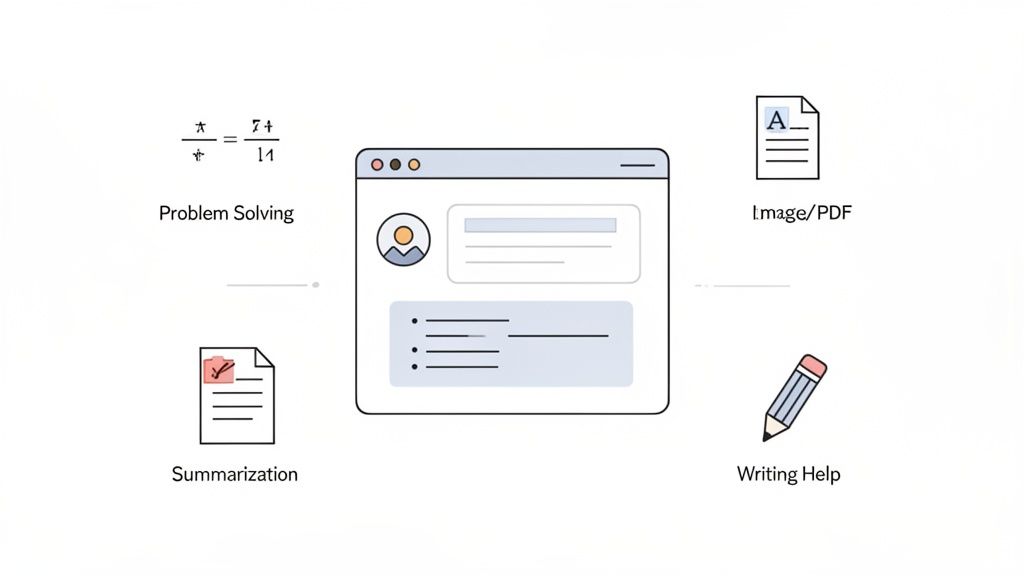
Let's get into the nitty-gritty and look at the key features you'll find in a solid tool like Feen AI. We'll explore how they work in real-world scenarios, because each one can genuinely change how you learn, making you more efficient and way more confident.
Instant Problem Solving and Walkthroughs
This is the big one, especially if you're in any STEM classes. We’ve all been there: it’s late, you're staring at a physics problem about projectile motion, and your brain has just shut down. Instead of giving up or waiting for your professor’s office hours, you can just snap a picture of the problem.
But here’s the crucial part: a good AI tool doesn't just spit out the answer. It gives you a detailed, step-by-step walkthrough of the entire process. That moment of frustration instantly becomes a learning opportunity. You see how to get to the solution, which means you're equipped to solve the next one all on your own.
Document and Image Analysis
Let's be real, modern assignments are rarely just plain text. You're juggling PDFs of lab reports, screenshots of complex diagrams, and blurry photos of your professor's whiteboard notes. The best AI-powered study tools can see and make sense of all this visual information.
A platform like Feen AI lets you upload these files directly. The tool then analyzes the content—whether it's scribbled handwriting, a data chart, or a printed worksheet—and lets you ask questions about it. No more retyping everything from a picture. You get instant help on your exact assignment materials, right when you need it.
Key Takeaway: The ability to analyze images and documents is a huge time-saver. It closes the gap between the material you have in front of you and the understanding you need to build.
Powerful Content Summarization
Students in high school and college are constantly buried under a mountain of reading. A 40-page academic journal article or a dense textbook chapter can easily eat up your entire evening. This is where AI summarization feels like a superpower.
You can upload a massive document, and the tool will distill it down to its core arguments, key findings, and essential takeaways. Now, this doesn't replace careful reading, but it gives you an incredible head start. For example, if you're writing a literature review, you can quickly grasp the main points of a dozen sources to see how they all connect. Learning how to use a good PDF summarizer can completely change how you tackle your reading lists.
Intelligent Writing Assistance
From figuring out the structure of a five-paragraph essay to polishing your thesis statement, writing is tough. AI assistants can help at every stage—without actually doing the work for you. Think of it as a brainstorming partner and a supercharged grammar checker all in one.
- Brainstorming and Outlining: If a prompt has you stumped, the AI can help you generate ideas and organize them into a logical flow.
- Grammar and Style: It goes way beyond a basic spell-check, suggesting ways to make your sentences clearer, more concise, and more persuasive.
- Argument Refinement: You can even ask the tool to play devil's advocate, helping you spot the weak points in your arguments so you can strengthen your paper before you turn it in.
These features—problem-solving, document analysis, summarization, and writing support—are the bedrock of today's best AI-powered study tools. They aren’t designed to give you shortcuts, but to build your understanding and make the whole learning process feel a lot less overwhelming.
How Students Actually Use AI to Study Smarter
Theory is one thing, but seeing how AI-powered study tools work in the real world is where it all clicks. It’s not about finding some magic button that does the work for you. Instead, it’s about building smarter, more efficient workflows that fit the subject you're studying.
Let’s walk through a few day-in-the-life scenarios to see how students are already weaving these tools into their study routines.
This isn't just a niche trend, either. A recent UK survey shows a huge jump in students using AI for their coursework, growing from 53% in 2024 to a predicted 88% in 2025. The data also tells us what they're using it for: specific tasks like getting a head start on research (44%) and summarizing dense material (38%). It's a clear move toward using AI strategically. You can dig deeper into these numbers and discover additional AI in education statistics.
Cracking a High School Biology Exam
Meet Sarah, a high school junior drowning in notes for her upcoming biology exam. Her notebook is a chaotic mess of cellular respiration diagrams and definitions she scribbled down in a hurry. She’s staring at a drawing of the Krebs cycle, and all the arrows connecting ATP, NADH, and FADH2 look like a subway map designed to confuse people.
Instead of rereading the textbook for the tenth time, she pulls out her phone. She snaps a picture of that messy notebook page and uploads it to Feen AI.
Within seconds, she’s having a conversation that gets her unstuck:
- Clarifying the Diagram: She asks, "Can you explain this diagram of the Krebs cycle? I'm confused about what NADH does."
- Getting a Clear Explanation: The AI gives her a simple, step-by-step breakdown, describing NADH as an "energy shuttle" that carries electrons to the next stage. Much clearer.
- Asking Follow-up Questions: Now that she gets it, she asks, "What’s the difference between NADH and FADH2?" and gets a quick, concise answer comparing their roles and how much energy they produce.
By using a tool that can literally read her own handwriting, Sarah turns a moment of frustration into active learning. She isn't just memorizing facts; she's actually understanding them by targeting exactly what was tripping her up.
This workflow—from a confusing, handwritten note to a clear, actionable explanation—is a perfect example of how AI serves as a personalized tutor, available at the precise moment a student gets stuck.
Navigating a College Statistics Assignment
Next up is Leo, a college sophomore hitting a wall with his stats homework. He's wrestling with a problem on probability distributions, and the formulas for binomial versus Poisson are starting to look identical. He's read the chapter twice but still can't figure out which formula to apply to a tricky word problem.
Leo opens up Feen AI's chat and just types out his question. He doesn't need to upload anything—he just needs a guide to help him think through the problem.
His process looks something like this:
- Presenting the Problem: He types, "I have a problem about the number of defects in a batch of 100 products. Should I use a binomial or Poisson distribution?"
- Receiving Guided Questions: Instead of just spitting out the answer, the AI prompts him: "What are the key conditions for a binomial distribution? Does your problem meet them?"
- Building Understanding: This little nudge forces Leo to recall the criteria—a fixed number of trials, constant probability of success. He realizes the problem fits. The AI then confirms his logic and helps him set up the formula correctly.
This simple chat becomes a Socratic dialogue. Leo isn't just handed a solution; he's guided to find it himself, which locks in the concepts for his upcoming exam.
Developing a Thesis for a Philosophy Paper
Finally, let’s look at Maria, a university student writing a paper on existentialism. She has to analyze a dense essay by Jean-Paul Sartre, and the language is making her head spin. Her immediate goal is to come up with a strong, original thesis statement.
She uploads the PDF of Sartre's essay to Feen AI to create a more effective research workflow.
- Summarization: First, she asks for a high-level summary. The AI distills Sartre’s 30 pages of dense philosophy into five key bullet points.
- Targeted Inquiry: With the main arguments laid out, she can ask super-specific questions, like, "What does Sartre mean by 'existence precedes essence' in paragraph 4?"
- Thesis Brainstorming: Now she’s ready. She prompts, "Based on this text, help me brainstorm three potential thesis statements about Sartre's view on freedom."
This multi-step approach turns an intimidating assignment into a manageable one. Maria saves hours of just trying to get through the text and jumps straight to the critical analysis, using the AI as a research assistant to sharpen her own thinking. Understanding these kinds of processes is valuable beyond the classroom, as many workflow automation tools use similar principles to boost productivity.
Choosing Your AI Study Companion
With new AI-powered study tools popping up constantly, picking the right one can feel like another complicated assignment. How do you sort through the noise and find a platform that will actually help you learn? The secret is to look past the flashy marketing and focus on a few key things that really matter for your studies.
Think of it like picking a partner for a big group project. You need someone reliable who knows their stuff and is easy to work with. The same goes for an AI study tool. The right one should feel like a natural extension of your brain, making you faster and more confident without ever getting in the way.
Let’s walk through the essential checklist for making a smart choice.
Evaluate Subject Coverage and Expertise
First things first: does the tool even understand your classes? Some platforms are amazing for STEM fields like calculus or physics but are completely lost when it comes to analyzing a Shakespearean sonnet or writing a history essay.
You'll get the most bang for your buck from a versatile tool that can handle a wide range of subjects. An AI like Feen AI is designed to work across the entire curriculum—from chemistry and biology to essays and tough math problems. Having one go-to platform for all your classes just makes life so much easier.
Pro Tip: Before you commit, give a potential tool a real test drive. Throw a problem from your toughest class at it. Seeing how it handles the specific details of your subject is the best way to know if it’s the real deal.
Prioritize Accuracy and Reliability
This one is non-negotiable. Can you actually trust the answers you’re getting? An AI that gives you wrong information is worse than no help at all; it can send you down a rabbit hole of confusion and tank your grade.
The best AI-powered study tools don't just spit out an answer—they show you how to get there. Use the AI’s step-by-step explanations to double-check your own work or make sense of a confusing concept. Always treat it like a co-pilot. If an explanation feels off, trust your gut and check it against your textbook or class notes. This keeps you in the driver's seat of your own learning.
This decision tree gives you a good idea of how to match a tool's features to what you need to get done.
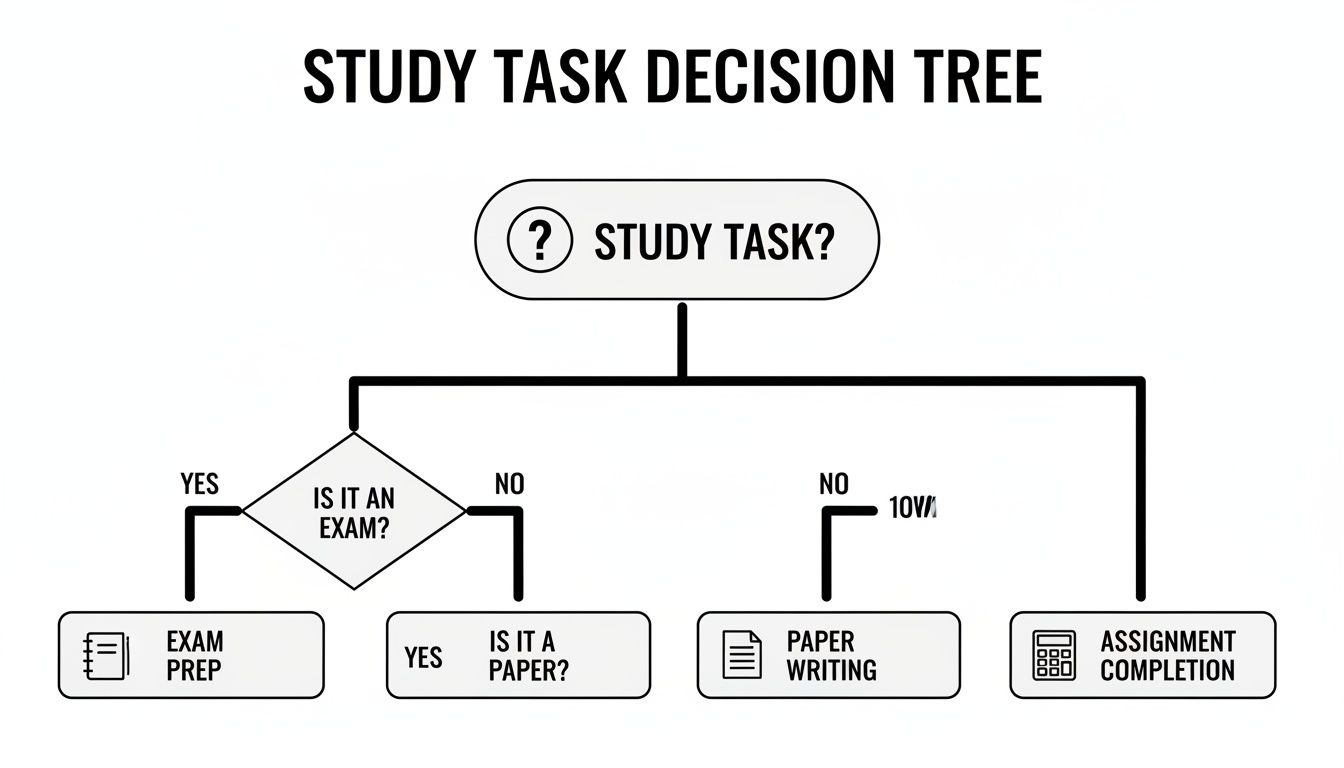
As you can see, it helps you think through whether you’re prepping for an exam, writing a paper, or just trying to finish an assignment, then points you toward the most helpful features for that task.
Assess the User Experience
Even the most powerful tool is worthless if it’s a nightmare to use. A clean, simple interface is crucial for a productive study session. You shouldn't have to wrestle with clunky menus just to get a straightforward question answered.
Here are a few things to look for that signal a good user experience:
- Easy File Uploads: How simple is it to upload a PDF of your assignment or a photo of your handwritten notes? Great platforms like Feen AI let you just drag-and-drop files or snap a pic with your phone. No friction.
- Intuitive Chat Interface: Does asking for help feel natural, almost like texting a knowledgeable friend? A conversational style makes the whole process feel less like a chore and more like a collaboration.
- Clear, Organized Explanations: Are the answers easy to read and understand? Look for tools that use formatting like bullet points or numbered steps to break down complex information.
Verify Data Privacy and Security
It’s a question we all need to ask more often: what’s happening to the data I upload? Before signing up for any study tool, take a minute to check out its privacy policy. A trustworthy company will be upfront about how it handles your information.
You want a platform that respects your privacy and keeps your academic work secure. If the privacy policy is vague or impossible to find, that's a major red flag. Your notes and assignments are personal, so make sure you’re using a service that treats them that way.
Consider Pricing and Overall Value
Last but not least, does it fit a student's budget? Most AI-powered study tools use a subscription model. Look for options that offer a free trial or a decent free version so you can try it out before you pull out your wallet.
Remember, the goal is to find the best value, not just the cheapest option. A tool that costs a few extra bucks but covers all your subjects and saves you hours of stress every week is a far better investment than a cheaper, less capable one. If you want a deeper dive into how different tools stack up, check out our guide on finding the best AI study tool for your personal needs.
Using AI Tools with Academic Integrity
The rise of powerful AI powered study tools has kicked off a major conversation for students and teachers everywhere: How do we use this technology ethically? It can feel like there's a fine line between a helpful study aid and a cheating shortcut, but the guiding principle is actually pretty straightforward.
The whole point is to use AI to genuinely understand your course material, not to get the AI to do the work for you.
Think of an AI tool like a super-smart tutor or even a calculator for complex ideas. You wouldn't ask your tutor to write your essay for you, and you wouldn't just scribble down the answer from a calculator without showing your work. The exact same logic applies here. These tools are meant to be partners in your education, helping you build real knowledge, not just find the fastest way to an answer.
The Right Way to Use AI for Studying
Academic integrity is all about honest learning. When you use AI tools responsibly, you’re still the one in the driver's seat doing the critical thinking, problem-solving, and writing. The AI is simply there to give you a nudge when you get stuck.
Here are a few clear, ethical ways to bring AI into your study routine:
- Checking Your Work: After you've wrestled with a tough math problem, use an AI tool to check your answer and walk through the steps. This is a great way to catch your own mistakes and really solidify the correct method.
- Explaining Confusing Steps: If a concept in your textbook just isn't clicking, ask the AI to explain it in a different way. It can break down dense theories into simple, easy-to-grasp pieces.
- Brainstorming and Outlining: Staring at a blank page for an essay? Use AI to explore different angles, brainstorm arguments, or structure a solid outline. It gets your creative juices flowing without actually writing the paper for you.
- Summarizing Dense Material: You can upload a lengthy research article and ask for the key takeaways. This gives you a quick overview so you know what to focus on when you read the full text.
The bottom line is this: Responsible AI use should always leave you smarter and more capable than when you started. You’re using it to fill in knowledge gaps, not to skip the learning process.
The Wrong Way to Use AI
It's surprisingly easy to cross the line into academic dishonesty, and the consequences can be pretty serious. You absolutely need to know your school’s honor code and what they consider plagiarism or cheating. Our guide on using AI to help with homework dives deeper into strategies for staying on the right side of the rules.
Here’s what you should never do:
- Never copy and paste answers directly. Submitting text generated by an AI as your own work is plagiarism. Full stop.
- Do not let the AI complete an entire assignment for you. Your professor needs to grade your understanding and skills, not the tool’s.
- Don’t treat it as a single source of truth. Always double-check important facts and figures against your course materials or other reliable academic sources.
Ultimately, AI powered study tools like Feen AI are built to empower you. They can shed light on confusing topics, boost your confidence, and make your study sessions far more effective. When you use them with integrity, they become incredible assets on your academic journey, helping you achieve true understanding and success.
Why Feen AI Is a Smarter Way to Study
Let's face it, being a student today is a balancing act. You're juggling packed schedules and tough assignments across a dozen different subjects. The last thing you need is a study tool that only does one thing. You need a partner in your corner, something that can keep up with your workload. That’s exactly what Feen AI was built for—to bridge that all-too-familiar gap between having a question and actually getting it.

Feen AI isn't just another chatbot. It’s a complete study companion designed to handle the real-world chaos of your academic life.
Unmatched Versatility Across Subjects
Your classes aren't all the same, so why would your study tool be? Feen AI was designed from the ground up to provide expert-level help, no matter what you're working on.
It's equally at home helping you with:
- Complex Math and Physics equations that need clear, step-by-step solutions.
- Detailed Chemistry and Biology concepts you need to pull from lab reports and diagrams.
- Humanities essays that require a solid brainstorming session and a strong outline.
Having this all-in-one approach means you’ve got a single, go-to resource for every class. No more bouncing between different apps—just one streamlined workflow.
Seamlessly Integrated Visual Learning
So much of learning is visual, right? Your assignments are probably PDFs, your notes are photos of a whiteboard, and your textbook is loaded with diagrams. This is where Feen AI’s ability to understand images and documents completely changes the game.
You can just upload a photo of that tricky homework problem or a multi-page PDF of a research paper. The platform instantly reads the content, letting you ask questions about it directly. It turns static documents into interactive study sessions, removing the frustrating barrier between seeing a problem and getting help to solve it.
Feen AI shifts studying from a desperate hunt for answers into a simple, direct conversation. It feels less like using a tool and more like chatting with a knowledgeable friend who's always around to help.
The amazing thing is that this kind of powerful help is now widely accessible. Thanks to rapid technological progress, the cost of running AI systems has plummeted. Between late 2022 and late 2024, the cost for some AI systems dropped by more than 280x. This trend is a big reason why specialized educational AI has become so affordable for students. You can read the full report about AI development trends from Stanford University to learn more.
Answering Your Questions About AI Study Tools
As AI-powered study tools start popping up more and more, it's totally normal to have questions. Students, parents, and even teachers are all trying to figure out where this tech fits in. Let's walk through some of the biggest concerns so you can feel confident using these tools the right way.
Are AI Study Tools Considered Cheating?
This is the big one, and the short answer is: it all comes down to how you use them.
If you’re just copying and pasting an essay an AI wrote for you, then yes, that’s cheating. But if you're using it to brainstorm ideas, check your grammar, or get a hand building an outline, you're just studying smarter. The real goal is to use AI to help you understand the material better, not to skip the work of actually learning it.
Think of it like a calculator. It’s a standard tool for a complicated physics problem, but you wouldn't use one during a basic multiplication test. It’s all about context. Using AI responsibly means focusing on learning the how and why—and that’s what academic integrity is all about.
How Accurate Are the Answers?
AI has come a long way, but it's not foolproof. It's always a good idea to approach the answers with a healthy bit of skepticism. Think of an AI study helper as a really knowledgeable tutor—it can steer you in the right direction and break down tough concepts, but it's not the ultimate source of truth.
Best Practice: Always double-check critical information, especially for big papers or exams. Let the AI guide your thinking, but confirm the final facts against your textbook, class notes, or other trusted sources. This simple habit ensures you’re always in the driver's seat.
Do These Tools Work for Every Subject?
A lot of people think AI is just for math and science, but today's tools are surprisingly flexible. The best AI-powered study tools are just as useful for a history or English class as they are for calculus.
For example, you can use them to:
- Get a quick summary of a dense chapter from your history textbook.
- Analyze the key themes in a novel for your English paper.
- Brainstorm a few solid arguments for an upcoming debate in social studies.
Platforms like Feen AI are built to handle a huge range of subjects, so you can have one go-to resource for pretty much any class you're taking.
Is My Data Safe When I Upload Assignments?
Data privacy is a huge deal, and it's smart to be cautious. When you upload your homework, you're sharing sensitive academic information. That's why it's so important to pick a tool with a clear, easy-to-understand privacy policy. A trustworthy company will tell you exactly how they protect your data and keep your work completely confidential.
Ready to see how an ethical, accurate, and versatile AI tool can fit into your study routine? Feen AI provides instant, step-by-step help across all your subjects while keeping your data secure. Start studying smarter today.
Relevant articles

Tired of the homework battles? Learn how to motivate kids to study with practical strategies that build focus, resilience, and a genuine love for learning.
Discover how to use AI for studying with proven strategies that actually work. Learn to leverage AI study tools to ace exams and understand complex topics.

Discover how using AI to help with homework can transform your study habits. Learn ethical strategies, practical tips, and how to use AI for real learning.
Discover key math problems for 5th graders covering fractions, geometry & more. Includes step-by-step solutions & teaching tips to boost skills.
Find the best AI study tool for your needs. We review 12 top AI helpers for homework, test prep, and writing to help you study smarter in 2025.
Discover our comprehensive roundup of math problems for 2nd graders, with free practice sets for addition, word problems, money, and more to boost skills.