How to Analyze the Text Like a Pro Without Getting Overwhelmed
Struggling to analyze the text for your next essay? This guide breaks down pre-reading, close reading, and thesis building into actionable strategies.
To really dig in and analyze a text properly, you have to start before you even read the first word. The most powerful insights come from understanding the world the text was born into, not just the words on the page.
Build Your Foundation Before You Start Reading
Jumping straight into a close read without any prep work is like trying to solve a puzzle with half the pieces missing. Sure, you'll see what's on the surface, but the deeper meaning will stay just out of reach. Taking just 15-20 minutes to gather some background info can completely change how you see everything.
This initial research is your backstage pass to the text. It reveals the forces that shaped the author's message, from the social norms of their day to their own personal history. Before you can truly analyze a text, you first need to develop strong reading comprehension skills—this is the absolute bedrock of any good analysis.
Gather Essential Context
Your first mission is to get a feel for the environment that produced the text. This isn't about writing a full biography of the author; it's about uncovering the key influences that were at play.
Use this simple checklist to gather that essential context before you dive in. It's a quick but powerful way to frame your entire analysis.
Pre-Reading Checklist for Smarter Text Analysis
| Checklist Item | Why It Matters | Where to Find Information |
|---|---|---|
| The Author | What were their core beliefs, experiences, or major life events? This often directly influences their work. | Author biographies, reputable encyclopedias (like Britannica), academic journals, or university websites. |
| The Time Period | What was happening in the world? Major political, social, or technological shifts create a specific cultural atmosphere. | Historical timelines, documentaries, and online archives can provide a snapshot of the era. |
| The Intended Audience | Was it written for experts, the general public, a specific political group, or a private circle? This shapes the tone and style. | Look at the publication source (e.g., a scientific journal vs. a popular magazine) or the text's introduction. |
This preliminary work helps you read with an informed lens. Suddenly, you'll start catching nuances you would have otherwise missed. For instance, knowing a poem was written during a war immediately adds layers of potential meaning to images of loss, hope, or even everyday life.
Map the Territory with Purposeful Skimming
Once you have some context, the next move is to create a quick mental map of the text itself. This isn't a full, deep read. It's a strategic skim designed to get the lay of the land.
Purposeful skimming is about understanding the architecture of a text before you start examining the individual bricks. It helps you see the forest for the trees, preventing you from getting lost in minor details during your close read.
As you skim, look for structural clues—things like chapter titles, subheadings, introductions, and conclusions. Pay attention to any recurring words, phrases, or ideas that seem to jump out at you. This process helps you form a few initial hunches about the text's main arguments and themes, which gives your detailed analysis a much clearer direction.
The ability to analyze text is becoming a critical skill, and not just for humans. It’s the engine behind modern EdTech, powering tools that can dissect assignments and summarize chapters. The global EdTech market is on track to hit USD 353.52 billion by 2034, largely driven by AI that helps personalize learning for over 1.5 billion students.
If you're looking to strengthen your own foundational skills, check out our guide on https://feen.ai/blog/how-to-improve-reading-comprehension-skills.
Mastering the Art of Active Close Reading
Alright, you've got the big-picture context. Now, it's time to zoom in and get your hands dirty. We're moving from the landscape view to the microscopic level of the words themselves. This is where the real work—and the real fun—of textual analysis begins. It’s a process called active close reading.
This isn't about just reading for the plot. It's about dissecting how the author constructs their message. Think of yourself as a detective, and the text is your crime scene. Every word, every comma, every stylistic choice is a clue. Your mission is to figure out how these tiny details work together to create a larger effect, whether that's building suspense, winning you over to an argument, or making you feel a certain way.
Passive readers see a story; active readers see the machinery that makes the story work. This means you need to read with a pen in hand, ready to argue with, question, and ultimately understand the text on a deeper level. You’re no longer just a consumer of the text; you're an investigator.
Annotating with Purpose: Your First Layer of Analysis
Effective annotation is really just a conversation you have with the page. Instead of just highlighting stuff that looks important, your notes should become a roadmap of your thoughts. You're building an evidence locker you can come back to when it's time to write.
The goal here is to tag specific elements and, most importantly, ask why they're there.
- Circle powerful words: Isolate verbs, adjectives, and nouns that just feel heavy with meaning. Ask yourself: Why this specific word? What would change if a synonym were used instead?
- Underline key phrases: Hunt for sentences that perfectly nail a theme, reveal a character's true colors, or state the author's argument in a nutshell.
- Note patterns and repetitions: Are you seeing the same images, symbols, or phrases pop up again and again? Repetition is never an accident. It's the author's way of screaming, "Pay attention to this!"
A well-annotated text isn't a chaotic mess of highlighter ink. It's a visual record of your thinking process. Every mark you make should start to answer that one crucial question: "How is the author achieving this effect?"
Deconstructing the Author's Toolkit
Once you've marked up the text, you can start sorting your observations. You’re essentially looking for the specific tools and techniques the author is using to shape your experience as a reader. This means looking at both the small-scale language choices and the larger architectural decisions.
Uncovering Literary and Rhetorical Devices
Literary and rhetorical devices are the specialized tools in an author's kit—things like metaphors, irony, and alliteration. But just spotting one isn't enough. The real analysis comes from explaining the effect of that device. Don't just say, "The author uses a metaphor." Instead, explain how that specific metaphor makes a complex idea easier to grasp or creates a particular mood.
Take the famous opening of F. Scott Fitzgerald's The Great Gatsby.
Even this iconic cover is a text worth analyzing, hinting at the novel's themes of voyeurism, superficial beauty, and the sadness lurking beneath the Jazz Age glamour.
Early on, the narrator, Nick Carraway, recalls his father's advice: "all the people in this world haven't had the advantages that you've had." This is more than just a bit of fatherly wisdom. It's a brilliant piece of characterization that immediately positions Nick as an outsider from a world of privilege, which fundamentally shapes how he tells the story.
At the same time, that single line introduces the central theme of social class that powers the entire novel. A close read reveals how one simple sentence can operate on multiple levels at once.
Crafting a Thesis Statement That Guides Your Analysis
So, you've done the deep dive. You've annotated the text, filled the margins with questions and ideas, and now you're sitting on a pile of really smart observations. What now? The next step is to connect all those brilliant dots into a single, cohesive argument.
This is where your thesis statement comes in. Think of it as the backbone of your entire analysis—the central argument that gives all your other ideas a clear direction and purpose.
A weak thesis just states a fact or summarizes the plot. For example, saying "The Great Gatsby is a novel about the American Dream" is true, but it’s not an argument. It's a dead end. There's nothing to prove.
A strong, analytical thesis, however, makes a specific, debatable claim about how or why the text achieves its effect. It's your unique interpretation, the one you'll spend the rest of your essay defending with evidence straight from the text.
From Observation to Argument
Your thesis is essentially the answer to a critical question you’ve posed about the text. To find it, look back at your notes from your close read. Hunt for recurring patterns, interesting tensions, or contradictions that surprised you. That's usually where the best arguments are hiding.
Let's go back to our Gatsby example. Instead of that flat, obvious statement, a much stronger thesis would be something like this: "F. Scott Fitzgerald’s The Great Gatsby critiques the American Dream by portraying it as an illusion built on inherited wealth and social class, ultimately revealing its inaccessibility to those outside the established elite."
See the difference? This version is so much better because it:
- Is arguable: Someone could reasonably disagree, perhaps arguing the novel actually celebrates the dream.
- Is specific: It gets into the how—the critique works through the specific lens of wealth and class.
- Provides a roadmap: This sentence tells your reader exactly what your essay is going to prove, step by step.
Your thesis isn't just a hurdle to clear in the introduction. It's the compass for your entire essay. Every single point you make in a body paragraph should directly connect back to and support this central claim. If it doesn't, you either need to rethink the point or refine your thesis.
Testing and Refining Your Thesis
Nobody gets their thesis perfect on the first try. Writing a great one is all about drafting and refining. Start with a working idea and then stress-test it. The best question you can ask is, "So what?" If your thesis doesn't lead to an interesting or significant answer, it probably needs more punch. A truly great thesis offers a fresh perspective that makes your reader think.
This process of refining arguments is at the heart of learning. It’s also a big reason the educational technology market is growing so quickly. The global EdTech market was valued at USD 163.54 billion in 2024 and is projected to hit USD 572.08 billion by 2034, according to Precedence Research. This growth is all about the demand for tools that can help students with complex tasks like, you guessed it, developing a strong thesis.
Once you have a solid thesis, you’ll find that the rest of the essay starts to fall into place much more easily. For a more detailed walkthrough, be sure to check out our complete guide on how to write a thesis statement that really makes an impact.
Weaving Textual Evidence Seamlessly into Your Argument
So you've got a killer thesis. Now what? It's time to prove it. This is where textual evidence comes into play—the specific words, phrases, and moments from the text that serve as the foundation for your argument.
A trap many students fall into is just "dropping" quotes into their paragraphs and expecting them to do all the work. They won't.
Truly great analysis comes from selecting the perfect evidence and weaving it so gracefully into your own writing that it feels completely natural. This is what elevates your interpretation from just an opinion to a compelling, persuasive argument. You want every quote to land like a knockout punch, proving your point with undeniable precision.
Choosing Evidence That Packs a Punch
Let's be clear: not all quotes are created equal. Don't just grab the first sentence that seems vaguely related to your point. You need to be a surgeon here, selecting evidence that is both potent and specific.
The best pieces of evidence are multi-taskers. A single phrase might reveal a character’s hidden motive, highlight a key stylistic choice, and reinforce a central theme all at once. My advice? Prioritize short, impactful snippets over long, clunky block quotes. Integrating a few carefully chosen words is almost always more effective than dropping in a four-sentence paragraph from the author.
Here’s what to hunt for:
- Revealing Language: Zero in on words with heavy connotations or phrases dripping with subtext.
- Pivotal Moments: Pull quotes from key scenes—the turning points where the plot shifts or a character has a major realization.
- Illustrative Examples: Find evidence that is a perfect demonstration of a literary device or rhetorical strategy you're discussing.
Integrating Quotes With The ICE Method
One of the most battle-tested frameworks I recommend for integrating evidence is the ICE method. It’s a simple, three-part structure that makes "quote dropping" impossible. The letters stand for Introduce, Cite, and Explain.
Using this method forces you to frame your evidence properly and—most importantly—connect it directly back to your main argument.
The "Explain" step is where the magic happens. This is your moment to show the reader why this specific quote is so important and how it proves the point you’re making. It’s the crucial step that separates bland summary from true textual analysis.
The table below breaks down the ICE method with a simple example. Let's say we're analyzing a text and want to argue that a character is an unreliable narrator.
Integrating Evidence Effectively with The ICE Method
| Component | What to Do | Example Snippet |
|---|---|---|
| Introduce | Give your reader some context. Who's speaking? What's happening in the scene? Set the stage. | Early in the narrative, the protagonist tries to downplay his role by claiming... |
| Cite | Insert the quote itself, blending it smoothly into your own sentence. Remember proper formatting! | ...he was merely "an innocent bystander caught in the crossfire." |
| Explain | This is your analysis. Unpack the quote's meaning and explicitly connect it to your thesis or paragraph's claim. | The use of the word "innocent" is a clear attempt to shape our perception, creating a jarring disconnect between his words and his earlier actions. |
Following this simple structure ensures your evidence is always working for you. If you need a refresher on formatting, our guide on how to cite sources in MLA is a great resource.
By making ICE a habit, you build a powerful rhythm in your writing where every piece of evidence is introduced, presented, and then analyzed, creating a rock-solid and convincing argument.
How to Structure Your Analysis for Real Impact
You've put in the time, wrestled with the text, and landed on a thesis you feel good about. That’s the hard part done, right? Now comes the crucial step: putting it all together in a way that actually persuades your reader. A killer analysis isn't just a list of smart observations; it's a carefully constructed argument that flows logically from one point to the next.
Think of your essay's structure as its skeleton. Without a solid frame, even the most brilliant ideas will just be a jumbled mess on the page. A clear, intentional structure ensures every paragraph pulls its weight and works toward proving your central claim. For some great insights on this, it's worth seeing how professional authors approach mastering structure in writing.
The Classic Blueprint for a Killer Essay
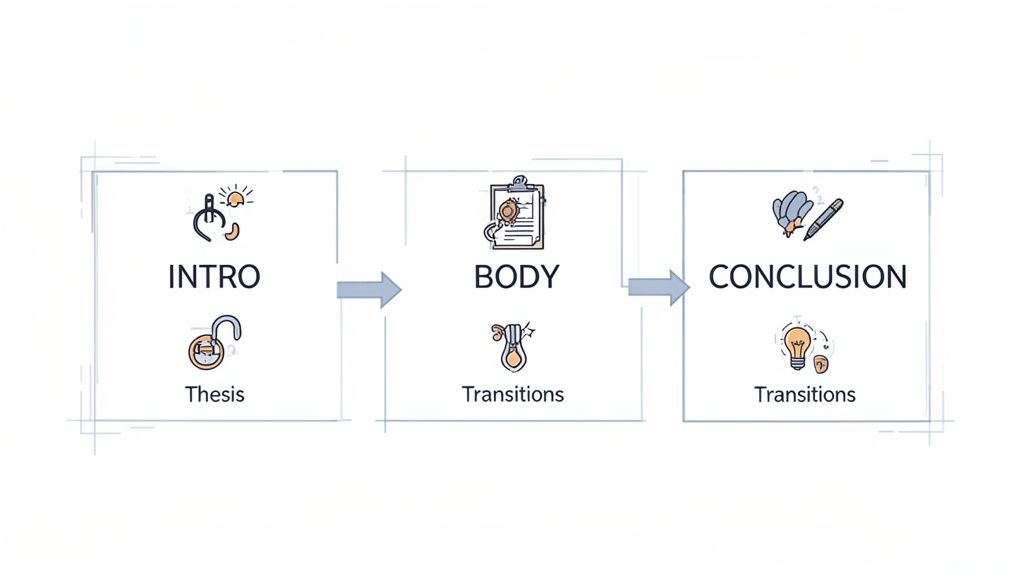
Most analytical essays stick to a tried-and-true blueprint: the introduction, the body, and the conclusion. Each piece has a specific job, and when you nail all three, your argument becomes incredibly powerful.
The Introduction: This is your first impression. Your goal here is to grab the reader's attention, give just enough context about the text you're analyzing, and then—critically—state your thesis. Your thesis is the roadmap for the entire essay; it tells the reader exactly where you're going and what you plan to prove.
The Body Paragraphs: Here’s where you do the heavy lifting. Each body paragraph should zoom in on a single, specific idea that supports your overall thesis. Think of them as mini-essays, each with its own claim (the topic sentence), evidence from the text, and your own analysis explaining how that evidence proves your point.
The Conclusion: Don't just repeat what you've already said. A strong conclusion brings all your points together to show how they collectively validate your thesis. The best conclusions leave the reader with something to think about, answering that nagging "So what?" question by touching on the text's broader meaning or implications.
Building Body Paragraphs That Flow
The real muscle of your essay is in the body paragraphs. Each one needs to be a tight, focused unit that makes a clear point in service of your main argument. Start with a sharp topic sentence, back it up with well-chosen evidence, and then dive into your analysis.
But just as important is how you connect these paragraphs. Smooth transitions are the secret ingredient. They guide your reader effortlessly from one idea to the next, making your entire argument feel cohesive and intentional.
A well-structured essay takes the reader on a journey. Your transitions are the signposts that make sure the path from your introduction to your conclusion is clear, logical, and easy to follow.
This kind of organized thinking is more important than ever. The AI in education market, which was already valued at $2.5 billion in 2022, is growing rapidly as students use new tools to help organize their thoughts and drafts. It's just one piece of the massive EdTech market, which is projected to hit an incredible USD 688.56 billion by 2034. You can read the full research on EdTech from Fortune Business Insights to see just how fast this space is evolving.
Common Sticking Points in Text Analysis
Even with the best game plan, you're going to hit a wall at some point. It happens to everyone. Getting stuck is just part of the process, but knowing how to handle those common frustrations can keep you moving forward and digging deeper.
Think of these as the questions that pop up when you're staring at a page, feeling like you've got nothing. Let's walk through a few of the most frequent roadblocks and how to get past them.
"I Can't Find Any Literary Devices!"
This is probably the most common panic-inducing moment in text analysis. But take a breath. Your job isn't to go on a literary device scavenger hunt.
If the author uses plain, direct language, that’s a massive clue right there. It's a deliberate stylistic choice. The real question to ask is: Why did they write it this way? What effect does that straightforwardness have?
Instead of hunting for metaphors that aren't there, pivot your attention to other crucial elements. You can always analyze:
- Tone: What’s the author's attitude? Are they being clinical and detached, or urgent and emotional? How can you tell from their word choice?
- Syntax: Look at the sentence construction. Are they long and winding, or short and choppy? How does that rhythm feel to a reader?
- Point of View: Who is telling this story? How does their perspective color the information we receive? What are we not being told?
Sometimes, the absence of flowery language is just as meaningful as its presence. The key is always to connect the what to the why.
How Is Analyzing Non-Fiction Different?
The fundamental skills are the same, but your lens changes. When you're looking at a historical document, a speech, or a persuasive essay, you're shifting from analyzing literary elements to dissecting rhetorical ones. Your main goal is to understand the author's argument and purpose.
When you analyze a text that makes an argument, you're essentially deconstructing its persuasive machinery. Your job is to show your reader how all the parts work together to convince an audience of a particular viewpoint.
This means you'll be on the lookout for the classic rhetorical appeals. How does the author establish their credibility (ethos)? Where do they use logic, data, or evidence (logos)? How do they tap into the reader's emotions (pathos)?
Pay close attention to word choice, how the argument is structured, and the overall tone. You’re aiming to explain how all these pieces work in concert to create a specific persuasive effect.
One final pro-tip on evidence: shorter quotes are almost always more powerful. Dropping a huge block quote into your paragraph just interrupts the flow. Instead, skillfully weave in the most potent words and phrases that directly prove your point. It shows you’re in complete control of the text.
Feeling stuck on a difficult text or need help structuring your essay? Feen AI is an AI-powered homework helper that can clarify complex passages, summarize long readings, and help you turn your analytical ideas into a well-organized draft. Get instant, clear explanations for any subject and make your study sessions more effective. Start asking questions and get the help you need.