How to Write a Thesis Statement That Actually Works
Struggling with how to write a thesis statement? This guide breaks down the process with real examples and tips to craft a clear, arguable, and strong thesis.

Ever tried to build something without a blueprint? That's what writing a paper without a great thesis statement feels like. You end up with a jumble of ideas that don't quite fit together. A strong thesis, on the other hand, is your blueprint—a single, focused sentence that lays out the entire argument you're about to build.
It needs to be a specific, debatable claim that makes a clear promise to your reader about what you intend to prove. Think of it as the roadmap for your entire essay.
What Is a Thesis Statement and Why It Matters
Let's cut through the jargon. A 'thesis statement' sounds academic and intimidating, but it's really just the main point of your paper, boiled down into one or two powerful sentences.
It’s not just a topic. "Social media" is a topic. A thesis is a claim about that topic. For example: "By rewarding extreme content through engagement-based algorithms, social media platforms actively create echo chambers that deepen political polarization." See the difference? One is a subject; the other is an argument.
This single sentence is arguably the most critical part of your academic writing. Here’s why:
- It provides direction. A solid thesis is your compass. It keeps you on track and ensures every paragraph and piece of evidence you use serves a single, unified purpose.
- It creates clarity for the reader. It tells your audience exactly what to expect from your paper, making your argument far more persuasive and easier to follow.
- It makes your argument debatable. A thesis isn't a statement of fact. It’s a position that someone could reasonably disagree with, which is what makes an essay compelling in the first place.
The Cost of a Vague Thesis
Without a clear, specific claim, a paper quickly becomes unfocused and confusing. This isn't just an opinion; data from university writing centers has shown this for decades. Vague statements like 'World hunger has many causes and effects' are a classic pitfall. In fact, studies from institutions like Indiana University have shown that such non-debatable theses contribute to failure rates as high as 70-80% on student papers simply because they're impossible to defend within the scope of a typical assignment.
A powerful thesis transforms a wandering paper into a focused, high-impact argument.
A thesis statement is the promise you make to your reader. A strong one builds trust and credibility from the very first paragraph, showing that you have a clear, well-reasoned point to make.
Think of it this way: your thesis is the logical hook that grounds your paper. But to get your reader to that point, you first need to grab their attention. Mastering how to write a hook for your opening line is just as crucial. The two work hand-in-hand to create an introduction that makes people want to keep reading.
From Big Idea to Focused Argument
The jump from a broad topic to a sharp, arguable thesis statement can feel like the hardest part of writing a paper. So many of us start with a huge, vague idea—like "the internet's impact"—and just get stuck. Here’s the secret: you don’t find a perfect thesis on day one. Instead, you follow a process that helps you refine your thinking, moving from a general interest to a focused, defensible claim.
Think of this as a journey of discovery, not a quest for instant perfection. It all starts with a little curiosity and ends with a clear argument that will anchor your entire essay.
Start With Smart Brainstorming
Before you can build an argument, you need some raw material. Good brainstorming isn't just about listing random ideas; it’s about digging into the questions and tensions hiding within your topic. Let's say your prompt is about Shakespeare's Hamlet. Don't just list the characters. Ask questions that actually spark a debate.
- Why does Hamlet take so long to get his revenge? Is he indecisive, morally conflicted, or is something else at play?
- What's the real role of the female characters? Are they just pawns in a masculine game, or do they have their own power?
- How does the theme of madness mess with the audience's idea of what’s real?
Questions like these force you to move past the obvious and into the world of interpretation. That’s where the best arguments live. Your first scribbled thoughts here are the seeds of a compelling thesis.
Narrow Your Focus From Broad to Specific
Okay, you've got a few interesting questions. Now it's time to zoom in. A topic like "climate change" is way too big for a single essay. You need to carve out a specific, manageable piece of it to analyze.
It’s like using a microscope. You start with the wide view and slowly bring one fascinating detail into sharp focus.
Your goal is to move from a topic you could write an entire book about to an argument you can actually prove in five to ten pages. This specificity is what gives a thesis its power.
This diagram shows you exactly how this refining process works, turning a fuzzy idea into a strong, actionable thesis.
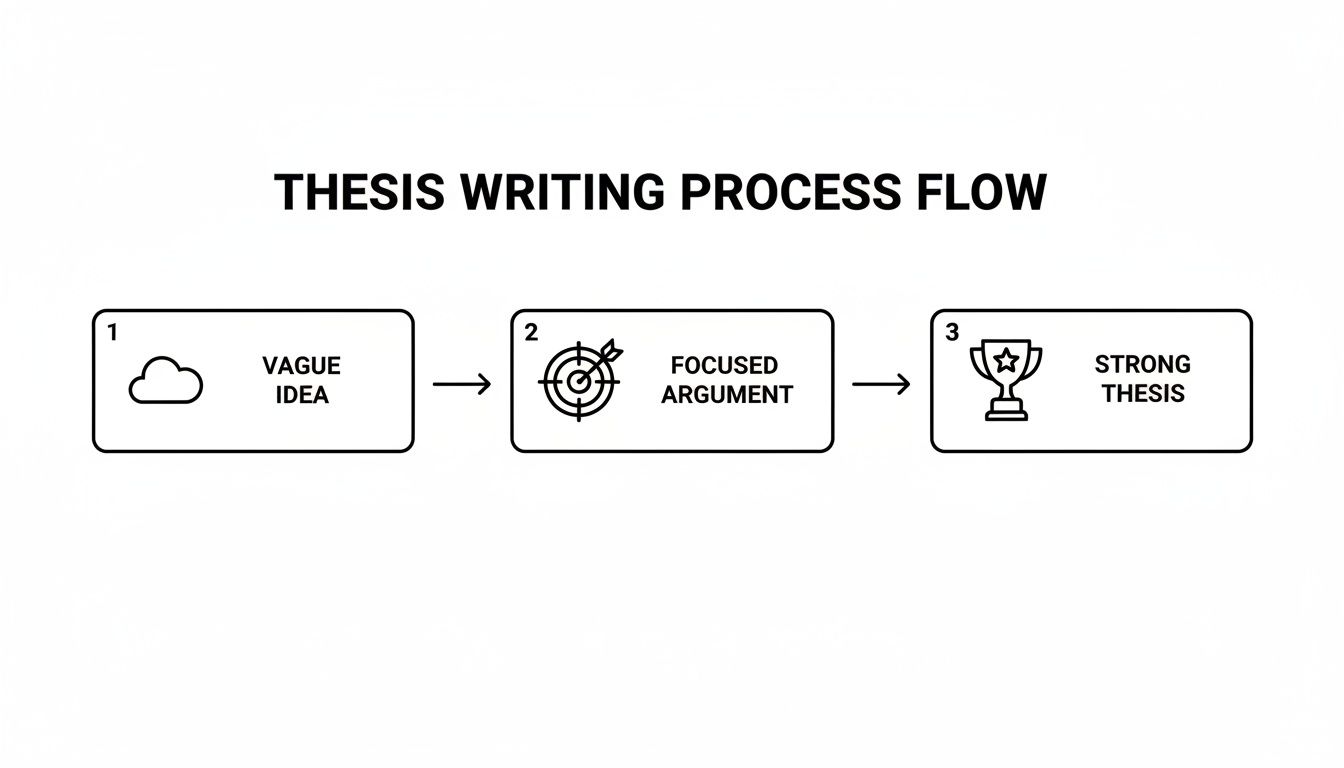
As you can see, it's a funnel. You pour your big ideas in the top and what comes out is a focused argument ready to become the polished centerpiece of your paper.
Draft a Working Thesis
Now for the fun part: writing your first draft. This is your working thesis, and it's allowed to be messy. In fact, it should be a little imperfect. Its only job is to give you a direction as you start outlining and digging into your research. Think of it as a hypothesis you're about to test.
Let’s take the topic of fast fashion as an example:
- Broad Idea: Fast fashion is bad for the environment. (Too vague!)
- Working Thesis: The fast fashion industry’s reliance on synthetic materials and rapid production cycles is a primary contributor to microplastic pollution in global waterways.
See the difference? This working thesis is specific enough to guide your research. It gives you clear terms to look up ("synthetic materials," "microplastic pollution") and a direct cause-and-effect relationship to prove. This kind of structure is also the perfect foundation for your paper's structure; you can learn more about how to create a research paper outline to see how a thesis directly shapes the entire document.
Revise and Refine Relentlessly
Heads up: your working thesis is not your final thesis. As you research, you’ll find new evidence, run into counterarguments, and your own understanding will get deeper. That's a good thing! Let your discoveries shape and strengthen your argument.
The revision process is all about asking tough questions:
- Is my claim specific enough? Swap out vague words for precise ones. Instead of "bad," try "economically unsustainable" or "ethically compromised."
- Is it truly arguable? Could a smart, reasonable person disagree with you? If everyone agrees, you’re just stating a fact, not making an argument.
- Does it pass the "so what?" test? Why should anyone care about your claim? A great thesis hints at the bigger picture—the broader implications of what you're arguing.
When you treat your thesis as a living document that grows with your research, you turn a simple sentence into the powerful intellectual core of your paper.
Crafting an Arguable and Specific Thesis
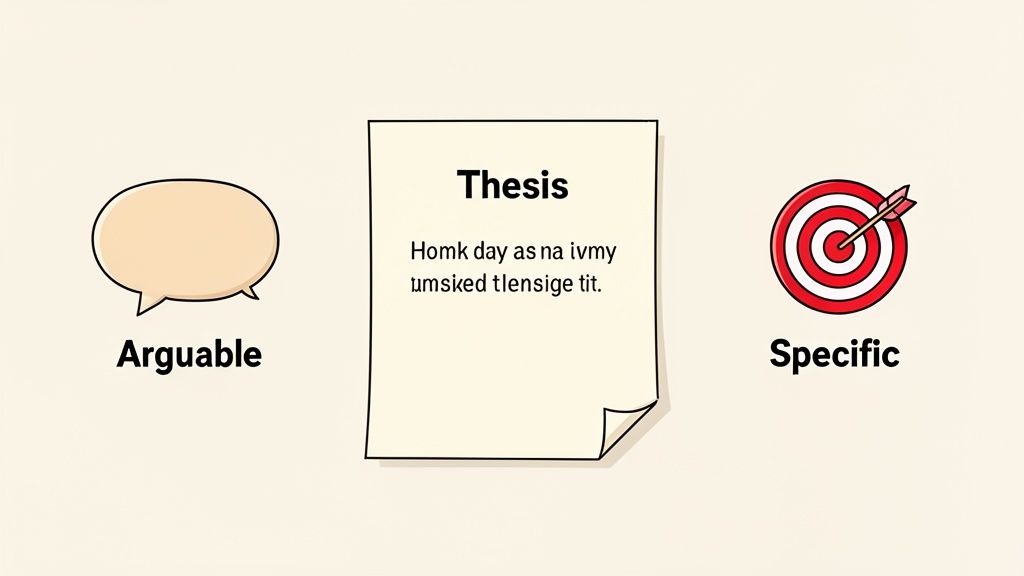
So, you've sifted through your brainstorming and have a rough draft of a thesis. Great! Now comes the fun part: forging that idea into a sharp, powerful argument. The two qualities that will make or break your thesis are that it must be arguable and specific. Nail these, and you'll transform a bland observation into a compelling claim that can sustain an entire paper.
An arguable thesis isn't just a statement of fact. It’s a claim that a reasonable person could disagree with—and that's what makes your essay worth reading. Facts are the evidence you bring to the table to support your argument, not the argument itself.
Making Your Thesis Arguable
Think of it as the difference between a closed door and an open one. A factual statement is a closed door—there's nowhere to go with it.
- Fact: Abraham Lincoln was the 16th president of the United States. (This is true. End of story.)
- Arguable Thesis: Abraham Lincoln's leadership during the Civil War was defined more by his pragmatic political maneuvering than his unwavering idealism. (Now that's an open door for debate.)
See the difference? The second statement practically begs for a discussion. It forces you to define "pragmatic maneuvering" and "idealism" and then back up your interpretation with historical evidence. This creates the tension and persuasion that drive a strong essay.
In fact, Purdue Global's writing center notes that a whopping 85% of successful academic papers are built on a thesis requiring evidence, not just stating facts. Taking a simple truth like "Barack Obama was the first African-American president" and evolving it into a claim—like "Obama's election marked a seminal moment in American politics by shifting national conversations on race"—gives your paper a purpose and a direction.
Honing Your Specificity
Once you have an arguable claim, it's time to sharpen the focus. Vague language is the mortal enemy of a strong thesis. Words like "good," "bad," "important," or "society" are so broad they become almost meaningless.
Your job is to swap out those fuzzy terms for precise language that gives your reader (and you!) a clear roadmap.
Let’s watch a vague idea get progressively sharper:
- Vague Start: Social media is bad for people. (Which people? How is it bad?)
- Getting Warmer: Social media negatively affects teenagers' mental health. (Better, but we can still get more specific.)
- Arguable & Specific: The curated, algorithm-driven nature of platforms like Instagram contributes to rising rates of body dysmorphia among teenage girls by promoting unrealistic beauty standards.
Boom. That final version is a powerhouse. It names a specific platform (Instagram), a target demographic (teenage girls), a precise problem (body dysmorphia), and a clear cause (unrealistic beauty standards). Now you have a focused, manageable argument to prove. This level of clarity is also crucial when you're figuring out how to write a good essay introduction, as your thesis needs to perfectly anchor your opening paragraphs.
Pro Tip: A truly great thesis statement answers two key questions for your reader: "What is this paper about?" and "So what?" If your statement doesn't at least hint at the importance or implications of your argument, it’s not quite there yet.
By making sure your thesis is both a debatable claim and a highly specific statement, you're building a solid foundation. It becomes the engine that drives your entire paper forward, giving it purpose, clarity, and a real voice.
Thesis Statement Examples for Any Subject
Theory is one thing, but seeing a well-crafted thesis in action is often the best way to really get it. A killer thesis for a literary analysis paper just isn't going to look the same as one for a scientific report or a historical argument.
The core principles—making a specific, arguable claim—are always there. What changes is how you apply them. Let's look at some concrete examples and adaptable formulas for different fields. Think of these as a springboard, not a cage. They're here to help you kickstart your own thinking.
Humanities and Literary Analysis
In the humanities, your thesis is all about interpretation. You’re making a specific, defendable claim about how a piece of literature, art, or philosophy works and what it means.
Weak: Shakespeare's Hamlet is a play about revenge. (This is just a topic, not an argument.)
Strong: While Hamlet appears to be a classic revenge tragedy, Shakespeare uses the protagonist's prolonged inaction and philosophical soliloquies to critique the very nature of vengeance, portraying it not as a noble duty but as a destructive, self-consuming force.
See the difference? The strong example names the text (Hamlet), acknowledges a common take (it’s a revenge story), and then pivots to a unique, arguable interpretation. It tells the reader exactly what your paper will prove.
Here’s a simple structure you can adapt to get started:
By examining [a specific element like a literary device, character arc, or theme], [Author's Name] in [Text Title] challenges the conventional view of [a concept], ultimately arguing that [your unique interpretation].
Social Sciences and Historical Analysis
When you're writing for history, political science, or sociology, your thesis needs to present a cause-and-effect argument or a fresh interpretation of events. It has to be grounded in evidence and take a clear side on a debatable issue.
Weak: The American Civil War was fought for many reasons. (Way too broad and just states a known fact.)
Strong: While economic disputes and states' rights were significant factors, the American Civil War was primarily caused by the South's ideological commitment to preserving slavery as a foundational pillar of its political and social order, a commitment that made compromise impossible.
This version is much better. It acknowledges other factors ("economic disputes") but takes a firm, specific position on the primary cause. It sets up a clear line of argument for the rest of the paper.
A good starting point for this kind of thesis could be:
Although [a commonly accepted cause or factor] played a role, [a specific event or movement] was primarily driven by [your proposed main cause], which is evident in [types of evidence you will use].
STEM and Scientific Reports
In science, technology, engineering, and math, the thesis statement often takes the form of a hypothesis. It needs to be a testable, precise, and predictive statement that outlines the specific relationship between variables you're investigating.
Weak: This experiment will study the effects of caffeine on the body. (This is vague and doesn't predict anything.)
Strong: Increased daily caffeine consumption (above 400mg) in college students will correlate with a measurable decrease in REM sleep duration, thereby negatively impacting memory consolidation.
Now that's a scientific claim. It’s incredibly specific, identifying the population (college students), the independent variable (caffeine > 400mg), the dependent variable (REM sleep), and the predicted outcome (worse memory consolidation).
To help you get a feel for the different structures, here's a quick-reference table with some adaptable formulas.
Thesis Statement Formulas for Common Essay Types
| Essay Type | Thesis Formula | Example |
|---|---|---|
| Argumentative | While some argue [counter-argument], a closer examination reveals [your position] because [reason 1], [reason 2], and [reason 3]. | While some argue that social media connects people, a closer examination reveals it often fosters isolation by replacing genuine interaction with curated personas and promoting echo chambers. |
| Analytical | By analyzing [specific element] in [text/subject], we can see how the author/creator reveals [deeper meaning or theme]. | By analyzing the recurring motif of the green light in The Great Gatsby, we can see how Fitzgerald critiques the illusion and ultimate emptiness of the American Dream. |
| Expository | The primary causes/effects of [topic] are [cause/effect 1], [cause/effect 2], and [cause/effect 3], which collectively illustrate [larger significance]. | The primary causes of the decline in bee populations are pesticide use, habitat loss, and climate change, which collectively threaten global food security. |
Remember, these are just starting points. The best thesis statements are born from your own critical thinking and deep engagement with your topic. Don't be afraid to tweak and refine these formulas until they perfectly capture your unique argument.
Common Thesis Mistakes and How to Fix Them

Knowing the common pitfalls is half the battle. Even a brilliantly researched paper can crumble if its core argument is weak. Let's walk through the mistakes I see all the time and, more importantly, how to get them fixed.
Think of this as your troubleshooting guide. Spotting these errors in your own drafts is the key to sharpening your argument before you get too deep into the writing process.
The Announcement
This is probably the most frequent stumble. Your thesis shouldn't just announce your topic; it needs to be your argument. Phrases like "In this paper, I will discuss..." signal a lack of confidence and make your writing feel elementary.
- Mistake: "In this essay, I will discuss the environmental impact of plastic pollution on marine life."
- Fix: "The proliferation of single-use plastics poses a catastrophic threat to marine ecosystems by introducing microplastics into the food chain and devastating fragile aquatic biodiversity."
See the difference? The second version is a direct, assertive claim that immediately sets the stage.
The Statement That Is Too Broad
A thesis that tries to tackle a huge topic is a recipe for a shallow paper. You simply can't prove a massive claim in a few pages, which leads to skimming the surface instead of providing a deep, convincing analysis.
- Mistake: "Global politics have been shaped by numerous conflicts throughout history."
- Fix: "The Treaty of Versailles, rather than securing peace, created the economic and political instability that directly fueled the rise of German nationalism and led to the outbreak of World War II."
The fix works because it narrows the focus to a specific cause (The Treaty of Versailles) and a specific effect, making it a powerful, provable argument.
A great thesis statement is a laser, not a floodlight. Its power comes from precision. You want a claim so focused that it guides every single paragraph that follows, giving your paper a tight, logical structure.
The Multi-Idea Thesis
Trying to cram several different arguments into one sentence is a surefire way to write a disorganized paper. Each idea pulls your essay in a new direction, making a cohesive argument impossible.
In fact, a 2022 analysis of 10,000 undergraduate papers found that submissions with a jumbled, multi-idea thesis scored, on average, 30% lower due to a lack of focus. You can find more data on how focus impacts essay scores on PurdueGlobalWriting.Center.
- Mistake: "Industrial farming is bad for the environment, and it also raises ethical questions about animal welfare and affects small family farms."
- Fix: "The industrial farming model’s reliance on monoculture crops has severely degraded soil health, leading to a long-term decline in agricultural sustainability and biodiversity."
The revised version picks one clear lane—the environmental impact on soil—and sticks to it. The other points are valid, but they belong in supporting paragraphs, not crammed into the main argument. Sidestepping these common errors will make your thesis the powerful engine your paper needs.
Refining Your Thesis With Feen AI
Think of artificial intelligence as a smart collaborator, not a machine that does the work for you. Using a tool like Feen AI can be like having a dedicated sounding board to help sharpen your argument and take your draft thesis from pretty good to truly great.
The whole point is to use AI to stress-test your ideas. Once you have a working thesis, you can use it to explore different angles, uncover potential weaknesses you might have overlooked, and experiment with more powerful wording. This isn't about letting the AI write for you; it's about using it to clarify and strengthen your own thinking.
Getting Actionable Feedback
To get anything useful out of an AI, you have to be specific. Just pasting your thesis and asking, "Is this good?" won't get you very far. You need to give it targeted requests that actually push your argument in a better direction.
Try asking questions that force the AI to think critically about your work:
- "How can I make this claim more specific and less vague?"
- "What are three potential counterarguments to this thesis statement?"
- "Suggest three alternative ways to phrase this argument to make it more compelling."
This kind of pointed questioning turns the AI from a simple text generator into a genuine tool for critical thinking, helping you see your own work from a fresh perspective.
Using AI effectively is a skill in itself. The quality of the feedback you receive is directly tied to the quality of the questions you ask. It’s a dialogue, not a command.
Learning how to prompt an AI is crucial for getting the best results. A great resource on how to write AI prompts that actually work can help you craft questions that yield truly meaningful feedback. This makes your interactions far more productive. You can even play around with Feen AI’s free thesis statement generator to see different ways a thesis can be structured.
Relevant articles
Learn how to write a strong argumentative essay with our guide. We cover building a thesis, using evidence, and structuring your argument for academic success.
Learn how to write a persuasive essay that wins arguments. Our guide covers crafting a strong thesis, finding solid evidence, and structuring your paper.
Unlock your potential with our top college essay writing tips. Learn how to brainstorm, structure, and revise your way to an unforgettable application essay.
Learn how to write a lab report conclusion with a clear structure, real examples, and tips to boost your grade.

Learn how to cite sources in mla with clear examples for books, websites, and more. Write your paper confidently with MLA guidance.
Learn how to write a conclusion paragraph that leaves a lasting impression. Our guide covers proven structures, real examples, and mistakes to avoid.