How to Improve Reading Comprehension Skills: Active Reading Strategies
Discover how to improve reading comprehension skills with proven strategies, active reading, and practice that builds lasting understanding.
Ever feel like you’re just reading words on a page without actually absorbing them? The secret to better reading comprehension isn't about pushing through more pages; it’s about changing how you read. You need to stop being a passive observer and start actively engaging with the text—asking questions, connecting ideas, and boiling down the main points. This shift turns reading from a one-way lecture into a two-way conversation, which is where true understanding is born.
Why Most Reading Comprehension Advice Fails
If you’ve ever been told to just "read more" or "focus harder," you know how frustrating and ineffective that advice is. It’s like telling an aspiring chef to "cook more" without ever teaching them about ingredients, techniques, or how flavors work together.
The reality is, there's a huge difference between basic literacy—simply being able to read the words—and advanced comprehension, which is the skill of actually building meaning from them.
Many people can read fluently yet struggle to remember what they've read, follow a complex argument, or see how different ideas in a text connect. This isn't a sign of laziness; it's a sign that the right strategies are missing. Most generic advice fails because it treats reading as a passive activity, but real comprehension is anything but.
Beyond Basic Literacy
True understanding depends on a set of mental habits that, unfortunately, most of us were never explicitly taught. These are the skills that separate proficient readers from those who struggle.
The data backs this up. A 2022 OECD assessment found that while 74% of 15-year-old students can identify the main idea in a text, only a tiny fraction—a mere 7%—reach the highest levels of comprehension. These top performers can read between the lines, pick up on subtle meanings, and think critically about the content. You can explore more about these reading proficiency levels to see the full picture.
The problem is that we often treat reading as an act of consumption when it should be an act of creation. You’re not just downloading words; you’re building a mental model of the author's world.
This is exactly why tactics like rereading a chapter over and over or highlighting half the page don't work. They feel productive, but they're passive. They don’t force your brain to grapple with the material. Without a structured approach, you end up with a pile of disconnected facts instead of a solid web of knowledge.
The good news? The right strategies can be learned and practiced. With a little guidance, you can turn that feeling of frustration into genuine confidence.
Prime Your Brain for Understanding Before You Start Reading
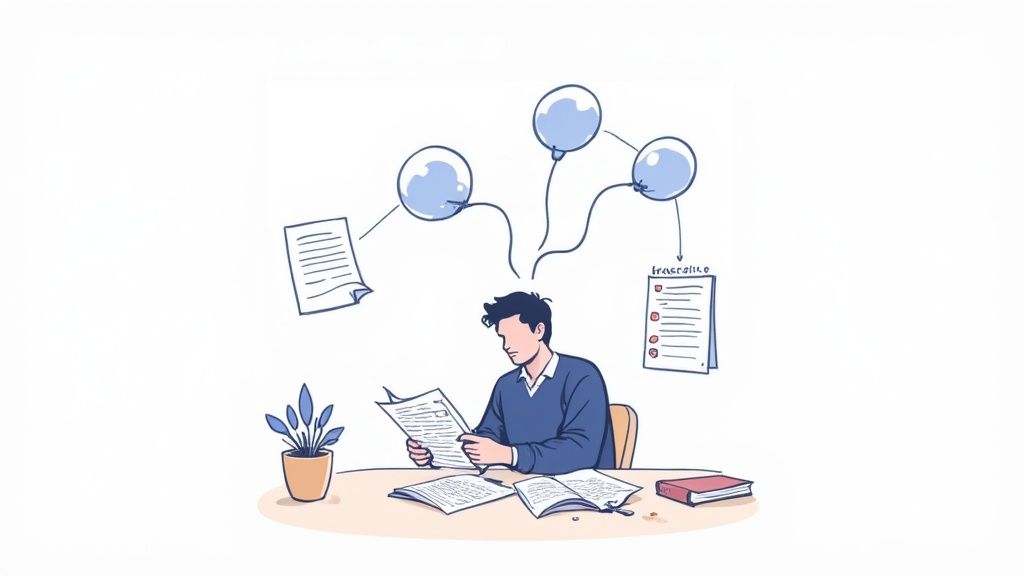
Here’s a secret that strong readers know: the most important part of reading happens before your eyes hit the first sentence. Think of it like a warm-up before a workout. Jumping straight into a complex text without any preparation is a recipe for getting lost and forgetting what you just read.
A few minutes spent on a strategic preview can completely change the game. It’s a small investment that pays off big time in both understanding and memory.
Create a Mental Map
Before diving into the details, you need a lay of the land. Take a minute to scan the text for structural clues—these are like a roadmap the author left for you. This quick reconnaissance mission turns you from a lost tourist into a confident navigator.
Be on the lookout for these signposts:
- Headings and Subheadings: These are the big ideas. They outline the entire structure of the argument.
- Introduction and Conclusion: This is where you’ll usually find the main point (thesis) and a summary of the key takeaways.
- Bolded Terms: The author is practically shouting, "Pay attention to this!" These are crucial concepts.
- Visuals: Glance at any charts, graphs, or images. They’re there to make complex information easier to digest.
This quick survey builds a framework in your mind. As you start the actual reading, your brain will already have a place to slot every new piece of information, making it so much easier to see the connections.
By previewing the text, you’re not just skimming. You are actively building a mental outline of the content, which prepares your brain to absorb and organize the details that follow.
Activate What You Already Know
The next pre-reading step is to connect the material to your own experience. This simple habit transforms reading from a passive activity into an active investigation.
Before you start, just ask yourself two powerful questions:
- What do I already know about this subject?
- What do I want to learn from this text?
Asking these questions fires up the right circuits in your brain, making it easier for new information to find a home. It also gives your reading a clear mission. You’re no longer just plowing through words; you’re on a hunt for answers.
Your Pre-Reading Strategy Checklist
Use this quick reference before you read any new text to dramatically increase how much you understand and retain.
| Strategy | Actionable Step | Why It Works |
|---|---|---|
| Scan for Structure | Quickly read all headings, subheadings, and bolded text. | Creates a mental outline so your brain knows where to file new information. |
| Read the Bookends | Read the very first paragraph (introduction) and the very last one (conclusion). | These sections contain the main argument and key takeaways in a nutshell. |
| Question Everything | Turn the title and headings into questions. (e.g., "What is a mental map?") | Primes your brain to look for answers, turning reading into an active search. |
| Connect to Self | Ask: "What do I already know about this?" and "What do I want to learn?" | Activates existing knowledge, making it easier for new concepts to "stick." |
This pre-reading routine is a foundational part of building real literacy. It’s not just a nice-to-have trick; it’s a core strategy that reduces the mental effort needed to process dense material. When you set the stage properly, your brain can focus on what really matters: understanding the meaning behind the words.
Of course, none of this works if your mind is wandering. To get the most out of these techniques, it's crucial to find strategies to keep focus and master your attention before you even begin.
Adopt the Habits of an Active Reader
Alright, you've warmed up your brain. Now for the main event. Passive reading is the enemy of understanding. It’s when your eyes move across the page, but your mind is a million miles away. We've all been there—you get to the bottom of the page and have zero memory of what you just "read."
To truly improve your reading comprehension skills, you have to become an active reader. This means you stop being a silent audience member and start participating in a conversation with the author. You need to engage, question, and connect with the ideas on the page.
Start a Dialogue with the Text
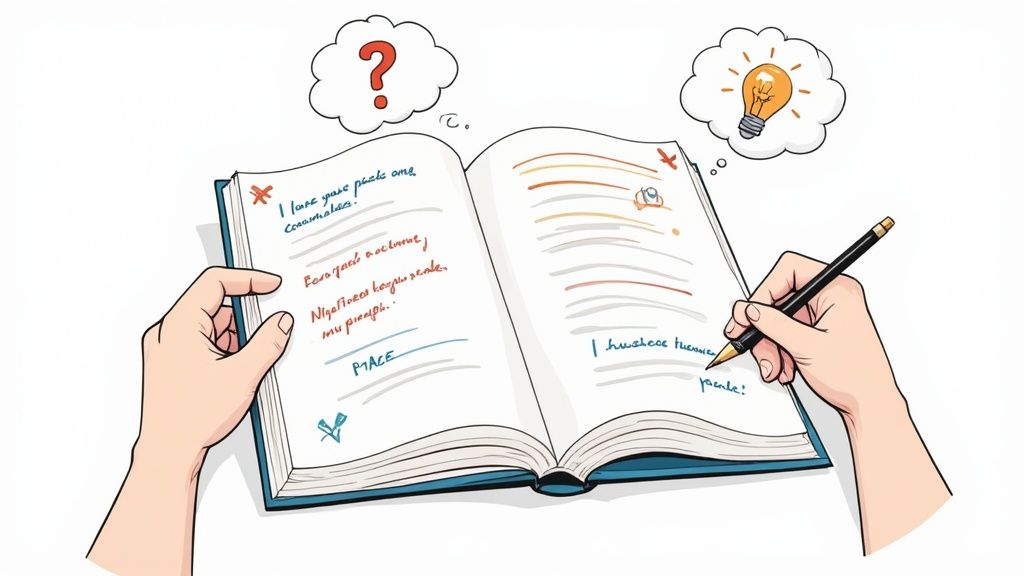
The single most effective way to force this engagement is through annotation. And I don't just mean dragging a yellow highlighter across sentences that seem important. Real annotation is your thought process made visible, right there in the margins.
Think of it as leaving breadcrumbs for your future self. As you read, make these habits second nature:
- Jot down questions: Did something confuse you? Did a claim seem a bit thin? Write it down. A simple "Why?" or "What’s the proof?" in the margin keeps you skeptical and engaged.
- Make connections: Note where an idea clicks with something you already know, another chapter, or a recent news story. A quick note like "connects to chapter 2" or "like that study I read" builds a web of knowledge instead of isolated facts.
- Write micro-summaries: After a tricky paragraph, force yourself to rephrase the main point in five or six words. This is a powerful check for understanding.
This entire process is a lifesaver for dense material. If you're tackling something like a textbook, these techniques are non-negotiable. We go even deeper on this in our guide on how to effectively study a textbook. The goal is to wrestle with the ideas, not just let them wash over you.
Think About Your Thinking
Expert readers have a secret weapon: metacognition. It sounds academic, but it just means thinking about your own understanding as it happens. It's the little voice in your head that acts as a quality-control check while you read.
Get into the habit of pausing every few paragraphs and asking yourself two simple questions:
- Do I really get what I just read?
- Could I explain this to someone else right now?
If the answer is shaky, you’ve just caught a comprehension gap in real time. Instead of plowing ahead and getting even more lost, you can go back and re-read that one section with renewed focus. It’s a simple but profound self-correction habit.
By regularly pausing to self-assess, you shift from a passive "I hope I get this" mindset to an active "Am I getting this?" approach. This small change in awareness is a game-changer for retaining complex information.
Create Mental Movies
Not everything you read is abstract theory. Often, you're reading about processes, historical events, or physical descriptions. The best way to lock this information in is to visualize it.
As you read, consciously build a movie in your mind. If you're reading a manual on building a shelf, picture your hands performing each step. If it's a history text about a battle, imagine the sights and sounds of the scene.
This technique taps into a different part of your brain, making the information more concrete and sticky. You're anchoring the words to a sensory experience, even if it's just in your head. By making these habits part of your routine, reading transforms from a passive chore into an active, rewarding skill.
Turn What You Read Into Knowledge That Lasts
So you've finished the chapter. Great. But that's just the first step. The real challenge is making sure what you just read actually sticks. If you just close the book and walk away, most of that information will vanish before you know it.
The secret to locking in new knowledge is to do something with it, right away. This doesn't mean you need to spend hours poring over your notes. A few focused, strategic exercises can make all the difference, forcing your brain to recall and process the material.
Teach It to Understand It
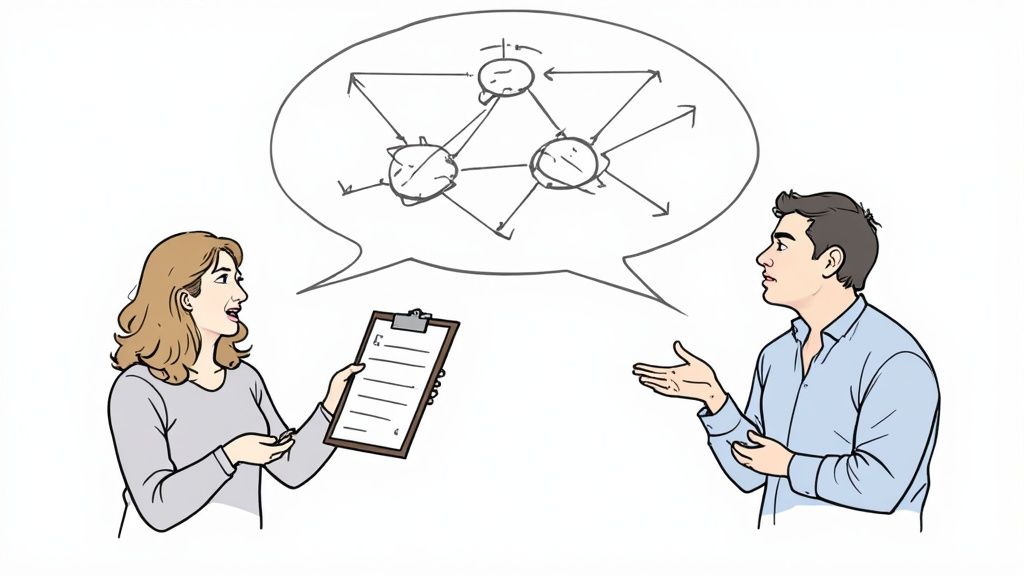
Have you ever heard of the Feynman Technique? It's a method developed by the brilliant physicist Richard Feynman, and it's deceptively simple. The whole idea is to explain what you've just learned in the simplest terms you can, as if you were teaching it to a kid.
When you try this, you'll immediately find the weak spots in your understanding. You’ll see exactly where your explanation gets hazy or where you're leaning on jargon you can't quite define. It's a quick and brutal test of your comprehension.
- Grab a blank sheet of paper.
- Write the core concept you just read about at the top.
- Now, explain it in your own words. Use analogies. Keep it simple.
- The moment you get stuck or feel your explanation is weak, that's your cue to revisit the original text and shore up that specific gap.
This isn't about rote memorization. It’s about building a genuine, deep understanding. After all, if you can’t explain it simply, you probably don’t understand it as well as you think.
By forcing yourself to translate complex ideas into simple language, you are actively reconstructing the knowledge in your own mind. This act of reconstruction is what builds strong, long-lasting memory pathways.
Craft a Powerful Summary
Another crucial post-reading habit is learning how to summarize well. I'm not talking about just jotting down a few bullet points. A good summary distills the entire text down to its absolute essence, separating the main argument from all the supporting details.
After you finish reading, take a minute to answer these three questions:
- What was the author's main argument? What's the one big idea they're trying to get across?
- What were the key pieces of evidence or points they used to back it up?
- What's the single most important conclusion I should walk away with?
Writing out your answers forces a much deeper level of processing. You're moving from just consuming information to actively analyzing it. For bigger projects, learning how to summarize a book effectively can be a game-changer.
This kind of active engagement pays dividends. A 2021 study, the PIRLS assessment, looked at 400,000 students in 57 countries and found a clear link between students who enjoy reading and those who score higher. Simple post-reading strategies like these are what turn reading into a powerful tool for building real, lasting knowledge.
Use Modern Tools to Accelerate Your Learning
Getting good at active reading takes time and consistent practice. There's no substitute for putting in the work. But let’s be honest—why make it harder than it has to be? We can lean on some pretty sharp technology to learn smarter and make even the toughest texts easier to tackle.
Think of these tools as a training partner for your brain. They do some of the initial heavy lifting, like scanning for the main ideas, which frees you up to focus on what really matters: connecting the dots and truly understanding the material.
Get the Big Picture Instantly
One of the biggest roadblocks with a dense academic paper or a long business report is just figuring out where to start. It can feel like staring at a wall of text. This is exactly where AI summarization tools can completely change your pre-reading game.
Before you dive deep into the first chapter, you can use a tool to generate a quick, high-level overview. This gives you that crucial mental map we talked about earlier, laying out the main arguments and key takeaways in just a few seconds. It’s a bit like watching the trailer before the movie—you walk in already knowing the key players and the general plot.
A fantastic way to do this is with a specialized PDF summarizer to quickly digest long documents. Taking this one simple step primes your brain for the details, making the actual reading that follows far more productive.
As you can see below, a tool like Feen AI makes this incredibly straightforward. You just upload your file and go.
The whole point is to remove any friction. You can upload all kinds of file types, getting you from a dense document to a clear understanding as quickly as possible.
Test Your Understanding on Demand
So you’ve finished reading. Now what? How do you really know if you've absorbed the information? This is where AI-powered Q&A features can make a massive difference in how you improve your reading comprehension skills.
Instead of just re-reading your highlights, you can literally have a conversation with the document. It turns a static PDF into a dynamic, interactive study session.
- Need something simplified? Just ask, "Can you explain the author's point about quantum entanglement in simpler terms?"
- Want to quiz yourself? Try, "What were the three main reasons cited for the economic downturn in the third quarter?"
- Trying to connect concepts? Ask, "How does the conclusion relate back to the initial hypothesis mentioned in the introduction?"
Getting instant feedback on your own questions forces you to actively recall information, which is one of the most powerful, science-backed ways to lock in knowledge. It’s like having a personal tutor on call 24/7.
This method pulls you out of passive review and into active self-testing. It shines a spotlight on what you don't know, so you can go back and review specific sections with a clear purpose. Folding these modern tools into your study routine creates a powerful feedback loop that builds real, lasting comprehension and helps you learn faster.
A Practical Weekly Plan to Sharpen Your Skills
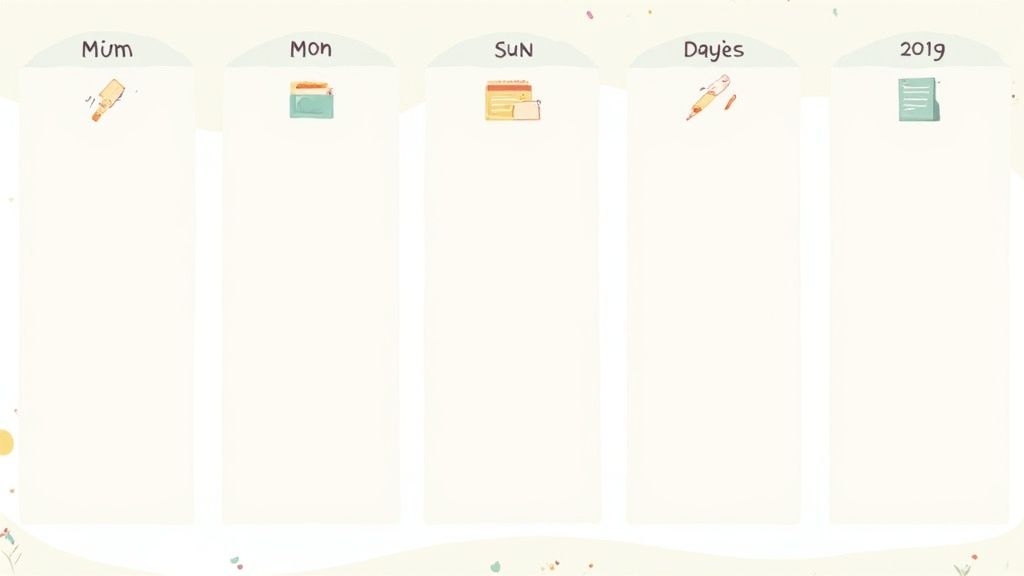
Knowing the strategies is one thing; actually putting them into practice is where the real magic happens. The key to making these skills stick isn't marathon study sessions—it's consistency. A short, daily habit is far more powerful than cramming once in a while.
This plan is all about building the habits of an active, engaged reader in just 15-30 minutes a day. Think of it less as another chore and more as a simple, repeatable routine that genuinely works. By rotating your focus and the types of texts you read, you'll build a more flexible and robust approach to understanding just about anything.
Your 7-Day Reading Comprehension Workout
Here’s a structured plan you can follow. Just 15-30 minutes a day is all it takes to build and reinforce the habits that lead to powerful comprehension.
| Day | Focus Skill | Activity (15-30 mins) | Text Type Suggestion |
|---|---|---|---|
| Monday | Vocabulary Building | Identify 3-5 new words. Write them down with your own definition and use each in a new sentence. | A challenging news article or opinion piece. |
| Tuesday | Active Annotation | Read a short piece, actively marking it up. Underline main points, circle keywords, and ask questions in the margins. | An interesting blog post or short non-fiction chapter. |
| Wednesday | Summarization Sprint | Using only your annotations from Tuesday, write a one-paragraph summary of the text. Don't peek! | The text you annotated on Tuesday. |
| Thursday | Question Generation | Read a text and create at least 5 "how" or "why" questions about the content. Go deeper than surface-level facts. | A few pages from a textbook or a technical manual. |
| Friday | The Feynman Technique | Pick a key concept from Thursday's reading and explain it in simple terms, as if teaching it to a beginner. | A blank page and your memory of Thursday's text. |
| Saturday | Review & Reinforce | Quickly review the week's vocabulary words, annotations, summaries, and questions. | Your notes from Monday through Friday. |
| Sunday | Read for Pleasure | No notes, no goals. Just grab a book, magazine, or article you're excited about and enjoy reading. | Anything you want! A novel, a comic, a long-form article. |
By the end of the week, you'll have practiced a full cycle of skills, from absorbing new information to solidifying it in your memory. Stick with it, and this routine will become second nature.
Common Questions About Reading Comprehension
As you start working on your reading skills, a few questions are bound to come up. It's completely normal. Let's walk through some of the most common ones I hear to help you stay focused and confident.
A big one is, "How long until I actually see a difference?" There's no magic number, of course, but most people who dedicate just 20-30 minutes a day to focused, active reading start to feel a real shift in their understanding within about four to six weeks.
The trick is consistency. You're not just trying to cram more pages; you're fundamentally rewiring how your brain interacts with text. A little bit of intentional practice every day goes a long way.
What's the Single Most Effective Technique?
If you had to pick just one thing to focus on, what would give you the most bang for your buck? Without a doubt, it's active self-questioning. This one habit forces you to stop being a passive observer and start engaging with the material.
Instead of just letting your eyes glaze over the words, constantly challenge yourself with questions like:
- What's the core message the author is trying to get across here?
- How does this fit with what I already know about this subject?
- Can I come up with a real-world example of this concept?
This simple shift turns reading from a chore into an investigation, and that’s where true comprehension is born.
The goal is to shift from a passive intake of words to an active search for meaning. By constantly questioning the text, you force your brain to process, analyze, and connect ideas, which is where true understanding is built.
Should I Worry About Reading Speed?
This is a classic dilemma: do you focus on speed or understanding? The honest answer? Focusing on speed too early will absolutely tank your comprehension. Speed reading techniques are great for skimming or getting the gist of a simple article, but they are the enemy of deep learning.
Real understanding demands that you slow down. You need to pause, think, and let the ideas sink in.
Concentrate on mastering the active reading strategies first. Once you get better and faster at spotting main ideas, making connections, and questioning the text, your reading speed will naturally improve—without you having to sacrifice your grasp of the material.
It’s also worth considering that the material itself plays a huge role. Exploring the concept of comprehensible input really drives home how important it is to pick texts that stretch you just enough without being completely overwhelming. Finding that sweet spot is key to making progress.
Ready to stop struggling with dense readings and complex assignments? Feen AI can help. Use our AI-powered tools to instantly summarize long PDFs, get clear answers to your questions, and generate practice quizzes from any text. Start studying smarter, not just harder, by visiting https://feen.ai today.
Relevant articles
Struggling to absorb what you read? Learn how to improve comprehension skill with actionable reading strategies and smart tools for real, lasting results.
Discover how to improve comprehension skills with proven reading strategies. Master active reading and note-taking for deeper understanding.
Learn how to study from textbooks effectively with active reading, note taking, and spaced review strategies to boost comprehension and retention.
Discover how to study a textbook with active recall, smart notes, and proven strategies to boost memory and ace exams.