The 10 Best Way to Study Chemistry and Ace Your Exams in 2026
Discover the best way to study chemistry with our top 10 actionable strategies. Master concepts from stoichiometry to organic chem and boost your grades.

Chemistry can feel like an insurmountable challenge, filled with abstract concepts, complex equations, and a vocabulary all its own. Many students find themselves staring at textbooks, feeling lost between moles, orbitals, and reaction mechanisms. The good news? It doesn't have to be this way. The key isn't just studying harder; it's about studying smarter. Finding the best way to study chemistry means adopting proven, active learning strategies that build deep, lasting understanding.
Passive reading and last-minute cramming are recipes for frustration. Instead, you need a toolkit of methods that transform abstract symbols into tangible knowledge. This guide moves beyond generic advice like "read the textbook" and provides a prioritized, actionable collection of study methods that truly work. We will detail specific workflows for problem-solving, techniques for visual concept-mapping, and practical routines for making information stick.
In this comprehensive listicle, we'll break down the 10 most effective, research-backed strategies to not only pass your course but to genuinely master the material. You will learn how to:
- Implement active recall and spaced repetition for long-term memory.
- Develop a structured workflow for tackling complex problems, from stoichiometry to organic mechanisms.
- Use concept maps to connect seemingly disparate topics like thermodynamics and kinetics.
- Prepare for labs and practicals to maximize your hands-on learning.
Each item is designed to be a clear, actionable technique you can start using today. We’ll also show you how integrating a powerful tool like Feen AI can supercharge your efforts, providing instant clarification and personalized support whenever you get stuck. Get ready to turn confusion into confidence and finally make chemistry click.
1. Active Problem Solving
The single most effective way to study chemistry is to actively solve problems. This method moves beyond passively reading textbook chapters or watching lecture videos. Instead, it requires you to engage directly with the material by working through equations, stoichiometry calculations, and reaction mechanisms on your own, solidifying your understanding and building critical thinking skills.
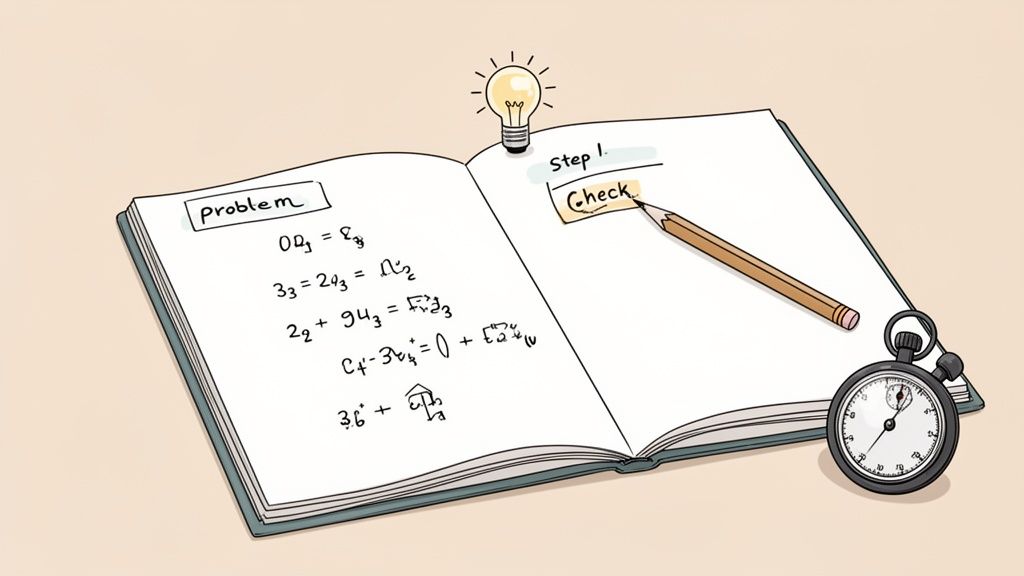
Simply put, you cannot learn to solve chemistry problems by watching someone else do it. You must attempt them independently before consulting solutions. This hands-on practice is where true learning happens, as it forces you to confront what you don't know and develop a systematic approach. This technique is non-negotiable for mastering topics from basic unit conversions to complex organic synthesis.
How to Implement Active Problem Solving
To make this the best way to study chemistry for your specific needs, follow a structured process. Begin with foundational problems to build your confidence before progressing to more complex, multi-step questions.
- Solve First, Check Later: Always attempt a problem from your textbook or problem set without looking at the answer key. This simulates a real test environment and reveals your true comprehension level.
- Show Your Work: Write out every step of your calculation or reasoning. This practice helps you pinpoint exactly where errors occur and reinforces the logical flow of the solution.
- Targeted Practice: Group similar problem types together. For example, spend a session working exclusively on limiting reactant problems. This helps you recognize patterns and master the specific algorithm for that type of question. For extra practice, you can find a variety of stoichiometry practice problems with answers to test your skills.
- Simulate Exam Conditions: Use a timer when working through a set of problems. This helps you build speed and manage pressure, preparing you for the constraints of an actual exam.
- Verify and Understand: After you've completed your attempt, use the solution manual or a tool like Feen AI to verify your answer. If you made a mistake, focus on understanding the why behind the correct process, not just memorizing the final number.
2. Visual Concept Mapping
Chemistry is a subject built on interconnected ideas, and visual concept mapping is a powerful technique for seeing and understanding these links. This method involves creating diagrams that visually organize information, showing the relationships between central concepts like atoms, molecules, reactions, and theories. By turning abstract information into a structured, spatial map, you can build a more intuitive and lasting mental framework.
Simply reading about periodic trends or memorizing functional groups in isolation often leads to fragmented knowledge. A concept map forces you to connect these pieces logically, for example, by linking an element’s electron configuration to its bonding behavior and typical reactions. This active organizational process is a highly effective way to study chemistry because it transforms you from a passive recipient of information into an active constructor of knowledge.
How to Implement Visual Concept Mapping
To get the most out of this technique, approach it as a way to summarize and connect ideas after a lecture or reading session. It’s perfect for seeing the big picture and identifying knowledge gaps.
- Start with a Central Idea: Place your main topic, such as "Acids and Bases," in the center of a blank page. From there, branch out to related sub-topics like "Arrhenius Theory," "Brønsted-Lowry Theory," and "pH Scale."
- Use Color and Symbols: Assign different colors to different categories of information (e.g., green for definitions, blue for equations, red for examples). This visual coding helps your brain categorize and recall information more efficiently.
- Link Concepts with Actions: Use connecting lines with labels to describe the relationship between ideas. For instance, a line between "Strong Acid" and "H+ Ions" could be labeled "completely dissociates to produce."
- Redraw from Memory: After creating a detailed map, try to replicate it from memory on a new sheet of paper. This practice actively tests your recall and solidifies the connections in your mind.
- Leverage Digital Tools: For more polished and easily editable maps, use software like MindMeister or Lucidchart. You can also upload your hand-drawn or digital maps to Feen AI for feedback on the connections and suggestions for missing concepts.
3. Spaced Repetition
Cramming for a chemistry exam is one of the least effective study strategies. The best way to study chemistry for long-term retention is through spaced repetition, a method that leverages the "forgetting curve." This technique involves reviewing material at systematically increasing intervals, moving information from your short-term to your long-term memory.
Instead of reviewing a topic intensely for hours and then neglecting it, you revisit it just as you are about to forget it. For example, you might review reaction mechanisms one day after learning them, then three days later, then a week later. This process interrupts the natural decay of memory and strengthens neural pathways, making recall during an exam much faster and more reliable. To dive deeper into this powerful method and its applications, explore guides on Spaced Repetition.
How to Implement Spaced Repetition
Integrating this technique into your routine transforms your study from a frantic, last-minute activity into a consistent, manageable process. It’s particularly effective for memorizing formulas, definitions, and periodic table trends.
- Use Digital Flashcard Apps: Tools like Anki or Quizlet have built-in algorithms that automatically schedule cards for review based on your performance. This is ideal for learning element properties, polyatomic ions, and functional groups.
- Schedule Manual Reviews: For conceptual topics, manually schedule review sessions in your calendar. A typical schedule might be: Day 1 (learn), Day 2 (review), Day 7 (review), Day 16 (review), and Day 35 (review).
- Combine with Active Problem Solving: Don’t just re-read your notes during a review session. Instead, rework challenging problems from previous assignments. This active engagement makes your review sessions far more effective.
- Prioritize Difficult Concepts: If you struggle with thermodynamics, schedule more frequent, shorter review intervals for those specific concepts. Use easier, longer intervals for topics you've already mastered.
- Generate Fresh Questions: During a scheduled review, ask an AI tool like Feen AI to generate new practice questions on the topic. This ensures you are testing your understanding rather than just your memory of a specific problem.
4. Laboratory and Hands-On Experimentation
Chemistry is a physical science, and engaging with it through hands-on lab work is a powerful way to transform abstract concepts into tangible reality. This approach moves learning beyond the pages of a textbook by allowing you to conduct experiments, observe reactions firsthand, and collect data. This direct experience bridges the gap between theoretical principles and practical application, reinforcing your understanding in a way that reading alone cannot.
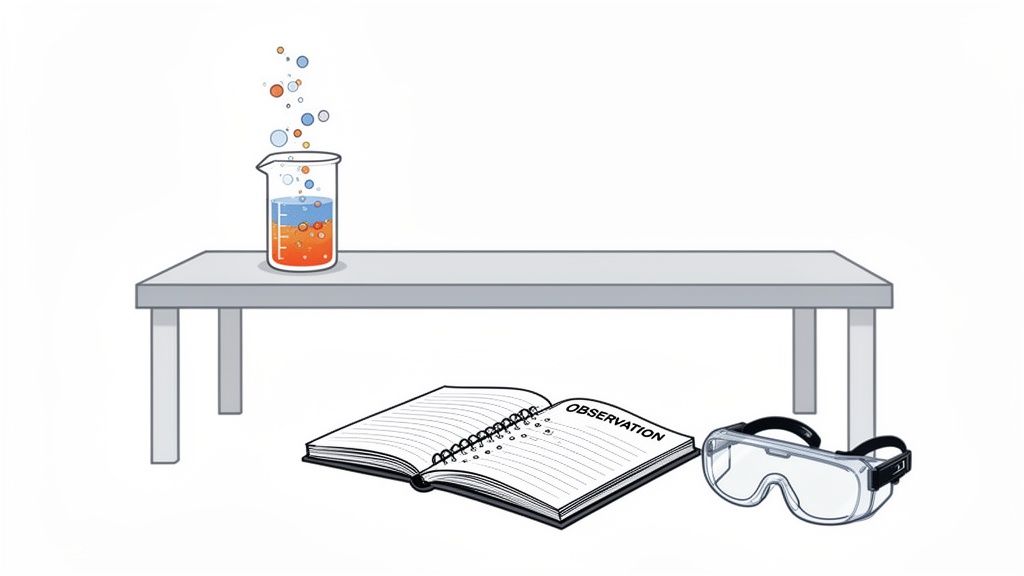
Simply put, seeing a chemical reaction occur is fundamentally different from reading about it. When you perform a titration to find the concentration of an acid or synthesize a compound and watch it crystallize, you are creating a strong mental model of the underlying processes. This makes laboratory work one of the best ways to study chemistry, as it provides concrete evidence for the theories you learn in lectures.
How to Implement Laboratory and Hands-On Experimentation
To maximize the educational value of lab work, treat it as an active learning session rather than just a set of instructions to follow. This means being prepared, observant, and reflective throughout the entire process.
- Prepare Before Lab: Read the entire lab procedure beforehand. Understand the why behind each step, the chemicals you are using, and the main goal of the experiment.
- Keep Detailed Notes: During the experiment, record everything you observe, not just the expected results. Note color changes, temperature shifts, or unexpected outcomes. These details are crucial for your analysis.
- Connect Theory to Practice: As you perform each step, ask yourself which chemical principle is being demonstrated. If you are mixing an acid and a base, connect your observations back to neutralization reactions and stoichiometry.
- Use Virtual Labs for Practice: When physical lab time is limited, use virtual chemistry simulations to practice procedures and visualize reactions without the constraints of a real lab.
- Reflect on Your Results: After the experiment, focus on interpreting your data. Analyze what your results mean and how they support or contradict the theoretical concepts. Writing a strong analysis is key, and you can learn more about crafting a powerful lab report conclusion to solidify this skill.
Beyond the classroom, you can find engaging ways to understand chemical reactions through simple at-home projects; explore some fascinating and relevant resources for easy chemistry experiments at home to continue your hands-on learning.
5. Peer Teaching and Explanation
Explaining a complex chemistry concept to someone else is a powerful test of your own understanding. Peer teaching forces you to move beyond simple recognition of terms and into true comprehension, as you must organize your thoughts, simplify intricate ideas, and articulate them clearly. This method quickly reveals gaps in your knowledge that passive studying often masks.
When you teach, you are forced to process information at a deeper level. You must anticipate questions, connect different topics, and use analogies to make sense of abstract principles like molecular orbital theory or thermodynamics. This active engagement makes the information stick, solidifying it as one of the best ways to study chemistry for long-term retention.
How to Implement Peer Teaching and Explanation
To get the most out of this collaborative method, structure your sessions for focus and mutual benefit. The goal is not just to talk about chemistry, but to actively build and test understanding together.
- Form a Small, Focused Group: Work with two to four committed peers. A small group size ensures everyone has a chance to speak and teach a concept without the session becoming disorganized.
- Assign Topics in Advance: Before meeting, assign specific topics or problem types to each member. For example, one person prepares to explain VSEPR theory, while another focuses on drawing Lewis structures. This ensures everyone comes prepared to contribute.
- Use a Whiteboard or Shared Document: Visually explaining concepts is key in chemistry. Use a physical whiteboard or a digital one to draw molecules, map out reaction mechanisms, and show calculation steps.
- Encourage Clarifying Questions: The listener's job is just as important as the teacher's. Actively ask questions like "Why does that electron move there?" or "Can you explain the difference between enthalpy and entropy again?" This pushes the "teacher" to refine their explanation.
- Verify and Fill Gaps: If the group gets stuck or is unsure about an explanation, use your textbook or a tool like Feen AI to get a verified answer. This ensures you are reinforcing correct information and can quickly resolve any misconceptions that arise during the discussion.
6. Chunking and Organization
One of the most powerful strategies for tackling chemistry's vast scope is to break large topics into smaller, more manageable pieces. This technique, known as chunking, prevents cognitive overload and allows you to build a deep understanding progressively. Instead of trying to study a massive chapter on "Chemical Equilibrium" all at once, you can chunk it into distinct concepts like Le Chatelier's principle, equilibrium constants (Kc and Kp), and reaction quotients (Q).
Simply put, your brain can only process so much new information at one time. Chunking respects this limitation by focusing your attention on one sub-topic until you master it. This method transforms an intimidating subject like organic chemistry into a series of achievable learning goals, such as understanding alkanes, then alkenes, then specific reaction types. This approach is the best way to study chemistry without feeling overwhelmed.
How to Implement Chunking and Organization
To apply chunking effectively, use your syllabus or textbook's table of contents as a roadmap. Identify the main pillars of a chapter and treat each one as a separate study session before you attempt to connect them.
- Deconstruct the Syllabus: Start by breaking down a major topic like "Acids and Bases" into its fundamental parts: Arrhenius, Brønsted-Lowry, and Lewis definitions; strong vs. weak acids; pH and pOH calculations; and titrations. Master each one individually.
- Focus on One Concept at a Time: Dedicate a study block exclusively to a single chunk. For example, spend an entire session on learning the periodic trend of electronegativity before moving on to ionization energy or atomic radius.
- Master Sub-Skills First: Before tackling complex multi-step organic synthesis problems, ensure you have mastered each individual reaction type that might be involved. This foundational knowledge is crucial for building more complex problem-solving skills.
- Create Mini Concept Maps: For each chunk you study, draw a small concept map that outlines its key ideas and formulas. Later, you can connect these mini-maps to form a larger, comprehensive overview of the entire chapter.
- Ask for Guidance: If you're unsure how to break down a difficult topic, use a tool like Feen AI. You can ask, "How should I chunk the topic of chemical kinetics to study it effectively?" to get a structured learning plan.
7. Practice Testing and Self-Assessment
Regularly testing yourself is one of the most powerful strategies for deep, long-term learning in chemistry. This method goes far beyond simply rereading notes; it forces your brain to actively retrieve information, a process known as retrieval practice. This active recall strengthens the neural pathways associated with the material, making it easier to remember during high-pressure situations like exams.
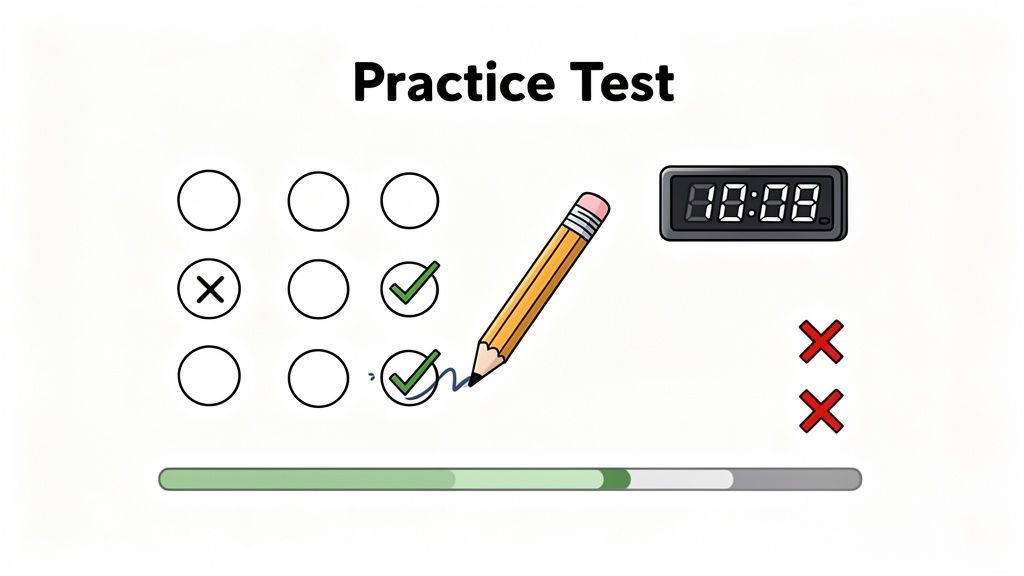
Simply put, you cannot gauge your true understanding until you put it to the test. Low-stakes practice quizzes and past exams provide crucial feedback, highlighting exactly which concepts or problem-types you struggle with before they impact your grade. This form of self-assessment is a core component of an effective study routine and an essential way to build both confidence and competence in chemistry.
How to Implement Practice Testing and Self-Assessment
To make practice testing the best way to study chemistry for you, integrate it into your regular schedule rather than saving it for last-minute cramming. Use end-of-chapter questions, official practice exams like those from the College Board for AP Chemistry, or online problem sets.
- Replicate Exam Conditions: Take practice tests in a quiet environment without distractions. Set a timer to match the actual exam duration to get used to the time pressure and improve your pacing.
- Analyze Every Mistake: Don't just look at the correct answer and move on. For every question you get wrong, dig deep to understand why your approach was incorrect. Was it a calculation error, a conceptual misunderstanding, or a misinterpretation of the question?
- Identify Weak Areas: After several practice tests, look for patterns in your mistakes. Are you consistently struggling with equilibrium problems or organic reaction mechanisms? This analysis tells you exactly where to focus your review efforts.
- Use AI for Deeper Insight: If you're stuck on a problem from a practice test, take a screenshot and upload it to Feen AI. You can get a step-by-step explanation that clarifies the underlying principles, helping you avoid similar errors in the future.
- Space It Out: Instead of doing five practice tests the night before an exam, complete one each week leading up to it. This spaced repetition reinforces learning over time. For more tips on exam preparation, explore our guide on how to study for a chemistry test.
8. Multimodal Learning Integration
Engaging with chemistry through multiple learning formats is a powerful strategy for building a deeper, more resilient understanding. Multimodal learning involves combining various sensory inputs like reading, watching, writing, and hands-on interaction. This approach caters to different learning styles and reinforces complex concepts by creating multiple neural pathways to the same information.
Simply reading a textbook chapter on reaction mechanisms may not be enough. However, when you supplement that reading by watching an animated video of the reaction, drawing the electron-pushing arrows yourself, and then building the molecules with a model kit, the concept becomes tangible and easier to recall. This is arguably the best way to study chemistry because it transforms abstract ideas into concrete knowledge.
How to Implement Multimodal Learning
To effectively integrate this method, actively seek out and combine different types of resources during your study sessions. Don't just stick to one format; create a dynamic learning environment that engages multiple senses.
- Combine Visual and Textual Resources: After reading about a topic like VSEPR theory in your textbook, find a YouTube video from channels like The Organic Chemistry Tutor or Crash Course Chemistry that visually demonstrates the 3D molecular shapes.
- Move from Digital to Physical: Use interactive simulations or molecular visualization software (like Jmol or Avogadro) to rotate and inspect molecules on-screen. Follow this up by building the same molecules with a physical ball-and-stick model kit to get a tactile sense of their structure.
- Connect Theory to Application: Watch a documentary or a video on the real-world application of a concept, such as the role of electrochemistry in batteries. Then, return to your notes or textbook to solve practice problems related to that application.
- Leverage AI for Explanations: If a video or diagram is confusing, use a tool like Feen AI to get a clear, text-based explanation. You can ask it to break down a difficult concept in simple terms, providing a valuable textual layer to your visual learning.
- Mix Modalities in One Session: A highly effective study block could involve watching a 15-minute lecture video, spending 20 minutes solving related problems, and finishing with 10 minutes of drawing out key diagrams or concept maps from memory.
9. Question-Driven Learning
Question-driven learning flips the traditional study model on its head by using curiosity as the engine for learning. Instead of passively absorbing information from a textbook, this method requires you to start by asking questions about the material. This active, inquiry-based approach transforms studying from a chore into a self-directed mission to find answers, leading to a much deeper and more permanent understanding of chemical principles.
Simply put, learning is more effective when you are actively searching for an answer to a specific question you posed. This process builds a strong mental framework because you are not just memorizing facts; you are connecting concepts to satisfy your own curiosity. This technique is invaluable for understanding the fundamental "why" behind everything from why atoms bond to what determines the speed of a chemical reaction.
How to Implement Question-Driven Learning
To make this the best way to study chemistry, integrate it into the start of every study session. Before you even open your textbook to read, take a few minutes to formulate questions that will guide your learning and provide a clear purpose.
- Generate Pre-Study Questions: Before diving into a new chapter on kinetics, for example, write down questions like, "What actually determines how fast a reaction goes?" or "How do catalysts work without being used up?" This primes your brain to look for specific answers.
- Use the SQ3R Method: This classic technique perfectly aligns with question-driven learning. Survey the chapter, formulate Questions, Read to find the answers, Recite the answers in your own words, and Review your notes and questions.
- Annotate with Questions: As you read, write down new questions that arise in the margins of your notes or textbook. If you encounter a statement about bond enthalpy, you might ask, "What makes some chemical bonds stronger than others?"
- Seek Out Answers: Use your textbook, lecture notes, and supplementary resources to actively hunt for the answers to your questions. This turns reading into a focused and engaging activity.
- Leverage AI for Instant Clarity: When a concept is particularly tricky, use a tool like Feen AI as your personal question-answering machine. You can ask it to explain why some reactions release energy (exothermic) while others absorb it (endothermic) and get a clear, immediate explanation to fill in knowledge gaps.
10. Error Analysis and Metacognitive Reflection
One of the most powerful learning strategies involves transforming mistakes into your greatest study asset. Error analysis is the systematic review of incorrect answers to diagnose the root cause of the misconception, moving beyond simply correcting the final number. Paired with metacognitive reflection, the practice of "thinking about your thinking," this becomes the best way to study chemistry for long-term retention and deep understanding.
This method forces you to engage with your weaknesses directly. Instead of feeling discouraged by a low score on a practice quiz, you treat each error as a clue pointing to a specific gap in your knowledge. By analyzing not just what you got wrong but why, you can refine your study plan to target those areas, making your efforts more efficient and effective.
How to Implement Error Analysis and Metacognitive Reflection
To turn mistakes into a structured learning process, you need a system. This goes beyond a quick glance at the correct answer; it requires a deliberate investigation into your thought process during the problem-solving attempt.
- Create an Error Log: Dedicate a section of your notebook or a spreadsheet to track your mistakes. For each incorrect problem, record the question, your incorrect answer, and the correct solution.
- Diagnose the "Why": Beside each entry, write a short analysis. Did the error come from a simple calculation mistake (careless), a misunderstanding of a core concept (conceptual), or misapplying a formula (procedural)? Be honest with yourself.
- Write a Correction Plan: For each error, articulate the correct process in your own words. For instance, if you mixed up enthalpy and entropy, write a sentence defining each and explaining how they differ. Then, write a note on how you will avoid this mistake in the future.
- Categorize and Review: Group your errors by type. If you notice a pattern, such as consistently making mistakes on limiting reactant problems, you know exactly where to focus your next study session.
- Seek Deeper Insight: Use study partners or a tool like Feen AI to discuss your errors. You can ask, "I made this mistake on a thermodynamics problem. Can you help me understand the conceptual error behind my approach?" This external feedback provides new perspectives you might have missed.
Comparison of 10 Chemistry Study Strategies
| Strategy | Implementation complexity | Resource requirements | Expected outcomes | Ideal use cases | Key advantages |
|---|---|---|---|---|---|
| Active Problem Solving | Moderate — regular practice and problem selection | Diverse problem sets, solutions, time, optional tutor/feedback | Strong problem-solving skills, better retention, exam readiness | Preparing for exams, mastering calculations and mechanisms | Deep conceptual understanding, rapid identification of gaps |
| Visual Concept Mapping | Moderate — time to design clear maps | Paper/software (MindMeister, Lucidchart), color tools, examples | Improved organization, memory via visual links | Understanding relationships, mapping large topic networks | Makes abstract connections visible, aids recall |
| Spaced Repetition | Low–Moderate — initial setup then routine maintenance | SRS app (Anki/Quizlet), curated cards, scheduling | Long-term retention, reduced need to cram | Memorizing facts, periodic review of core concepts | Highly efficient for durable memory consolidation |
| Laboratory & Hands-On Experimentation | High — planning, safety, and supervision required | Lab space/materials or virtual simulations, safety gear | Practical skills, experimental intuition, memorable learning | Applying theory, developing lab techniques, data analysis | Real-world experience that links theory to practice |
| Peer Teaching & Explanation | Low–Moderate — coordination and preparation needed | Study partners, meeting space or online tools, topic notes | Deeper understanding, clarified misconceptions | Explaining concepts aloud, study groups, teaching practice | Exposes misunderstandings, reinforces knowledge by teaching |
| Chunking & Organization | Low — requires upfront planning and structuring | Textbook/syllabus, outlines, note-taking tools | Manageable study units, improved focus, staged mastery | Tackling complex subjects, stepwise curriculum planning | Reduces overwhelm, enables progressive learning |
| Practice Testing & Self-Assessment | Moderate — sourcing or creating quality tests | Past exams, quizzes, timed conditions, feedback tools | Improved retrieval, measured progress, exam confidence | Final exam prep, tracking learning gaps, timed practice | Most effective for retention; provides concrete feedback |
| Multimodal Learning Integration | Moderate–High — gather and coordinate multiple resources | Videos, texts, simulations, models, software | Richer encoding, greater engagement, flexible understanding | Complex topics, mixed learning preferences, remediation | Multiple encoding pathways strengthen memory and understanding |
| Question-Driven Learning | Low–Moderate — self-directed question generation | Question lists, research resources, guidance or tutor | Higher engagement, deeper conceptual inquiry | Exploratory study, building critical thinking, unknown topics | Motivates learning and targets information gaps through inquiry |
| Error Analysis & Metacognitive Reflection | Moderate — disciplined review and logging required | Error log, past work, feedback, time for reflection | Reduced repeated mistakes, improved strategy selection | Post-test reviews, procedural error correction, long-term improvement | Directly targets misconceptions; improves self-monitoring |
Your Blueprint for Chemistry Success
Embarking on the journey to master chemistry can feel like navigating a complex molecular structure; it’s intricate, layered, and requires a precise approach. As we've explored, the search for the single "best way to study chemistry" is misguided. True mastery isn't found in a magic bullet or a single, secret technique. Instead, it is constructed by assembling a personalized, dynamic study system from the powerful, evidence-based methods we've detailed.
The core principle connecting all these strategies is the shift from passive consumption to active engagement. You don’t learn chemistry by simply watching it happen. You learn it by doing, by struggling, by connecting, and by teaching.
Weaving Your Personal Study Tapestry
Your most effective study plan will be a unique blend of the techniques covered in this guide. Think of it as creating a personalized blueprint for success, where you select the right tools for each specific challenge.
- For Foundational Understanding: Start with Visual Concept Mapping to see the big picture and Chunking to break down intimidating topics like stoichiometry or thermodynamics into manageable pieces.
- For Long-Term Retention: Integrate Spaced Repetition into your daily routine using flashcards or apps. This is non-negotiable for memorizing formulas, reaction types, and polyatomic ions.
- For True Application: The real test of knowledge comes from Active Problem Solving. Work through problems methodically, then supercharge your learning with Error Analysis to understand not just what you got wrong, but why.
- For Deepening Your Knowledge: Use Peer Teaching to solidify your own understanding. If you can explain a concept like chemical equilibrium or an SN2 reaction to someone else, you truly know it. Reinforce this with Question-Driven Learning to stay curious and probe deeper.
This active approach transforms studying from a chore into a process of discovery. You are no longer just memorizing facts; you are building a flexible and resilient mental framework that allows you to analyze and solve unfamiliar problems.
From Strategy to Lasting Success
The transition from a struggling student to a confident one is marked by consistency. A structured, 20-minute practice session five days a week will yield far greater results than a single, frantic 4-hour cram session. It’s about building momentum, reinforcing neural pathways, and making learning a sustainable habit rather than a dreaded event.
Remember that every mistake is not a failure, but a crucial data point. Each incorrect calculation or misunderstood concept is an opportunity for Metacognitive Reflection-a chance to refine your approach and strengthen a weak link in your knowledge chain. This mindset is perhaps the most critical component of finding the best way to study chemistry for you. It’s about being an active, strategic, and resilient architect of your own learning.
Ultimately, mastering chemistry is more than just passing an exam. It’s about developing a powerful lens through which to understand the world, from the air we breathe to the technology we use. It cultivates critical thinking, problem-solving skills, and a meticulous attention to detail that will serve you in any field you choose to pursue. You have the tools and the blueprint; now it’s time to build your success.
Ready to supercharge your study sessions? Stop struggling with confusing concepts and endless problem sets alone. Integrate Feen AI into your workflow to get instant, step-by-step explanations, generate tailored practice questions, and check your work 24/7. Transform your study habits today by visiting Feen AI and discover your new essential chemistry partner.
Relevant articles

Learn how to study for chemistry test with a proven strategy. Master concepts, practice problems, and test-day tips to boost your score.