Stoichiometry Practice Problems With Answers: 8 Essential Exercises for 2025
Master stoichiometry with our curated set of stoichiometry practice problems with answers, from basic to challenging. Includes a downloadable worksheet.

Stoichiometry can feel like one of chemistry's biggest hurdles, turning simple equations into complex puzzles of ratios and conversions. But what if you could transform it from a point of confusion into a source of confidence? This guide is designed to do just that. We provide a comprehensive set of stoichiometry practice problems with answers that will build your skills systematically, from foundational concepts to advanced applications. This isn't just a list; it's a structured workout for your chemistry muscles.
Our collection of stoichiometry practice problems is meticulously crafted following essential instructional design best practices to ensure an effective and engaging learning experience. We break down each problem with clear, step-by-step solutions, strategic tips, and common pitfalls to avoid. You won't just find the right answer; you'll understand the process behind it.
Whether you're a high school student tackling homework, a college undergraduate in a STEM course, or an adult learner refreshing your knowledge, this is your starting point for mastery. We will cover a wide range of topics to ensure you are well-prepared:
- Mole-to-Mole & Mass-to-Mass Conversions: The core of stoichiometry.
- Limiting Reactants & Percent Yield: Critical for understanding real-world lab outcomes.
- Gas & Solution Stoichiometry: Applying principles to different states of matter.
- Advanced Problems: Tackling multi-step reactions and formula determination.
Ready to master the math behind the molecules and gain clarity on this crucial chemistry topic? Let's dive in.
1. Mole-to-Mole Stoichiometry: Combustion of Methane (Beginner)
Welcome to the foundational step in your stoichiometry journey: mole-to-mole conversions. This is the simplest type of stoichiometry problem, but it’s also the most critical because every other calculation builds upon this core skill. Mole-to-mole problems use the coefficients from a balanced chemical equation to establish a ratio, allowing you to convert the number of moles of one substance into the equivalent number of moles of another.
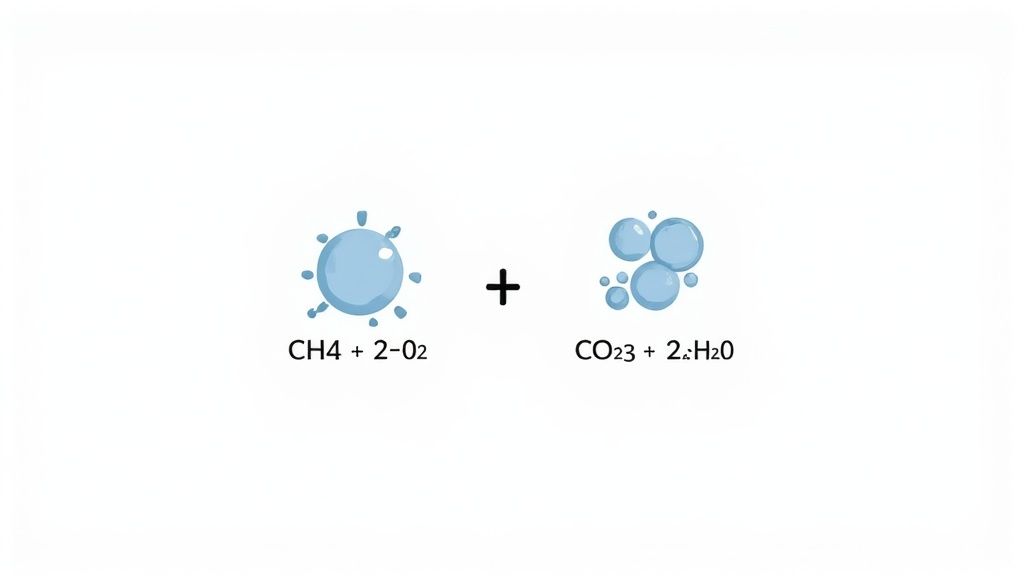
This method is the heart of stoichiometry. It directly applies the "recipe" provided by the balanced equation to determine how much product you can make or how much reactant you need. Let's dive into one of the most common introductory examples: the combustion of methane.
Problem
Given the balanced chemical equation for the combustion of methane:
CH₄ (g) + 2O₂ (g) → CO₂ (g) + 2H₂O (g)
If you start with 3.0 moles of methane (CH₄), how many moles of carbon dioxide (CO₂) will be produced, assuming you have more than enough oxygen to complete the reaction?
Step-by-Step Solution
Identify the Given and the Goal:
- Given: 3.0 moles of CH₄
- Goal: Find the number of moles of CO₂
Determine the Mole Ratio: Look at the coefficients in the balanced equation. The ratio between CH₄ and CO₂ is 1 to 1. This means for every 1 mole of CH₄ that reacts, 1 mole of CO₂ is produced.
Set Up the Conversion Factor: We can write this mole ratio as a fraction to help us cancel units. Since we want to find moles of CO₂, it goes in the numerator:
(1 mole CO₂) / (1 mole CH₄)Calculate the Answer: Multiply the given amount by the conversion factor.
3.0 moles CH₄ × (1 mole CO₂) / (1 mole CH₄) = 3.0 moles CO₂
Answer: 3.0 moles of carbon dioxide (CO₂) will be produced.
Strategy and Tips
- Balance First, Always: An unbalanced equation gives incorrect mole ratios. Always double-check that the equation is balanced before you do anything else.
- Write the Ratio: Clearly write out the mole ratio as a conversion factor. This visual step prevents confusion and helps you correctly cancel units.
- Unit Cancellation is Your Friend: The units for the substance you start with (moles CH₄) should cancel out, leaving you with the units for the substance you want to find (moles CO₂). This is a quick way to verify your setup. If your units don't cancel, your conversion factor is likely upside down.
- Practice with Different Ratios: Work through problems with ratios like 2:3 or 1:4 to get comfortable with coefficients other than one. For complex calculations, our AI-powered chemistry problem solver can provide further assistance and step-by-step guidance.
2. Mass-to-Mass Stoichiometry: Sodium and Chlorine Reaction
Now that you've mastered mole-to-mole conversions, let's tackle the most common type of stoichiometry problem you'll encounter in a lab setting: mass-to-mass calculations. In practice, we measure substances in grams, not moles. This process bridges the gap by adding two extra steps: converting the initial mass to moles and converting the final moles back to mass.
This three-step process (grams → moles → moles → grams) is a cornerstone of chemical calculations. It allows you to predict the actual mass of a product you can create from a known mass of a reactant. We will explore this with the synthesis of sodium chloride, also known as table salt.
Problem
Given the balanced chemical equation for the reaction of sodium metal with chlorine gas:
2Na (s) + Cl₂ (g) → 2NaCl (s)
If you start with 23.0 grams of sodium (Na), what mass of sodium chloride (NaCl) in grams will be produced? (Molar mass of Na = 22.99 g/mol; Molar mass of NaCl = 58.44 g/mol)
Step-by-Step Solution
Identify the Given and the Goal:
- Given: 23.0 grams of Na
- Goal: Find the mass in grams of NaCl
Convert Given Mass to Moles: Use the molar mass of sodium to convert grams of Na to moles of Na.
23.0 g Na × (1 mole Na / 22.99 g Na) ≈ 1.00 mole NaDetermine the Mole Ratio and Convert Moles: Look at the balanced equation. The ratio between Na and NaCl is 2 to 2, which simplifies to 1 to 1. For every 2 moles of Na that react, 2 moles of NaCl are produced.
1.00 mole Na × (2 moles NaCl / 2 moles Na) = 1.00 mole NaClConvert Final Moles to Mass: Use the molar mass of sodium chloride to convert moles of NaCl back to grams.
1.00 mole NaCl × (58.44 g NaCl / 1 mole NaCl) = 58.44 g NaCl
Answer: 58.44 grams of sodium chloride (NaCl) will be produced.
Strategy and Tips
- Organize Your Conversions: A great way to solve these is with a single dimensional analysis setup:
Grams Given → Moles Given → Moles Unknown → Grams Unknown. This keeps all your steps organized and makes unit cancellation clear. - Molar Mass is Key: The accuracy of your answer depends on using the correct molar masses. Double-check your calculations for each compound, as this is a common source of error.
- Write Out All Units: When setting up your calculation, write out every unit for every number (e.g., "g Na," "mol NaCl"). This ensures you are canceling correctly and not mixing up substances.
- Check the Ratio Carefully: Don't assume a 1:1 ratio. Always refer back to the coefficients in the balanced equation. This skill is crucial when dealing with more complex formulas, such as those you'd find when learning about the copper hydroxide formula and its reactions.
3. Limiting Reactant Problem: Aluminum and Oxygen Reaction
Now we advance to a more realistic scenario in chemistry: limiting reactant problems. Unlike previous examples where one reactant was assumed to be in excess, these problems provide starting amounts for two or more reactants. Your task is to determine which reactant will be completely consumed first, as this "limiting reactant" dictates the maximum amount of product that can be formed.
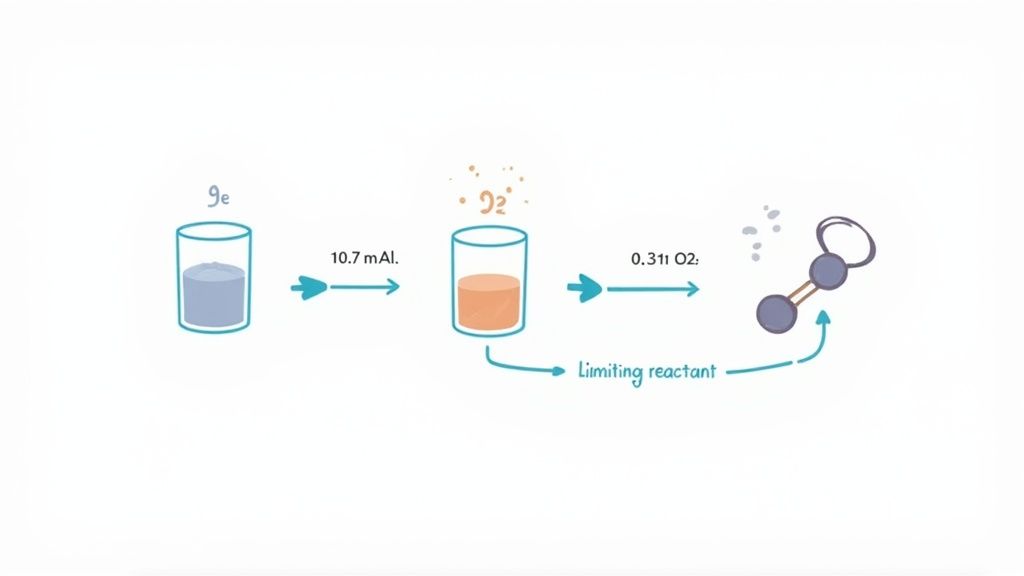
This concept is crucial in both laboratory settings and industrial manufacturing, where efficiency and resource management are key. By identifying the limiting reactant, chemists can predict the theoretical yield and optimize reaction conditions. Let's explore this with the reaction between aluminum and oxygen.
Problem
Consider the synthesis of aluminum oxide from its elements:
4Al (s) + 3O₂ (g) → 2Al₂O₃ (s)
If you start with 10.0 grams of aluminum (Al) and 10.0 grams of oxygen (O₂), which is the limiting reactant, and what is the maximum mass (theoretical yield) of aluminum oxide (Al₂O₃) that can be produced?
(Molar masses: Al ≈ 26.98 g/mol, O ≈ 16.00 g/mol)
Step-by-Step Solution
Calculate Moles of Each Reactant: First, convert the given mass of each reactant into moles.
- Moles of Al:
10.0 g Al × (1 mole Al / 26.98 g Al) = 0.371 moles Al - Moles of O₂:
10.0 g O₂ × (1 mole O₂ / 32.00 g O₂) = 0.313 moles O₂
- Moles of Al:
Determine the Limiting Reactant: Use stoichiometry to calculate how much product (Al₂O₃) each reactant could produce if it were the only limiting factor.
- From Al:
0.371 moles Al × (2 moles Al₂O₃ / 4 moles Al) = 0.186 moles Al₂O₃ - From O₂:
0.313 moles O₂ × (2 moles Al₂O₃ / 3 moles O₂) = 0.209 moles Al₂O₃
- From Al:
Identify the Limiting Reactant and Theoretical Yield in Moles: The reactant that produces the least amount of product is the limiting reactant. Here, aluminum (Al) produces only 0.186 moles of Al₂O₃, while oxygen could produce 0.209 moles. Therefore, Al is the limiting reactant, and the maximum amount of product that can be formed is 0.186 moles.
Calculate Theoretical Yield in Grams: Convert the moles of product (determined by the limiting reactant) back to grams. The molar mass of Al₂O₃ is (2 × 26.98) + (3 × 16.00) = 101.96 g/mol.
0.186 moles Al₂O₃ × (101.96 g Al₂O₃ / 1 mole Al₂O₃) = 18.9 g Al₂O₃
Answer: Aluminum (Al) is the limiting reactant. The theoretical yield of aluminum oxide (Al₂O₃) is 18.9 grams.
Strategy and Tips
- Calculate Product from Each Reactant: The most reliable method is to calculate the potential amount of product from each given reactant. The one that yields the smallest amount is your limiting reactant.
- Label Everything: When performing two separate calculations, it's easy to mix them up. Clearly label which calculation corresponds to which reactant (e.g., "Yield from Al," "Yield from O₂").
- The Smallest Moles Isn't Always Limiting: Don't assume the reactant with the fewer starting moles is automatically the limiting one. The mole ratio from the balanced equation is critical. In this problem, we had fewer moles of O₂ (0.313) than Al (0.371), but Al was still the limiting reactant.
- Final Answer from Limiting Reactant: Once you've identified the limiting reactant, all subsequent calculations for product yield or excess reactant must be based on the initial amount of that limiting reactant. You can ignore the other calculation.
4. Percent Yield Problem: Iron Oxide Synthesis
So far, our stoichiometry practice problems with answers have assumed perfect conditions. But in a real lab, things rarely go exactly as planned. This brings us to a crucial concept: percent yield. Percent yield compares the actual yield (what you physically produce in an experiment) to the theoretical yield (the maximum amount of product you should be able to make, calculated via stoichiometry).
This calculation is vital for chemists in industrial and research settings to measure the efficiency of a chemical reaction. A low percent yield might indicate side reactions, incomplete reactions, or loss of product during handling. Let's calculate the efficiency of iron rusting.
Problem
A chemist performs a synthesis reaction between iron and oxygen to produce iron(III) oxide, also known as rust. The balanced chemical equation is:
4Fe (s) + 3O₂ (g) → 2Fe₂O₃ (s)
If 40.0 g of iron (Fe) reacts completely, and the chemist isolates 45.0 g of iron(III) oxide (Fe₂O₃), what is the percent yield of the reaction? (Molar mass of Fe ≈ 55.85 g/mol; Fe₂O₃ ≈ 159.70 g/mol).
Step-by-Step Solution
Identify the Given and the Goal:
- Given: 40.0 g of Fe (reactant)
- Actual Yield: 45.0 g of Fe₂O₃ (product obtained)
- Goal: Calculate the percent yield of Fe₂O₃
Calculate the Theoretical Yield (Mass-to-Mass Stoichiometry):
- First, convert the given mass of Fe to moles:
40.0 g Fe × (1 mole Fe / 55.85 g Fe) = 0.716 moles Fe - Next, use the mole ratio from the balanced equation (4 moles Fe to 2 moles Fe₂O₃) to find the moles of Fe₂O₃ produced:
0.716 moles Fe × (2 moles Fe₂O₃ / 4 moles Fe) = 0.358 moles Fe₂O₃ - Finally, convert the moles of Fe₂O₃ back to grams to find the theoretical yield:
0.358 moles Fe₂O₃ × (159.70 g Fe₂O₃ / 1 mole Fe₂O₃) = 57.17 g Fe₂O₃ - The theoretical yield is 57.17 g of Fe₂O₃.
- First, convert the given mass of Fe to moles:
Calculate the Percent Yield: Use the formula:
Percent Yield = (Actual Yield / Theoretical Yield) × 100%Percent Yield = (45.0 g / 57.17 g) × 100% = 78.7%
Answer: The percent yield for the reaction is 78.7%.
Strategy and Tips
- Theoretical First: You must always calculate the theoretical yield using stoichiometry before you can find the percent yield. The "given" product mass is the actual yield, not the theoretical one.
- Check Your Units: Ensure that your actual yield and theoretical yield are in the same units (usually grams) before plugging them into the formula. Mismatched units will lead to an incorrect answer.
- Yield is Never Over 100%: In a real-world scenario, a percent yield greater than 100% is impossible and typically indicates an error, such as the product being contaminated (e.g., still wet with a solvent).
- Analyze the Result: Think about what a yield like 78.7% means. It tells you the reaction was reasonably efficient, but nearly 21.3% of the potential product was lost, perhaps due to incomplete reaction or issues during product collection.
5. Gas Stoichiometry: Volume-to-Volume Relationships at Constant Conditions
Welcome to gas stoichiometry, where we expand our calculations to include substances in the gaseous state. When reactants and products are gases held at the same temperature and pressure, a fascinating simplification occurs. According to Avogadro's Law, equal volumes of gases at the same conditions contain an equal number of moles. This means the mole ratios from a balanced equation can be directly applied as volume ratios.
This shortcut is incredibly powerful, allowing you to bypass mass or mole calculations entirely and work directly with volumes (like liters or milliliters). It's a key concept in understanding how gases react, making it an essential part of our advanced stoichiometry practice problems with answers. Let's explore this with a classic reaction: the synthesis of water.
Problem
Given the balanced chemical equation for the formation of water from hydrogen and oxygen gas:
2H₂ (g) + O₂ (g) → 2H₂O (g)
If 500 mL of hydrogen gas (H₂) reacts completely with excess oxygen gas, what volume of water vapor (H₂O) is produced? Assume the temperature and pressure remain constant throughout the reaction.
Step-by-Step Solution
Identify the Given and the Goal:
- Given: 500 mL of H₂ (g)
- Goal: Find the volume of H₂O (g)
- Condition: Constant temperature and pressure.
Determine the Volume Ratio (from Mole Ratio): Because the conditions are constant, the mole ratio from the balanced equation is identical to the volume ratio. The ratio between H₂ and H₂O is 2 to 2. This means for every 2 volumes of H₂ that react, 2 volumes of H₂O are produced.
Set Up the Conversion Factor: We write this volume ratio as a fraction. Since we are solving for the volume of H₂O, it goes in the numerator:
(2 volumes H₂O) / (2 volumes H₂)Calculate the Answer: Multiply the given volume by the conversion factor.
500 mL H₂ × (2 volumes H₂O) / (2 volumes H₂) = 500 mL H₂O
Answer: 500 mL of water vapor (H₂O) will be produced.
Strategy and Tips
- Confirm Constant Conditions: The volume-to-volume shortcut only works if the temperature and pressure are the same for all gases involved. If they change, you must use the Ideal Gas Law (PV=nRT).
- Ratio is King: The core of the problem is still the mole ratio derived from the coefficients. In this special case, that ratio just happens to apply directly to volumes.
- Units Must Match: Ensure your given volume unit (e.g., mL) is the same as your final answer's unit. The conversion factor itself is unitless in terms of volume (L/L or mL/mL).
- STP is a Specific Condition: While this problem uses general "constant conditions," many problems specify Standard Temperature and Pressure (STP). Be aware that the modern definition is 0°C and 1 bar, where 1 mole of gas occupies 22.7 L. The older, more common definition is 0°C and 1 atm, where 1 mole is 22.4 L. Always clarify which standard you should use.
6. Sequential Reaction Stoichiometry: Multi-Step Synthesis
Now we move into more advanced stoichiometry practice problems where the product of one chemical reaction becomes a reactant in the next. This is known as sequential or multi-step reaction stoichiometry. It mirrors how chemical synthesis often works in real-world labs and industrial processes, where a target molecule is built through a series of distinct steps.
The key to solving these problems is to treat them as a chain of individual stoichiometry calculations. You solve the first reaction completely, find the amount of the intermediate product, and then use that amount as the "given" starting material for the second reaction. Let's trace a substance through two consecutive reactions.
Problem
Calcium carbonate (CaCO₃) can be produced from carbon (C) through a two-step process. First, carbon is combusted to produce carbon dioxide, which then reacts with calcium oxide.
- Step 1: C (s) + O₂ (g) → CO₂ (g)
- Step 2: CO₂ (g) + CaO (s) → CaCO₃ (s)
If you begin with 12.0 g of carbon (C), how many grams of calcium carbonate (CaCO₃) can be produced? Assume both reactions go to completion and you have excess O₂ and CaO. (Molar masses: C ≈ 12.01 g/mol, CO₂ ≈ 44.01 g/mol, CaCO₃ ≈ 100.09 g/mol)
Step-by-Step Solution
Solve for Step 1: C to CO₂
- Convert Given Mass to Moles: First, find the moles of the initial reactant, carbon.
12.0 g C × (1 mole C / 12.01 g C) = 0.999 moles C - Mole-to-Mole Conversion: Use the mole ratio from the first balanced equation (C to CO₂) to find the moles of CO₂ produced. The ratio is 1:1.
0.999 moles C × (1 mole CO₂ / 1 mole C) = 0.999 moles CO₂
- Convert Given Mass to Moles: First, find the moles of the initial reactant, carbon.
Solve for Step 2: CO₂ to CaCO₃
- Use the Intermediate as the New "Given": The 0.999 moles of CO₂ produced in Step 1 is now the starting reactant for Step 2.
- Mole-to-Mole Conversion: Use the mole ratio from the second balanced equation (CO₂ to CaCO₃). The ratio is also 1:1.
0.999 moles CO₂ × (1 mole CaCO₃ / 1 mole CO₂) = 0.999 moles CaCO₃
Convert Final Moles to Mass:
- Convert Moles of CaCO₃ to Grams: Use the molar mass of CaCO₃ to find the final mass.
0.999 moles CaCO₃ × (100.09 g CaCO₃ / 1 mole CaCO₃) = 100.0 g CaCO₃
- Convert Moles of CaCO₃ to Grams: Use the molar mass of CaCO₃ to find the final mass.
Answer: Starting with 12.0 g of carbon, 100.0 g of calcium carbonate (CaCO₃) can be produced.
Strategy and Tips
- Work Sequentially: Do not try to solve both steps at once. Complete all calculations for the first reaction before moving to the second.
- Track the Intermediate: The substance that links the two reactions (CO₂ in this case) is the "intermediate." The amount of intermediate you calculate from the first step is the only number you carry over to the second step.
- Check Each Ratio: Double-check the mole ratios for each reaction separately. It's a common mistake to accidentally use a coefficient from the wrong equation.
- Keep Molar Masses Organized: Write down the molar masses of all relevant substances before you begin. This prevents confusion and saves time during calculations. For more complex stoichiometry practice problems with answers, a dedicated tool can help verify your steps.
7. Molarity and Solution Stoichiometry: Acid-Base Neutralization
Now we move from solids and gases to the liquid phase, where reactions often happen in solutions. Solution stoichiometry introduces molarity (moles of solute per liter of solution) as a key conversion factor. This type of problem is incredibly common in lab settings, especially for processes like titration, where you determine the concentration of an unknown solution by reacting it with a solution of known concentration.
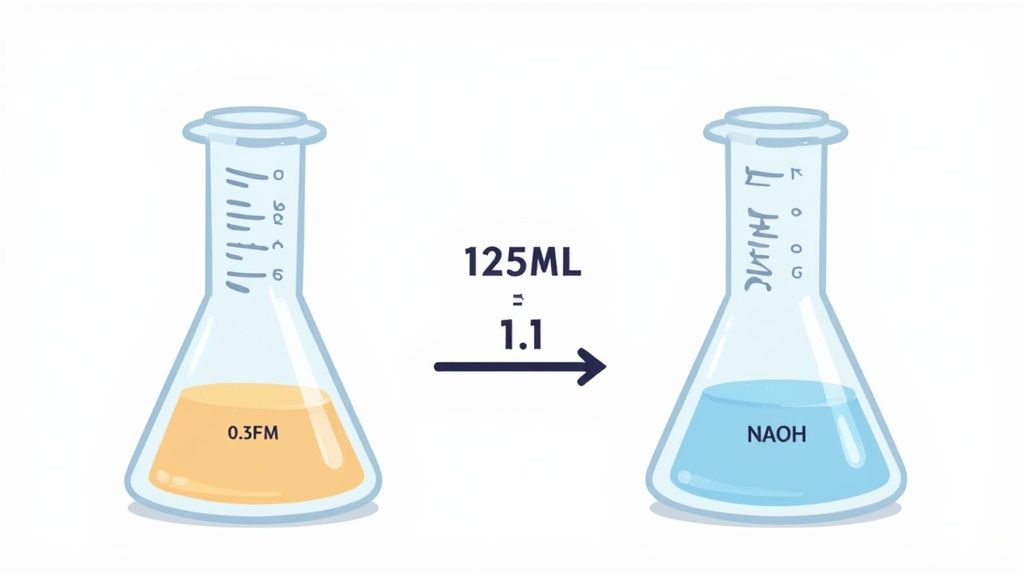
The core principle remains the same: use a balanced equation's mole ratio to bridge two different substances. The new skill is using molarity and volume to find the number of moles before applying that ratio. Let's work through a classic acid-base neutralization reaction.
Problem
Given the balanced chemical equation for the neutralization of hydrochloric acid with sodium hydroxide:
HCl (aq) + NaOH (aq) → NaCl (aq) + H₂O (l)
If it takes 50.0 mL of a 0.5 M HCl solution to completely neutralize a sample of 0.2 M NaOH solution, what volume of the NaOH solution was used?
Step-by-Step Solution
Identify the Given and the Goal:
- Given: 50.0 mL of 0.5 M HCl; Concentration of NaOH is 0.2 M.
- Goal: Find the volume of NaOH solution in mL.
Convert Volume to Liters: The molarity formula (M = mol/L) requires volume in liters.
50.0 mL × (1 L / 1000 mL) = 0.0500 L HClCalculate Moles of the Known Substance (HCl): Use the molarity formula rearranged to solve for moles (moles = Molarity × Volume).
Moles of HCl = 0.5 mol/L × 0.0500 L = 0.025 moles HClUse the Mole Ratio to Find Moles of NaOH: The balanced equation shows a 1:1 ratio between HCl and NaOH.
0.025 moles HCl × (1 mole NaOH / 1 mole HCl) = 0.025 moles NaOHCalculate the Volume of the Unknown Substance (NaOH): Use the molarity formula again, this time rearranged to solve for volume (Volume = moles / Molarity).
Volume of NaOH = 0.025 moles NaOH / 0.2 mol/L = 0.125 LConvert Volume Back to Milliliters: The question asks for the volume of NaOH, which is typically expressed in mL in a lab setting.
0.125 L × (1000 mL / 1 L) = 125 mL NaOH
Answer: 125 mL of the 0.2 M NaOH solution was used for the neutralization.
Strategy and Tips
- Liters are Law: Always convert milliliters (mL) to liters (L) before using the molarity formula. This is one of the most common sources of error in these stoichiometry practice problems with answers.
- Organize Your Data: Before you start, write down the molarity, volume, and moles for both the acid and the base. This helps keep your information straight and highlights what you need to find.
- The Bridge is Still Moles: Remember that you cannot convert directly from the volume of one solution to the volume of another. You must go through moles using the mole ratio from the balanced equation.
- Check Your Units: Ensure units cancel properly at each step. If you start with moles of HCl and want moles of NaOH, your conversion factor must have moles HCl in the denominator.
8. Empirical and Molecular Formula Determination from Stoichiometry (Advanced)
This advanced problem integrates several key chemistry concepts: combustion reactions, mass-to-mole conversions, and empirical formula calculations. You'll work backward from the mass of the products (CO₂ and H₂O) to determine the mole ratio of elements in the original reactant. This process, known as combustion analysis, is a classic experimental technique used to identify unknown organic compounds.
Combustion analysis problems are a true test of your stoichiometry skills because they require you to map a path from the mass of products back to the simplest whole-number ratio of atoms in a single reactant. It’s a multi-step puzzle that combines several calculations into one cohesive problem.
Problem
A 4.4 g sample of an unknown hydrocarbon (a compound containing only carbon and hydrogen) undergoes complete combustion, producing 13.2 g of carbon dioxide (CO₂) and 7.2 g of water (H₂O). The molar mass of the hydrocarbon is determined to be 44.0 g/mol. Determine the empirical and molecular formulas of the hydrocarbon.
Step-by-Step Solution
Find Moles of Carbon and Hydrogen:
- Moles of C from CO₂: First, convert the mass of CO₂ to moles of CO₂. The molar mass of CO₂ is 12.01 g/mol (C) + 2 * 16.00 g/mol (O) = 44.01 g/mol.
13.2 g CO₂ × (1 mol CO₂) / (44.01 g CO₂) = 0.300 mol CO₂ - Since there is 1 mole of C in every 1 mole of CO₂, the moles of carbon are the same:
0.300 mol C. - Moles of H from H₂O: Now, convert the mass of H₂O to moles. The molar mass of H₂O is 2 * 1.01 g/mol (H) + 16.00 g/mol (O) = 18.02 g/mol.
7.2 g H₂O × (1 mol H₂O) / (18.02 g H₂O) = 0.400 mol H₂O - Since there are 2 moles of H in every 1 mole of H₂O, you must multiply the moles of water by two:
0.400 mol H₂O × (2 mol H) / (1 mol H₂O) = 0.800 mol H.
- Moles of C from CO₂: First, convert the mass of CO₂ to moles of CO₂. The molar mass of CO₂ is 12.01 g/mol (C) + 2 * 16.00 g/mol (O) = 44.01 g/mol.
Determine the Empirical Formula:
- Now you have the mole ratio of the elements in the hydrocarbon: 0.300 mol C to 0.800 mol H.
- Divide both values by the smallest number of moles (0.300) to find the simplest ratio.
C: 0.300 / 0.300 = 1H: 0.800 / 0.300 = 2.66 - The ratio is C₁H₂.₆₆. To get whole numbers, multiply by 3:
1 * 3 = 3and2.66 * 3 ≈ 8. - The empirical formula is C₃H₈.
Determine the Molecular Formula:
- Calculate the molar mass of the empirical formula (C₃H₈):
(3 × 12.01 g/mol) + (8 × 1.01 g/mol) = 36.03 + 8.08 = 44.11 g/mol - Divide the given molecular mass by the empirical formula mass:
n = (Molecular Mass) / (Empirical Formula Mass) = 44.0 g/mol / 44.11 g/mol ≈ 1 - Since the ratio is 1, the molecular formula is the same as the empirical formula.
- Calculate the molar mass of the empirical formula (C₃H₈):
Answer: The empirical formula is C₃H₈, and the molecular formula is also C₃H₈ (propane).
Strategy and Tips
- Product to Element: The key is realizing all the carbon in the CO₂ product came from the original hydrocarbon, and all the hydrogen in the H₂O product also came from the hydrocarbon.
- Don't Forget the H₂O Ratio: A common mistake is forgetting to multiply the moles of water by two to get the moles of hydrogen atoms. Remember, each H₂O molecule contains two hydrogen atoms.
- Divide by Smallest: To find the simplest whole-number ratio for the empirical formula, always divide the mole amounts of each element by the smallest mole value you calculated.
- Whole Number Ratios: If dividing doesn't give you whole numbers, multiply by a small integer (2, 3, or 4) to clear the fractions (e.g., a ratio of 1.5 becomes 3 when multiplied by 2).
- Connect to Formulas: This type of problem is a great example of how stoichiometry is used in practice. For a deeper look, you can explore how to find the empirical formula for ascorbic acid using similar principles.
Comparison of 8 Stoichiometry Practice Problems (with Answers)
| Example | Implementation complexity | Resource requirements | Expected outcomes | Ideal use cases | Key advantages |
|---|---|---|---|---|---|
| Mole-to-Mole Stoichiometry: Combustion of Methane | Very low | Balanced equation, basic arithmetic | Compute product moles from given reactant moles | Introductory stoichiometry practice, classroom drills | Teaches fundamental mole ratios; quick confidence-building |
| Mass-to-Mass Stoichiometry: Sodium and Chlorine Reaction | Low–Moderate | Molar masses, calculator, unit conversions | Convert grams of reactant to grams of product | Laboratory-prep problems, bridging theory to lab | Applies stoichiometry to real masses; develops dimensional analysis |
| Limiting Reactant Problem: Aluminum and Oxygen Reaction | Moderate–High | Multiple reactant masses, molar masses, parallel calculations | Identify limiting reactant and theoretical yield | Complex lab scenarios, manufacturing efficiency lessons | Teaches constraint identification; prepares for yield/optimization |
| Percent Yield Problem: Iron Oxide Synthesis | Moderate | Theoretical yield calculation, experimental mass data | Calculate percent yield (efficiency) from actual vs theoretical | Laboratory result analysis, quality control exercises | Connects theory and experiment; introduces reaction efficiency |
| Gas Stoichiometry: Ideal Gas Law Integration | Moderate–High | Gas law constants, specified T/P conditions, molar volume | Determine gas volumes or moles using Avogadro/PV=nRT | Gas-phase reactions, industrial gas calculations, STP problems | Bridges stoichiometry and gas laws; simplifies volume-based problems |
| Sequential Reaction Stoichiometry: Multi-Step Synthesis | High | Multiple balanced equations, intermediate tracking, molar masses | Track intermediates to final product mass or moles | Multi-step synthesis, process design, synthesis planning | Models real manufacturing/synthesis chains; builds systematic reasoning |
| Molarity and Solution Stoichiometry: Acid-Base Neutralization | Low–Moderate | Molarity values, volumetric units, conversion between mL/L | Calculate required solution volumes or moles for neutralization | Titration practice, solution preparation, analytical labs | Directly applicable to titrations and solution work; practical lab skill |
| Empirical & Molecular Formula Determination from Combustion | High | Combustion product masses, molar masses, molar mass of compound | Determine empirical and molecular formulas of unknowns | Organic analysis, compound identification, research labs | Comprehensive application of stoichiometry; identifies unknown compounds |
Your Next Steps in Stoichiometry Mastery
Congratulations on working through this comprehensive set of stoichiometry practice problems with answers. You have navigated the foundational principles of chemical reactions, from simple mole-to-mole conversions to the more complex challenges presented by limiting reactants, percent yield, and solution stoichiometry. This journey has equipped you with the strategic frameworks necessary to deconstruct and solve a wide array of chemical calculations.
The most critical takeaway is that every stoichiometry problem, regardless of its apparent complexity, is built upon the same core principles. Mastering this subject is not about memorizing solutions; it's about internalizing a repeatable, logical process. By consistently applying the fundamental steps of converting to moles, using the balanced equation's mole ratio, and converting to the desired final units, you transform daunting problems into manageable tasks.
Recapping the Core Strategies
As you move forward, keep these essential strategies at the forefront of your problem-solving approach. They are your roadmap to success in any stoichiometry challenge you encounter.
- The Molar Bridge: Always remember that the mole ratio from the balanced chemical equation is the central connection between reactants and products. Your first goal is almost always to convert given quantities into moles to use this powerful bridge.
- Identify the Limiter: In problems involving multiple reactants, the concept of the limiting reactant is non-negotiable. It dictates the maximum possible amount of product that can be formed. Always perform the necessary calculations to identify it before determining theoretical yield.
- Units are Your Guide: Pay meticulous attention to units. Whether you're working with grams, liters of gas at STP, or molarity, letting your units guide your calculations is a foolproof way to ensure you are setting up the problem correctly and avoiding common conversion errors.
Solidifying Your Understanding: From Practice to Mastery
True mastery comes from consistent and varied practice. The problems in this article were designed to build a strong foundation, but the key to long-term retention is to challenge yourself further. This is how you develop the intuition to quickly identify the type of problem you're facing and select the most efficient strategy to solve it.
The value of mastering stoichiometry extends far beyond your next chemistry exam. These principles are fundamental to countless scientific and industrial processes, from pharmaceutical development and manufacturing to environmental science and materials engineering. Understanding these quantitative relationships gives you a deeper appreciation for how the world works on a molecular level.
Keep this guide as a reference, but don't let your learning stop here. Continue to seek out new stoichiometry practice problems with answers to test your skills. Each problem you solve is another step toward building unshakable confidence in your abilities. Stay curious, embrace the process, and you will soon find that what once seemed complicated has become second nature.
Feeling stuck on a specific homework question or need a personalized explanation for a problem not covered here? Don't let frustration derail your progress. Feen AI can act as your personal tutor, providing instant, step-by-step solutions for any stoichiometry problem you upload. Get the detailed guidance you need to understand the process and master the concepts at Feen AI.
Relevant articles

Explore chemistry dimensional analysis practice with 8 problem types and step-by-step solutions covering unit conversions, stoichiometry, redox, and more.