How to Study for a Chemistry Test: how to study for chemistry test and ace it
Learn how to study for chemistry test with a proven strategy. Master concepts, practice problems, and test-day tips to boost your score.

Let’s be real for a second. We’ve all been there: the night before a huge chemistry exam, staring at a mountain of notes, fueled by nothing but caffeine and sheer panic. Trying to jam an entire semester's worth of reactions, equations, and molecular structures into your brain is a classic rite of passage, but it’s also a surefire recipe for disaster.
The secret to acing chemistry isn't about pulling an all-nighter. It's about shifting your entire approach. Instead of a last-minute sprint, think of it as a steady, strategic climb. This means moving away from cramming and focusing on a smarter, three-part game plan: first, truly understanding the core principles, then actively solving problems, and finally, building a study plan that actually works.
This mindset shift turns studying from a source of dread into a process that genuinely builds your confidence.
Why Cramming for Chemistry Fails
We've all tried the brute-force method—hoping that if we just stare at our notes long enough, the information will somehow stick. And hey, sometimes for subjects heavy on pure memorization, you can squeak by. But with chemistry, that strategy consistently crashes and burns.
Why? Because chemistry isn’t just a list of random facts you can memorize. It’s a cumulative science, where every new concept is built firmly on top of the last one.
Think of it like building with LEGOs. You can't assemble a complex spaceship just by memorizing the shape of each individual brick. You have to understand how they snap together. In the same way, you can’t possibly solve a stoichiometry problem if you don't have a rock-solid grasp of what a mole is, which itself depends on understanding atomic mass. Cramming is like trying to memorize the bricks without ever learning how to build.
The Critical Shift from Surface to Deep Learning
This is where we need to talk about the difference between "surface learning" and "deep learning." Most students get stuck in the surface-level stuff: rereading notes, highlighting half the textbook, and making flashcards for definitions. It feels productive, but it doesn't lead to real understanding.
Deep learning, on the other hand, is about getting your hands dirty. It’s about actively wrestling with the material—connecting different ideas, constantly asking "why" something works the way it does, and using what you know to tackle problems you haven't seen before.
The data backs this up, big time. A 2021 study of general chemistry students found a massive gap in outcomes: those who used deep learning strategies had success odds of up to 86.9%. Meanwhile, students stuck in surface-level habits? Their success rates dropped to just 66.5%. The takeaway is crystal clear: true comprehension is what gets you through chemistry, not just memorizing facts.
The goal isn't just to remember information long enough to spit it out on the test. It's to build a mental framework that lets you analyze, predict, and solve problems you’ve never encountered. That's what mastery in chemistry really looks like.
Making this fundamental shift is the core of any study plan that works. For a broader look at this philosophy, our guide on how to study efficiently for exams offers more techniques that apply to any subject.
A Smarter Path Forward
So, what does this actually look like day-to-day? Instead of passively rereading a chapter for the third time, you spend that hour working through tough practice problems, sketching out a concept map to connect reaction types, or trying to explain a tricky process to a friend (or even just your dog).
To make this distinction clearer, let's compare these two approaches side-by-side.
Surface Learning vs Deep Learning for Chemistry
Most of us default to surface-level habits because they feel easier, but they don't create the strong neural pathways needed for chemistry. Here’s how to spot the difference and make the switch.
| Study Habit Category | Ineffective Surface Habit (Avoid This) | Effective Deep Habit (Do This Instead) |
|---|---|---|
| Reviewing Notes | Passively rereading highlighted text and lecture slides over and over again. | Actively summarizing notes in your own words or creating a one-page "cheat sheet." |
| Using Textbooks | Skimming the chapter summary and looking at solved examples without trying them. | Working through end-of-chapter problems with the book closed first, then checking your work. |
| Memorization | Trying to memorize every formula and reaction without context. | Understanding the principles behind a formula and practicing when and how to apply it. |
Ultimately, by embracing these deep learning habits, you stop being a passive observer and become an active participant in your education. This proactive approach doesn't just boost your grades—it also gets rid of the anxiety that comes from leaving everything to the last minute.
Designing Your Personal Study Blueprint
Telling yourself to "study for chemistry" is like telling a pilot to just "fly the plane"—it’s a recipe for disaster without a flight plan. Vague goals lead to disorganized, stressful study sessions where you just sort of float around your notes without getting anywhere. The trick is to shift from panicking and reacting to proactively building a personal study blueprint.
This isn't about magically finding more hours in the day. It’s about making the hours you already have actually count. When you map out what to cover and when, that mountain of a task suddenly breaks down into a series of small, manageable hills. This plan becomes your roadmap, guiding you through tricky topics so nothing falls through the cracks.
Building Your Two-Week Study Calendar
Let's make this real. Your final is two weeks out and it covers three big units: stoichiometry, gas laws, and thermodynamics. A caffeine-fueled all-nighter is not the answer. Instead, let's build a schedule that actually works with your brain.
Here’s what that might look like:
- Week 1 (Days 1–3) — Stoichiometry: Dedicate these first few days to the fundamentals—moles, molar mass, and limiting reactants. Each day, aim for 30 minutes of pure concept review followed by 45 minutes of grinding through practice problems.
- Week 1 (Days 4–6) — Gas Laws: Now, pivot to gas laws (Boyle's, Charles's, and the Ideal Gas Law). Stick to the same review-then-practice pattern. On Day 6, throw in a mixed review of stoichiometry and gas laws to start connecting the dots.
- Week 2 (Days 7–9) — Thermodynamics: Time to tackle enthalpy, entropy, and Gibbs free energy. These concepts can be a bit abstract, so you might need more time absorbing the principles before you even touch a calculator.
- Week 2 (Days 10–13) — Putting It All Together: This is where you integrate everything. Use these days for mixed problem sets, old exams, and zeroing in on the weak spots you identified earlier.
- Week 2 (Day 14) — Final Review: No cramming! Create a single-page "cheat sheet" (for your brain, not the test!) with the most critical formulas and ideas. Do a light review, then get a good night's sleep.
This whole process is about shifting from cramming to deep learning, which is a much more effective way to actually retain information.
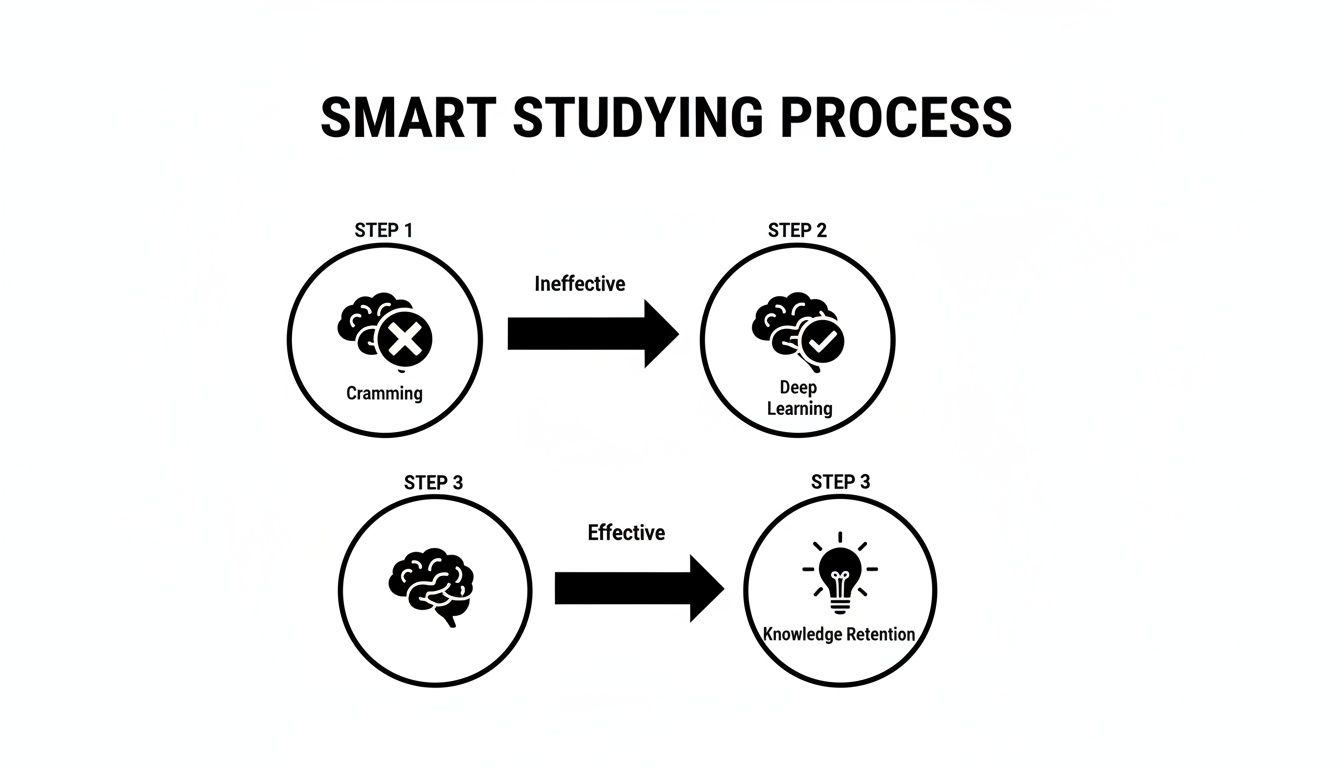
As you can see, effective studying is a deliberate process, not a last-minute scramble.
Weaving in Spaced Repetition and Focused Work
A good study calendar is more than just a list of topics. It needs to be built around methods that actually help your brain hang onto information. Two of the best are spaced repetition and the Pomodoro Technique.
Spaced repetition is all about interrupting the "forgetting curve." Instead of studying stoichiometry on Day 1 and never looking back, you'd briefly review it again on Day 4, and maybe again on Day 8. Each time you revisit it, you push that information deeper into your long-term memory.
Then there's the Pomodoro Technique, a lifesaver for maintaining focus. The method is incredibly simple:
- Pick one task (e.g., "solve five gas law problems").
- Set a timer for 25 minutes and work on only that task. No phone, no distractions.
- When the timer goes off, take a 5-minute break. Stretch, get water, do anything but study.
- After four of these cycles, take a longer 15-30 minute break.
This approach keeps you from burning out and makes a three-hour study block feel way less intimidating. If you really want to level up, look into other strategies to work smarter, not harder.
Building a consistent routine isn't just a nice idea—it's backed by science. Research consistently shows that how you study is just as critical as how long you study.
In fact, a 2023 study found that for every single unit improvement in a student's study habits, their performance in chemistry jumped by 20.3%. That’s proof that a structured approach gives you a massive advantage.
Use your syllabus as your guide. It tells you exactly what the professor thinks is important and where the points are. Prioritize those high-value topics in your schedule, and you’ll be focusing your energy where it makes the biggest difference.
Ditch the Flashcards, Build Real Understanding
Let's be honest: you can't just memorize your way through a chemistry exam and expect a good grade. The best students don't have photographic memories; they have a deep, connected understanding of the core concepts. They've built a mental framework that lets them solve problems they've never seen before.
This is all about shifting from passive review to active learning. Rereading your notes over and over is passive. Your brain isn't really doing the heavy lifting. To truly master the material, you have to engage with it, wrestle with it, and make it your own. The difference between active versus passive learning is everything when it comes to a subject like chemistry.
So, how do you do that? It comes down to a few powerful techniques that force your brain to connect the dots.
Map It Out to See the Big Picture
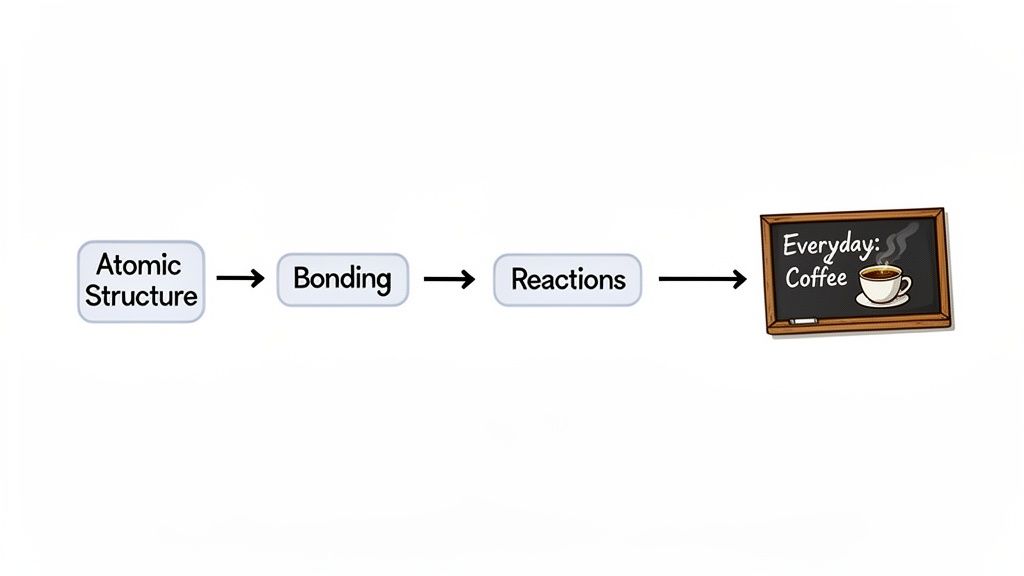
Nothing in chemistry exists in a vacuum. Atomic structure determines chemical bonding, which in turn dictates how reactions happen. A concept map is a fantastic tool for visualizing these critical links.
Grab a blank sheet of paper and put a central idea, like “Chemical Bonding,” right in the middle. From there, start branching out. Draw lines to related concepts like “Ionic Bonds,” “Covalent Bonds,” and “Electronegativity.” Then go deeper. Under “Ionic Bonds,” you might add a note about the "transfer of electrons" and draw another line connecting it back to your school notes on "ions" or "atomic structure."
This isn't just about making pretty diagrams. The act of creating the map forces you to articulate exactly how these ideas relate, turning a jumble of facts into a cohesive web of knowledge. It’s one of the best ways I know to organize your thoughts before a big test.
Test Your Knowledge with the Feynman Technique
If you can't explain something simply, you don't really understand it. That's the core principle behind the Feynman Technique, a deceptively simple method named after the brilliant physicist Richard Feynman.
Pick a tough concept, like Le Châtelier's Principle, and try it out:
- Grab a blank page and write the name of the concept at the top.
- Explain it in plain English. Pretend you’re teaching it to a friend who has never heard of it. Avoid jargon. You might start with something like, "Okay, so if a reaction is stable and you mess with it—like by changing the temperature—it's going to shift to undo what you just did."
- Find where you get stuck. You'll inevitably hit a wall where your explanation gets vague or you can't quite remember the details. That’s the good part! You’ve just pinpointed the exact edge of your understanding.
- Fill in the gaps. Go back to your textbook, notes, or ask Feen AI for a quick, clear explanation of that specific point. Once you get it, go back and fix your simple explanation.
Keep at it until you have a clear, simple, and accurate explanation. You'll find the concept is cemented in your mind in a way that just rereading the definition could never achieve.
The real test of knowledge is not whether you can remember something, but whether you can explain it. The Feynman Technique forces you to confront what you truly know versus what you’ve only memorized.
Connect Chemistry to Your Daily Life
Abstract principles are so much easier to remember when they're anchored to something real. This isn't just a gimmick; it actually creates more pathways in your brain to access the information when you're under pressure during a test.
Start looking for chemistry in the world around you. Your morning coffee? That’s all about solution chemistry—solubility, concentration, and extraction. The battery in your phone is a masterclass in electrochemistry and redox reactions.
When you start making these connections, the concepts become tangible and far more memorable. For example, if you’re getting bogged down in organic chemistry, try relating the different functional groups to things you see every day. For more ideas on how to do this, our organic chemistry study guide is packed with real-world examples.
With this approach, you stop studying for a test and start learning to see the world like a chemist.
Get Your Hands Dirty with Active Problem-Solving
Reading about chemical principles is one thing; actually using them to solve a tricky, multi-step problem with the clock ticking is another world entirely. Real mastery in chemistry isn’t born from passive reading. It’s built when you roll up your sleeves and move from theory to application.
This is why active problem-solving is, without a doubt, the most effective way to prepare for a chemistry test. You have to wrestle with the questions, make mistakes, and—most importantly—learn from them. This process forges the mental pathways you'll need to rely on when you're staring down a real exam.
Start with the Basics, Then Raise the Bar
Diving headfirst into a full-blown practice exam without a solid grasp of the fundamentals can be a recipe for frustration. It's much smarter to build up your skills—and your confidence—progressively.
Kick things off with the end-of-chapter problems in your textbook. These questions are there for a reason; they're designed to drill the concepts you've just covered in a pretty direct way. Think of it as your warm-up. At this stage, your goal isn't speed, but accuracy and truly understanding the why behind each step.
For instance, if you're tackling stoichiometry, you'd start with simple mole-to-gram conversions before trying to figure out complex limiting reactant problems. If you need more of these foundational questions, you can find a good variety of stoichiometry practice problems with answers to build your base.
Once those foundational problems start to feel comfortable, it’s time to level up. Hunt down past quizzes or old exams from your professor. This is your first taste of the real thing. You'll get a feel for the question style, the difficulty, and the time pressure you can expect on test day.
Building your problem-solving skills is a gradual process. The key is to start with manageable challenges and increase the difficulty as you gain confidence, moving from simple recall to complex application.
A Progressive Chemistry Practice Plan
| Practice Stage | Objective | Example Activity | Feen AI Application |
|---|---|---|---|
| Foundational Drill | Reinforce core concepts and procedures. | Completing end-of-chapter textbook problems. | Snap a picture of a problem you're stuck on to get a step-by-step explanation. |
| Concept Application | Apply knowledge to varied, single-topic questions. | Working through focused problem sets or online quizzes. | Ask for five more practice problems on "limiting reactants" to solidify your skills. |
| Integrated Practice | Combine multiple concepts to solve complex problems. | Using past quiz questions that cover several topics. | Upload a photo of your notes and ask Feen AI to generate exam-style questions from them. |
| Exam Simulation | Replicate test-day conditions for timing and pressure. | Taking a full-length past exam under a strict time limit. | After the mock exam, ask for a summary of the key concepts you missed to guide your final review. |
This tiered approach ensures you’re not just memorizing steps but actually developing the critical thinking skills needed to excel.
Don't Just Check the Answer—Analyze Your Mistakes
This is one of the biggest mistakes I see students make. They do a problem, see they got it wrong, glance at the solution, and just move on. A wrong answer isn't a failure; it's a fantastic learning opportunity.
When you miss a question, put on your detective hat and perform a "mistake autopsy." Ask yourself:
- Was it a simple calculation error? Did I just punch a number into my calculator wrong? It happens.
- Was it a conceptual misunderstanding? Did I use the wrong formula or completely misread what the question was asking for?
- Was it a process mistake? Did I forget a crucial step, like balancing the equation or converting all my units correctly?
Pinpointing the exact source of your error is everything. If it's a conceptual gap, you know you need to go back to your notes or get a clearer explanation from a tool like Feen AI. This kind of targeted review is way more effective than just re-reading an entire chapter hoping you absorb it this time.
Simply doing problems isn't enough. The real learning happens when you deeply analyze why you made a mistake and actively work to fix that specific gap in your knowledge.
The Undeniable Power of Consistent Practice
The idea that frequent, low-stakes practice is the key to success isn't just a hunch—it's backed by some serious data. A massive 24-year study that followed nearly 20,000 chemistry students found that active learning interventions, like holding short chapter quizzes every 10 days, had a stunning impact.
In one part of the program, these regular practice sessions caused pass rates to jump from 31% to an incredible 60%. This long-term research confirms that consistent, active problem-solving is one of the most powerful study strategies you can adopt. You can dive deeper into the data from this long-term chemistry education study.
Working in a study group can make this even more effective. Trying to explain how you solved a problem to a classmate is one of the best ways to lock in your own understanding. Plus, when you get stuck, a fresh perspective from a friend can help you break through a mental block you've been hitting a wall on.
Your Final 48-Hour and Test Day Game Plan
The final stretch before a chemistry test isn't about learning new material. Seriously, that ship has sailed. Your brain needs this time to consolidate everything you’ve worked so hard on. Trying to cram new concepts in the last 48 hours is just a recipe for anxiety and confusion, and it can actually interfere with the solid knowledge you've already built.
At this point, your goal shifts to strategic review and getting your head in the game. Think of it as sharpening your tools, not building new ones. You’ll perform your best when you walk into that exam feeling calm, confident, and well-rested—not frazzled from a last-minute panic.
Consolidate Your Knowledge
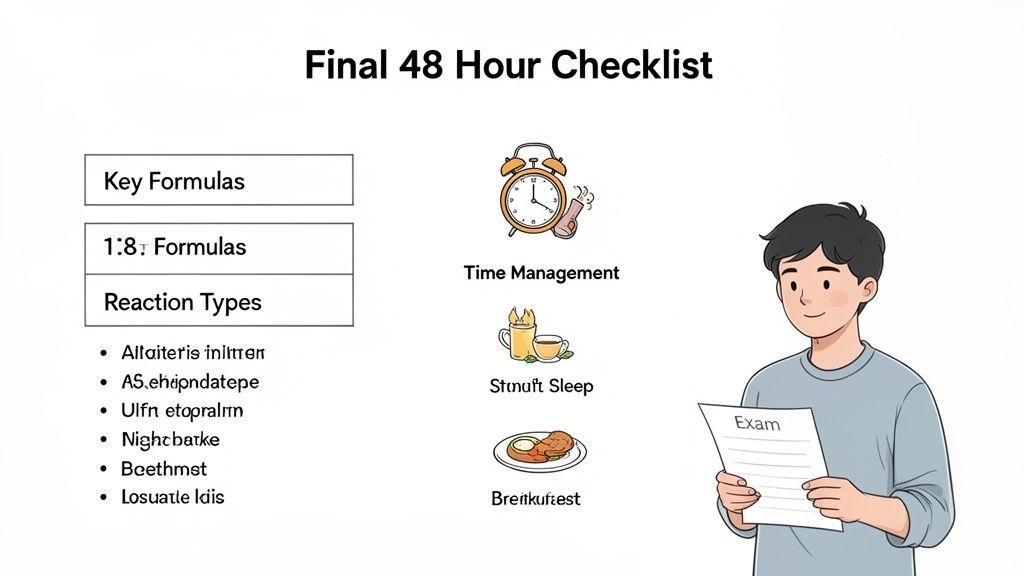
The day before the exam, I always tell my students to create a single-page "master review sheet." This isn't about re-learning anything; it's a tool for quick recall. The very act of creating it forces you to boil down weeks of material into the absolute essentials, which is a powerful study technique in itself.
Your master sheet should be concise. Stick to the highlights:
- Key Formulas: Jot down the big ones you know you'll need, like the Ideal Gas Law (PV=nRT) or Gibbs Free Energy (ΔG = ΔH - TΔS).
- Core Concepts: Write brief, one-sentence reminders for major ideas. Think Le Châtelier's Principle or the rules for assigning oxidation states.
- Reaction Types: List the main categories you covered (e.g., acid-base, redox, precipitation) and maybe include one classic example for each.
Once this sheet is done, put your textbook and dense notes away. For real. Spend your remaining study time lightly reviewing this sheet and maybe working through a few familiar practice problems just to keep your problem-solving muscles warm.
Your final day of preparation should be about building confidence, not cramming content. Trust the work you've put in and focus on consolidating that knowledge into an accessible mental toolkit for the test.
Master Your Test-Taking Strategy
Knowing the material is only half the battle. How you actually navigate the test is just as critical. I've seen countless students lose points not because they didn't know the answer, but because of poor time management or test-day anxiety.
When the proctor says "begin," resist the urge to dive into question one immediately. Instead, take two full minutes to scan the entire exam. This gives you a mental map of the terrain. You can spot the questions you know you can nail right away and get a feel for the overall structure.
From there, I recommend a three-pass approach:
- First Pass (Easy Wins): Go through the entire test and answer every question you feel absolutely confident about. This banks easy points and builds momentum.
- Second Pass (The Thinkers): Now, circle back to the questions that require more thought or complex calculations. You’ll be calmer and have a much better sense of your remaining time.
- Third Pass (The Educated Guesses): In the final minutes, tackle the absolute hardest problems. If you're completely stuck, make an educated guess (as long as there’s no penalty for wrong answers).
Your Test Day Morning Routine
How you spend the morning of your exam has a huge impact on your performance. The goal is to arrive calm and focused. The number one rule? Do not cram. A last-minute frantic review will only spike your anxiety.
Instead, prioritize your well-being. Eat a balanced breakfast with protein and complex carbs—think eggs and whole-wheat toast, not a sugary donut—to keep your energy stable. Give yourself plenty of extra time to get to the exam so you aren’t rushing.
Walk into that room knowing you’ve prepared thoroughly. You're ready to show what you know.
Frequently Asked Questions About Studying Chemistry
Even the best study plan hits a snag. You’re deep into stoichiometry, and suddenly a question pops up that wasn't in your notes. You're not alone. When it comes to chemistry, certain hurdles seem to trip everyone up, from how to tackle a massive cumulative final to keeping your cool when the exam timer starts.
Let’s get into the nitty-gritty and answer some of the most common questions I hear from students. Getting these details right can be the difference between walking into your test with confidence and feeling like you're just guessing.
How Should I Study for a Cumulative Chemistry Final?
A cumulative final feels like a mountain, but you don't have to climb it all at once. The goal is smart, targeted review, not re-learning an entire semester's worth of material. Your old tests and homework are your treasure map—they point directly to the concepts that gave you trouble the first time around. Start there.
Instead of just flipping through old chapters, try creating a "master summary sheet" for each major unit. This isn't about copying your notes; it's about condensing everything down to its absolute core. For each unit, jot down:
- The Big Idea: What’s the one-sentence takeaway? (e.g., "Le Châtelier's Principle explains how a system at equilibrium pushes back against change.")
- Essential Formulas: List the equations you used over and over again.
- A Classic Problem: Find one or two problems that perfectly capture the skill from that unit.
Spaced repetition is your best friend for keeping old material fresh. Maybe on Monday, you review chapters 1-3. On Tuesday, you hit chapters 4-6. Then on Wednesday, you do a mixed quiz covering all six. This forces your brain to pull that information from long-term memory, which is exactly what you need to do on the final.
When you're facing a cumulative exam, think consolidation, not cramming. Spend 80% of your time on the major themes and the types of problems that showed up repeatedly. The final is designed to test your grasp of the big picture, not some obscure detail from week two.
This is also a perfect time to bring in a tool like Feen AI. Instead of spending hours re-reading, you can upload PDFs of your notes or textbook chapters and ask it to pull out the key concepts. This frees you up to spend less time reviewing and more time actively solving problems.
What Is the Best Way to Memorize Chemistry Formulas?
Honestly? Don't. Pure memorization is brittle; it shatters under pressure. The real trick is to understand the story behind the formula. When you get the 'why,' the 'what' sticks in your brain without you having to force it.
Take the Ideal Gas Law (PV=nRT). Don't just drill the letters. Think about the relationships. Ask yourself, "If I crank up the temperature (T) but keep the volume (V) the same, what has to happen to the pressure (P)?" You can almost feel the gas molecules bouncing around faster, hitting the container walls harder. That intuitive understanding is way more durable than rote memorization.
The same goes for reactions. Instead of memorizing a million individual reactions, learn to recognize the families: acid-base neutralizations, redox reactions, precipitation reactions. They each have a distinct pattern. Once you can spot the pattern, you can predict the outcome, even with chemicals you haven't seen before.
If you like flashcards, make them active. Put a sample problem on one side. On the other, write out the complete, step-by-step solution, explaining your thought process as you go. The act of writing and problem-solving locks the information in your head much better than just staring at a list.
How Can I Manage My Test Anxiety?
Test anxiety is real, especially in a subject as demanding as chemistry. It usually stems from a fear of the unknown. So, the best way to fight it is to make the test environment feel as familiar as possible before you even walk into the room.
Start practicing under the gun. Set a timer. Give yourself 20 minutes to knock out five problems from an old exam. Doing this regularly accomplishes two huge things: it gets you used to the pressure of the clock, and it proves to yourself that you can perform when it counts. Confidence is the ultimate antidote to anxiety.
In the days leading up to the test, try some simple mindfulness exercises. If you feel that wave of panic rising during the exam, just stop. Put your pencil down. Close your eyes and take three slow, deep breaths. It only takes 30 seconds, but that tiny reset can be enough to break the anxiety spiral and let you think clearly again.
A great test-day strategy is to scan the entire exam first. Find the questions you know you can nail and do those immediately. Bagging those easy points builds momentum and makes the tougher problems feel a lot less intimidating when you circle back to them.
Can Feen AI Help with My Lab Report?
Absolutely. Lab reports are tough because you have to connect abstract theories to your messy, real-world data. This is where a tool like Feen AI really shines.
Let's say you're stuck on your titration lab report. Your results seem off, and you're not sure why. Instead of falling down a Google rabbit hole, you can upload your lab data or even just snap a photo of the part that's confusing you. Then, you can ask questions that are specific to your experiment.
For example, you could ask:
- "Here's my titration data. Can you walk me through calculating the molarity of the acid?"
- "My result is a bit different from the theoretical value. What are some likely sources of error in this experiment that could explain that?"
- "Why did we use this specific indicator for this reaction? What does it do?"
The AI gives you a step-by-step walkthrough using your own numbers. It's like having a teaching assistant on demand. This doesn't just help you finish the report; it actually helps you understand the concepts on a deeper level, which is a huge win for your next test.
Ready to make studying for your next chemistry test less stressful and more effective? Feen AI can help you understand complex topics, solve tough problems, and get personalized help whenever you're stuck. Stop staring at your textbook and start getting the clear explanations you need. Try Feen AI for free today!
Relevant articles

Master how to study for biology exam with proven methods: active recall, spaced repetition, and practice questions to boost mastery and scores.

Unlock the best way to study for finals with 10 evidence-based strategies. Our guide covers everything from active recall to using Feen AI for success.

Discover the best way to study chemistry with our top 10 actionable strategies. Master concepts from stoichiometry to organic chem and boost your grades.
Discover how to improve test taking skills with proven strategies. Learn study techniques, anxiety management, and ways to analyze mistakes for better grades.

Discover how to study efficiently for exams with proven, science-backed techniques, smarter planning, and tools that boost memory and reduce stress.

Discover how to study a textbook with active recall, smart notes, and proven strategies to boost memory and ace exams.