Top 10 College Essay Writing Tips That Actually Work in 2026
Unlock your potential with our top college essay writing tips. Learn how to brainstorm, structure, and revise your way to an unforgettable application essay.

The college essay can feel like the most daunting part of your application. How do you condense your life, personality, and ambitions into just 650 words? It’s not about finding the 'perfect' topic; it's about telling a compelling story in your authentic voice. This guide provides actionable, no-nonsense college essay writing tips designed to help you move past clichés and craft a narrative that truly stands out to admissions officers. We will cover everything from finding your core message and structuring your story to polishing your final draft with precision.
These aren't just abstract ideas, they are concrete strategies you can implement today. To effectively master your college essay, it's also highly beneficial to examine powerful personal statement examples that have succeeded for college, grad school, and scholarships.
By combining proven techniques with successful models, you can develop a clear roadmap. This listicle will break down the essential steps for brainstorming, drafting, and revising, ensuring the final piece you submit is a powerful and memorable reflection of who you are. Let's transform that blank page into an unforgettable story.
1. Start with a Strong, Personal Hook
An admissions officer reads hundreds, if not thousands, of essays. Your first sentence is your only chance to make a first impression and convince them yours is worth their full attention. A strong, personal hook grabs the reader immediately by dropping them into a specific moment, posing a compelling question, or presenting a surprising observation that demands further explanation.

This technique sets the tone and establishes your unique voice from the very beginning. Instead of a generic opening like "I have always been interested in science," a powerful hook makes your story feel immediate and important. It’s the difference between telling the reader you’re a leader and showing them a moment where you led.
How to Craft a Winning Hook
A great hook creates curiosity. It’s a puzzle piece that makes the reader want to see the full picture. Consider these approaches as you brainstorm your opening:
- Vivid Scene: Describe a specific moment using sensory details. Instead of "I learned to be resilient at summer camp," try: "The splintered paddle dug into my palms as the canoe tipped, plunging me into the icy Maine lake."
- Intriguing Dialogue: Start with a line of conversation that reveals conflict or character. For example: "'You can't major in philosophy,' my father declared, 'there are no jobs in it.'"
- Surprising Realization: Open with a counterintuitive thought that shows your unique perspective. An example could be: "I learned more about physics from baking cakes with my grandmother than I ever did in a classroom."
Putting Your Hook to the Test
To ensure your opening is effective, test it. Ask yourself: if I were a busy admissions officer, would this sentence make me stop scrolling and lean in? One of the most useful college essay writing tips is to write 3-5 different hooks for your story. Read them aloud to see which one sounds the most natural and engaging. This simple exercise can transform your essay from forgettable to memorable.
2. Show, Don't Tell – Use Specific Examples and Details
Admissions officers want to understand who you are, not just be told. The principle of "show, don't tell" is the most effective way to bring your personality and experiences to life. Instead of making abstract claims about your character, you demonstrate your qualities through vivid stories, sensory details, and specific actions, allowing the reader to reach their own conclusions.

This technique is crucial because it builds credibility and makes your narrative more engaging. A statement like "I am a determined leader" is forgettable, but a story about how you rallied your robotics team after a critical failure is compelling. It offers proof of your leadership in a way a simple declaration never could.
How to Turn Telling into Showing
The key is to replace broad statements with concrete evidence from your life. Think like a film director and create a scene for the reader. Consider these transformative examples:
- Instead of: "I love science." Try: "The acrid smell of sulfur filled the lab as I carefully titrated the solution, watching for the exact moment the liquid would shift from clear to a pale, triumphant pink."
- Instead of: "I am culturally aware." Try: "Sharing a meal of homemade injera with my host family in Addis Ababa, I learned that community was built not just through words, but through the simple act of breaking bread together."
- Instead of: "I overcame adversity." Try: "My hands shook as I gripped the podium, the speech I had practiced for weeks now a blur. I took a deep breath, found my best friend's face in the crowd, and began."
Putting Your Descriptions to the Test
To make sure you are showing effectively, review your draft and highlight any general claims about your personality. Ask yourself: where in this essay do I prove this quality? One of the best college essay writing tips is to use AI tools for feedback. Upload your draft to Feen AI and ask it to identify sentences that "tell." The AI can pinpoint abstract claims and help you brainstorm specific memories or sensory details to replace them, ensuring your story is both believable and memorable.
3. Develop a Clear, Coherent Narrative Arc
The most compelling college essays aren't just collections of impressive facts; they are stories. A strong narrative arc structures your essay with a clear beginning, middle, and end that logically moves the reader toward a realization or moment of growth. This progression keeps admissions officers engaged and showcases your capacity for self-reflection.
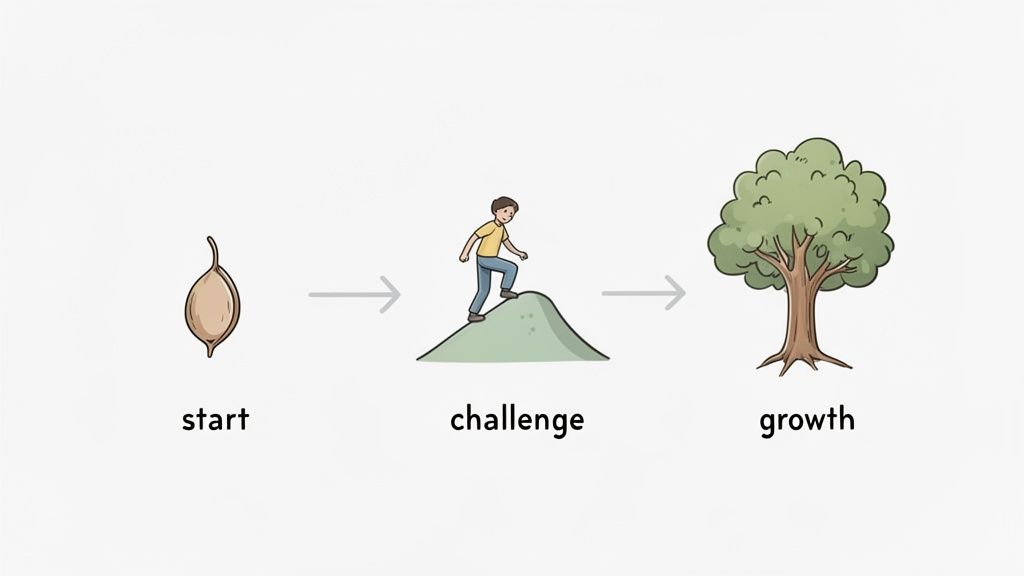
Think of your story as a journey. You start at one point (the beginning), encounter a challenge or experience (the middle), and emerge changed or with a new understanding (the end). This structure demonstrates personal development, a key quality colleges look for.
How to Build Your Narrative
A strong arc doesn't have to be overly dramatic. It simply needs to show change. Consider these common frameworks as you outline your story:
- Skill Development: Begin with initial intimidation in robotics club, describe the gradual skill-building process, and culminate in a leadership moment that reveals your new understanding of persistence.
- Identity Exploration: Start with childhood confusion about your cultural background, pinpoint a pivotal event that forced you to reflect, and conclude with an embrace of your dual heritage.
- Overcoming Failure: Open with your initial confidence before a big test, describe the setback of failing, and show how you regrouped, reflected, and developed a more resilient approach to learning.
Putting Your Arc to the Test
To ensure your narrative is clear, outline it first. A useful tip is to describe your story's progression beat-by-beat. Ask yourself: is the turning point obvious? Does the conclusion clearly reflect growth from the starting point and tie everything together? A well-structured narrative is one of the most effective college essay writing tips because it transforms a simple anecdote into a powerful story of personal growth.
4. Write in Your Authentic Voice and Avoid Clichés
Admissions officers want to meet the real you, not a formal, walking thesaurus. Your authentic voice is your unique personality translated onto the page, encompassing your humor, vocabulary, and perspective. Resisting the urge to sound overly academic or adopt an artificial "essay voice" allows your genuine character to shine through, creating a memorable connection with the reader.
This approach means writing in a way that feels natural to you. If you’re known for your witty observations, let that humor appear in your essay. Authenticity also requires avoiding tired clichés like "I'm passionate about making a difference" or "I learned the value of hard work." These phrases are so common they become invisible, robbing your story of its power.
How to Find Your Authentic Voice
Your voice emerges when your writing aligns with how you think and speak. The goal is to sound like the best version of your conversational self: clear, thoughtful, and distinct. Consider these strategies:
- Specific Over General: Instead of "I'm a people person," describe a specific interaction: "I spent an hour helping a nervous freshman find her locker, even though it made me late for my own class."
- Use Your Language: Incorporate vocabulary and cultural references that are genuine to you. If you think in terms of metaphors from your favorite video game, use them to explain a complex idea.
- Embrace Your Personality: If you are naturally funny, let it show. If you are deeply introspective, let your reflective tone guide the essay. Don't force a persona that isn't yours.
Putting Your Voice to the Test
To ensure you’re being genuine, you need to hear your words. Reading your draft aloud is one of the most effective college essay writing tips. Ask yourself: does this sound like me? A key aspect of this process is mastering tone and voice in writing to ensure your intended personality is what the reader actually experiences. If it feels stiff or unfamiliar, rewrite the sentence as if you were telling the story to a friend. This simple check can be the difference between a flat essay and one that truly feels alive.
5. Clearly Connect Your Essay to the Specific Prompt
Many colleges use unique essay prompts for a reason: they want to learn something specific about you. Admissions officers can easily spot a generic, recycled essay that fails to address their question. Connecting your narrative directly to the prompt shows you are a thoughtful, attentive applicant who is genuinely interested in their specific institution.
This demonstrates more than just good reading comprehension; it proves your respect for the college's process. Instead of submitting a well-written but irrelevant story, your essay should feel like a direct response in a conversation, tailored precisely to what was asked. This is one of the most critical college essay writing tips for making a targeted impact.
How to Align Your Essay with the Prompt
Your goal is to weave the prompt’s core question into the fabric of your story. This ensures every paragraph serves the central purpose of answering their question with your personal experience.
- Deconstruct the Prompt: Identify the key verbs and nouns. If a prompt asks you to "describe a challenge and its impact on you," your essay must explicitly detail both the "challenge" and the "impact."
- Be Specific to the School: If asked "Why this college?", name specific professors, unique courses, or campus organizations. Instead of "Your biology program is great," write "I'm eager to contribute to Dr. Anya Sharma's research on CRISPR technology."
- Translate Personal Stories: Frame your experiences as answers. If the prompt is about community, don't just tell a story about your soccer team; explain how that experience prepared you to contribute to that college's specific campus culture.
Putting Your Alignment to the Test
To ensure your essay is on-target, have a friend or teacher read the prompt first, then your essay. Ask them, "Did my essay answer this question directly?" For a high-tech check, copy the prompt into an AI chat and ask it to verify that your draft addresses the core questions. This simple step can reveal where your narrative might drift, allowing you to refocus it for maximum effect.
6. Revise and Edit Ruthlessly for Clarity and Impact
Your first draft is just the starting point; the real magic happens during revision. A polished college essay requires multiple rounds of editing focused on improving clarity, removing unnecessary words, and strengthening sentences. Ruthless editing means being willing to cut well-written phrases or even entire paragraphs if they don't serve the core narrative and maximize your impact within the strict word count.
This process transforms your essay from a good story into a powerful statement. Every word must earn its place. Instead of telling the admissions committee something was important, your concise and impactful prose will show them exactly why it mattered.
How to Edit for Maximum Impact
Effective editing is about more than just fixing typos; it's about refining your message. It’s the difference between a story that meanders and one that drives purposefully toward its conclusion. Consider these revision strategies:
- Condense Vague Statements: Sharpen generic sentences to be more specific and powerful. Instead of "The experience was very important to me and taught me a lot," try: "Through that failure, I learned humility."
- Strengthen Word Choice: Replace weak, common words with more descriptive alternatives. Swap a word like "nice" for more vivid options such as "meticulous," "chaotic," or "enlightening" to paint a clearer picture.
- Eliminate Redundancy: Cut sentences or phrases that repeat ideas already expressed. If you’ve already shown your dedication through an anecdote, you don't need a concluding sentence that says, "This shows I am a dedicated person."
Putting Your Editing Skills to the Test
To ensure your essay is as tight as possible, read it aloud to catch awkward phrasing. Another one of the most effective college essay writing tips is to get feedback from a trusted teacher or mentor. Ask them to identify any sentences that are confusing or sections that slow the story down. This ruthless approach ensures every single word contributes to a compelling and memorable essay.
7. Focus on Personal Growth and Self-Reflection
Admissions committees care less about the event you describe and more about how that event shaped you. Your essay shouldn’t just be a narrative of what happened; it must showcase how you grew from the experience. This demonstrates maturity, self-awareness, and the ability to find meaning in your life, all critical traits for a successful college student.

The core of a powerful essay is the change it reveals. It’s the shift in your perspective, the new understanding you gained, or the resilience you discovered within yourself. This focus on reflection is one of the most vital college essay writing tips because it answers the "so what?" question that every admissions officer has in mind.
How to Showcase Growth
Effective reflection connects your past experiences to your present self. The goal is to show the admissions officer the "before" and "after" version of you. Consider these approaches to frame your story:
- Failure to Insight: Describe a time you failed in a leadership role and what it taught you about humility. For example: "I thought being captain meant having all the answers. I learned it really means knowing how to listen to the team."
- Perspective Shift: Detail a moment that changed your worldview. An essay about realizing a certain privilege could reflect on how that awareness now informs your actions and goals.
- Discovering Inner Strength: Write about a difficult family situation, focusing not on the hardship itself, but on the resilience and empathy you gained as a result.
Putting Your Reflection to the Test
To ensure your essay highlights growth, you must move beyond simple narration. After writing a draft about an event, ask yourself: What did I learn that I didn't know before? How am I different now? You can even use AI tools like Feen AI by asking it to help identify the gap between who you were before the experience and who you became after. This simple check ensures your essay is a story of transformation, not just a report of an event.
8. Avoid Sensitive Topics Unless Central to Your Identity
Authenticity is key in a college essay, but it's important to approach sensitive topics with caution. Subjects like trauma, significant family conflict, or mental health struggles require careful handling. Only include them if they are absolutely central to the story you are telling about who you are and if you can reflect on them with maturity, focusing on growth and perspective rather than raw emotion.
The goal is to reveal your character and resilience, not to create discomfort or concern for the reader. Over-sharing can make an admissions officer worry about your readiness for college life, while completely omitting a major life challenge can seem like a lack of self-awareness. It's a delicate balance between honesty and discretion.
How to Handle Sensitive Subjects
The focus should always be on your response and growth, not the event itself. The story is about you, not the hardship. Frame the narrative to highlight your strength, maturity, and what you learned from the experience.
- Financial Hardship: You can mention family financial struggles as context for your work ethic or career goals, without detailing private family conflicts.
- Mental Health: Discussing how you managed anxiety to become a leader in a club is powerful. Focusing only on the anxiety itself is less effective.
- Trauma or Discrimination: Briefly provide context for the event, but dedicate most of the essay to exploring how you responded, what you built, or how your perspective changed for the better.
Finding the Right Balance
One of the most valuable college essay writing tips is to get an outside perspective on sensitive content. Your essay should showcase your readiness for the future, not dwell on the past. Ask a trusted teacher, counselor, or family member if your essay focuses more on the problem or your growth. You can also ask an AI tool to review your tone and identify areas that might be oversharing or too vague, helping you strike the perfect balance between vulnerability and strength.
9. End with a Strong Conclusion That Leaves a Lasting Impression
Your conclusion is the last thing an admissions officer will read, making it your final opportunity to leave a powerful impression. A common mistake is to simply restate what you’ve already written. A truly effective conclusion, however, elevates your narrative by reflecting on the broader significance of your experience, connecting it to your future, and giving the reader a final, memorable insight.
This final paragraph should provide a sense of closure while simultaneously opening a window into your potential. It’s not just an ending; it’s a resolution that shows growth and forward momentum. A strong conclusion proves that the story you told wasn’t just an isolated event but a formative experience that has genuinely shaped who you are and who you will become.
How to Craft a Memorable Conclusion
A great conclusion provides a feeling of satisfaction and completeness, tying everything together without being repetitive. It should resonate with the reader long after they’ve finished. Consider these approaches to finalize your essay:
- Circle Back: Revisit the opening image, hook, or metaphor with a new perspective. If you started with a splintered paddle, you might end with: "Now, holding my acceptance letter, I feel the same grain of the wood, not as a source of pain, but as a reminder of the resilience I'll bring to campus."
- Look Forward: Connect your story directly to your future goals. For example: "The quiet hum of the server room taught me more than just coding; it taught me the patience and collaborative spirit I hope to bring to your university's computer science program."
- Quiet Realization: End with a final, subtle insight rather than a grand statement. An example could be: "I didn’t win the election, but I learned that leadership isn't always about the title. Sometimes, it's just about showing up."
Putting Your Conclusion to the Test
To ensure your ending has the right impact, step back and analyze it. Ask yourself: does this conclusion add a new layer of meaning to my story? One of the most useful college essay writing tips is to read your introduction and conclusion back-to-back. Do they feel like a matched set of bookends, connected by a central theme? This simple check helps ensure your essay feels whole, intentional, and unforgettable.
10. Have Multiple People Review Your Draft for Fresh Perspectives
You are too close to your own story to be an objective editor. Getting feedback from multiple readers is essential for identifying blind spots, catching errors, and understanding how your essay lands with different audiences. A fresh pair of eyes can reveal if your intended message is clear and if your voice truly shines through.
This step ensures your essay communicates effectively to someone who doesn't know you personally. Different readers bring unique perspectives: a teacher might focus on structure, while a friend can tell you if it sounds authentic. This collaborative process is one of the most reliable college essay writing tips for polishing a good draft into a great one.
How to Manage Feedback Effectively
Gathering opinions is helpful, but remember this is your story. The goal is to refine your message, not replace it with a committee's version. Be strategic about who you ask and what you ask for.
- Ask a Teacher or Counselor: They can check for clarity, structure, and whether your essay effectively addresses the prompt. Ask them: "Does this story successfully showcase my problem-solving skills?"
- Ask a Peer or Friend: A friend can give you an honest take on authenticity. Ask: "After reading this, do you feel like you know me better? Does it sound like me?"
- Ask a Family Member: They can help verify if the essay accurately reflects your values and personal growth. Ask: "Does this feel like a true representation of my experience?"
Putting Your Feedback to the Test
Not all advice is created equal. Your job is to filter the feedback and decide what strengthens your essay while preserving your voice. Before sending your draft to human reviewers, use an AI tool as a first-pass editor to catch grammatical errors, clichés, or structural issues. When you receive notes from people, ask specific questions and look for patterns. If three people say the conclusion is confusing, it probably is. Ultimately, you must decide which changes to make, ensuring the final essay remains yours.
10-Point College Essay Tips Comparison
| Technique | Implementation complexity | Resource requirements | Expected outcomes | Ideal use cases | Key advantages |
|---|---|---|---|---|---|
| Start with a Strong, Personal Hook | Medium — needs drafting and refinement | Moderate time for brainstorming; optional feedback/tools | Immediate engagement; memorable opening | Competitive applications needing quick attention | Distinct voice; draws reader in quickly |
| Show, Don't Tell – Use Specific Examples and Details | High — requires replacing abstract claims with scenes | Time for revision; concrete examples; possible editor/tool help | Vivid, believable portrayal; reader visualizes you | Demonstrating character traits or skills with evidence | More engaging; builds credibility |
| Develop a Clear, Coherent Narrative Arc | Medium–High — requires planning and structure | Outlining time; multiple drafts; feedback | Logical progression; satisfying resolution and insight | Story-driven essays showing development | Demonstrates growth and self-awareness |
| Write in Your Authentic Voice and Avoid Clichés | Medium — needs self-reflection and tuning | Time to read aloud and revise; feedback to check tone | Natural, distinctive tone that feels genuine | Personal identity pieces or informal tones | Authenticity; stands out from generic essays |
| Clearly Connect Your Essay to the Specific Prompt | Low–Medium — requires careful tailoring per prompt | Time to analyze prompts; research (school/program); edits | Higher relevance; shows attention to instructions | “Why this college?” or prompt-specific questions | Demonstrates fit and intentionality |
| Revise and Edit Ruthlessly for Clarity and Impact | High — multiple concentrated revision passes | Significant time; editors or revision tools | Concise, polished prose that maximizes impact | Finalizing essays under word limits | Stronger clarity; tighter, more effective writing |
| Focus on Personal Growth and Self-Reflection | Medium — requires honest analysis of change | Time for reflection; feedback to validate insight | Shows maturity, learning, and future orientation | Essays asking about challenges, learning, or values | Adds depth; evidences emotional intelligence |
| Avoid Sensitive Topics Unless Central to Your Identity | Medium — requires careful judgment and framing | Possible counselor/mentor input; careful editing | Controlled narrative; reduced risk of negative impressions | Topics involving trauma, family conflict, mental health | Protects privacy; maintains appropriate tone |
| End with a Strong Conclusion That Leaves a Lasting Impression | Medium — craft non‑clichéd, connected closure | Time to revise and tie back to opening | Memorable finish; reinforces theme and impact | All essays, especially those needing strong takeaway | Elevates essay; provides thematic closure |
| Have Multiple People Review Your Draft for Fresh Perspectives | Low–Medium — coordinate reviewers and synthesize feedback | Reviewers (teachers/peers/counselors); time to integrate feedback; tools to compare notes | Catches blind spots and errors; confirms message clarity | Early and late draft stages for iterative improvement | Diverse feedback; error detection; clearer message |
Your Story, Your Voice: Bringing It All Together
Navigating the college application process can feel like a daunting puzzle, and the personal essay is often the most intimidating piece. Yet, it's also your single greatest opportunity to move beyond test scores and transcripts and show admissions committees who you truly are. The journey from a blank page to a polished, compelling narrative is a process of deep reflection, strategic storytelling, and meticulous refinement. The collection of college essay writing tips throughout this guide is designed to empower you on that journey.
Think of each tip not as a rigid rule, but as a tool in your writer's toolkit. By focusing on a powerful personal hook, you grab the reader's attention from the first sentence. When you commit to showing instead of just telling, you paint vivid pictures that bring your experiences to life. Developing a coherent narrative arc ensures your story has direction and purpose, culminating in a meaningful takeaway. Above all, embracing your authentic voice is what makes your essay uniquely yours, transforming a generic response into a memorable self-portrait.
Key Takeaways for Your Writing Process
As you move forward, keep these core principles at the forefront of your mind:
- Authenticity Over Perfection: Admissions officers read thousands of essays. They can spot inauthenticity and cliché from a mile away. Your unique experiences, your genuine voice, and your honest reflections are your greatest assets. Don't write what you think they want to hear; write what you need to say.
- Revision is Where the Magic Happens: Your first draft is just the starting point. The real work begins in the revision process. This is where you clarify your message, sharpen your language, and ensure every single word serves a purpose. Seeking feedback from teachers, counselors, and peers is a crucial step that provides fresh perspectives and helps you see your work in a new light.
- Connect the Dots for the Reader: Your essay must answer the prompt directly, but it should also implicitly answer the larger question: "Why should we want you on our campus?" Weave a thread through your story that highlights your growth, intellectual curiosity, and potential to contribute to a college community.
Ultimately, your college essay is more than just an assignment; it is a declaration of identity. It's a chance to articulate your values, showcase your resilience, and share your vision for the future. By applying these proven college essay writing tips, you are not just learning how to write a better essay; you are learning how to tell your own story with confidence and impact. Trust in your voice, be bold in your reflections, and let the person behind the application shine through.
Ready to transform your ideas into a polished, standout essay? Let Feen AI be your dedicated writing partner, helping you brainstorm, structure your narrative, and refine your prose with precision. Get started for free and see how our tools can elevate your college application at Feen AI.
Relevant articles

Learn how to solve inequalities step by step. This guide covers linear, absolute value, and quadratic inequalities with clear examples and real-world tips.
Learn how to read scientific papers more efficiently with practical steps, summaries, and quick takeaways. how to read scientific papers made simple.
Discover how to improve comprehension skills with proven reading strategies. Master active reading and note-taking for deeper understanding.

Struggling with how to write a thesis statement? This guide breaks down the process with real examples and tips to craft a clear, arguable, and strong thesis.
Discover the best good transition words for conclusions to elevate your essays. Our guide offers examples, tips, and templates to make your writing stand out.
How to write a literary analysis essay: Learn to craft a strong thesis, support with evidence, and perform close reading for a compelling argument.