How to Read Scientific Papers: how to read scientific papers made simple
Learn how to read scientific papers more efficiently with practical steps, summaries, and quick takeaways. how to read scientific papers made simple.
Learning to read a scientific paper isn't like reading a novel. If you try to go from start to finish, you'll likely get bogged down and miss the point entirely. The real key is learning how to dismantle it strategically, piece by piece. It's a skill, and like any skill, it takes a bit of practice. But once you have a system, you can turn those dense, intimidating articles into a treasure trove of information.
This process is about turning confusion into clarity and making academic literature work for you, not the other way around.
Why Reading Scientific Papers Is a Skill Worth Mastering
Let's be honest—staring at a scientific paper for the first time can feel like trying to read a different language. The jargon, the complex charts, the rigid IMRAD structure… it’s a far cry from a simple textbook chapter. That initial feeling of being overwhelmed is completely normal. Pushing past it, however, unlocks a skill that will pay you back tenfold, both in your studies and your career.
This isn't just about cramming for an exam. It’s about training yourself to think critically, weigh evidence, and build a real, solid understanding of a topic from the ground up. You learn to go straight to the source instead of just accepting someone else's summary. To truly get good at this, you'll need to continuously work to improve your reading comprehension skills and build that mental muscle.
Beyond the Classroom Walls
The ability to dissect a research paper is valuable long after you've graduated. In any professional field, being able to keep up with the latest research gives you a serious advantage. It means you can make decisions based on solid evidence, contribute to important discussions, and see where your industry is headed.
Think about the practical benefits:
- You build real expertise. You’re not just repeating what others have said; you’re forming your own opinions based on primary data, which makes you far more knowledgeable and credible.
- You can win arguments with data. Imagine being in a meeting and being able to back up your point not with a vague "I read somewhere that..." but with specific findings from a relevant study.
- You spot future trends early. The newest ideas and technologies often show up in research papers long before they hit the mainstream.
The goal isn't just to "get through" a paper. The goal is to develop a systematic approach that allows you to efficiently extract the information you need, evaluate its credibility, and integrate it into your knowledge base.
That's exactly what this guide will walk you through. We'll lay out a proven workflow for tackling academic articles with confidence. From pre-reading and goal-setting to making sense of confusing results, you’ll learn the techniques to make this daunting task feel routine. We'll even explore how AI tools like Feen AI can act as a research assistant, helping you cut through the jargon and get to the core findings faster.
2. Your Pre-Reading Ritual for Maximum Efficiency
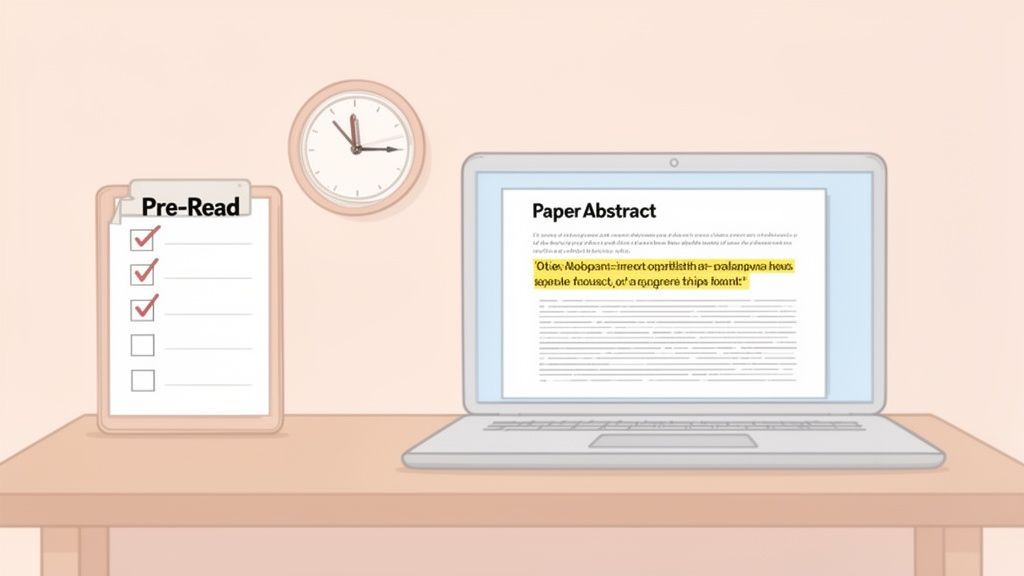
Before you even think about diving into the main text of a scientific paper, a few minutes of prep can save you hours of frustration. This isn't about adding busywork; it's about making sure the paper you're about to invest time in is actually worth reading.
We've all been there: you get halfway through a 20-page article only to realize it’s completely irrelevant. This pre-reading ritual is your first line of defense against that exact scenario. Think of it as scouting the terrain before a long hike—it ensures you’re on the right path from the very beginning.
First, Define Your Reading Goal
The most important question to ask yourself is: Why am I reading this paper? Without a clear answer, you'll just be reading passively, and the information won't stick. Your answer completely changes your strategy.
What’s your mission?
- Getting a General Overview? Maybe you just need to understand the main findings or get the gist of a new research area.
- Hunting for a Specific Method? You might be looking for a detailed procedure or technique you can use in your own lab work.
- Gathering Evidence? You could be searching for specific stats, facts, or quotes to support a claim in an essay or lit review.
- Staying Current? Sometimes, you're just keeping up with the latest developments in your field.
Knowing your "why" lets you read with purpose. If you only need a specific method, you can skim the intro and jump right to that section. If you just need the big picture, the abstract and discussion might be all you need to read carefully.
This initial goal-setting step is what separates efficient reading from wasted time. It turns a passive task into an active information-gathering mission.
Next, Quickly Vet the Paper for Quality
Once you know your goal, spend no more than two minutes on a quick background check. This little step helps you gauge the paper's credibility and relevance before you commit.
Here’s what to look for:
- The Authors and Their Affiliations: Who wrote this? Are they from a well-respected university or research institution? A quick Google search can tell you if the authors are established experts in this field.
- The Journal: Where was it published? A top-tier, peer-reviewed journal like Nature or Science has a much higher bar for quality than a lesser-known one. The journal’s reputation often reflects the rigor of its review process.
- The Publication Date: Is this research from last year or 20 years ago? Science moves fast. An older paper might be outdated unless you're specifically researching the history of a concept.
This quick vetting process is your quality filter. If a paper is from an obscure journal or the authors have clear conflicts of interest, you'll know to approach it with a healthy dose of skepticism. For more strategies on effective reading, check out our guide on how to improve comprehension skills.
Globally, reading habits show a huge range of dedication. For example, readers in India lead the pack, averaging 10 hours and 42 minutes per week. You probably won't spend that long on a single paper, but this strategic approach ensures every minute you do spend is time well spent. You can learn more about these trends by reading up on the statistics on reading habits and demographics.
The Three-Pass Approach to Strategic Reading
One of the biggest mistakes you can make is trying to read a scientific paper from start to finish like a novel. It's a recipe for frustration. You'll get bogged down in technical jargon before you even figure out what the authors are trying to say.
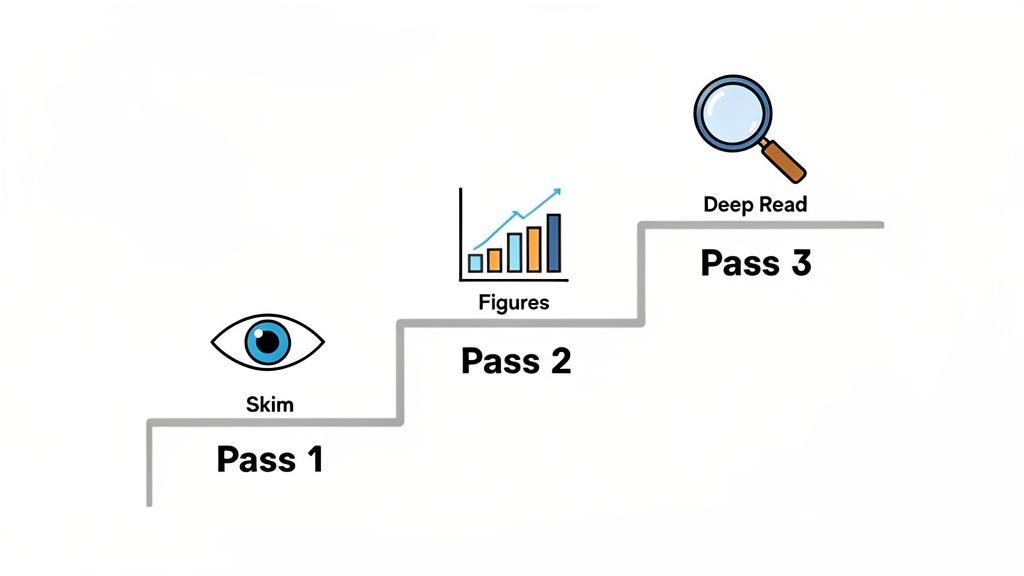
Seasoned academics have a much smarter method, often called the "three-pass approach." Instead of aiming for 100% comprehension on the first try, you build your understanding in layers. This system turns a daunting task into a series of manageable steps, ensuring you get the most out of every paper you tackle.
The First Pass: The Bird's-Eye View
The goal here is simple: get a high-level overview and decide if the paper is even worth your time. You're not trying to understand the details, just the gist. This should be quick, taking only about 10-15 minutes.
Think of this as a quick reconnaissance mission. You’re trying to answer one crucial question: "Should I invest more of my time reading this?"
Here’s what to focus on:
- Title and Abstract: Read these carefully. They are the most condensed summary of the entire paper, covering the problem, methods, findings, and conclusion.
- Introduction and Conclusion: Scan the first and last paragraphs of the introduction to understand the research context. Then, jump straight to the conclusion to see what the authors claim they discovered.
- Section Headings: A quick glance at the headings gives you a mental map of the paper's structure and the flow of the argument.
After this first pass, you should be able to explain the paper's main point in a single sentence. If you can't, or if it seems irrelevant to your project, you can confidently set it aside.
By the end of this initial skim, you should have a solid feel for the paper's category (Is it a new experiment? A review of old ones?) and its core contributions.
The Second Pass: Uncovering the Story
If the paper made the cut, it's time for the second pass. Now, your goal is to grasp the actual content, but you can still skip the nitty-gritty technical details. You’re trying to understand the "story" the authors are telling—the evidence they present and the logic behind their conclusions. This pass might take you about an hour.
Your main focus should be on the visuals, because that's often where the most important data lives. Don't worry about trying to prove complex equations just yet.
Here's your action plan:
- Figures, Graphs, and Tables: Look at every single visual. Read the captions and figure out what each one is showing. For graphs, pay close attention to the axes, error bars, and the trend of the data. The visuals are the heart of the evidence.
- The Discussion Section: Read the discussion thoroughly. This is where the authors interpret their results, connect them back to the original research question, and explain what it all means.
- Start Marking It Up: As you read, highlight key terms, jot down questions in the margins, and note anything that confuses you. Active reading is key, and these notes will be your guide for the final pass.
At this point, you should be able to summarize the main findings and the supporting evidence to a classmate. You should also have a clear list of questions to tackle in your final read.
The Third Pass: A Critical Deep Dive
This final pass is the most intense. It’s where you dive deep into the technical details and critically evaluate the research. You're trying to understand the work at a granular level, challenging the authors' assumptions and methods. The time this takes can vary wildly depending on the paper's complexity.
Your goal is to mentally re-implement the paper. You're no longer just a reader; you're a reviewer.
To do this effectively:
- Scrutinize the Methods: Read this section with a fine-tooth comb. Do the experiments make sense? Is the sample size big enough? Are there other ways to interpret their results?
- Analyze the Results: Connect the raw data from the results section to the story they told in the discussion. Do you agree with their interpretation of the findings?
- Identify Assumptions and Limitations: No study is perfect. Figure out what the limitations are and consider how they might impact the validity of the conclusions.
After this final, deep dive, you'll have a rock-solid understanding of the paper—its strengths, its weaknesses, and its place in the wider scientific conversation. You'll be ready to discuss it, cite it, and build upon its findings with real confidence.
Executing The Three-Pass Reading Strategy
To make this even clearer, here’s a table that breaks down the entire process. Think of it as your cheat sheet for tackling any scientific paper that comes your way.
| Pass | Main Goal | Key Actions | Time Commitment |
|---|---|---|---|
| First Pass | Get a high-level overview and determine relevance. | Read the title, abstract, introduction, and conclusion. Skim section headings. | 10-15 minutes |
| Second Pass | Understand the paper’s content and supporting evidence. | Focus on figures, tables, and graphs with their captions. Read the discussion section. Make notes on confusing points. | Up to 1 hour |
| Third Pass | Critically evaluate the methodology and conclusions. | Scrutinize the methods and results sections. Challenge assumptions, identify limitations, and connect the evidence to the interpretations. | Variable (1-5 hours) |
Following this structure consistently will transform how you approach your reading, making it far more efficient and a lot less intimidating.
How to Decode Each Part of a Research Paper
Think of a scientific paper less like a book you read from front to back and more like a house you're exploring. Each section is a different room with a specific function. Once you know what each room is for, you can navigate the paper efficiently to find exactly what you need.
Instead of a linear read-through, the best approach involves jumping between sections to piece together the full story of the research. Let's walk through the anatomy of a typical paper and what you should be looking for in each part.
The Abstract Is Your Executive Summary
The Abstract is a super-condensed, single-paragraph summary of the entire paper. It quickly covers the problem, the methods, the most important results, and the main takeaway. It’s the first thing you’ll see, but it's often wise to circle back to it at the end to confirm your understanding.
Basically, it's the movie trailer. It hits all the high points but lacks the depth to stand on its own. Use it to quickly decide if the paper is actually relevant to what you're studying.
Key Question to Ask: "Does this summary match my research goals, and does the study sound interesting enough to dig deeper?"
The Introduction Sets the Stage
The Introduction answers the "why" question. It starts with the big picture, explaining what the scientific community already knows about a topic. Then, it strategically narrows the focus down to a specific problem or an unanswered question—this is what we call the research gap.
Your main objective here is to pinpoint that gap. The authors will argue that their study was necessary to fill this hole in our knowledge. Keep an eye out for signal phrases like "however, it remains unknown..." or "previous studies have not addressed..." These are your clues to the paper's entire motivation.
The Methods Section Is the Recipe
This is usually the most technical, jargon-filled part of the paper. It's easy to get bogged down here, so don't feel like you have to understand every single detail on your first pass. Instead, focus on the overall experimental design.
What should you look for?
- Overall Approach: Was this an experiment, a survey, a simulation, or something else?
- Sample Size: How many subjects, cells, or data points were involved? A study with 10 participants is a world away from one with 10,000.
- Key Techniques: What were the main tools or procedures used to collect the data?
Think of the Methods section like the recipe for a complex dish. You don’t need to be a professional chef to get the gist of the ingredients and the basic steps. A general understanding is all you need to decide if their findings are built on a solid foundation.
As you get into the nitty-gritty of a paper, using practical note-taking strategies can make a huge difference in what you remember. For digital organization, you might also find it helpful to learn about adding comments directly to PDFs.
The Results Present the Raw Findings
The Results section is where the authors present their data without any interpretation. It answers the "what did they find?" question. This section is usually dense with tables, graphs, and statistics (like p-values or confidence intervals).
Your job here is to separate the raw data from the authors' story. My advice? Look at the figures and tables before reading the text. What trends do you see? What do the graphs show? Form your own conclusions first, which helps you think more critically and avoid being led by the authors' potential bias.
The Discussion Connects the Dots
If the Introduction was the "why" and Results were the "what," then the Discussion is the "so what?" This is where the authors finally get to interpret their findings. They explain what the data means and connect it back to the research gap they brought up in the introduction.
A good Discussion section will also address the study's limitations—because no research is perfect. Acknowledging weaknesses is actually a sign of quality work. They’ll often wrap up by suggesting what future research should look into next. For me, this is often the most insightful part of the paper for understanding the bigger picture.
Key Question to Ask: "Do their conclusions logically flow from the data in the Results section, and how does this new information change the scientific conversation?"
Using Feen AI as Your Personal Research Assistant
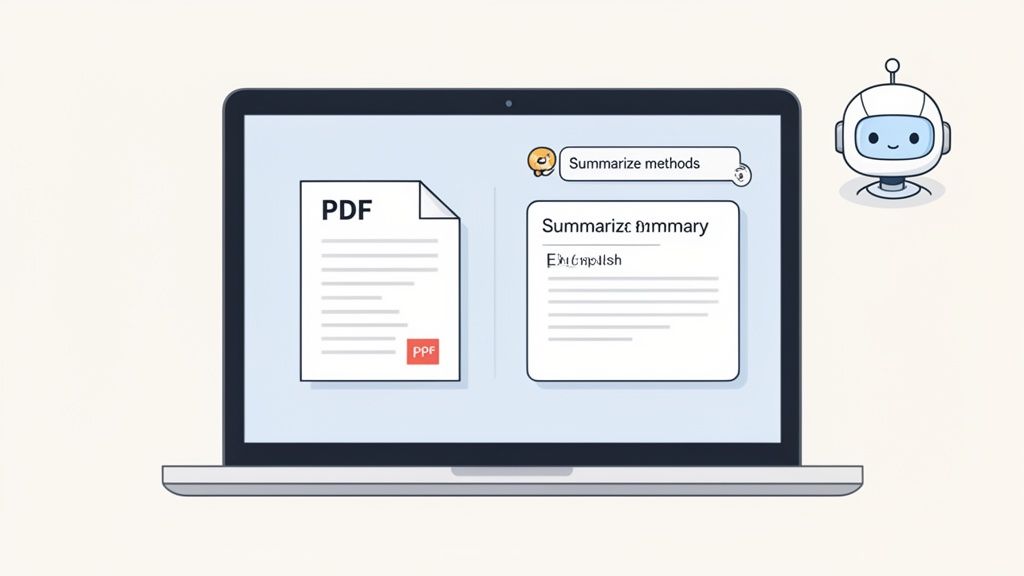
Imagine having an expert on standby, ready to explain complex concepts or translate dense jargon the moment you get stuck. This isn't science fiction; it’s a smarter way to tackle the challenge of learning how to read scientific papers. Using a tool like Feen AI can feel like having a personal research assistant who never gets tired of your questions.
This approach isn't about skipping the hard work. It's about automating the most tedious parts of the process, like defining obscure terms or summarizing lengthy background sections. That frees up your mental energy to focus on what really matters—evaluating the research and understanding its core ideas.
Getting Started: Uploading Your First Paper
The process itself is refreshingly simple. Most modern AI tools, including Feen AI, let you upload a PDF directly into a chat interface. Just drag and drop the file or select it from your computer. Within seconds, the AI has "read" the entire paper and is ready to talk.
Once the paper is loaded, you can start a conversation with it. This interactive element is what makes AI so powerful for academic reading. It turns a static document into a dynamic dialogue where you are in the driver's seat.
Think of the AI as your co-pilot. You're still the one steering and making the important decisions, but the AI is handling the navigation, pointing out obstacles, and providing data so you can focus on the big picture.
This immediate interactivity helps you maintain momentum. Instead of getting derailed by a confusing paragraph and spending twenty minutes on a frustrating internet search, you can get a clear explanation in seconds and move on.
Crafting Smart Prompts for Deeper Understanding
The real magic happens when you learn how to ask the right questions. Generic prompts will get you generic answers. The key is to be specific and targeted, treating the AI as if it were a knowledgeable teaching assistant.
Here are a few examples of effective prompts you can use to break down a difficult paper:
- For the Methodology Section: "Summarize the methodology of this study in three simple, numbered steps. Focus on what the researchers actually did with the participants."
- For the Results Section: "Explain what a T-test is in the context of Figure 2. What does a p-value of <0.05 mean for these specific findings?"
- For Defining Key Terms: "Define the term 'allosteric inhibition' as it's used in this paper and provide a simple analogy to help me understand it."
This kind of specific prompting results in a clear, useful response that is much easier to digest than the original text.
Beyond Summarization: Identifying Gaps and Limitations
A good AI assistant can do much more than just summarize. It can help you think critically about the paper’s structure and potential weaknesses, which is a crucial skill for any student.
Try these more advanced prompts to elevate your analysis:
- Identify Limitations: "Based on the methods section, what are two potential limitations of this study that the authors might not have mentioned?"
- Generate Discussion Questions: "Provide three thought-provoking questions about this paper's conclusions that I could bring up in a class discussion."
- Connect to Broader Concepts: "How do the findings of this paper support or challenge the theory of cognitive dissonance?"
By using these kinds of targeted questions, you transform the AI from a simple summarizer into a genuine study partner. This strategic use of technology is a core component of learning how to read scientific papers effectively in the modern academic world. To see this in action, you can try out an AI-powered PDF summarizer and see how quickly it can extract the essential information from your reading list.
Still Have Questions? Let's Tackle the Common Sticking Points
Even with the best strategy, you're going to hit snags when reading academic papers. That's just part of the process. The real skill is learning how to push through those moments of confusion instead of letting them derail you.
Let’s walk through some of the most common hurdles I see students face and how to get over them.
"What Do I Do When I Don't Understand the Terminology?"
First, take a breath. It happens to everyone, even seasoned researchers wading into a new subfield. When you hit a wall of jargon, don't immediately jump to Google. Your first move should be to quickly scan the paper itself.
Good authors often define a key term the first time they use it, so check the surrounding sentences in the introduction or the beginning of the methods section.
If you can't find it there, then it's time to ask for help. A quick prompt in an AI tool like Feen AI can be a lifesaver. Something as simple as, "Explain what 'in vivo' means in the context of this biology paper," will get you an answer in seconds.
Here's a pro-tip for the long game: keep a running glossary for each course or research topic. You’ll start noticing the same complex terms pop up again and again. Jotting them down helps the vocabulary stick, making every paper after this one just a little bit easier.
The goal isn't to instantly memorize every new word. It's to get a functional understanding that lets you grasp the author's point without getting bogged down.
"How Can I Tell if a Scientific Paper Is Credible?"
This is a huge one. A paper can look official and polished but be built on a shaky foundation. Think of yourself as a detective and start by checking the basics—these are your first-pass quality filters.
Start with the source:
- The Journal: Is it peer-reviewed? Is it respected in its field? A quick search for the journal's reputation or its "impact factor" will tell you a lot about its standards.
- The Authors: Who are they and where are they from? Researchers at well-known universities or research institutions tend to lend more credibility.
- The Funding: Always check the acknowledgments section to see who paid for the research. You need to be aware of potential conflicts of interest that could skew the results.
Once you've done that, you have to dig into the research itself. Does their experimental design make sense? Was the sample size large enough to mean anything? A high number of citations from other researchers is also a great sign—it shows the scientific community takes the work seriously.
"How Much Time Should I Spend Reading One Paper?"
Honestly, there's no magic number. The real question is, "What do I need to get out of this paper?" The biggest mistake students make is giving every single paper the same deep-dive treatment, wasting hours on an article that only needed a quick skim.
Match your time to your goal:
- Is this relevant? A quick "first pass" skim to decide if a paper is even useful for your project shouldn't take more than 15-20 minutes.
- Do I need details for a literature review? If you're mining the paper for evidence to support your own essay, a full, in-depth read could easily take one to two hours.
- Am I trying to replicate a method? If you're a science student trying to understand a protocol for your own lab work, you could spend several hours over multiple sessions to really nail down the details.
The key to learning how to read scientific papers without burning out is being strategic. Match your effort to your goal, and you'll get far more done.
"Is It Cheating to Use an AI to Help Me Read?"
Absolutely not. Think of it like using a calculator for a tough math problem. AI tools like Feen AI are there to help you understand, not to do the thinking for you. In an era where complex information is everywhere, using smart tools is just working efficiently. Some reports even show declining literacy scores among adults, making comprehension tools more valuable than ever. You can learn more about these trends from these adult literacy statistics.
Using AI to summarize a dense paragraph, define a confusing term, or point out the main arguments just helps you learn better and faster. It only crosses a line if you try to pass off an AI's summary as your own original analysis.
The best way to use it is as a co-pilot. Let it handle the heavy lifting with the jargon so you can focus your brainpower on what really matters: evaluating the research and forming your own educated opinions.
Ready to make reading scientific papers feel less like a chore? Feen AI can be your personal research assistant, helping you summarize dense articles, define complex terms, and grasp key concepts in seconds. Stop struggling and start understanding. Upload your first PDF to Feen AI today and experience a smarter way to study.
Relevant articles

Learn how to solve inequalities step by step. This guide covers linear, absolute value, and quadratic inequalities with clear examples and real-world tips.
Discover how to overcome math anxiety with proven strategies. Build confidence with practical study habits.
Unlock your potential with our top college essay writing tips. Learn how to brainstorm, structure, and revise your way to an unforgettable application essay.
Discover how to improve comprehension skills with proven reading strategies. Master active reading and note-taking for deeper understanding.
Learn how to read research papers efficiently with a proven system. This guide breaks down a time-saving method to help you extract key insights fast.