How to Improve Comprehension Skills: Quick Techniques for Better Reading
Discover how to improve comprehension skills with proven reading strategies. Master active reading and note-taking for deeper understanding.
Ever felt like you've read a whole page, only to get to the bottom and have no clue what it was about? It’s a frustratingly common experience, but it’s not a sign of a bad memory. It’s simply what happens when we read passively—letting our eyes glaze over the words without our brains truly engaging.
If you want to genuinely improve your comprehension, the secret is to shift from being a passive observer to an active participant. It’s about turning reading into a conversation. You need to ask questions, connect the dots to what you already know, and boil down the key ideas as you encounter them.
Why You Forget What You Just Read and How to Fix It
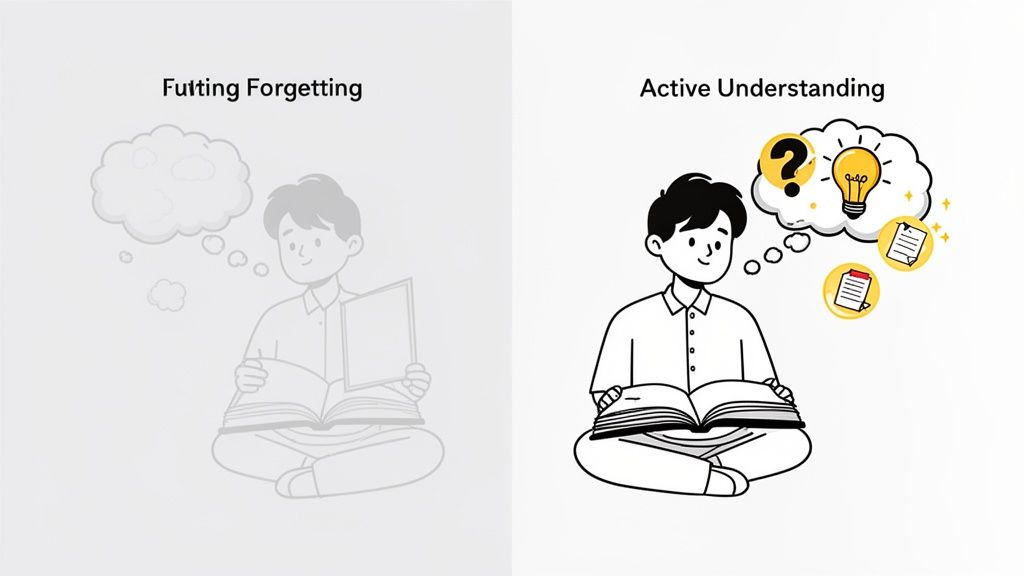
That "in one ear, out the other" feeling when reading happens because our brains are expert filters. They're built to discard information that doesn't seem relevant or important. When you read on autopilot, you're basically telling your brain, "This isn't worth remembering."
Real, lasting comprehension isn't a gift you're born with; it's a skill you build with the right habits. The fix is to consciously switch your brain into an active, engaged mode.
The Shift from Passive to Active Engagement
To really get a grip on new material, you have to treat it like a puzzle to solve, not just a list of facts to absorb. This means showing up with a purpose and a bit of curiosity. Instead of just letting the words wash over you, your job is to break down the information, question it, and make it your own.
This active approach is the foundation of effective learning. A few game-changing strategies include:
- Active Reading Techniques: This is where you get your hands dirty. You'll be questioning the author, making predictions, and creating mental movies of what you're reading.
- Strategic Note-Taking: Ditch the mindless copying. We're talking about summarizing big ideas in your own words, which forces your brain to process them on a deeper level.
- Vocabulary Building: You can't understand a complex idea if you don't know the words used to describe it. Actively growing your vocabulary is non-negotiable.
The secret to better comprehension is treating reading like a dialogue, not a monologue. You must constantly ask, "What does this mean?" and "Why does this matter?" to forge the neural pathways that lead to lasting memory.
Your Roadmap to Better Comprehension
Think of this guide as your GPS for building stronger comprehension skills. We’ll walk through practical, no-fluff methods that force your brain to switch on and process information more deeply. For a deeper dive into memory, check out these powerful tips on how to retain information when studying.
And you don't have to do it all alone. Tools like Feen AI can be a massive help here. For instance, you could upload a dense chapter from a textbook and ask it to pull out the main arguments or create a list of quiz questions. Just like that, you've turned a passive reading assignment into an active study session.
To give you a bird's-eye view, here's a quick rundown of the core techniques we’ll be covering.
Quick Guide to Boosting Your Comprehension Skills
This table breaks down the essential strategies we'll explore. Think of it as your cheat sheet for turning passive reading into active learning.
| Technique | What It Is | Why It Works |
|---|---|---|
| Active Reading | Interacting with text by questioning, annotating, and summarizing. | Forces your brain to process information instead of just scanning it. |
| Strategic Note-Taking | Using systems like the Cornell Method or mind mapping. | Encourages synthesis and organizes information for easier recall. |
| Vocabulary Expansion | Learning new words in context and understanding word parts. | Removes barriers to understanding complex ideas and arguments. |
By mastering these three areas, you'll be well on your way to not just reading more, but understanding and remembering more, too.
Make Your Reading an Active Pursuit, Not a Passive One
If you want to make a single, massive leap in your comprehension, you have to stop being a passive consumer of words and start acting like an active investigator.
Think about it. Passive reading is like letting a lecture wash over you while you scroll on your phone. You're physically there, but you're not really there. Active reading is the complete opposite—it’s about leaning in, asking questions, and wrestling with the material until it makes sense.
This isn’t just about “paying more attention.” It’s about having a system, a structured way to interact with whatever you're reading. These frameworks give your brain something to latch onto, creating mental hooks that make information stick for the long haul.
Try the Time-Tested SQ3R Method
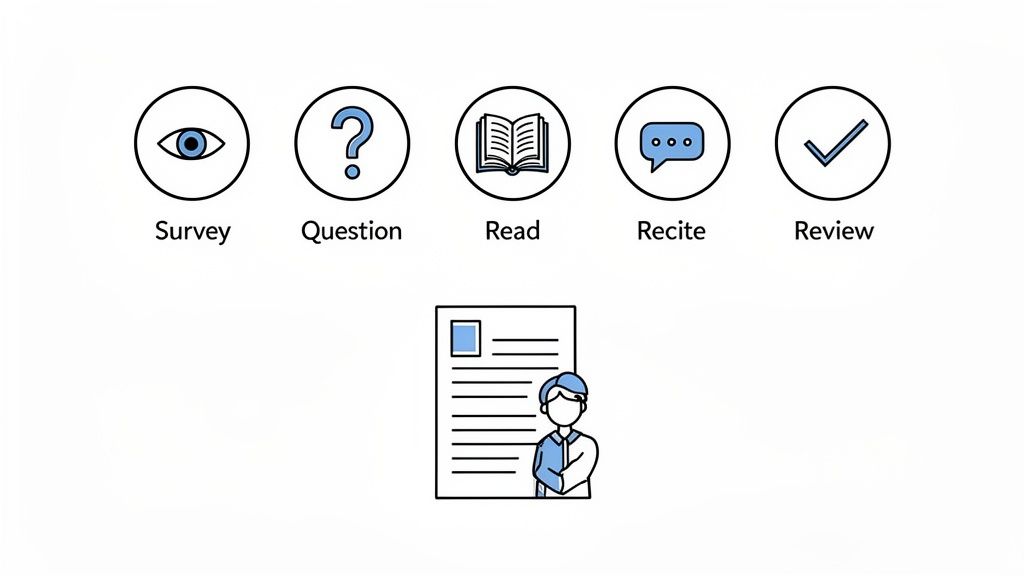
One of the best systems I’ve ever come across for active reading is the SQ3R framework. It's been around for decades for a good reason: it works. It breaks down the entire process into five simple stages: Survey, Question, Read, Recite, and Review.
Here's how you can put it into action with your next chapter or article:
- Survey: First, just get the lay of the land. Before you dive into the text, scan the whole thing. Look at the headings, check out any charts or images, and read the introduction and conclusion. This creates a mental map of what you're about to cover.
- Question: Now, go back to those headings and turn each one into a question. If a heading says "The Causes of the Industrial Revolution," your question becomes, "Okay, so what were the main causes of the Industrial Revolution?"
- Read: With your question in mind, start reading that section. Your goal isn't just to get through the words; it's to find the answer to your question. Suddenly, your reading has a clear purpose.
- Recite: Once you finish a section, look away from the page and try to answer your question out loud or by jotting it down. This is the magic step. It forces you to process the information in your own words, which is crucial for memory.
- Review: After you've worked through the entire chapter this way, take a few minutes to go over your questions and notes. This final pass locks in the information and helps you see the bigger picture.
It might feel a bit slow at first, but this method saves you from the frustration of having to reread the same material over and over. For a deeper dive, we've put together a guide on how you can apply these same ideas to your coursework: https://feen.ai/blog/how-to-study-textbook.
Annotate with a Purpose
We’ve all been there—a page so covered in yellow highlighter that nothing actually stands out. That’s a classic passive reading trap. Meaningful annotation is about having a conversation with the text, not just coloring it in.
Don’t fall into the trap of thinking that highlighting equals learning. Real comprehension comes from talking back to the text—summarizing ideas in the margins, questioning the author’s logic, and connecting what you're reading to what you already know.
Instead of just highlighting, try these techniques:
- Summarize Paragraphs: Jot down a quick, one-sentence summary in the margin for each key paragraph.
- Ask Questions: Write down any questions that pop into your head while you read. "Why did the author say that?" or "Is there evidence for this claim?"
- Define Key Terms: Circle words you don't know and write a quick definition right there on the page.
This shift in approach is more important than ever. Recent U.S. statistics show that only 44% of adults are truly proficient at complex comprehension tasks. Active strategies like these are proven to help people move into that top tier by turning reading into an engaging, memorable activity.
This is also a great place to bring in a tool like Feen AI. If you're stuck on the "Question" step of SQ3R, just upload your text. Feen AI can instantly whip up a list of thoughtful questions to guide your reading. It's an incredible way to practice the skill until it becomes second nature. And on a practical note, to make these longer reading sessions more comfortable, it's worth looking into choosing the right reading and computer glasses to reduce eye strain.
Build a Note-Taking System That Actually Helps You Remember
We've all been there—staring at a page covered in highlighter ink, with zero recollection of what we just read. Mindlessly highlighting or copying text word-for-word feels productive in the moment, but it's a classic study trap. It doesn't actually force your brain to engage, process, and truly understand the information.
To really lock in what you're learning, you need a system that transforms note-taking from a passive task into an active one. A good system forces you to filter out the noise, identify the core concepts, and build a personalized study tool for later.
Choose the Right System for the Task
There’s no single "best" way to take notes. The most effective method really depends on what you're trying to learn. The trick is to match your approach to the material.
- Linear Notes for Procedures: If you're learning something with a clear sequence, like a historical timeline or the steps in a science experiment, traditional linear notes are your friend. Using headings, bullet points, and numbered lists keeps everything organized and easy to follow.
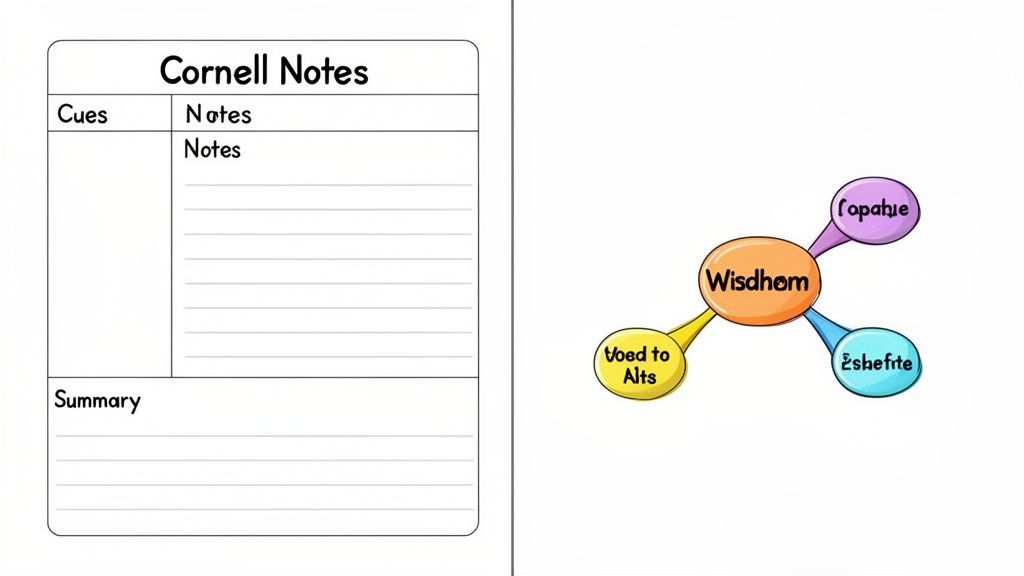
- Mind Maps for Brainstorming: When you're exploring how different ideas connect—like the central themes in a novel or the causes of a historical event—mind mapping is fantastic. This visual approach helps you see the bigger picture and uncover relationships you might miss with a standard outline.
The real purpose of taking notes isn't just to record information; it's to reconstruct it. When you force yourself to summarize, question, and connect ideas in your own words, you're building the mental connections needed for deep understanding and long-term recall.
Try the Cornell Method for Deeper Processing
For dense academic lectures or challenging readings, the Cornell Method is a total game-changer. It's designed to make you interact with your notes multiple times by dividing your page into three specific sections.
Here’s how it works:
- Main Notes Area (Right Column): As you listen or read, jot down your notes in this main section. Don't stress about making it perfect; just capture the key ideas, examples, and important details.
- Cues Column (Left Column): A little later, go back through your notes. In the smaller left-hand column, pull out keywords, potential quiz questions, and major concepts. This step forces you to distill the most important information.
- Summary Section (Bottom): This is the magic part. Cover up the main notes section and, using only the cues from the left column, write a one or two-sentence summary of the entire page at the bottom. It solidifies what you've learned and creates a perfect, quick-glance study guide.
Use AI to Create Structure
Let’s be honest, sometimes the hardest part is just starting, especially when you’re facing a mountain of information. This is where a little help from AI can be a huge time-saver.
If you have a long PDF or a bunch of messy, unorganized notes, you can use a tool to build a preliminary structure. For example, feeding your raw text into an AI-powered PDF summarizer can instantly generate a clean, structured outline. This doesn't do the thinking for you, but it handles the initial organization, freeing you up to focus on the more important work of analysis and synthesis.
Expand Your Vocabulary to Unlock Complex Ideas
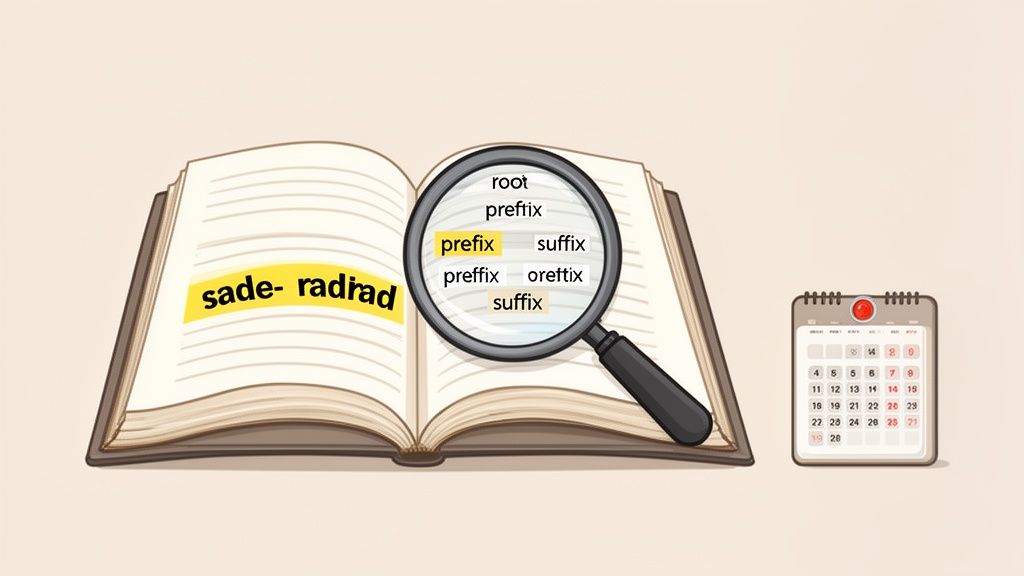
You can't really grasp a complex idea if the words used to explain it are a mystery. I’ve seen it time and again: a limited vocabulary is one of the biggest, yet most overlooked, roadblocks to better comprehension. It's like trying to build a sophisticated piece of furniture with just a hammer and a screwdriver—you're going to hit a ceiling pretty quickly.
But growing your vocabulary isn't about memorizing obscure words from a dictionary. The best way to make new words stick is through contextual learning. That means learning words as you naturally come across them in your reading, whether it's in a textbook, a novel, or a work report. This makes the new terms immediately useful and much easier to remember.
Learn to Deconstruct Words
Ever notice how many big, intimidating words are just smaller ideas glued together? If you can learn to spot common prefixes, suffixes, and roots, you can make a solid guess at a word's meaning, even if you’ve never laid eyes on it before. This is a game-changing skill for boosting comprehension in real time.
Let's take a word like photosynthesis. It sounds technical, right? But watch what happens when we pull it apart:
- Photo-: This is a Greek root for "light." You see it all the time in words like photograph and photon.
- Syn-: This prefix means "together" or "with." Think of words like synchronize or synthesis.
- -thesis: This root means "placing" or "an arranging."
All of a sudden, photosynthesis isn't some alien term. It literally means "putting things together with light." This simple decoding trick works for countless words across all subjects, turning confusing jargon into solvable puzzles.
Make New Words Stick with Spaced Repetition
Just finding a new word is half the battle. To actually own it—to have it ready in your working vocabulary—you need to revisit it. That's where a powerful technique called spaced repetition comes in. The idea is to review a new word at increasing intervals, right at the moment you're about to forget it.
Your brain is wired to remember information it has to work to retrieve. Spaced repetition forces this kind of "active recall," which is what builds the strong neural pathways needed for long-term memory.
You don't have to manage this yourself; modern flashcard apps can schedule it all for you. The only thing you need to bring is consistency. Spending just a few minutes on this each day is far more powerful than a marathon session once a week.
Use AI as Your Personal Vocabulary Tutor
When you hit a word you don't know, a basic definition is a start, but it often misses the mark. Context is everything. This is a perfect spot to bring in a tool like Feen AI to deepen your understanding.
Instead of just looking up a word in isolation, you can feed the entire text to the AI. Highlight a tricky word and ask something specific, like, "What does 'ephemeral' mean in this specific sentence?" Feen AI can break down not just the definition but the subtle meaning and purpose of the word within that exact context. This makes learning feel instant and relevant, which is far more effective than just memorizing a dictionary entry.
Turn Comprehension Practice into a Daily Habit
Getting better at understanding what you read isn't about cramming for a test or blocking off an entire weekend for a study marathon. Real, lasting improvement is built on consistency. It’s a lot like working out a muscle—a short, focused session every day is far more effective at building strength than one exhausting workout every few weeks.
The goal is to weave practice into your daily routine until it feels completely natural, not like a chore you have to get through.
This isn't just a nice idea; the data backs it up. A major study, the 2023 NAEP Long-Term Trend Assessment, found something incredible: 13-year-old students who said they read for fun almost every day scored an average of 275. That’s up to 20 points higher than their peers who only read once a week. You can dig into the full details at the Nation's Report Card, but the takeaway is clear. Consistent engagement is the secret sauce.
Design Your Daily Comprehension Workout
So, how do you actually fit this into a packed schedule? The good news is you don't need hours. All it really takes is about 15 minutes and a simple, repeatable plan. The trick is to keep it manageable and focus on topics you actually find interesting.
Here’s a quick framework for your daily workout:
- Read a Short Passage: Grab a high-quality article, a blog post, or just a few pages from a book on a subject you genuinely enjoy. It could be about sports, technology, history—anything that pulls you in.
- Identify the Main Idea: As soon as you finish reading, ask yourself: What’s the single most important message here? What is the author’s central point or key takeaway?
- Craft a One-Sentence Summary: Now for the real challenge. Boil that main idea down into one clear, concise sentence. This is the most important step because it forces your brain to synthesize the information, not just spit it back out.
This simple routine turns passive reading into an active, analytical exercise. You're training your brain to automatically search for structure, purpose, and the core message in everything you encounter.
Low-stakes, daily effort is the secret to long-term retention. By consistently practicing summarization and identifying main ideas, you're not just reading—you're actively building the mental architecture for deeper understanding.
Make Practice Stick
The best way to make sure this habit actually sticks is to make it incredibly easy to start. Pick a specific time that already exists in your day—maybe with your morning coffee, during your commute, or right before you wind down for the night—and commit that slot to your comprehension workout.
For example, you could read one article from a trusted news source each day. Afterward, pop open a notes app and jot down your one-sentence summary. If you're tackling a longer book, this technique works wonders on a chapter-by-chapter basis. If you need a more structured approach for that, our guide on how to summarize book chapters walks you through it.
Ultimately, it’s consistency that transforms these small actions into powerful, automatic skills.
Answering Your Top Comprehension Questions
As you start putting these new techniques into practice, you're bound to have some questions. That's a good thing—it means you're engaging with the process. Let's walk through some of the most common things people wonder about when they get serious about boosting their comprehension.
One of the first questions I always hear is, "How long does it take to actually see results?" While there’s no universal timeline, what I’ve seen is that with consistent daily practice—even just 15-20 minutes a day—most people feel a real shift in their focus and how much they remember within a few weeks. Consistency beats cramming every time.
Handling Dense or Boring Material
Okay, this is a big one. What do you do when you have to read something that's incredibly dry or complicated? It’s tough to stay engaged when the material itself feels like a slog.
The secret is to create your own interest. Before you even start reading, ask yourself a simple question: "What's one useful thing I can get out of this?" This little mind trick shifts your brain from passive reading mode into an active search for information. You can even use a tool like Feen AI to generate a few questions about the text beforehand, which gives you a clear mission from the get-go.
The goal isn't to fall in love with every text you read. It's to become a pro at pulling out the important information. Your mission is to find the core ideas and move on, no matter how you feel about the subject.
This isn't just a personal study challenge; it's a global one. A shocking report on the world's 'learning crisis' found that more than half of children in many countries can't understand a simple story by the end of primary school. Research from the same report shows that focused, structured practice can improve comprehension by as much as 30%. This proves that putting in the work pays off in a big way. You can dig into these global education findings on worldbank.org.
Do Audiobooks Count as Reading?
Yes, absolutely—but there's a catch. Audiobooks are a fantastic tool for building your vocabulary and soaking up new ideas, but only if you practice active listening.
Letting an audiobook play in the background while you do other things is just like skimming a page without paying attention. To make it a true learning exercise, you have to apply the same active principles:
- Pause and Summarize: When a chapter ends, hit pause and quickly run through the main points in your head.
- Question Everything: Keep a mental (or physical) list of questions that come to mind as you listen.
- Jot It Down: If you’re able, scribble down key names, concepts, or ideas that stand out.
Doing this transforms passive listening into a powerful comprehension-building workout.
Ready to make your study sessions smarter, not harder? Feen AI can help you generate questions from any text, summarize dense articles, and clarify confusing topics in seconds. Stop rereading and start really understanding. Get clear, AI-powered help with your homework today by visiting https://feen.ai.
Relevant articles

Learn how to solve inequalities step by step. This guide covers linear, absolute value, and quadratic inequalities with clear examples and real-world tips.

Learn how to read scientific papers more efficiently with practical steps, summaries, and quick takeaways. how to read scientific papers made simple.

Discover how to overcome math anxiety with proven strategies. Build confidence with practical study habits.
Struggling to absorb what you read? Learn how to improve comprehension skill with actionable reading strategies and smart tools for real, lasting results.

Unlock your potential with our top college essay writing tips. Learn how to brainstorm, structure, and revise your way to an unforgettable application essay.

Discover how to summarize book chapters effectively. Our guide covers proven methods and smart tools to help you retain more information and study smarter.