How to Balance Chemical Equations: A Simple, Step-by-Step Guide
Learn how to balance chemical equations with clear, step-by-step methods and practical examples to boost your stoichiometry skills.

Balancing a chemical equation is all about making sure the number of atoms for each element is the same on both sides of the reaction—what you start with (reactants) and what you end up with (products). We do this by adding whole numbers, called coefficients, in front of the chemical formulas. It's the only way to make our equations line up with a core principle of the universe: the Law of Conservation of Mass.
Why Balancing Chemical Equations Is Essential

Before jumping into the "how," it's worth taking a moment to appreciate the "why." The whole process hangs on one of the most fundamental rules in science: the Law of Conservation of Mass. Simply put, this law says that in any closed system, you can't create or destroy matter during a chemical reaction.
Think about it like baking. If you mix 500 grams of flour, 200 grams of sugar, and 100 grams of butter (your reactants), the final cake (the product) is going to weigh 800 grams. You can't magically end up with a heavier cake, and none of your ingredients can just disappear into thin air.
A chemical equation is really just a recipe written in the language of chemistry. Balancing it is our way of making sure the recipe is accurate and respects that unbreakable law of nature.
The Historical Roots of Mass Conservation
This isn't some new-fangled idea; it's the very foundation of modern chemistry. Back in the late 18th century, a brilliant chemist named Antoine Lavoisier performed a series of incredibly precise experiments that cemented this principle.
For instance, his work in the 1770s showed that when he heated 45 grams of mercury oxide, it broke down into exactly 40 grams of mercury and 5 grams of oxygen—a perfect 100% retention of mass. By 1782, he was already using early forms of notation to track these ratios, laying the groundwork for the equations we use today.
When we balance an equation, we're essentially proving Lavoisier was right, every single time. It's a mathematical check to ensure every atom that goes into a reaction is accounted for when it comes out.
Decoding the Language of a Chemical Equation
To get good at balancing, you first need to be fluent in the language of chemical equations. Let's quickly break down the key parts you'll see every time. Knowing these terms makes the whole process feel less like a chore and more like solving a logical puzzle.
Here's a quick reference table to keep the key terms straight.
Key Terminology at a Glance
| Term | Definition | Example (in 2H₂ + O₂ → 2H₂O) |
|---|---|---|
| Reactants | The starting materials in a reaction. Always on the left side of the arrow. | H₂ and O₂ |
| Products | The new substances formed by the reaction. Always on the right side of the arrow. | H₂O |
| Coefficients | The large numbers in front of formulas. This is the only number you can change. | The '2' in front of H₂ and H₂O. |
| Subscripts | Small numbers within a formula showing the atom count in a molecule. Never change these! | The '2' in H₂ and H₂O. |
Understanding these components is non-negotiable. If you change a subscript, you're changing the actual substance—it's like trying to make water (H₂O) but ending up with hydrogen peroxide (H₂O₂) instead. For a deeper look into how these numbers define a substance, check out this guide on determining the empirical formula for ascorbic acid.
The core task of balancing an equation is to find the correct coefficients that ensure the number of atoms of each element is identical on both the reactant and product sides.
Once you have this foundation, the practical steps of balancing become much more intuitive. You're not just mindlessly matching numbers; you're applying a fundamental law of the universe.
The Inspection Method for Everyday Equations
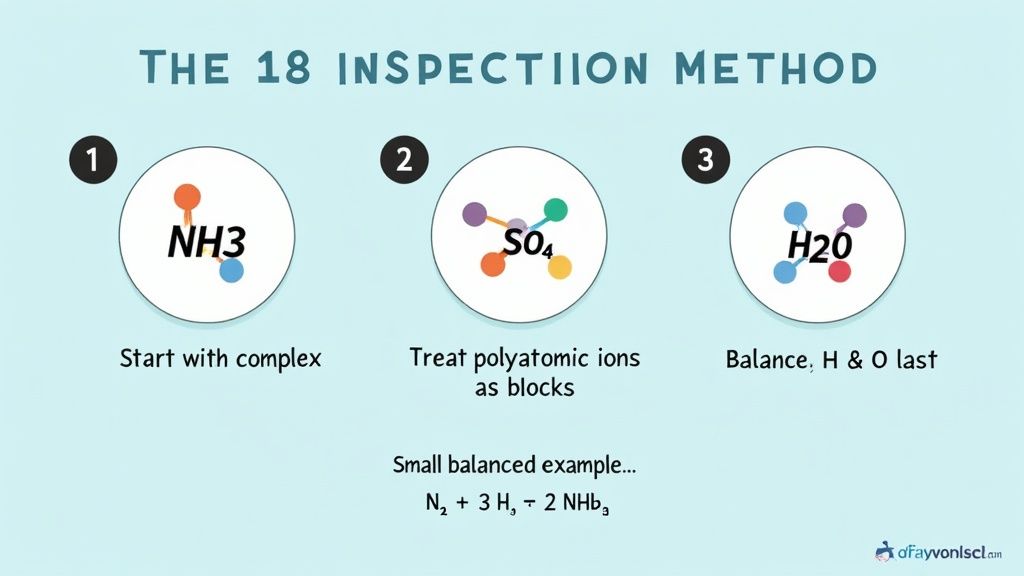
This is the workhorse. The inspection method, often called the trial-and-error method, is your go-to for the vast majority of equations you'll bump into in general chemistry. It's less about a rigid set of rules and more about developing an intuition—like solving a logic puzzle.
The name "trial and error" can be a little deceiving. It's not about making wild guesses. It's a guided process, and the more you practice, the less "error" is involved. The whole point is to approach it strategically so you aren't just plugging in numbers at random.
There's a reason it's taught everywhere. The inspection method is the foundation of chemical education, used in about 85% of introductory chemistry courses around the world. In fact, 88% of curricula in the US and UK rely on it for simpler cases, which account for roughly 90% of equations involving fewer than five chemical species. For a deeper dive, you can explore the evolution of chemical equations/02%3A_Stoichiometry/2.01%3A_The_Chemical_Equation).
Crafting a Winning Game Plan
So, how do you make inspection work for you without getting stuck in a loop of erasing and rewriting? It all comes down to having a smart opening move. Instead of just picking an element at random, a few simple guidelines can save you a ton of frustration.
I always tell my students to start with the most complex-looking molecule in the equation. That’s usually the one with the most atoms or the biggest variety of elements. Nail that one down first, and you'll often find the simpler molecules fall into place much more easily.
Here's the general thought process I run through:
- Start Complex: Find the busiest-looking molecule and begin by balancing its elements.
- Keep Groups Together: If you spot a polyatomic ion (like SO₄ or NO₃) that stays intact on both sides of the equation, treat it as a single unit. Don't break it down—this is a massive time-saver.
- Save the Lone Rangers: Elements that are all by themselves (like O₂ or just Fe) should be left for the very end. They're the easiest to tweak without messing up everything else you've balanced.
- Hydrogen and Oxygen Last: H and O atoms often pop up in multiple places. By saving them for the end, you give yourself the most flexibility to make final adjustments.
Pro Tip: Use a pencil! You’re almost guaranteed to change coefficients as you go. I find it really helpful to keep a running tally of atoms for each element right below the equation. It keeps you organized and helps you spot what's still out of whack.
Example 1: Synthesis of Ammonia
Let's put this into practice with a real-world reaction: the synthesis of ammonia, which is essential for making fertilizer. The unbalanced equation looks like this:
N₂ + H₂ → NH₃
First, let's take inventory. On the left (reactants), we have 2 nitrogen atoms and 2 hydrogen atoms. On the right (products), we have 1 nitrogen and 3 hydrogens. Not balanced.
Nitrogen is a good place to start. We have 2 N on the left, so we need 2 on the right. To get that, we'll put a coefficient of 2 in front of NH₃.
N₂ + H₂ → 2NH₃
Now our count is: Left side has 2 N and 2 H. The right side has 2 N and 6 H (because 2 * 3 = 6). The nitrogen is good, but now the hydrogen is off.
Let's fix the hydrogen. We need 6 H atoms on the reactant side. Since H₂ comes in pairs, a coefficient of 3 will give us exactly 6 hydrogen atoms (3 * 2 = 6).
N₂ + 3H₂ → 2NH₃
Time for a final check. Reactants: 2 N, 6 H. Products: 2 N, 6 H. Perfect. The equation is balanced.
Example 2: Decomposition of Hydrogen Peroxide
Next up, a decomposition reaction. Let's look at hydrogen peroxide breaking down into water and oxygen, a process you might see happening in a first-aid kit.
H₂O₂ → H₂O + O₂
Our initial count shows 2 H and 2 O on the left, but 2 H and 3 O on the right (1 from H₂O and 2 from O₂). The hydrogen looks fine for now, but the oxygen is the problem.
Oxygen is in three different places, and it shows up as a lone element (O₂). That's our cue to save it for last. The odd number of oxygen atoms on the product side is throwing us off, so let’s try to fix that by placing a 2 in front of H₂O.
H₂O₂ → 2H₂O + O₂
Recalculating the products gives us 4 H (2 * 2) and 4 O (2 from the water + 2 from the oxygen). Now the left side is unbalanced. We need 4 H and 4 O. Luckily, H₂O₂ has both. A coefficient of 2 in front of H₂O₂ does the trick.
2H₂O₂ → 2H₂O + O₂
Final check: Reactants have 4 H and 4 O. Products have 4 H and 4 O. We're all balanced.
Example 3: A Classic Metal and Acid Reaction
Let's do one more: a classic single displacement reaction where solid zinc metal reacts with hydrochloric acid.
Zn + HCl → ZnCl₂ + H₂
Here’s our starting inventory:
- Reactants: 1 Zn, 1 H, 1 Cl
- Products: 1 Zn, 2 H, 2 Cl
The zinc (Zn) is already balanced, which is nice. But both hydrogen and chlorine are out of sync. Let's tackle chlorine first. We need 2 Cl atoms on the left to match the ZnCl₂, so we'll put a 2 in front of HCl.
Zn + 2HCl → ZnCl₂ + H₂
That one small change had a huge effect. Let's re-tally everything. Reactants now have 1 Zn, 2 H, and 2 Cl. Products have 1 Zn, 2 H, and 2 Cl. With just one coefficient, the entire equation snapped into place. This really shows how starting with the more complex compounds can solve the puzzle quickly.
Advanced Strategies for Tricky Equations
Sooner or later, the simple inspection method just won’t get the job done. You’ll hit a wall, changing one coefficient only to mess up another, stuck in a frustrating loop. When you run into these more stubborn equations, it’s time to break out the heavy-duty tools.
Think of it like this: for most jobs around the house, a basic wrench works fine. But for those really tough, hard-to-reach bolts, you need a specialized socket set. The algebraic method and the half-reaction method are your specialized tools for chemistry. They provide a clear, systematic path forward when simple trial and error just leads to a headache.
Using the Algebraic Method for Complex Equations
The algebraic method is your secret weapon for equations that look impossibly tangled, especially complex combustion reactions. Instead of guessing and checking, you turn the chemical equation into a system of simple linear equations. It's a purely mathematical approach that guarantees you'll find the right answer without the guesswork.
Let’s put it to the test with the combustion of octane (C₈H₁₈), the main component of gasoline:
C₈H₁₈ + O₂ → CO₂ + H₂O
This looks pretty intimidating at first glance. Here’s how the algebraic method simplifies it.
First, you assign a variable (like a, b, c, d) to stand in for the coefficient of each substance:
aC₈H₁₈ + bO₂ → cCO₂ + dH₂O
Next, we'll create a simple equation for each element, based on the fact that atoms aren't created or destroyed in a reaction.
- For Carbon (C): There are 8 carbons in the octane molecule, so 8a = c.
- For Hydrogen (H): There are 18 hydrogens in octane, so 18a = 2d.
- For Oxygen (O): There are 2 oxygens on the left and they appear in two places on the right, so 2b = 2c + d.
Now for the easy part: solving the system. The trick is to just assume one of the variables is 1. It’s usually best to pick the most complex molecule, so let’s set a = 1.
- If a = 1, our carbon equation (8a = c) immediately tells us that c = 8.
- With a = 1, the hydrogen equation (18a = 2d) becomes 18 = 2d, which means d = 9.
- Finally, we plug our known values for c and d into the oxygen equation (2b = 2c + d). This gives us 2b = 2(8) + 9, which simplifies to 2b = 25. So, b = 12.5.
Our coefficients are a=1, b=12.5, c=8, and d=9. Since chemical equations need whole numbers, we just multiply everything by 2 to clear the decimal.
That gives us our final coefficients: a=2, b=25, c=16, and d=18.
Plugging them back in, we get the perfectly balanced equation:
2C₈H₁₈ + 25O₂ → 16CO₂ + 18H₂O
No guessing, no frustration—just a straightforward mathematical solution.
Mastering Redox with the Half-Reaction Method
When you’re looking at a redox (reduction-oxidation) reaction, you're not just balancing atoms; you're also tracking the transfer of electrons. This adds a layer of complexity that can make simple inspection nearly impossible, especially when the reaction happens in an acidic or basic solution.
The half-reaction method is the gold standard for these situations. It works by breaking the overall reaction into two manageable parts: one for oxidation (where electrons are lost) and one for reduction (where electrons are gained).
A Quick Reminder: A great mnemonic to keep this straight is OIL RIG: Oxidation Is Loss (of electrons), Reduction Is Gain (of electrons).
Let's walk through a classic example: the reaction between the permanganate ion (MnO₄⁻) and the oxalate ion (C₂O₄²⁻) in an acidic solution.
Here's our unbalanced starting point: MnO₄⁻ + C₂O₄²⁻ → Mn²⁺ + CO₂
First, we need to split this into its two half-reactions by identifying what's being oxidized and what's being reduced.
- Reduction: MnO₄⁻ → Mn²⁺ (Manganese’s oxidation state drops from +7 to +2)
- Oxidation: C₂O₄²⁻ → CO₂ (Carbon’s oxidation state increases from +3 to +4)
Now, we'll balance each half-reaction one at a time. The general rule is to balance all elements other than oxygen and hydrogen first. Then, balance oxygen atoms by adding H₂O, and finally, balance hydrogen atoms by adding H⁺ (since we are in an acidic solution).
Balancing the Reduction Half:
- Manganese (Mn) is already balanced.
- To balance the 4 oxygens on the left, we add 4 H₂O to the right: MnO₄⁻ → Mn²⁺ + 4H₂O
- Now we have 8 hydrogens on the right, so we add 8 H⁺ to the left: 8H⁺ + MnO₄⁻ → Mn²⁺ + 4H₂O
Balancing the Oxidation Half:
- To balance the 2 carbons on the left, we place a 2 in front of CO₂: C₂O₄²⁻ → 2CO₂
- The oxygens are now balanced (4 on each side), and there are no hydrogens. This one is done!
The next critical step is to balance the charges in each half-reaction by adding electrons (e⁻).
For the Reduction Half: The left side has a total charge of +7 (8 H⁺ and 1 MnO₄⁻). The right side has a charge of +2 (1 Mn²⁺). To make both sides equal +2, we need to add 5 electrons to the left:
5e⁻ + 8H⁺ + MnO₄⁻ → Mn²⁺ + 4H₂OFor the Oxidation Half: The left side has a charge of -2 (1 C₂O₄²⁻). The right side is neutral. We need to add 2 electrons to the right to make both sides equal -2:
C₂O₄²⁻ → 2CO₂ + 2e⁻
We're almost there. The electrons lost in oxidation must equal the electrons gained in reduction. We have 5 electrons on one side and 2 on the other. The least common multiple is 10. So, we'll multiply the entire reduction reaction by 2 and the entire oxidation reaction by 5.
- 2 x (5e⁻ + 8H⁺ + MnO₄⁻ → Mn²⁺ + 4H₂O) = 10e⁻ + 16H⁺ + 2MnO₄⁻ → 2Mn²⁺ + 8H₂O
- 5 x (C₂O₄²⁻ → 2CO₂ + 2e⁻) = 5C₂O₄²⁻ → 10CO₂ + 10e⁻
Finally, add the two reactions together and cancel out anything that appears on both sides (in this case, the 10e⁻).
16H⁺ + 2MnO₄⁻ + 5C₂O₄²⁻ → 2Mn²⁺ + 8H₂O + 10CO₂
The equation is now perfectly balanced for both atoms and charge. This method might seem long, but its step-by-step nature is what makes it so reliable for complex reactions, like those involving the properties of the copper hydroxide formula and other transition metal compounds. It ensures nothing gets missed.
Common Mistakes and How to Avoid Them
Even after you've got the hang of the basic methods, balancing chemical equations can feel like a minefield. It's easy to make small mistakes that throw the whole thing off. The good news is that most of these errors are common traps, and once you know what they are, you can learn to sidestep them.
Let's walk through the most frequent slip-ups I've seen students make over the years and, more importantly, how to keep them out of your own work.
The Cardinal Sin: Changing Subscripts
The single biggest and most fundamental mistake is changing the subscripts in a chemical formula. Subscripts, like the '2' in H₂O, are part of a molecule's identity. If you change them, you're not balancing the equation anymore—you're changing the substances involved. Think of it this way: changing H₂O to H₂O₂ turns water into hydrogen peroxide. You wouldn't want to drink that!
The non-negotiable rule is this: You can only change the coefficients. These are the big numbers you write in front of a chemical formula. They change the amount of a substance, not what it is.
Let's look at this mistake in the context of making water: H₂ + O₂ → H₂O.
A beginner might see two oxygens on the left and just change the product to H₂O₂. It looks balanced, but it describes a totally different reaction.
- What Not to Do: H₂ + O₂ → H₂O₂ (This isn't water anymore!)
- Correct Approach: 2H₂ + O₂ → 2H₂O (This keeps water as water, just making two molecules of it).
This isn't just a random rule; it's tied directly to core chemical laws. A 2018 study found that students who really understood concepts like the Law of Definite Proportions—which says a compound's formula is fixed—improved their balancing accuracy by a massive 65%. For a deeper dive, you can explore these foundational chemical reaction principles.
Forgetting to Treat Polyatomic Ions as a Single Unit
Here's a pro-tip that saves a ton of time and prevents headaches: if you see a polyatomic ion that stays intact on both sides of the equation, treat it as a single "chunk." Don't break it down into individual atoms.
Ions like sulfate (SO₄²⁻) or nitrate (NO₃⁻) often travel through a reaction as a single package.
Take this reaction, for example: AgNO₃ + CaCl₂ → Ca(NO₃)₂ + AgCl
Instead of counting nitrogens and then oxygens separately, just count the (NO₃) groups. You've got one on the left and two on the right. Instantly, you know you need to put a '2' in front of AgNO₃ to get started. It simplifies the whole process.
The chart below helps visualize how to choose the right strategy, especially as equations get more complicated.
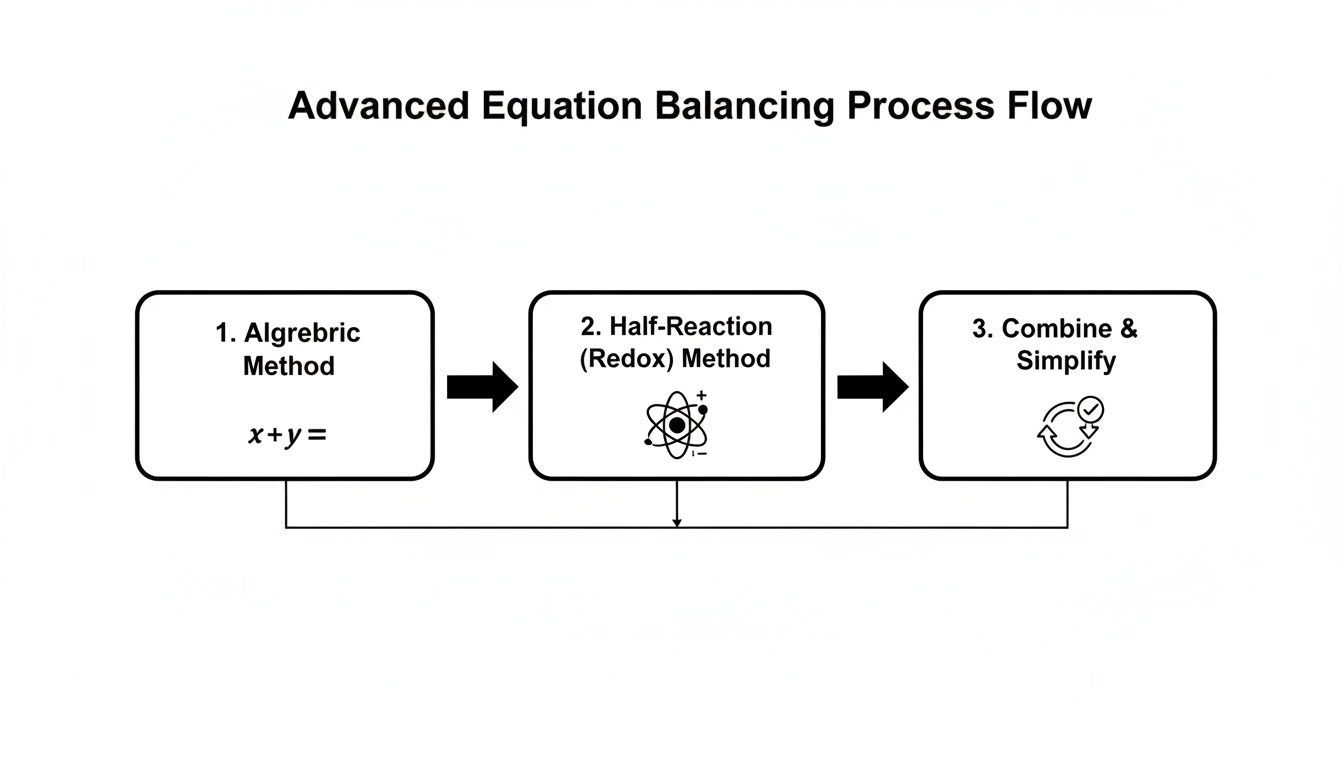
As you can see, for trickier reactions, more structured approaches like the algebraic or redox methods are your best bet.
Skipping the Final Check
You've adjusted the coefficients, everything looks good, and you're ready to move on. Stop! One of the easiest mistakes to fix is the one you catch yourself. Always, always, always do a final atom inventory.
It only takes a few seconds. Count up every single atom on the reactant side and make sure it perfectly matches the count on the product side. It’s the best way to catch a simple calculation error.
This simple checklist is a great habit to build. Run through it every single time you balance an equation.
Your Final Balancing Checklist
Before you call it done, run through this quick sanity check. It's the best way to guarantee you've nailed it.
| Check | Why It's Important | Yes / No |
|---|---|---|
| Atom Count | Does the number of each type of atom match on both sides? | |
| Lowest Ratio | Are all coefficients in their simplest whole-number ratio? | |
| No Subscript Changes | Did I leave all the original chemical formulas untouched? | |
| Polyatomic Ions Intact | If polyatomic ions were present, did I balance them as units? |
Taking a moment for this final review turns balancing from a guessing game into a methodical, verifiable skill. It’s the secret to building confidence and getting the right answer, every time.
Time to Get Your Hands Dirty: Practice Problems
You can read all the theory in the world, but balancing chemical equations is a skill you build by doing. Now's your chance to grab a pencil and some paper, apply what you've learned, and see how it all clicks into place.
I’ve put together a few problems that cover the different types of reactions we've discussed, from the more straightforward to the trickier redox examples. Give them your best shot before peeking at the solutions below. This is where the real learning happens.
The Practice Set
Synthesis: Solid sodium metal meets chlorine gas, and they react to form solid sodium chloride.
Na (s) + Cl₂ (g) → NaCl (s)Decomposition: When you heat solid potassium chlorate, it breaks down into solid potassium chloride and oxygen gas.
KClO₃ (s) → KCl (s) + O₂ (g)Combustion: Propane gas (what's in a BBQ tank) burns with oxygen, producing carbon dioxide and water.
C₃H₈ (g) + O₂ (g) → CO₂ (g) + H₂O (g)Double Displacement: Mix aqueous solutions of lead(II) nitrate and potassium iodide. A solid precipitate of lead(II) iodide forms, leaving potassium nitrate in the solution.
Pb(NO₃)₂ (aq) + KI (aq) → PbI₂ (s) + KNO₃ (aq)Redox (in Acid): A piece of copper metal is dropped into nitric acid. The reaction creates aqueous copper(II) nitrate, nitrogen dioxide gas, and water.
Cu (s) + HNO₃ (aq) → Cu(NO₃)₂ (aq) + NO₂ (g) + H₂O (l)
Sometimes a specific problem just won't budge, no matter how you look at it. If you find yourself hitting a wall or just want some one-on-one help, finding expert online tutoring for science can make a world of difference for Chemistry, Biology, and Physics.
The Solutions: How Did You Do?
Let's see how your answers stack up. I've included a quick thought process for each one.
2Na (s) + Cl₂ (g) → 2NaCl (s)
- A classic inspection problem. The Cl₂ on the left means you need two chlorines on the right, so you put a 2 in front of NaCl. That gives you two sodiums, so you just need a 2 in front of Na on the left. Done.
2KClO₃ (s) → 2KCl (s) + 3O₂ (g)
- The oxygens are the tricky part here. You have 3 on the left and 2 on the right. The easiest way to fix this is to find the least common multiple, which is 6. A 2 in front of KClO₃ gets you 6 oxygens on the left, and a 3 in front of O₂ gives you 6 on the right. That move also gives you 2 potassiums and 2 chlorines on the left, which is perfectly balanced by putting a 2 in front of KCl.
C₃H₈ (g) + 5O₂ (g) → 3CO₂ (g) + 4H₂O (g)
- With combustion, I always follow the same order: Carbon, then Hydrogen, then Oxygen (CHO). The C₃ means you need a 3 in front of CO₂. The H₈ means you need a 4 in front of H₂O (since 4 x 2 = 8). Now, count your oxygens on the right: (3 x 2) + (4 x 1) = 10. To get 10 oxygens on the left, you just need a 5 in front of the O₂.
Got a homework problem that’s making you want to tear your hair out? You can use modern tools to get unstuck. A good chemistry AI solver can walk you through the steps for your specific equation, showing you exactly where you might be going wrong.
Pb(NO₃)₂ (aq) + 2KI (aq) → PbI₂ (s) + 2KNO₃ (aq)
- Here's where treating polyatomic ions as a single "chunk" saves a ton of time. You have two nitrate (NO₃) groups on the left, so put a 2 in front of KNO₃ on the right. Now you have 2 potassiums on the right, so you need a 2 in front of KI on the left. Look at that—the 2 iodines on the left now perfectly match the I₂ on the right. Everything is balanced.
Cu (s) + 4HNO₃ (aq) → Cu(NO₃)₂ (aq) + 2NO₂ (g) + 2H₂O (l)
- If you tried to solve this one by simple inspection, you probably got frustrated fast. This is a prime candidate for the algebraic or half-reaction method. Notice how the atoms from HNO₃ end up in three different products? That's the tell-tale sign that a more systematic approach is needed to keep everything straight.
Common Questions Answered
Even after you get the hang of balancing equations, a few tricky questions always seem to surface. Let's tackle some of the most common ones I hear from students to help clear things up and build your confidence.
Why Can We Only Use Whole Numbers for Coefficients?
This is a great question that gets to the heart of what a chemical equation really represents. Think about it: reactions happen between individual atoms and molecules, and you just can't have half of a water molecule or a third of an oxygen atom. They are whole, discrete units.
Using whole numbers ensures the equation accurately reflects this reality. While you might see fractions pop up temporarily—especially if you're using the algebraic method—the final answer must always be scaled to the smallest possible whole-number ratio. It's about showing the simplest, most fundamental relationship between the particles involved.
Does the Order I Balance Elements In Actually Matter?
Yes, it absolutely does! While you might eventually stumble upon the right answer by picking elements at random, having a strategy makes the process much faster and less frustrating. I always tell my students to follow a simple hierarchy.
A good rule of thumb is:
- Start with the most complex-looking compounds first.
- If you see polyatomic ions (like SO₄ or PO₄) on both sides of the arrow, treat them as a single group. Don't break them up.
- Save the lone elements (like O₂ or just Fe by itself) for last. They're your "freebies"—super easy to adjust at the end without messing up everything you've already balanced.
My go-to order is usually metals, then non-metals, and always leaving hydrogen and oxygen for the very end. This little habit turns what can feel like a guessing game into a straightforward, step-by-step process.
What if an Equation Seems Impossible to Balance?
We've all been there. You're stuck in a loop where changing one coefficient throws another one off, and it feels like you're going in circles. When this happens, it's a huge clue that the simple inspection method just isn't cut out for this particular equation.
Don't waste time getting frustrated. It's time to switch your strategy.
- The Algebraic Method: This is your best friend when inspection fails. By turning the equation into a system of simple linear equations, you get a foolproof, mathematical path to the solution. It always works.
- The Half-Reaction Method: For redox reactions, this is non-negotiable. The problem is often not just about the atoms but also about the electrons being transferred. This method breaks the reaction down to balance both mass and charge separately, which is often the missing piece of the puzzle.
Knowing when to abandon one method for a more powerful one is a key skill. If you hit a wall, pivot.
Feeling stuck on a tough chemistry problem? Feen AI is your on-demand homework helper. Just upload a photo of your equation, and our AI can provide clear, step-by-step solutions to guide you through the process, making learning faster and more effective. Get instant help at https://feen.ai.
Relevant articles

Discover what is dimensional analysis in chemistry and master the factor-label method with clear, step-by-step examples.
Unlock the secrets of chemistry with our guide to the 5 signs of a chemical change. Learn to identify reactions through color, heat, gas, and more!
Master the essential skill of converting mass to moles. Our guide provides clear examples, molar mass calculations, and common pitfalls to avoid.