How to Improve Comprehension Skill with Proven Strategies
Struggling to absorb what you read? Learn how to improve comprehension skill with actionable reading strategies and smart tools for real, lasting results.
Improving your comprehension isn't about some secret trick; it’s about making a fundamental shift. You have to move from being a passive reader to an active one. This means you’re asking questions, connecting new ideas to what you already know, and having a clear goal before you even start. If you can build these habits, you'll completely change how you absorb information.
Why You're Struggling with Reading Comprehension (and How to Fix It)
We’ve all been there. You finish a page, or maybe an entire chapter, and realize you retained almost nothing. It's incredibly frustrating, and you're not alone. So many people run into this because they treat reading like watching TV—they just let the words wash over them without really engaging. More often than not, this passive approach is the real reason comprehension breaks down.
A few common roadblocks can turn a straightforward text into a dense, confusing mess. Maybe it's information overload, or you're just mentally tired. Sometimes, it’s a simple lack of background knowledge. If you don't have existing mental "hooks" to hang new facts on, the information just doesn't stick.
Pinpointing Your Specific Roadblocks
Before you can fix the problem, you need to know exactly what it is. Do you find your mind wandering after just a few paragraphs? Or are you getting tripped up by jargon and technical terms you don't recognize?
A great first step is to do a quick diagnostic check right after you finish reading something.
Ask yourself these questions:
- Did my mind wander? If yes, it’s likely a focus or engagement issue.
- Did I get stuck on key vocabulary? If so, unfamiliar words are your main obstacle.
- Could I explain the main idea to a friend? A "no" here means you probably missed the core message.
This kind of self-awareness is everything. For a more detailed look at different strategies, this practical guide to improving reading comprehension skills is an excellent resource to get you started.
The goal is to shift from being a passive observer to an active investigator. Every text has a purpose, and your job is to uncover it by questioning, connecting, and reflecting on the material as you go.
This isn’t a new problem, and the data is clear: consistent practice really works. Recent studies from the NAEP reading assessment showed a dip in average reading scores. But here’s the encouraging part: the same research found that students who read for fun almost every day scored significantly higher than those who rarely did.
It’s proof that regular, enjoyable reading is one of the most powerful tools for building understanding. Once you identify your personal hurdles and commit to active practice, you can start making real progress today.
Mastering the Art of Active Reading
If there's one change that makes the biggest difference in comprehension, it’s shifting from being a passive reader to an active one. It’s the difference between letting words just wash over you and actually wrestling with the ideas on the page. Active reading forces your brain to engage, question, and connect—building the mental muscle you need for real understanding.
One of the most battle-tested frameworks for this is the SQ3R method. It’s a five-step process that turns reading into a systematic investigation instead of a mindless scan.
- Survey: First, get the lay of the land. Before you dive into a dense chapter on cellular respiration, scan the headings, look at the diagrams, and read the introduction and conclusion. This gives you a mental map of where you're going.
- Question: Turn those headings into questions. If a section is titled "The Krebs Cycle," your question becomes, "What happens during the Krebs Cycle and why is it important?" This gives your reading a clear mission.
- Read: Now, you read with a purpose—to find the answers to your questions. This isn't about speed; it's about targeted engagement.
- Recite: After each section, stop. Can you summarize the main points out loud in your own words? If you can't explain it simply, you probably haven't grasped it yet. This is a crucial self-check.
- Review: Once you're done, go back over your notes and the questions you started with. This final pass helps lock the information into your long-term memory.
Make Your Mark: How to Annotate Effectively
We've all been there—highlighting entire pages in bright yellow, only to realize later that we retained nothing. That’s the illusion of learning. Real annotation is about having a conversation with the text.
So, grab a pen and start scribbling in the margins. Ask questions. Circle and define words you don't know. Draw arrows connecting related ideas across paragraphs. After reading a particularly tough paragraph in a philosophy text, challenge yourself to summarize its core argument in just five to seven words. This simple act forces you to process the information on a much deeper level. For more strategies on breaking down complex material, check out our guide on how to summarize book chapters effectively.
The process is about moving from simply seeing the words to actively working with them.
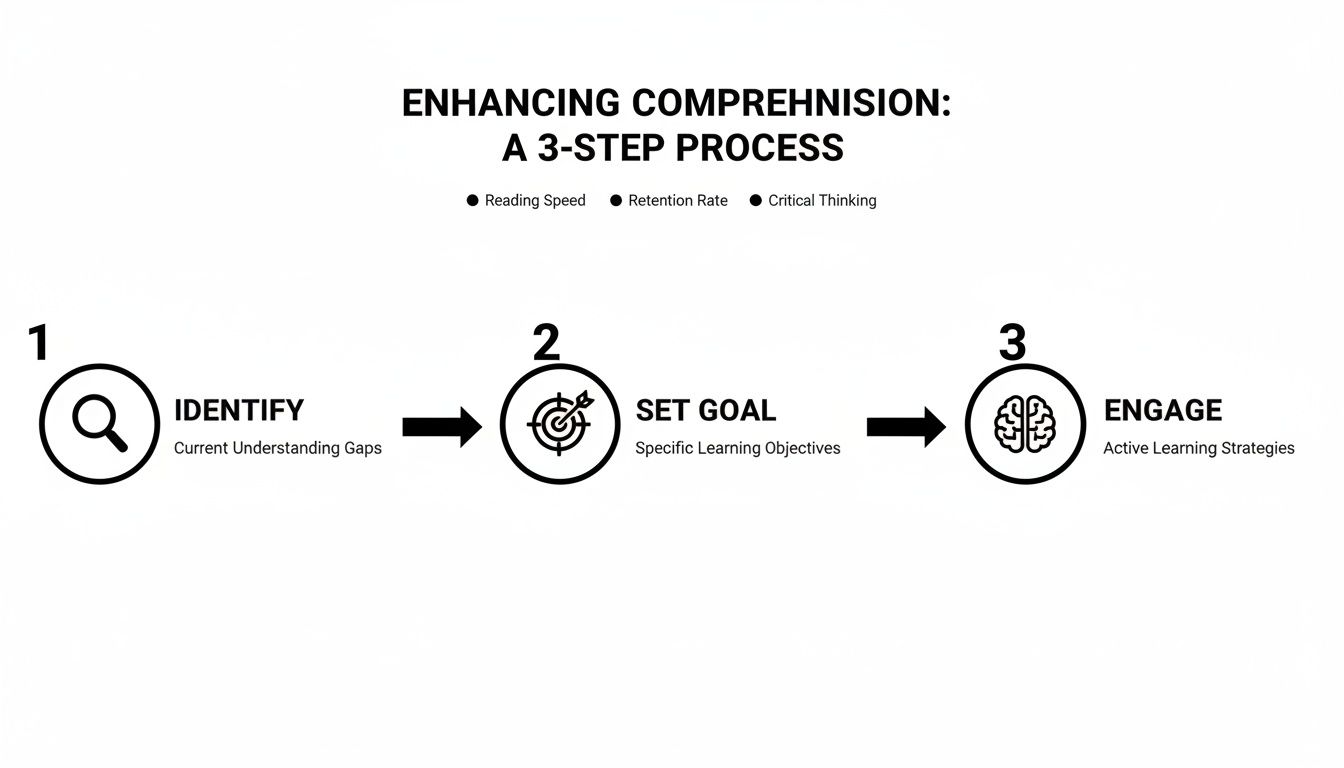
As you can see, comprehension isn't a one-and-done event. It’s a continuous cycle of identifying your purpose, setting goals, and using active strategies to engage with the material.
Bring It to Life with Visualization and the Teach-Back Method
Another fantastic technique is visualization. As you read about a historical battle or a complex chemical reaction, try to create a movie in your head. Picture the sequence of events, see the key players, or imagine how the molecules are interacting. This transforms abstract text into a concrete, memorable story.
Finally, get comfortable with the teach-back method. After you finish reading a concept, stand up and explain it out loud—to your dog, an empty room, or a patient friend. The act of verbalizing an idea immediately reveals any gaps in your understanding and solidifies what you actually know.
These aren't just feel-good exercises; they get real results. With reading challenges being a global issue—64% of fourth graders in the U.S. read below a proficient level—we know that passive approaches aren't enough. Studies have shown that active strategies like previewing texts and visualizing concepts can improve retention by 20-30% in comprehension tasks. It’s a small investment of effort for a huge return on understanding.
Tailoring Your Reading Strategy for Different Subjects
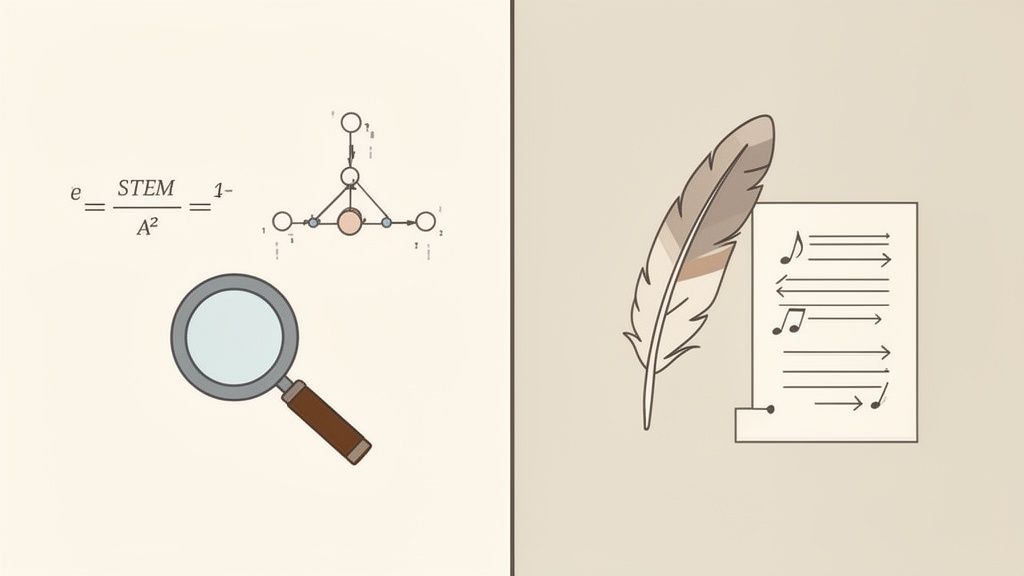
Trying to read a physics textbook the same way you read a historical novel is like using a hammer to turn a screw—it’s the wrong tool for the job, and you’re bound to get frustrated. The single biggest leap you can make in comprehension is recognizing that different subjects demand different approaches.
STEM fields are all about precision, logic, and interconnected systems. The humanities, on the other hand, live in the world of interpretation, argument, and nuance. Learning to switch your mental gears between these modes is a game-changer.
Cracking the Code of STEM Texts
When you’re staring down a chapter on organic chemistry or calculus, your mission is to deconstruct and connect. You're not just trying to learn what a concept is, but how it works and why it matters in the larger framework. This isn't speed-reading territory.
Slow down. Treat every diagram, chart, and equation as a main character in the story, not just a picture on the side.
- Take Equations Apart: Don't just gloss over a formula and try to memorize it. Break it down. What does each symbol actually mean? What happens to the outcome if you change one of the variables? This turns a random string of letters into a logical tool.
- Narrate the Visuals: That diagram of a cell isn't just decoration; it’s a visual narrative. Talk yourself through the process it shows, step by step, connecting each label back to the explanation in the text.
- Wrestle with the Examples: Never, ever skip the worked-out problems. They are your training ground. The best way to do this is to cover up the solution, try to solve it on your own first, and only then compare your method to the one in the book. This is where theory gets real.
Navigating the Nuances of the Humanities
In subjects like literature, philosophy, or history, your job is to become a detective. You’re hunting for arguments, themes, and the evidence an author uses to build their case. You're not just absorbing information; you’re analyzing a perspective and digging for deeper meaning.
This means reading with a critical, questioning eye. Every word choice matters. The way a story is structured is deliberate.
The real magic happens when you start reading between the lines. For a history text, ask yourself, "Whose voice is telling this story, and whose is missing?" For a novel, "Why does this symbol keep appearing? What could it represent?" This kind of active questioning is what powers deep understanding.
To really get a grip on humanities texts, try these moves:
- Map the Argument: Find the author's core thesis—what are they trying to convince you of? As you read, highlight or jot down the key pieces of evidence and supporting points they use. You're essentially creating a blueprint of their argument.
- Track Recurring Ideas: In literature or poetry, keep a running list of themes, motifs, or symbols that pop up again and again. Seeing these patterns helps you connect the dots and grasp the author’s overarching message.
- Interrogate the Source: Always think about the context. Who wrote this? When did they write it, and why? Understanding an author's background and potential biases is absolutely essential for a full and honest interpretation.
The reading skills needed for a dense scientific paper are fundamentally different from those required to analyze a Shakespearean sonnet. The table below breaks down these distinct approaches.
| Technique | How It Applies to STEM | How It Applies to Humanities |
|---|---|---|
| Pacing | Slow, deliberate, and often requires re-reading sections multiple times. | Can be faster, but requires slowing down for key passages and arguments. |
| Focus | Understanding processes, definitions, and logical connections. | Identifying the author’s thesis, evidence, and underlying themes. |
| Visuals | Diagrams, charts, and graphs are central to the core concepts. | Images are often supplementary or illustrative, not the main argument. |
| Questioning | "How does this work?" "What principle does this demonstrate?" | "Why did the author say it this way?" "What is the subtext here?" |
| Goal | To understand an objective system or process. | To interpret a subjective argument or narrative. |
Ultimately, being a flexible reader—one who can shift strategies based on the material—is the hallmark of a strong comprehender. It’s a skill that pays dividends in every area of learning.
Using AI as Your Personal Comprehension Tutor
Think of an AI helper like Feen AI not as a shortcut to skip the work, but as a way to make the work you do count for more. It’s like having a personal tutor on call 24/7, ready to help you nail down tough concepts and make your study sessions incredibly efficient.
This completely changes the game when you’re facing dense material. Instead of slogging through a complex academic paper multiple times, you can get a quick summary of its core arguments first. That overview gives you the mental scaffolding you need to read the full text with purpose and understanding.
Getting Instant Clarity on Complex Topics
Let’s get practical. Imagine you’re staring at a physics problem in your textbook, and the explanation just isn't making sense. You're stuck. Instead of giving up, you can just snap a picture of the problem and upload it.
Feen AI will give you a detailed, step-by-step walkthrough that shows you the how and the why behind the solution. That moment of frustration instantly becomes a real learning opportunity.
Here’s a look at how you can upload a document and start asking questions to break down its contents.
This direct Q&A is a huge time-saver. You get targeted answers right away without having to hunt through the entire document all over again.
Asking the Right Questions in Plain English
One of the biggest hurdles in learning is specialized jargon. The great thing about an AI tutor is that it can act as your personal translator. You don't need to know the official terms to ask for help.
Just ask naturally, like you would a real person. Try prompts like these:
- "Can you explain the Krebs cycle like I'm a high school student?"
- "What are the three most important takeaways from this chapter on macroeconomics?"
- "Give me an analogy to help me understand quantum entanglement."
This is where the magic happens. Asking for clarification in plain English removes the intimidation factor from even the most challenging subjects. It puts you back in the driver's seat, allowing you to get the exact explanation you need to make a concept finally click.
Beyond general studies, this technology is also making a huge impact in specific fields. For example, AI language learning tools can act as conversation partners and grammar coaches.
To see how you can fit these strategies into your own routine, check out our guide on how to use AI for studying. By using these tools to check your understanding and get help when you're stuck, you'll build a much stronger foundation of knowledge.
Building a Consistent Reading Habit That Lasts
Knowing all the right active reading techniques is one thing, but the real magic happens when you show up consistently. Improving your comprehension isn't a one-and-done project. It’s a habit, much like working out at the gym, that you cultivate over time. The ultimate goal is to weave reading into your life so it feels natural, not like a chore.
And here's the good news: you don't need to carve out huge chunks of your day. The secret weapon is short, focused bursts of reading. Committing to just 20-30 minutes a day creates incredible momentum. This daily practice not only builds your reading stamina but also expands your vocabulary, making even the densest material feel less daunting over time.
Designing a Routine That Actually Works
If you want a habit to stick, you have to build it into the life you already have. "I'll read more" is a nice thought, but it's not a plan. The key is to get specific and put it on your calendar. Find a slot where you can realistically protect 20 minutes from interruptions.
Maybe that's with your morning coffee, during your commute, or as you wind down before bed. Whatever it is, treat that time like an appointment you can't miss.
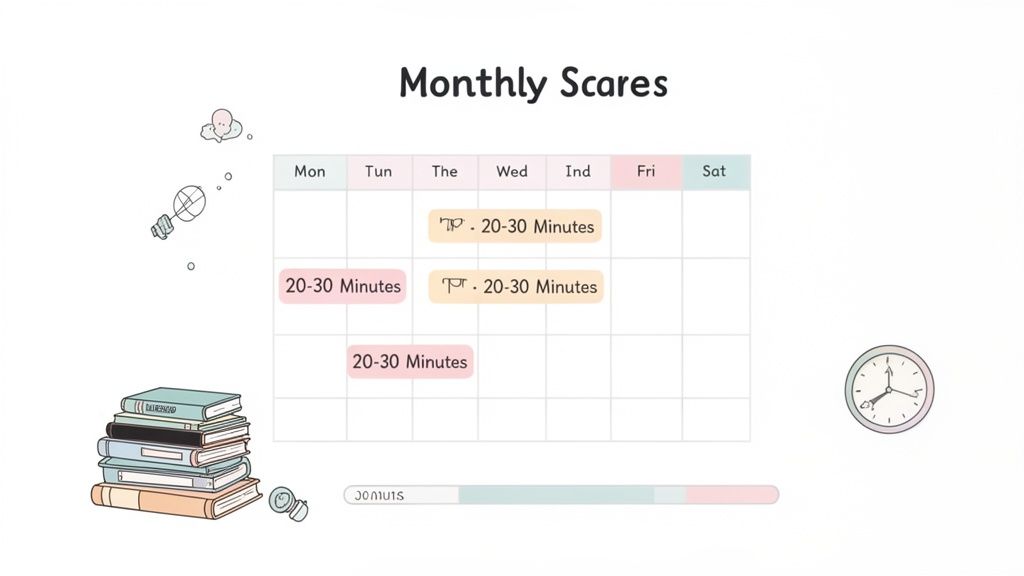
Here’s a simple weekly structure to get you started:
- Monday & Wednesday: Dive into a chapter from a tough textbook or a dense academic paper. Pick one active reading strategy to focus on, like jotting a one-sentence summary in the margin after each paragraph.
- Tuesday & Thursday: Switch gears and read something purely for fun—a novel, a favorite magazine, or an interesting online article. This keeps reading from feeling like a chore and builds positive momentum.
- Friday: Take a few minutes to review your notes from the week. Try to explain the main arguments from Monday's reading out loud. This kind of self-quizzing is what really makes information stick.
This mix of challenging and enjoyable reading is the key to staying motivated. For more strategies on wrestling with dense course materials, our guide on how to study from textbooks has some great tips.
The most effective way to improve comprehension skill is to turn deliberate practice into an automatic habit. Start small, be consistent, and choose material that keeps you engaged.
This isn't just theory. A 2023 PIAAC survey found that a staggering 28% of U.S. adults have difficulty with basic reading tasks. The same data highlights that a daily habit of just 15-20 minutes of reading varied materials is one of the most powerful ways to build strong comprehension. You can dig into more of these adult literacy statistics and facts over at NU.edu.
Tracking Your Progress for Long-Term Motivation
To make any new habit last, you need to see that it’s actually working. Tracking your progress gives you that concrete proof, and it doesn't have to be complicated at all.
Just start a simple reading journal in a notebook or a notes app. After each session, jot down three quick things:
- What you read: The title and page numbers or chapter.
- One-sentence takeaway: Can you distill the core idea into a single sentence?
- Clarity score: On a simple 1-5 scale, how well did you really get it?
After a few weeks of this, you’ll start seeing those clarity scores creep up. Texts that once seemed impenetrable will become clearer, and you'll find yourself summarizing complex ideas with more ease. Seeing that tangible progress is the best motivation to keep the streak going.
Got Questions? Let's Get Them Answered
Even with a solid game plan, you're bound to run into a few hurdles. It happens to everyone. Let's tackle some of the most common questions that pop up when you're working on sharpening your comprehension skills.
How Long Until I Actually See a Difference?
There’s no magic number, but here’s what I’ve seen work. Most people who dedicate 20-30 minutes a day to focused, active reading start to feel a real shift in their concentration and understanding within just a few weeks. For those skills to become second nature, you’re looking at a few months of consistent effort.
The single most important factor is consistency. Don't worry about massive gains overnight. Just focus on building the daily habit, and the results will take care of themselves. A great way to stay motivated is to track your progress—maybe time how long it takes to get through a chapter or see how well you can explain it to a friend afterward. You'll see the growth.
I Can't Stop Getting Distracted When I Read. What's the Fix?
You and pretty much everyone else. Distraction is the modern-day enemy of deep reading. The first, non-negotiable step is to build your fortress of focus. Put your phone in another room. Seriously. Turn off the notifications on your computer.
Next, give the Pomodoro Technique a shot. It's simple: set a timer for 25 minutes of pure, uninterrupted reading. When it goes off, take a 5-minute break. It’s amazing how much you can get done in these short bursts.
But the real game-changer is making reading a physical, active process. Don't just let your eyes skim the page. Grab a pen. Underline key ideas. Scribble questions in the margins. Summarize a tricky paragraph in your own words. When your hands are busy, your mind is less likely to wander.
A quick tip: Many people find they stay focused better with physical books. The weight of the book and the act of turning a page can be more grounding than scrolling on a screen. But ultimately, stick with whatever format keeps you locked in.
Can Feen AI Help with Listening, Too?
Absolutely. While you might think of Feen AI as a text-based tool, it’s incredibly useful for sharpening your listening skills.
Picture this: you're watching a dense university lecture online and the speaker drops a term you've never heard before. Instead of getting lost, you can pop it into the AI and get a quick definition without missing a beat.
Here are a couple of other ways to use it:
- Got a transcript? If the video or podcast has a transcript, upload it. Feen AI can give you a summary of the core arguments in seconds, which is a fantastic way to check if your understanding matches the main points.
- Need a simpler explanation? You can ask the AI to break down a complex idea from the audio into simpler terms. This process of re-explaining is a powerful way to make sure the information really sticks. It's a great way to build comprehension muscle across different types of media.
Ready to stop struggling and start truly understanding your coursework? Think of Feen AI as your personal tutor, ready 24/7 to provide step-by-step solutions, summarize dense material, and answer any question you have. Give it a try and see how much faster you can learn at https://feen.ai.
Relevant articles
Discover how to improve critical thinking skills with practical exercises, proven frameworks, and strategies for students and professionals.
Discover how to improve test taking skills with proven strategies. Learn study techniques, anxiety management, and ways to analyze mistakes for better grades.
Learn how to take lecture notes effectively with proven strategies. Discover methods that boost retention and turn your notes into powerful study tools.
Discover how to improve comprehension skills with proven reading strategies. Master active reading and note-taking for deeper understanding.
Discover how to summarize book chapters effectively. Our guide covers proven methods and smart tools to help you retain more information and study smarter.
Learn how to study from textbooks effectively with active reading, note taking, and spaced review strategies to boost comprehension and retention.