How to Overcome Math Anxiety: how to overcome math anxiety with confidence
Discover how to overcome math anxiety with proven strategies. Build confidence with practical study habits.
Beating math anxiety isn't about suddenly becoming a math genius overnight. It's about dismantling the fear, piece by piece. The process starts with understanding what sets off your stress and then methodically building new habits and a healthier mindset. You can absolutely get there with practical, low-pressure strategies that build both your confidence and your skills.
What Math Anxiety Really Is and How It Shows Up

Before you can tackle math anxiety, you have to know your enemy. This isn't just a mild dislike for algebra; it's a real, gut-level emotional and physical reaction to anything involving numbers. For many, it’s that awful feeling of panic or helplessness that makes your brain freeze up the second you see an equation.
If this sounds familiar, you are in good company. This feeling is incredibly common. Research shows that a staggering 93% of adult Americans have felt some level of math anxiety. For about 17% of the US population, it's severe enough to derail their lives and even dictate their career paths.
Identifying the Symptoms
Math anxiety manifests differently for everyone. It can creep into your thoughts, stir up your emotions, or even cause a physical reaction. Pinpointing these signs in yourself is the first real step toward taking back control.
Many of these reactions overlap with the classic symptoms of an anxiety disorder. That racing heart before a test? Sweaty palms when you’re called on in class? Those are textbook anxiety responses. The trick is to see them for what they are: signals from your body reacting to a perceived threat, not a reflection of your actual ability to do the math.
This table breaks down some of the most common ways math anxiety shows up. See if any of these resonate with your own experience.
Common Signs of Math Anxiety
| Symptom Category | What It Looks and Feels Like |
|---|---|
| Psychological | Negative self-talk ("I'm just not a math person"), mind going blank on tests, trouble concentrating on a problem. |
| Emotional | A feeling of dread before math class, intense frustration over small mistakes, avoiding math-related tasks altogether. |
| Physical | Sweaty palms, racing heartbeat, nausea or an upset stomach, feeling tense and jittery, shortness of breath. |
Recognizing these signs helps you separate the feeling of anxiety from the fact of your intelligence.
Takeaway: Math anxiety is a real, measurable response. It's not a character flaw or a sign of low intelligence. It's a conditioned reaction that, with the right strategies, you can unlearn.
Why Does It Happen?
So, where does this all come from? Understanding the "why" can help take the sting out of the experience, making it feel less like a personal failing.
For most people, math anxiety can be traced back to a specific negative experience. Maybe it was being put on the spot at the chalkboard, feeling the intense pressure of timed tests, or getting a bad grade after you genuinely tried your best.
Middle school is often a flashpoint. The concepts get more abstract, the pace picks up, and the social pressure is on. Once that cycle of fear and avoidance gets going, it can feel impossible to break without a deliberate effort. But the good news is, identifying those old triggers is the first step toward creating new, more positive connections with math.
The Real-World Cost of Avoiding Numbers

Math anxiety is so much more than that sinking feeling during a pop quiz. It's a quiet but persistent force that follows you long after you've left the classroom, subtly shaping your life and closing doors to opportunities you might not even see. This isn't just a school problem; it’s a life problem.
When you find yourself constantly dodging numbers, you're not just skipping homework. You're likely steering yourself away from some of the most rewarding and in-demand careers out there today. Fields like data science, engineering, software development, and modern business analytics all run on a common foundation: quantitative reasoning.
A deep-seated lack of confidence with math can make these paths seem completely off-limits. It has a way of pushing incredibly talented people toward careers that feel "safer" but may not line up with their real passions or earning potential. That avoidance builds a self-imposed ceiling on what you think you can achieve.
The Impact on Your Career and Finances
The consequences aren't just theoretical—they’re real, tangible, and measurable. The fear of numbers directly hits your professional growth and financial stability, creating a ripple effect that can last for decades.
And this isn't some rare issue. Research paints a startling picture of just how widespread the problem is. One recent study found that nearly half of Americans—47%, to be exact—feel that math anxiety has held them back either professionally or academically. Even more shocking, one in five said it directly cost them a specific career opportunity. Gen Z seems to be feeling the brunt of these professional setbacks. You can dive deeper into the findings in the full study on how math anxiety impacts careers and education.
This hesitation translates directly into real-world financial limitations. When you're not comfortable with numbers, it becomes a genuine struggle to:
- Build a Solid Budget: Trying to track what’s coming in versus what’s going out can feel overwhelming, adding a ton of financial stress.
- Plan for the Future: Concepts like compound interest for retirement or analyzing mortgage options become sources of anxiety, not empowerment.
- Make Informed Investments: The world of investing can seem like a completely foreign language, keeping you from growing your wealth.
- Negotiate a Better Salary: Confidence with data is often the key to proving your value and making a strong case for better pay.
At the end of the day, avoiding numbers means avoiding the very tools you need to build a secure financial future. It complicates everything from calculating the best deal at the grocery store to truly understanding your own credit score.
By not addressing the root of the anxiety, you risk making major life decisions based on fear rather than on your true goals and potential. The cost is not just about missed job opportunities but also about a lifetime of diminished financial confidence.
Why Understanding This Matters
Laying out these consequences isn't about adding more pressure. Far from it. The goal is to highlight what's truly at stake here. Seeing the long-term impact of math anxiety can give you a powerful reason to finally confront it head-on.
It helps you reframe the issue from a hopeless "I'm bad at math" to a much more proactive "My anxiety is holding me back, and I'm ready to change that." This shift in perspective is the first, most important step. It's what empowers you to take ownership and start building a new, healthier relationship with numbers—one that opens doors instead of closing them.
Rewiring Your Brain for Mathematical Thinking
Overcoming math anxiety doesn’t start with a calculator or a formula sheet. It starts with your own thoughts. That knot in your stomach is a conditioned response, a well-worn mental path your brain defaults to. The good news? You can forge new paths. You have the power to rewire your perspective from fear to genuine curiosity.
Honestly, this battle is almost entirely won in your mind. It’s all about shifting your internal monologue from "I'm just bad at math" to "This is a challenge I can figure out." That simple but profound change is the bedrock of what's known as a growth mindset.
Embrace a Growth Mindset
A growth mindset is simply the belief that your abilities—especially math skills—aren't set in stone. They can be developed with effort, the right strategies, and a bit of guidance. It's the difference between seeing a tough problem as a final verdict on your intelligence versus seeing it as a puzzle that's just waiting to be solved.
Think of it like learning to play the guitar. Nobody expects to nail a solo after one lesson. You know you'll hit wrong notes, and some chords will feel impossible at first. Math is exactly the same. Every mistake is just a wrong note—it’s feedback, not failure. Adopting this view is a powerful first step in learning how to manage that anxiety.
Shifting your perspective is the single most effective tool you have. When you see challenges as opportunities to get stronger, you strip anxiety of its power. The experience transforms from a threat into a game.
This isn't just a feel-good idea; it's a strategy with real-world results. While math anxiety has been rising among 15-year-olds in most countries, some nations are successfully pushing back. South Korea, for instance, saw a significant drop in student-reported math anxiety from 44% in 2012 to 32% in 2022. A major factor seems to be confident teachers who help students reframe their entire approach to mathematics. You can read more about these encouraging global trends in defying math anxiety.
Catch and Challenge Your Negative Self-Talk
That nagging voice in your head whispering "you can't do this" is the real fuel for math anxiety. Your job is to become a detective—actively listen for that inner critic and challenge its every claim.
When you catch yourself thinking something negative, don't just let it slide. Interrogate it with cold, hard logic.
Negative Thought: "I'm just going to fail this test anyway."
Challenge: "Failing isn't a foregone conclusion. I've studied some of this. What's one topic I feel halfway decent about? I'll start there."
Negative Thought: "Everyone else gets this but me."
Challenge: "That's a huge assumption. Lots of people probably find this tricky. What's one specific question I can ask to get unstuck on the first step?"
This process, called cognitive reframing, is a powerful way to disrupt the anxiety spiral. It pulls your brain out of emotional panic and into logical problem-solving mode. This mental exercise is a cornerstone of a much broader strategy, which you can explore in our guide on how to improve your problem-solving skills.
Use Mindfulness to Ground Yourself
When anxiety spikes, your body kicks into "fight or flight" mode, which makes clear thinking nearly impossible. Simple grounding techniques can pull you back to the present moment and calm your nervous system right when you need it most.
Before a test or during a tough homework session, give this simple box breathing exercise a try:
- Inhale: Slowly breathe in through your nose for a count of four.
- Hold: Gently hold your breath for a count of four.
- Exhale: Slowly breathe out through your mouth for a count of four.
- Hold: Hold your breath again for a count of four.
Repeat this cycle three to five times. It's incredibly effective because it forces your focus onto the rhythm of your breath instead of the anxious thoughts swirling in your mind.
Celebrate the Small Wins
Momentum is your best friend here. To build it, you have to acknowledge every single bit of progress, no matter how tiny it seems. Did you finish a practice set? Celebrate it. Finally understood a concept that was stumping you? That’s a huge win.
Keeping a "math wins" journal can be a fantastic tool for this. Each day you study, jot down one thing you accomplished.
- "Solved three homework problems without peeking at the answer key."
- "Actually asked a question in class today."
- "Spent 20 focused minutes on my assignment without getting distracted."
Looking back at this list gives you tangible, undeniable proof of your progress. It creates a positive feedback loop that slowly but surely replaces old feelings of dread with new feelings of competence and confidence.
Smarter Study Habits That Actually Reduce Stress
A positive mindset is a powerful start, but it really takes off when you pair it with a solid game plan. The real goal here is to replace those chaotic, last-minute cram sessions—a huge source of anxiety for most people—with a calm, consistent, and predictable routine. Smart study habits aren't about grinding harder; they're about working in a way that actually builds understanding without kicking your stress levels into high gear.
This means rethinking your whole approach to homework and test prep. Instead of staring down a chapter on trigonometry and seeing a single, massive mountain to climb, you can learn to see it as a series of small, manageable hills. This technique is often called chunking, and it’s a game-changer.
The Power of Chunking Your Studies
Chunking is just a fancy term for breaking a big topic down into its smallest, most digestible pieces. You wouldn't try to eat a whole pizza in one bite, right? So don't try to learn an entire math concept in one go. By splitting a chapter into individual definitions, formulas, and specific types of problems, you create a clear roadmap for yourself.
This method directly attacks that "I'm so overwhelmed" feeling. Your to-do list instantly transforms from the vague and intimidating "Study Chapter 5" to a concrete set of mini-tasks:
- Read and understand the definitions of sine, cosine, and tangent.
- Do five practice problems just on finding the sine of an angle.
- Watch a quick video explaining the unit circle.
Every little item you check off gives you a small hit of accomplishment, building momentum and confidence. This process starts to rewire your brain, helping it associate math with steady progress instead of paralyzing fear. This simple visual breaks down the core steps for a less stressful approach.
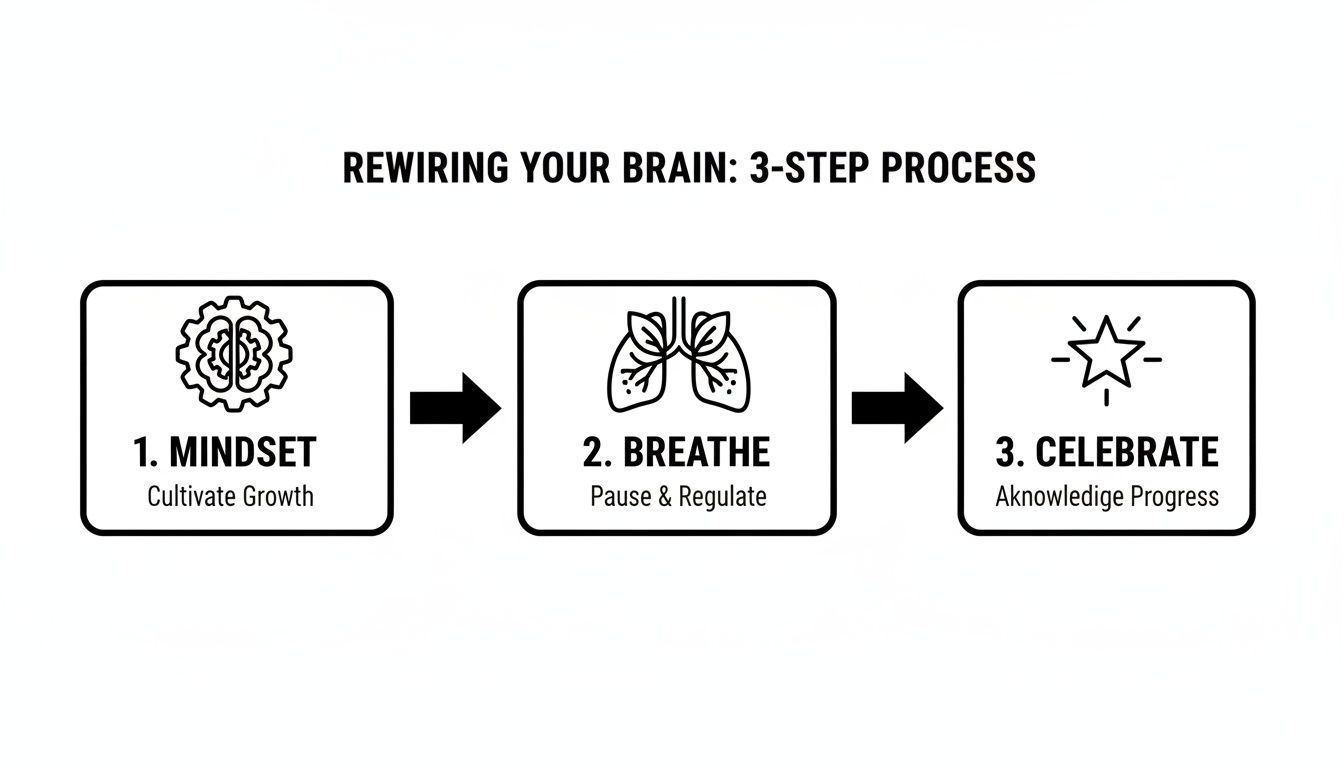
As the flowchart shows, a calm, methodical process is key. It all starts with your mindset, grounding yourself with your breath, and then celebrating the small wins along the way.
Building a Sustainable Weekly Routine
When it comes to math, consistency beats intensity every single time. It's been proven that short, focused study sessions spread throughout the week are far better for long-term memory than one giant cram-a-thon. A grueling four-hour study session on a Sunday night is a perfect recipe for anxiety and burnout.
What you want instead is predictability. A structured routine eliminates the guesswork and decision fatigue, which frees up your mental energy for what matters: learning the material.
Here’s an idea of what a low-stress weekly math schedule could look like:
| Day | Activity | Time | Goal |
|---|---|---|---|
| Monday | Review Class Notes & Start Homework | 30 mins | Solidify concepts from today's lecture and tackle the first few problems. |
| Tuesday | Continue Homework | 25 mins | Work on the next "chunk" of the assignment. Stop when the timer goes off. |
| Wednesday | Active Learning & Problem Check | 30 mins | Try teaching a concept to a friend or use an AI tool to check your work. |
| Thursday | Finish Homework & Review Week | 30 mins | Complete the assignment and do a quick review of the week's topics. |
| Friday | Rest | 0 mins | Give your brain a break. No math today. |
| Saturday | Practice Quiz | 20 mins | Do a few problems from the week without notes to test your recall. |
| Sunday | Plan Ahead | 15 mins | Briefly look over what's coming up in the week ahead. |
This schedule adds up to just over two and a half hours for the whole week, but that consistent, spaced-out practice will produce far better results than a single, panicked study block. For a deeper dive into structuring your sessions, our guide on how to study math effectively offers even more detailed strategies.
The secret to effective study isn't finding more hours in the day. It's making the minutes you do have more focused, intentional, and less stressful. A predictable routine is your best defense against anxiety.
Adopt Active Learning Techniques
Just rereading your notes or passively watching someone else solve a problem isn't going to cut it. To truly conquer math anxiety, you have to get your hands dirty and engage with the material actively.
One of the best methods for this is the Feynman Technique. The idea is simple: try to explain a concept in the most basic terms you can, as if you were teaching it to a child. If you find yourself getting stuck or relying on jargon, that's a huge red flag that you don't understand it as well as you thought. It's a fantastic, low-stakes way to find your own knowledge gaps long before an exam does.
Another great active strategy is to work backward. Find a solved problem in your textbook, cover up the steps, and try to get from the answer back to the original question. This forces you to think critically about how each step connects to the next. For more foundational advice that can apply to any learning environment, this practical guide on how to manage stress and anxiety is a great resource.
Using Tech as Your Private, Judgment-Free Tutor
Let's be honest: a huge trigger for math anxiety is the fear of asking a "stupid question." That thought alone can be paralyzing, keeping us silent in class when we desperately need clarity.
But what if you could ask any question, no matter how basic you think it is, without an ounce of judgment? That’s exactly what modern technology offers—a private, patient, and endlessly available tutor right in your pocket.
This is where AI-powered homework helpers like Feen AI can become a powerful ally. They create a safe, anonymous space where you’re in total control. You can work through problems at your own speed, ask for just the first step, check an answer, or even explore five different ways to solve the same equation until one finally clicks.
The real benefit here is removing the social pressure that so often fuels anxiety. There's no one tapping their foot waiting for you to get it, and no classmates to compare yourself against. It's just you and the tool, focused entirely on building your understanding. This privacy lets you be vulnerable, admit you don't get it, and build up those foundational skills without an audience.
How to Use AI Tutors Effectively
Remember, the goal isn't just to get the right answer—it's to build genuine confidence and skill. To really make these tools work for you, think of them as a guide, not a crutch. Imagine having a knowledgeable study partner who can nudge you in the right direction whenever you get stuck.
Here’s how to use an AI helper to your advantage:
- The "First Step" Nudge: When a problem feels completely overwhelming, just ask for the very first step. Often, just seeing how to begin is enough to break through that initial mental block.
- Check Your Process: Instead of jumping to the final answer, try to solve the problem on your own first. Then, ask the AI to review your steps. This is a fantastic way to pinpoint exactly where you went wrong.
- Explore Different Methods: Try asking, "Is there another way to solve this?" You might discover a method that makes way more sense to you than the one taught in class.
This image shows just how simple it is—you can snap a picture of a problem and immediately start a conversation about it.
This transforms a static, intimidating worksheet into a dynamic and supportive learning session. It removes the friction of getting stuck and helps you approach challenging material with more curiosity and less anxiety.
Building Confidence at Your Own Pace
When you use technology this way, you're not just learning math; you're practicing the crucial skill of self-directed learning. You start to recognize your own knowledge gaps and actively seek out the information to fill them.
Every time you use a tool to finally grasp a concept you were struggling with, you're proving to yourself that you are capable of learning this stuff.
The real power of these tools isn't just in providing answers. It's in creating a judgment-free zone where you can dismantle your fear of being wrong, allowing you to focus purely on learning.
This cycle—identifying a challenge, using a resource to understand it, and successfully applying that new knowledge—builds real, lasting confidence. It's a low-stakes environment to practice and make mistakes, which is absolutely essential for growth. For a deeper dive, our guide on how to use AI for studying offers even more strategies.
Ultimately, the goal is to build your skills to the point where you rely on these tools less and less. Think of them as scaffolding—a temporary support structure that helps you build a strong foundation. As your confidence grows, you’ll find yourself turning to them not out of desperation, but out of curiosity to confirm your own work or explore new ideas.
Common Questions About Overcoming Math Anxiety
Even with a great plan, the path to overcoming math anxiety is rarely a straight line. It's totally normal to have questions and moments of doubt pop up along the way. Let's tackle some of the most common concerns I hear from people as they start building a better relationship with numbers.
Think of this as your go-to FAQ for the real-world stuff—the practical questions that come up when you’re trying to turn new mindsets and study habits into a reality.
How Long Does It Take to Overcome Math Anxiety?
This is the big one, and the honest answer is: there's no set timeline. Everyone’s journey is different. How quickly you see progress really depends on how deep the anxiety runs and, more importantly, how consistently you apply these new strategies.
Some people feel a real shift in just a few weeks of using a growth mindset and better study habits. For others, especially if the anxiety started from negative experiences way back in elementary school, it might take a few months of steady, patient effort.
The key is to stop focusing on a finish line and start celebrating the small wins. Every single time you understand a tough concept or just get through homework without that familiar wave of panic—that’s progress. Consistency is what really matters here, not speed.
The goal isn't a race. It's about slowly and deliberately replacing old, anxious habits with new, confident ones. You're unlearning years of conditioning, so be patient with yourself.
Can Math Anxiety Be Cured Completely?
While "cured" might not be the right word, you can absolutely learn to manage math anxiety so effectively that it no longer runs your life or limits your choices. The real goal is to shift your relationship with math from one based on fear to one built on competence and a quiet sense of confidence.
You'll develop your own toolkit of coping mechanisms, grounding techniques, and study systems that work for you. Will you still feel a few butterflies before a huge exam? Probably. That's just a normal human response to pressure. But it won't be that paralyzing dread that used to stop you in your tracks.
The true victory is when you start to see math as just another skill—something to be practiced and improved, not a measure of your worth or intelligence. That change in perspective is everything.
What Should I Do If I Am Too Afraid to Even Start My Homework?
That feeling of being frozen in front of your textbook is a classic anxiety response. The best way to break through it is to make the first step ridiculously small. Don't think about the entire assignment; that's what's so overwhelming.
Instead, just commit to five minutes. Seriously. Set a timer, open your book, and just read the first problem. You don't even have to solve it. This one tiny, non-threatening action is often all it takes to break the inertia and get you moving.
Here are a few other tricks that work wonders:
- Start with the Easiest Problem: Scan the assignment and find the one question that looks the least intimidating. Nail that one first for an instant little win.
- Use a Nudge: Get just the very first step of a problem from an AI tool. Sometimes, just seeing how to begin is the little push you need.
- Body Double: Ask a friend or family member to just sit in the room with you while you work. You don't even have to talk—just having someone else there can make the task feel less isolating and daunting.
The whole idea is to make the task so small that your anxiety doesn't have time to build a wall against it.
When Should I Ask a Teacher or Tutor for Help?
The best time to ask for help is the moment you feel genuinely stuck, not when you're completely lost. There's a huge difference. If you wait until you're totally overwhelmed, it’s much harder for you to explain the problem and for someone else to help you pinpoint where things went wrong.
If you've tried a problem, reviewed your notes, maybe even used a tool to see the steps, and you still don't get the logic behind it, that's your cue. It's so much more effective to go to your teacher and say, "I understand how to set up the equation, but I'm confused about why we isolate this variable next."
That's a world away from saying, "I just don't get any of this." Asking for help isn't a sign of weakness. It's a smart, strategic move that the best students use all the time. It shows you're engaged enough to know exactly where you need a hand.
Ready to take the first step with a judgment-free study partner? Feen AI provides instant, step-by-step help for your toughest math problems. Snap a picture of your homework, ask any question, and get the clear explanations you need to build confidence at your own pace. Try it for free at feen.ai.
Relevant articles

Learn how to read scientific papers more efficiently with practical steps, summaries, and quick takeaways. how to read scientific papers made simple.
Discover how to improve comprehension skills with proven reading strategies. Master active reading and note-taking for deeper understanding.