How to Use AI for Studying to Master Any Subject
Discover how to use AI for studying with proven strategies that actually work. Learn to leverage AI study tools to ace exams and understand complex topics.
Let's be real: staring at a tough homework problem can feel like hitting a wall. But what if you could get unstuck in seconds, just by snapping a picture? That's exactly where AI study tools like Feen AI are changing the game.
You can upload images or PDFs of your assignments and get clear, step-by-step breakdowns for everything from tricky calculus equations to dense chemistry concepts. It's not about finding shortcuts; it's about making your study time count.
Your New AI Study Partner for Academic Success
Think of it less as a magic answer key and more as a personal tutor that's always on call. The real power of these tools isn't in some futuristic hype—it’s in how you weave them into your everyday study habits to actually learn more effectively.
This isn't about skipping the hard work. It's about cutting through the frustration that kills your motivation. The whole point is to spend your energy on what truly matters: understanding the core ideas so you can tackle future problems with confidence.
Making Homework Less Intimidating
For most of us, just starting is the hardest part. An AI study partner can be that on-demand guide you need at 11 PM when you're wrestling with a problem set. It breaks down overwhelming tasks into smaller, more manageable steps, helping you build momentum and the confidence to keep going.
This simple workflow is all it takes to get instant help.
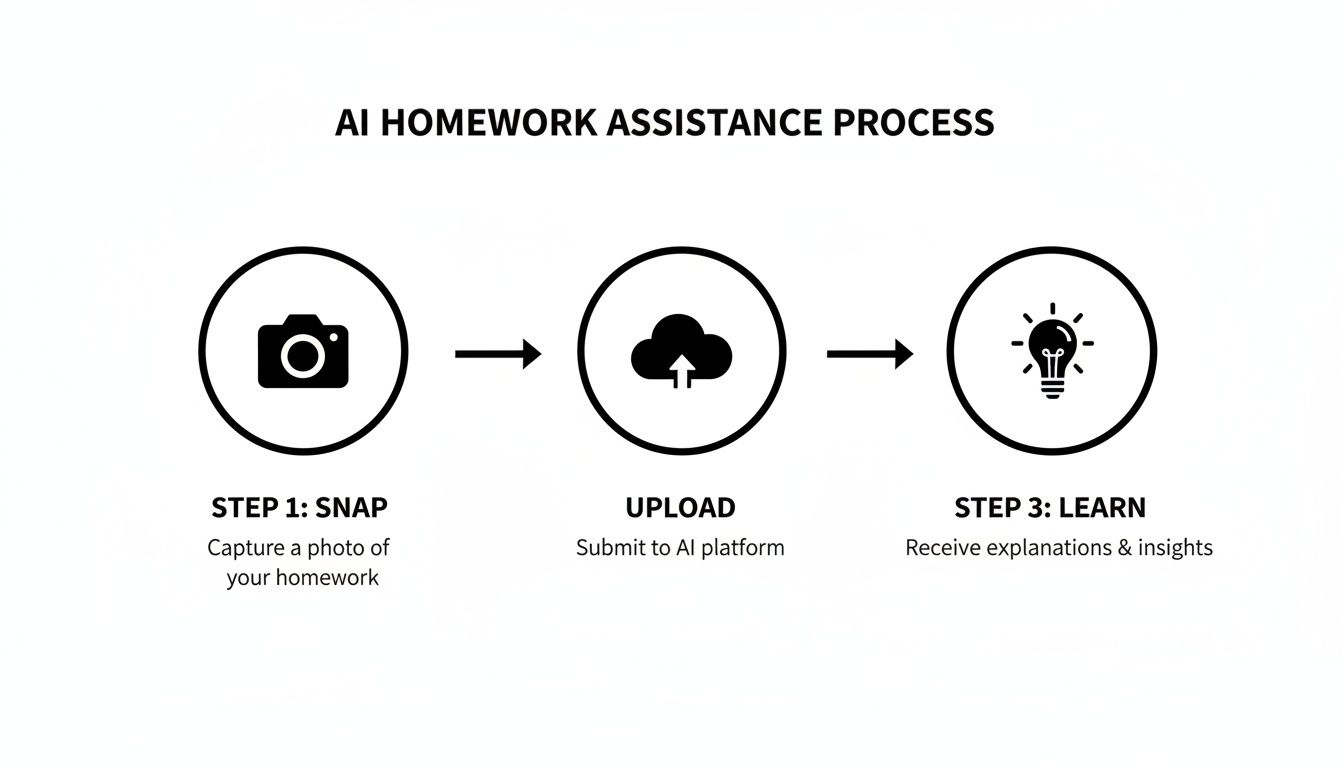
The "snap, upload, learn" process really is that straightforward. You're turning a static problem on a page into an interactive learning moment.
And this isn't some niche trend. The global AI in education market was valued at USD 7.05 billion back in 2025 and is expected to explode to USD 112.30 billion by 2034. That’s a massive growth rate of 36.02% annually, which shows just how many students are already relying on these tools.
To help you see the practical side of this, here’s a quick breakdown of how an AI partner can solve common study headaches.
Quick Wins with Your AI Study Partner
| Common Study Problem | How AI Solves It | The Direct Benefit |
|---|---|---|
| Getting stuck on a single math problem. | Provides a step-by-step solution breakdown. | You learn the process, not just the answer. |
| Feeling overwhelmed by a long reading. | Summarizes dense text into key bullet points. | Saves hours of reading time and boosts retention. |
| Staring at a blank page for an essay. | Helps brainstorm ideas and generate an outline. | Overcomes writer's block and structures your thoughts. |
| Forgetting a concept from a past lesson. | Offers instant explanations and examples on demand. | Fills knowledge gaps quickly without derailing your study session. |
As you can see, the goal is always to make your learning more active and efficient. It's about empowering you to take control of your studies.
Key Benefits of an AI Study Partner
When you start integrating AI into your routine, you'll notice a few key advantages that go beyond just getting homework done.
- Instant Clarification: No more waiting for office hours. Get immediate, detailed explanations for tricky problems so you don't lose momentum.
- Efficient Summarization: Turn long articles or textbook chapters into digestible summaries. This is a game-changer for exam prep.
- Improved Writing Skills: Use it as a sounding board to brainstorm ideas, structure your essays, and refine your arguments for better clarity.
- Personalized Pace: You're in the driver's seat. Revisit difficult topics as many times as you need without feeling rushed or judged.
The most effective way to use AI is not as an answer machine, but as a tireless tutor that helps you practice, find gaps in your knowledge, and ask better questions.
Of course, a smart AI is only one part of the equation. A solid academic toolkit also includes the best student productivity apps to keep you organized and on track. By combining smart technology with good habits, you build a system that truly sets you up for success.
To see what else is out there, check out our guide on other powerful AI-powered study tools.
Solving Complex STEM Problems with AI
Let's be honest—STEM subjects like math, chemistry, and physics can feel like hitting a brick wall. The real challenge isn't just checking your answer in the back of the book; it's about actually grasping why the solution works. This is where AI completely changes the game, acting less like a simple tool and more like an on-demand personal tutor.
Instead of getting stuck and frustrated, you can get immediate help with complex processes. Just imagine snapping a quick photo of a nasty chemical equation or a confusing physics diagram and having an AI break it down for you, piece by piece. That’s how you move from just staring at a problem to actively learning how to solve it.

This kind of interaction is so powerful because it bridges the gap between seeing a problem on the page and truly understanding the principles behind it. You’re not just getting the final answer; you’re learning the method so you can do it yourself next time.
From Photo to Problem Solved
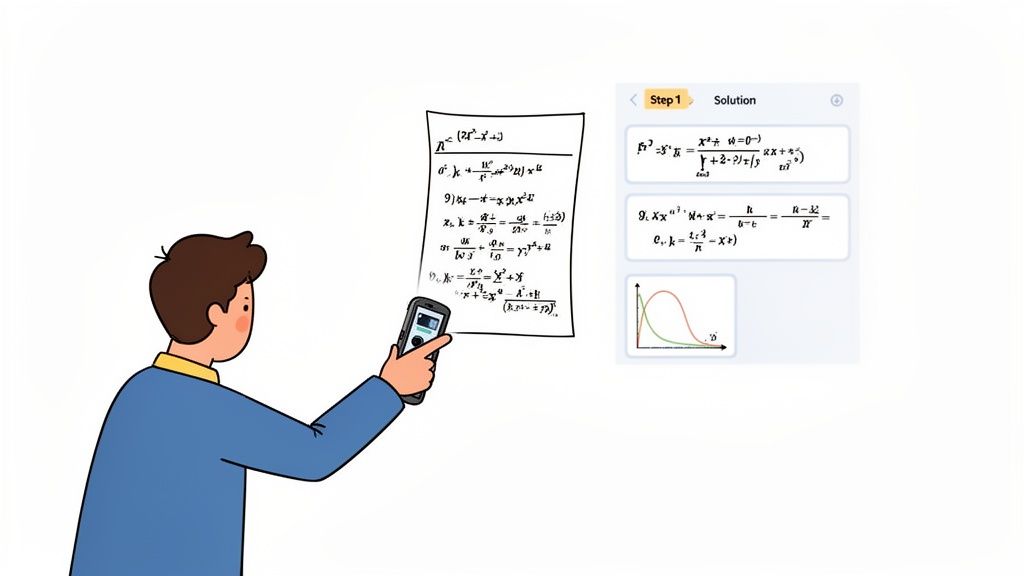
The quickest way to get help is to show the AI the exact problem giving you trouble. Tools like Feen AI are designed for exactly this. You can drag and drop a screenshot or upload a photo of your textbook page right into the chat.
Once your image is uploaded, the real secret is asking the right questions. A lazy prompt like "solve this" will get you an answer, sure, but a specific, thoughtful prompt will get you an education.
Here are a few examples of much better prompts to use after you upload an image:
- For a Math Equation: "Walk me through the steps to solve this quadratic equation. Tell me which formula you used and explain why it was the right one for this problem."
- For a Chemistry Problem: "Show me how to balance this chemical equation step-by-step. What are the reactants and products, and what do the coefficients actually represent?"
- For a Physics Diagram: "Analyze the forces on the object in this free-body diagram. Explain how to calculate the net force using Newton's Second Law."
Prompts like these push the AI to be a teacher, not just a calculator. That distinction is everything. It ensures you’re building real skills, not just getting homework done. For more practice, a dedicated AI math solver can be a fantastic resource for honing these techniques.
Mastering Math Step by Step
Math is all about building blocks. If you have a crack in your foundation, everything you try to build on top of it will feel wobbly and confusing. This is where an AI tutor really excels—it has endless patience and can explain the same concept in a dozen different ways until it finally clicks for you.
Let's say you're getting tangled up in integrals in your calculus class. You can upload a problem and ask for way more than just the solution.
Pro Tip: After the AI explains a problem, ask it to generate a similar but slightly different practice problem. This is a great way to test if you’ve actually learned the method or just memorized the steps for that one specific question.
This method of active recall is far more effective for long-term learning than just passively reading through solutions. It transforms your study time into an interactive workshop.
Decoding Chemistry and Physics Concepts
Chemistry and physics are full of abstract ideas, from invisible molecular bonds to complex electromagnetic fields. An AI can help make these concepts more concrete by offering simple analogies and connecting them to real-world examples you can actually picture.
Take stoichiometry in chemistry, a topic that often trips students up. After uploading a problem, you could try asking:
- "Can you explain stoichiometry using an analogy, like following a recipe for a cake?"
- "Walk me through the dimensional analysis for this problem. I want to understand what each unit conversion is actually doing."
The same goes for a physics concept like projectile motion. You could upload a diagram and ask, "Explain the horizontal and vertical components of motion in this scenario. How do they work independently to affect the object's trajectory?"
This back-and-forth conversation lets you dig into the parts that are confusing you, getting explanations built around your specific questions. The whole point is to build a solid mental model of the concept, which is what you'll need to ace exams and tackle more advanced courses. You're not just finding answers; you're building genuine understanding.
Conquering Humanities: Reading and Writing with an AI Assist
Humanities courses are notorious for their mountains of reading. You're often juggling dense historical texts, complex philosophy, and intricate literary works all at once. Just getting through it, let alone truly understanding it, can feel overwhelming. This is where a smart AI study partner can completely change your game.
Instead of dedicating hours just to decipher a single chapter, an AI tool like Feen AI gives you a massive head start. Think of it like getting a map before you venture into a dense forest. By uploading a PDF of a reading assignment, you can ask for a quick summary of the main arguments, key themes, or important evidence. This doesn't mean you skip the reading—far from it. It means you go in knowing exactly what to look for, making your reading time far more efficient and focused.
This kind of preview helps you zero in on what truly matters, so you can read with purpose instead of getting bogged down in the details.
Turning Dense Texts into Clear Summaries
Let's get practical. Imagine your history professor assigns a 40-page chapter on the economic causes of the French Revolution. It's packed with names, dates, and complicated theories. Rather than just diving in cold, you could upload the PDF to Feen AI and use a few specific prompts to pull out the essentials.
Here are a few prompts I've found incredibly useful in situations like this:
- "Summarize the main arguments in this chapter about the causes of the French Revolution. List the top three economic factors the author identifies."
- "Extract the key quotes from this article that support the author's primary thesis and briefly explain the significance of each one."
- "Create a bulleted list of the key historical figures mentioned in this document and their role in the events described."
These prompts don't just shorten the text; they force you to engage with it critically and extract the most valuable information for your notes or a future essay. If you want to dive deeper into these techniques, our guide on https://feen.ai/blog/how-to-improve-reading-comprehension-skills has some great strategies.
Brainstorming and Outlining Your Next Essay
We've all been there: staring at a blank page, trying to transform a vague essay idea into a clear, logical argument. That initial hurdle can be the toughest part of writing. AI can be a brilliant brainstorming partner, helping you get your thoughts organized before you write a single sentence.
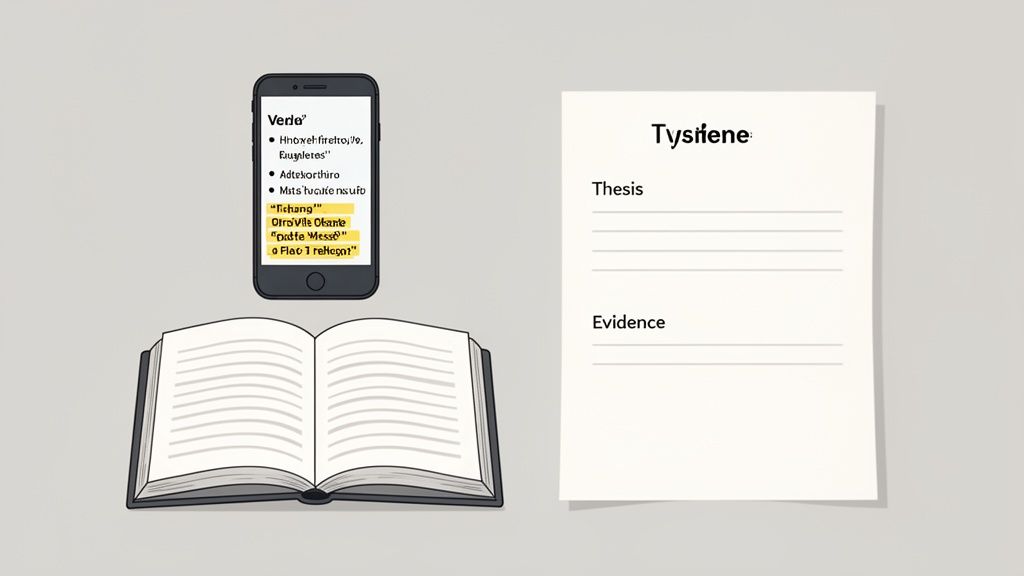
Let's say you need to write a paper on a theme in Shakespeare's Macbeth. You could open a chat with Feen AI to explore a few different angles and build a solid outline.
The quality of your essay outline often determines the quality of your final paper. Using AI to brainstorm and structure your arguments ensures you have a strong, logical flow before you start writing prose.
You can start broad and then narrow your focus as you go. The process might look something like this:
- Initial Brainstorming: "Brainstorm three potential essay topics about the theme of ambition in Shakespeare's Macbeth."
- Developing a Thesis: "For the topic of 'ambition as a destructive force,' help me refine a strong, arguable thesis statement."
- Building an Outline: "Create a five-paragraph essay outline based on this thesis. Include a topic sentence for each body paragraph and suggest key scenes from the play to use as evidence."
This back-and-forth helps you think through your argument, spot potential weaknesses, and make sure your final paper is persuasive and well-supported. As you get to the editing stage, you can even explore how AI tools for grammar checking are used to polish final drafts. By treating AI as a thinking partner, you can walk into your humanities assignments with more confidence and clarity, ready to do your best work.
2. Crafting AI Prompts That Get Better Results
The quality of answers you get from an AI directly reflects the quality of the questions you ask. To really get the hang of using AI for studying, you have to move past simple, one-line questions and start thinking more strategically about your prompts. This means crafting instructions that are clear, detailed, and laser-focused on what you need to learn.
A well-designed prompt turns an AI from a basic answer machine into a genuine learning partner. Instead of just getting a quick solution, you can get detailed explanations, relevant examples, and breakdowns that actually help you grasp the material.
This shift is crucial. It’s the difference between asking "what's the answer?" and asking "can you teach me how to find the answer?"
The Anatomy of a Powerful Prompt
A great academic prompt usually contains a few key ingredients that steer the AI toward the most helpful response. You won't need all of them every time, but combining them makes your requests much more effective.
Think of it like giving a friend directions. "How do I get to the city?" is vague. "Can you give me directions to the library on Main Street? I want the scenic route, so please avoid the highway," is so much better. The same logic applies here.
A simple but powerful framework to remember is Role, Task, Context, Format (RTCF).
- Role: Tell the AI who to be. "Act as a friendly chemistry tutor."
- Task: State exactly what you want it to do. "Explain the concept of molarity."
- Context: Provide all the necessary background info. "I'm a high school student and I'm confused about how volume affects concentration."
- Format: Specify how you want the answer delivered. "Give me a simple definition, a real-world analogy, and one practice problem with a step-by-step solution."
Stitching these elements together gives you a prompt that is almost guaranteed to produce a better result than a generic question. It gives the AI guardrails, making sure the output is built for your specific learning needs.
The goal of a good prompt isn't just to get an answer; it's to start a conversation. By giving the AI a clear role and context, you invite a more detailed and supportive dialogue that helps you learn.
This approach is becoming more important as AI models get more specialized. Stanford's 2025 AI Index points out that a massive 90% of new industry models are designed for precise tasks. This means tools like Feen AI are built to understand detailed instructions, saving you time while boosting your comprehension.
With an 86% adoption rate of AI in schools, knowing how to craft these prompts gives you a serious academic edge. You can find more information about AI's educational impact in recent market intelligence reports.
From Vague Questions to Powerful Prompts
Seeing the difference between a weak prompt and a strong one is the best way to understand why being specific matters so much. A lazy prompt gets you a generic, often unhelpful, response. A thoughtful prompt, on the other hand, unlocks a detailed, educational explanation.
The table below gives you a clear comparison, showing how to level up your prompts for far better academic help.
| Subject Area | Weak Prompt to Avoid | Strong Prompt to Use |
|---|---|---|
| Physics | "Help with Newton's Second Law." | "Explain Newton's Second Law of Motion using the example of a 10kg box being pushed with 50N of force on a frictionless surface. Show the formula and calculate the acceleration." |
| History | "Summarize the Cold War." | "Create a bulleted list of the top five key events of the Cold War, including the years they occurred and a one-sentence summary of their significance. The tone should be for a high school history report." |
| Literature | "What is foreshadowing in Romeo and Juliet?" | "Identify three clear examples of foreshadowing in Shakespeare's Romeo and Juliet. For each example, provide the quote and explain what future event it hints at." |
As you can see, the strong prompts provide clear instructions, context, and formatting requirements. They tell the AI exactly what a successful answer looks like, which dramatically improves the quality of the response you receive. This level of detail is a core skill for anyone wanting to get the most out of AI for their studies.
Using AI Ethically and with Academic Integrity
Bringing AI into your study routine is a game-changer, but it comes with a huge responsibility: protecting your academic integrity. It might seem like there's a blurry line between using AI as a smart study tool and outright cheating, but the distinction is actually pretty clear. It all boils down to your intent and what you do with the answers you get.
Think of an AI tool like Feen AI as a personal tutor who's available 24/7. You'd ask a tutor to explain a tough concept or check your math homework, right? You wouldn't ask them to do the homework for you. The goal is to use AI to deepen your own understanding and sharpen your skills, not to have it do the heavy lifting.
The Clear Line Between Learning and Cheating
So where, exactly, is that line? You cross it the moment the AI's output takes the place of your own thinking and effort.
Submitting an essay written by an AI or just copying a solution without grasping the "why" behind it isn't just a bad look—it completely defeats the purpose of your education. Real learning happens when you wrestle with the material, make mistakes, and build your own connections.
The best way to stay on the right side of that line is to treat AI as a partner in your learning, not a shortcut to a finished product.
AI can remove unnecessary learning difficulties, like a poorly written textbook explanation. But it can also remove the necessary effort required to build real knowledge. Use it to overcome hurdles, not to avoid the race altogether.
Do’s and Don’ts for Responsible AI Use
Let's make this super practical. Here’s a straightforward guide to keeping your work honest while still getting the most out of tools like Feen AI.
What You SHOULD Do:
- Ask for Explanations: Get it to break down confusing topics. Try asking, "Can you explain photosynthesis to me like I'm 15?"
- Check Your Work: After you've done the work, ask the AI to review your steps and point out where you might have gone wrong.
- Brainstorm Ideas: Use it as a creative partner. Ask for potential essay topics on a theme or help structuring the outline for your paper.
What You should NEVER Do:
- Copy-Paste Final Answers: This is plagiarism, plain and simple. Never submit work generated entirely by an AI as your own.
- Let It Write Your Essays: Don't ask it to write entire paragraphs or, worse, the whole paper for you.
- Use It During Proctored Exams: Unless your professor has explicitly given you permission, using AI during a test is cheating. No exceptions.
Got Questions? We've Got Answers
It's natural to have a few questions before diving into a new way of studying. Let's tackle some of the most common ones I hear from students so you can start using AI with total confidence.
Is Using an AI Like Feen AI Considered Cheating?
Honestly, it all comes down to how you use it. Using an AI to help you grasp a tough concept, break down a complicated formula, or even check your work is smart studying. Think of it as a super-powered tutor available 24/7.
Where you can run into trouble is simply copying and pasting an answer and passing it off as your own. That's not learning; that's just... copying. The goal here is to use the tool to understand the process behind the answer, not just to snag the final result.
Can AI Help with Non-STEM Subjects?
Absolutely! This is a common misconception. While AI is a powerhouse for math and science, it’s just as valuable for humanities. I’ve seen students use it to do amazing things.
You can feed it a dense chapter from your history textbook and ask for a bulleted summary of the key events. You can use it to brainstorm arguments for an English essay or get feedback on your thesis statement. It's an incredibly versatile partner for any subject on your course list.
How Do I Get the Best Answers from an AI Helper?
The secret is giving it great prompts. Specificity is your best friend.
Instead of a vague question like "help me with this," try uploading a screenshot of the exact problem you're stuck on. Then, ask it to "explain the steps to solve this, focusing on why you chose that specific formula." The more context you provide, the more tailored and useful the AI’s guidance will be.
Remember, the smartest students use AI to handle the grunt work. This frees up their mental energy to focus on what really matters: critical thinking and truly understanding the core concepts. It's about working smarter to deepen your knowledge.
Ready to see what a smarter study session feels like? Give Feen AI a try today and get the clear, step-by-step help you need to master any subject. Get started at https://feen.ai.
Relevant articles

Tired of the homework battles? Learn how to motivate kids to study with practical strategies that build focus, resilience, and a genuine love for learning.

Discover how AI powered study tools are changing education. Learn how to choose the right AI helper, use it ethically, and study smarter for any subject.
Discover how to summarize book chapters effectively. Our guide covers proven methods and smart tools to help you retain more information and study smarter.
Struggling with hard math problems? Discover proven strategies, practical frameworks, and smart AI tips to conquer complex challenges and boost your skills.

Discover how to study efficiently for exams with proven, science-backed techniques, smarter planning, and tools that boost memory and reduce stress.
Discover key math problems for 5th graders covering fractions, geometry & more. Includes step-by-step solutions & teaching tips to boost skills.