10 Essential Math Problems for 10th Graders to Master in 2025
Struggling with math? Discover our curated list of math problems for 10th graders, covering Algebra, Geometry, and more with solutions and tips.
Welcome to your ultimate resource for mastering 10th-grade mathematics. This year marks a critical juncture where abstract concepts in Algebra II, logical reasoning in Geometry, and foundational Trigonometry converge. Navigating these subjects requires more than just memorization; it demands practice, strategy, and a deep understanding of core principles. We've curated a comprehensive collection of math problems for 10th graders, broken down by key curriculum areas from Geometry proofs to systems of equations.
Each category in this guide includes a variety of problems with difficulty labels, worked-out solutions or strategic hints, and expert tips on avoiding common mistakes. This structured approach is designed to help you build confidence and precision. Whether you're aiming to ace your next exam, create a strong foundation for future STEM courses, or simply sharpen your quantitative skills, this guide provides the targeted practice you need to succeed.
Use these problem sets to methodically sharpen your abilities. If you ever get stuck, remember that modern learning tools can offer immediate assistance. To support your problem-solving journey, you might also explore innovative tools like those offering AI chatbots for homework help, which can provide step-by-step guidance on complex problems. For instance, our own Feen AI lets you upload a photo of any problem to receive instant, interactive support. Dive into the problems below to begin strengthening your mathematical toolkit.
1. Algebra II Problem Sets
Algebra II serves as a crucial bridge from foundational algebraic concepts to higher-level mathematics. The math problems for 10th graders in this area focus on mastering complex expressions and multi-step equations. These problem sets are designed to build deep procedural fluency and conceptual understanding, which are essential for future STEM courses.
Comprehensive problem sets typically cover four core areas: quadratic equations, polynomials, exponential functions, and systems of equations. These aren't just abstract exercises; they model real-world phenomena. For instance, a student might solve a quadratic equation to determine the trajectory of a launched rocket or use an exponential function to predict the growth of a bacterial culture. This practical application makes the learning process more engaging and relevant. Platforms like Khan Academy and IXL Learning offer extensive, standards-aligned problem sets that are perfect for practice.
How to Tackle Algebra II Problems
To get the most out of your practice, follow a structured approach. A solid strategy can transform challenging math problems for 10th graders into manageable tasks.
- Master Factoring: Many Algebra II problems, especially those involving quadratics and polynomials, depend on strong factoring skills. Practice factoring different types of expressions until it becomes second nature.
- Visualize with Technology: Use graphing calculators or online tools like Desmos to visualize functions and equations. Seeing a parabola or an exponential curve can provide critical insights into the behavior of a function and the nature of its solutions.
- Create an Error Log: Keep a dedicated notebook or digital document to track your mistakes. Note the problem, your incorrect solution, and the correct method. Over time, you'll identify recurring patterns and address specific weaknesses in your understanding.
Key Insight: Start with concrete, real-world examples (like calculating break-even points for a small business) before moving to more abstract problems. This helps ground the mathematical concepts in tangible scenarios, making them easier to grasp and retain.
2. Geometry Proof and Problem-Solving Sets
Geometry moves beyond simple calculations and into the realm of logical reasoning and spatial awareness. The math problems for 10th graders in this discipline are centered on constructing proofs, applying theorems, and solving problems involving shapes and space. These exercises are crucial for developing deductive thinking and a systematic approach to problem-solving, skills that are valuable far beyond the math classroom.
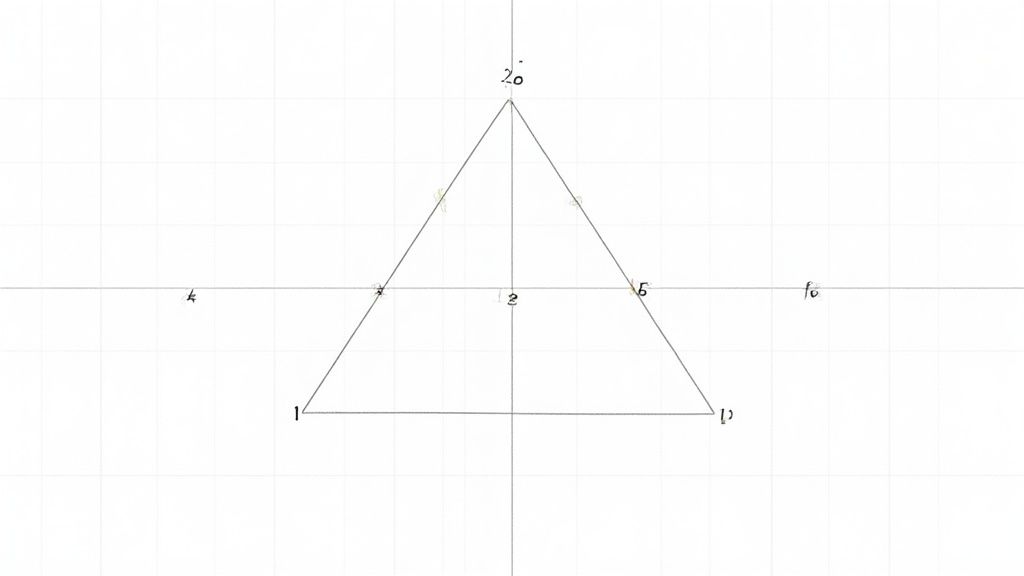
Problem sets in geometry typically explore angle relationships, properties of polygons, circles, and 3D solids. The real-world applications are vast, from land surveying that uses triangulation to architectural blueprints built on geometric principles. A student might be asked to prove that two triangles are congruent to ensure structural stability or calculate the volume of a cylinder to determine material needs for a design. Resources like the Art of Problem Solving (AoPS) and Khan Academy offer challenging problem sets that build a deep, intuitive understanding of geometry.
How to Tackle Geometry Problems
Success in geometry requires a blend of creativity and rigor. Adopting a methodical strategy will help you navigate complex math problems for 10th graders and build sound logical arguments.
- Create a Theorem Guide: Keep a running list of all postulates, theorems, and definitions. Organize it by topic (e.g., triangles, circles) and review it regularly. This will become your go-to reference when constructing proofs.
- Visualize with Software: Use dynamic geometry software like GeoGebra to construct figures, measure angles, and manipulate shapes. This interactive approach helps you explore properties and relationships visually before attempting a formal proof.
- Sketch First, Prove Second: Always start by drawing a rough, labeled sketch of the problem. This helps you visualize the given information and identify the relationships you need to prove. A clear diagram is often the first step toward a clear solution.
Key Insight: Master the foundational proofs (e.g., triangle congruence theorems like SSS, SAS, ASA) before moving on to more complex, multi-step proofs. A strong command of these building blocks makes it easier to construct longer, more intricate logical arguments.
3. Trigonometry Fundamentals Problem Sets
Trigonometry introduces the fascinating relationship between angles and side lengths in triangles. The math problems for 10th graders in this area focus on mastering sine, cosine, and tangent ratios (SOH-CAH-TOA), understanding the unit circle, and applying trigonometric functions to solve practical problems. These problem sets build a critical foundation that connects geometry and algebra, preparing students for physics, engineering, and calculus.

Effective problem sets cover right-triangle trigonometry, trigonometric functions in the coordinate plane, and real-world applications. These are not just abstract calculations; they are tools for measuring the world. For example, a student might use the tangent function to calculate the height of a building given the angle of elevation, or use sine and cosine for navigation and bearing calculations. The AP Precalculus curriculum and platforms like Khan Academy offer a wide range of problems that bring these concepts to life.
How to Tackle Trigonometry Problems
Developing a systematic approach is key to turning complex trigonometry challenges into solvable puzzles. A good strategy will make these math problems for 10th graders far more approachable.
- Memorize with Mnemonics: Use devices like SOH-CAH-TOA (Sine = Opposite/Hypotenuse, Cosine = Adjacent/Hypotenuse, Tangent = Opposite/Adjacent) to easily recall the primary trigonometric ratios.
- Create a Unit Circle Poster: The unit circle is fundamental. Draw and label your own reference poster with key angles in both degrees and radians, along with their corresponding sine, cosine, and tangent values. Having this visual aid readily available during practice is invaluable.
- Practice with Both Degrees and Radians: Fluency in converting between degrees and radians is crucial for advanced math. Regularly practice conversion problems until you can switch between the two measures effortlessly.
Key Insight: Start by mastering right-triangle trigonometry in tangible scenarios (like finding the length of a shadow) before diving into the more abstract concepts of the unit circle and graphing trigonometric functions. This grounds your understanding in observable reality, making the transition to abstract ideas smoother.
4. Statistics and Probability Problem Sets
Statistics and probability provide powerful tools for making sense of data and uncertainty in the world around us. The math problems for 10th graders in this field focus on data analysis, probability models, and making inferences. These problem sets are crucial for developing critical thinking and data literacy, skills that are valuable in almost any career path.
A strong set of problems will typically cover measures of central tendency and spread, probability distributions, and the fundamentals of statistical inference. These are not just theoretical exercises; they have direct applications in real-world scenarios. For example, a student might analyze election polling data to understand margins of error, interpret the results of a clinical trial, or use probability to predict outcomes in sports analytics. This focus on practical application helps students see the relevance of statistics in everyday decision-making.
How to Tackle Statistics and Probability Problems
To excel at these types of math problems for 10th graders, it's important to move beyond mere calculation and focus on interpretation and context. A structured approach can make complex data more manageable.
- Work with Real Datasets: Instead of just using textbook examples, find real datasets from sources like Kaggle or government websites. This makes the problems more authentic and engaging, showing how statistics are used in professional fields.
- Visualize the Data: Always create visual representations of your data, such as histograms, box plots, or scatter plots. Visuals can reveal patterns, outliers, and relationships that are not obvious from numbers alone. Tools like spreadsheet software can make this process simple.
- Focus on Interpretation: The answer to a statistics problem is rarely just a number. Practice writing a concluding sentence that explains what your result means in the context of the original problem. What story does the data tell?
Key Insight: Emphasize context and interpretation over pure calculation. Understanding what the numbers mean is more important than the calculation itself. For instance, before diving into complex formulas, consider exploring concepts like hypothesis testing, which forms the basis for much of scientific research. You can learn more about what is hypothesis testing in statistics to build a stronger foundation.
5. Rational and Radical Expression Problem Sets
Working with rational and radical expressions is a core component of advanced algebra. The math problems for 10th graders in this area focus on simplifying complex fractions, performing operations with radicals, and solving equations that contain these elements. These problem sets build crucial algebraic manipulation skills that are foundational for calculus and other higher-level mathematics.
These exercises go beyond rote memorization, often modeling complex real-world scenarios. For example, a student might use a rational equation to solve problems related to work rates or simplify a radical expression found in a physics formula for gravity. Engineering and financial calculations frequently involve fractional exponents and complex fractions, making mastery of these topics highly practical. Excellent resources for practice include Paul's Online Math Notes and the Precalculus materials from OpenStax.
How to Tackle Rational and Radical Expression Problems
A methodical approach is essential for navigating these often complex math problems for 10th graders. A structured strategy helps prevent common errors and builds confidence.
- Check for Extraneous Solutions: When solving radical or rational equations, it's vital to check your answers by substituting them back into the original equation. This process helps identify extraneous solutions, which are answers that arise from the algebraic process but do not satisfy the initial conditions of the problem.
- Show All Steps: Do not skip steps, especially when simplifying complex fractions or rationalizing denominators. Writing out each part of the process, from finding a common denominator to distributing terms, minimizes careless mistakes and makes it easier to spot errors.
- Create Formula Reference Cards: Make quick-reference cards for key rules, such as exponent properties, rules for adding and multiplying radicals, and common perfect squares and cubes. Having these readily available during practice sessions reinforces memory and speeds up problem-solving.
Key Insight: Always start by identifying the domain of the variable. For rational expressions, find values that make the denominator zero. For radical expressions, ensure the value under the radical is non-negative. This proactive step helps you immediately discard invalid or extraneous solutions.
6. Exponential and Logarithmic Function Problem Sets
Exponential and logarithmic functions are fundamental to describing processes of rapid change, from finance to biology. The math problems for 10th graders in this category challenge students to understand growth, decay, and the inverse relationship between these two powerful functions. Problem sets are crafted to build a strong conceptual foundation, preparing students for calculus and science courses.
These problem sets often focus on real-world applications to make abstract concepts tangible. Students might use exponential functions to model population growth, calculate compound interest on an investment, or understand radioactive decay in carbon dating. Logarithmic functions are explored as the tool to solve for the exponent, answering questions like "How long will it take for an investment to double?" The IB Mathematics curriculum and platforms like Khan Academy provide excellent, in-depth problem sets that connect theory to practice.
How to Tackle Exponential and Logarithmic Problems
A methodical approach can simplify what often seem like intimidating math problems for 10th graders. Building confidence with these functions requires specific strategies.
- Create a Properties Reference Sheet: Write down the core properties of exponents and logarithms with a simple example for each (e.g., product rule, power rule, change of base). Keep this sheet handy during practice to build recall.
- Relate Logarithms to 'Undoing' Exponents: Always remember that a logarithm's purpose is to find the exponent. Thinking "log base 2 of 8 is the power I raise 2 to in order to get 8" reinforces the core concept. To dive deeper, you can explore guides on how to solve logarithmic equations.
- Visualize with Graphing Tools: Use Desmos or a graphing calculator to plot an exponential function (like y = 2^x) and its inverse logarithm (y = log₂(x)). Seeing their symmetrical relationship across the line y = x makes their inverse nature clear.
Key Insight: Start with tangible examples of exponential growth, such as a story about a single penny doubling every day. This intuitive entry point makes it easier to understand the underlying mechanics before introducing the more abstract concept of logarithms as the tool to reverse the process.
7. Sequence and Series Problem Sets
Sequences and series are fundamental concepts that explore patterns and summations in mathematics. The math problems for 10th graders in this category focus on arithmetic and geometric progressions, helping students develop strong pattern recognition and logical reasoning skills. These problem sets are critical for understanding more advanced topics in calculus, finance, and computer science.
Typical problem sets cover identifying sequence types, finding specific terms, and calculating the sum of a series. These concepts have direct real-world applications. For instance, a student might use an arithmetic sequence to model a simple interest savings plan or a geometric series to calculate the total distance a bouncing ball travels. This connection to tangible scenarios makes the material more intuitive and memorable. Resources like Art of Problem Solving and Khan Academy offer excellent courses and practice problems on sequences and series.
How to Tackle Sequence and Series Problems
A methodical approach can simplify what often seem like complex patterns. Adopting a few key strategies will make these math problems for 10th graders much more accessible.
- Create a Formula Comparison Chart: Keep a chart handy that lists the formulas for arithmetic and geometric sequences and series. Visually comparing them helps in quickly identifying which formula to apply based on whether there's a common difference or a common ratio.
- Identify the Type First: Before trying to solve, always determine if the sequence is arithmetic, geometric, or neither. This single step dictates your entire problem-solving path and prevents you from using the wrong set of formulas.
- Use Spreadsheets for Verification: Tools like Google Sheets or Microsoft Excel are perfect for modeling sequences. You can generate a long list of terms instantly to check your manual calculations or visualize the pattern of growth or decay.
Key Insight: Connect the abstract formulas to practical tools. For example, use an online loan amortization calculator to see how a geometric sequence plays out in calculating monthly payments and total interest. This grounds the concepts in real-world financial literacy.
8. Conic Sections Problem Sets
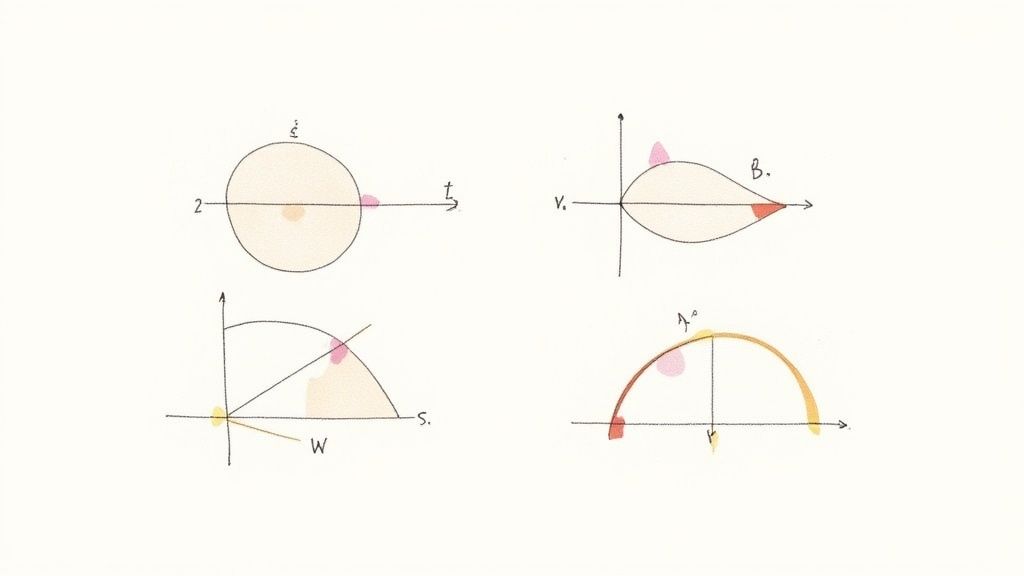
Conic sections represent the intersection of a plane and a double-napped cone, creating shapes like circles, ellipses, parabolas, and hyperbolas. The math problems for 10th graders in this unit connect algebraic equations to these fundamental geometric figures. These problem sets are designed to build a strong foundation in analytic geometry, showing students how equations can precisely describe the world around them.
This topic moves beyond basic shapes to explore their properties and applications in depth. For example, a student might use the equation of an ellipse to model planetary orbits, a parabola to describe the path of a projectile, or a hyperbola to understand navigation systems. This link to real-world physics and engineering makes the concepts more tangible and exciting. Interactive platforms like Desmos and GeoGebra offer excellent, visually-driven problem sets that bring these shapes to life.
How to Tackle Conic Sections Problems
To excel with these geometric and algebraic math problems for 10th graders, a systematic approach is key. A few targeted strategies can help clarify complex concepts and build confidence.
- Master Completing the Square: This algebraic technique is essential for converting conic section equations from their general form to their standard form, which reveals key information like the center, vertices, and foci.
- Visualize with Graphing Tools: Use Desmos or a graphing calculator to see how changing parameters in an equation (like the values of h, k, a, and b) affects the shape, size, and orientation of the conic section. This visual feedback is incredibly powerful.
- Create a Formula Chart: Develop a one-page reference sheet with the standard form equations, key features (foci, directrix, asymptotes), and graphs for each of the four conic sections. This organizes the information and provides a quick study guide.
Key Insight: Before solving equations, try to identify real-world objects and sketch them as conic sections. A satellite dish is a paraboloid, a whispering gallery is an ellipsoid. This practice helps connect the abstract formulas to concrete physical forms, strengthening conceptual understanding.
9. Word Problem and Application-Based Problem Sets
Word problems serve as a vital link between abstract mathematical concepts and tangible, real-world applications. These math problems for 10th graders challenge students to translate narrative scenarios into mathematical models, a critical skill for both higher education and practical problem-solving. This approach moves beyond simple computation to build deep analytical and reasoning abilities.
Comprehensive problem sets focus on developing modeling skills across various contexts, such as motion, mixtures, work rates, and optimization. For instance, a student might be asked to calculate the optimal speed for a delivery truck to minimize fuel costs, determine the right mixture of chemical solutions for a lab experiment, or schedule a team to complete a project on time. This direct application, championed by standards like the Common Core, makes mathematics more meaningful and engaging.
How to Tackle Word and Application Problems
A systematic approach can demystify even the most complex word problems. Following a clear strategy will transform these challenging math problems for 10th graders from confusing narratives into solvable equations.
- Implement a Four-Step Process: Adhere to a strict Read-Plan-Solve-Check method. First, read carefully to understand the goal. Next, plan your attack by identifying variables and relevant formulas. Then, solve the equations you've set up. Finally, check if your answer makes sense in the context of the original problem.
- Visualize the Information: Do not hesitate to draw diagrams, charts, or tables. A simple sketch of a distance-rate-time problem or a table organizing mixture concentrations can clarify relationships between variables and make the path to a solution much clearer.
- Start with Single-Variable Scenarios: Before tackling complex multi-variable systems, build confidence by mastering simpler problems. Focus on scenarios that can be modeled with a single linear or quadratic equation. This builds a strong foundation for more intricate applications.
Key Insight: Ground abstract concepts in familiar situations. Frame problems around scenarios students understand, like calculating phone plan costs or planning a school event budget. This relatability makes the underlying mathematical principles more intuitive and easier to master.
10. Systems of Equations and Inequalities Problem Sets
Mastering systems of equations is a fundamental skill in algebra that involves finding the point where two or more functions intersect. The math problems for 10th graders in this category challenge students to solve for multiple variables using methods like substitution, elimination, and graphing. These problems extend beyond simple linear equations to include non-linear systems and systems of inequalities, laying the groundwork for more advanced mathematical concepts like linear programming.
These problem sets are deeply rooted in practical applications, helping students model and solve complex real-world dilemmas. For instance, a business owner might use a system of equations to calculate the break-even point for multiple products, or a manufacturer could use a system of inequalities to optimize resource allocation under specific constraints. This direct link to tangible outcomes makes the practice both meaningful and memorable. Sites like Khan Academy and standard Algebra II textbooks offer a wealth of problems to build proficiency.
How to Tackle Systems of Equations and Inequalities
A methodical approach is key to untangling these multi-layered problems. Adopting a clear strategy can make even the most complex math problems for 10th graders feel approachable and solvable.
- Choose the Right Method: Analyze the structure of the equations first. Substitution works best when one variable is already isolated. Elimination is ideal when coefficients are opposites or can be easily manipulated. Graphing is excellent for visualizing the solution and for solving systems of inequalities.
- Always Verify Your Solution: After finding a potential solution (e.g., an (x, y) coordinate), plug the values back into all original equations. This crucial step confirms that your answer is correct and satisfies every condition in the system.
- Use Technology Strategically: For complex systems, especially those with three variables or non-linear equations, graphing calculators or online tools can verify solutions quickly. Use them to check your work, not to replace the foundational solving process. You can learn more about how to solve systems of linear equations to strengthen your base.
Key Insight: When dealing with systems of inequalities, focus on shading the correct regions. The solution is the overlapping shaded area. Test a point within this region in all original inequalities to ensure it represents the valid solution set. This visual verification is incredibly powerful.
10th Grade Math Problem Sets Comparison
| Item | Implementation complexity | Resource requirements | Expected outcomes | Ideal use cases | Key advantages |
|---|---|---|---|---|---|
| Algebra II Problem Sets | Medium — multi-step algebraic reasoning | Paper/worksheets, TI/graphing calculator, algebra reference | Mastery of polynomials, quadratics, exponents, systems | 10th grade algebra II, calculus readiness, standardized test prep | Builds algebraic foundations; broad real-world uses |
| Geometry Proof and Problem-Solving Sets | Medium-High — formal proof structure & spatial reasoning | Geometry tools, diagrams, GeoGebra or dynamic geometry software | Logical deduction, proof writing, spatial visualization | Geometry courses, architecture/engineering intro, competitions | Strengthens deductive reasoning and visualization |
| Trigonometry Fundamentals Problem Sets | Medium — requires trig ratios and unit circle fluency | Unit circle charts, graphing calculator/Desmos, reference identities | Sine/cos/tan proficiency, angle measure, trig identities | Precalculus, physics fundamentals, navigation problems | Bridges algebra and geometry; practical in sciences |
| Statistics and Probability Problem Sets | Medium — conceptual and computational mix | Real datasets, spreadsheets/statistical software, calculators | Data interpretation, probability, basic inferential skills | Data literacy courses, AP Stats, real-world data analysis | Highly relevant to data-driven decisions across fields |
| Rational and Radical Expression Problem Sets | Medium-High — error-prone symbolic manipulation | Algebra notes, CAS optional, step-by-step practice problems | Simplifying rational/radical forms, solving related equations | Algebra II/Precalculus, calculus preparation, remediation | Builds precision in algebraic manipulation |
| Exponential and Logarithmic Function Problem Sets | Medium — inverse function concepts & modeling | Graphing tools, calculators, application examples | Understanding growth/decay, solving exp/log equations | Modeling in science/finance, precalc, AP curricula | Direct modeling of natural and financial phenomena |
| Sequence and Series Problem Sets | Low-Medium — formula application and recognition | Formula sheets, spreadsheets for verification | Identify sequence types, compute sums, sigma notation fluency | Finance math, algorithm analysis, precalc/calculus intro | Pattern recognition; foundations for series in calculus |
| Conic Sections Problem Sets | Medium — coordinate geometry and transformations | Graphing software (Desmos/GeoGebra), algebra tools | Translate equations to graphs, find foci/vertices/eccentricity | Precalculus, physics/orbital mechanics intro, design | Visual link between algebra and geometry; applied in physics |
| Word Problem and Application-Based Problem Sets | Medium-High — requires modeling and reading skills | Real-world contexts, diagrams, calculator/spreadsheets | Translate situations to equations, model optimization | Real-world math classes, standardized tests, applied projects | Enhances modeling skills and student engagement |
| Systems of Equations and Inequalities Problem Sets | Medium — multiple solution methods including matrices | Graphing calculators, matrix tools/software, graph paper | Solve linear/nonlinear systems, linear programming | Optimization problems, business/math modeling, advanced algebra | Fundamental for applied math and optimization tasks |
Putting It All Together: Your Path to Math Confidence
You’ve explored a comprehensive collection of math problems for 10th graders, spanning the core domains of Algebra II, Geometry, Trigonometry, and Statistics. This journey through diverse problem sets, from navigating conic sections to deciphering complex word problems, isn't just about finding the right answers. It's about building a robust framework for logical thinking, analytical reasoning, and persistent problem-solving.
Mastering 10th-grade math is a significant milestone. The concepts you engage with now form the bedrock for higher-level mathematics in 11th and 12th grade, as well as for college-level courses in STEM fields, economics, and even the social sciences. The key takeaway is that progress is built on a cycle of practice, analysis, and refinement. It's not enough to simply complete a problem; you must understand the 'why' behind each step.
Your Action Plan for Continued Success
To transform this article from a simple resource into a powerful learning tool, here are your actionable next steps:
Create a Balanced Practice Schedule: Don't just focus on the topics you find easy. Deliberately mix in problem sets from your weaker areas. For example, dedicate one study session to Geometry proofs and the next to logarithmic functions. This balanced approach prevents skill gaps and reinforces the interconnectedness of mathematical concepts.
Analyze, Don't Just Correct: When you get a problem wrong, resist the urge to just glance at the solution and move on. Instead, perform a "mistake post-mortem." Ask yourself:
- Was it a simple calculation error?
- Did I misunderstand a core concept (e.g., the properties of a trapezoid)?
- Did I apply the wrong formula or theorem?
- Did I misinterpret the question itself?
Pinpointing the exact source of the error is crucial for preventing its recurrence.
Connect Concepts to Context: The "Word Problem and Application-Based Problem Sets" section is arguably one of the most important. Actively look for ways the abstract formulas and theorems you're learning apply to the real world. This contextual understanding makes the material more engaging and easier to retain. For instance, think about how quadratic equations model the trajectory of a basketball or how exponential functions describe population growth.
Key Insight: True mathematical proficiency isn't about memorizing formulas; it's about developing the mental flexibility to select the right tool for a given problem and applying it with precision. The diverse math problems for 10th graders in this guide are designed to build exactly that kind of versatile thinking.
Beyond the Classroom: Why This Matters
The skills you are honing by tackling these challenges extend far beyond your next quiz or final exam. You are learning how to break down large, intimidating problems into smaller, manageable parts. You are training your brain to recognize patterns, evaluate evidence, and construct logical arguments. These are the very skills that innovators, engineers, scientists, and leaders rely on every single day.
Whether you're calculating the vectors for a video game, analyzing market data for a business, or simply managing your personal finances, the ability to think critically and quantitatively will be an invaluable asset. Embrace the challenge. View each problem not as a hurdle, but as an opportunity to sharpen your mind and build lasting confidence. Keep practicing, stay curious, and remember that every problem you solve is another step forward on your path to mastery.
Don't let a challenging problem stop your progress. When you're stuck on one of our math problems for 10th graders or a question from your own homework, get instant, step-by-step guidance with Feen AI. Just upload a photo of the problem to see how it’s solved and truly understand the concepts behind the solution. Try it for free at Feen AI.
Relevant articles

Struggling with algebra or geometry? This guide breaks down key math problems for 9th graders with examples, solutions, and pro tips to help you succeed.