8 Types of Math Problems for 9th Graders to Master in 2025
Struggling with algebra or geometry? This guide breaks down key math problems for 9th graders with examples, solutions, and pro tips to help you succeed.

Ninth-grade math marks a pivotal moment, shifting from foundational concepts to the complex logic of algebra and geometry that underpins future STEM success. This guide is your roadmap to mastering this crucial year. We will dissect the essential types of math problems for 9th graders, moving beyond simple answers to reveal the strategic thinking behind each one. You'll learn not just how to solve them, but why the methods work, equipping you with the skills to tackle any problem with confidence.
This comprehensive listicle breaks down key topics, including linear equations, quadratic functions, polynomials, and the Pythagorean theorem. Each section provides worked examples, strategic tips, and actionable takeaways designed to build both competence and understanding. We have curated a set of problems that represent the core challenges you'll face, ensuring you're prepared for homework, quizzes, and exams.
If a problem seems particularly tricky, don't worry. You can always use an AI tool to get step-by-step guidance. These tools can walk you through the solution process, helping you understand the core concepts without just giving away the answer. To further empower your learning and organize your problem-solving skills, consider exploring an AI Study Guide Maker as a complementary resource.
Our goal is to transform difficult concepts into manageable steps. By focusing on the strategy behind the solution, you will develop a deeper, more flexible understanding of mathematics. Let’s dive into the problems and begin building your problem-solving toolkit.
1. Linear Equations and Systems of Equations
Linear equations are the bedrock of algebra, representing straight-line relationships between variables. Systems of equations take this a step further, challenging you to find the unique point where two or more lines intersect. Mastering these concepts is vital for modeling real-world scenarios, from calculating business break-even points to determining the meeting point of two moving objects.
Example Problem: Solving a System by Substitution
Consider the following system of equations, a classic type of math problem for 9th graders:
y = 2x - 34x + y = 9
Strategic Breakdown:
The first equation already has y isolated. This is a clear signal to use the substitution method, where you substitute the expression for y from the first equation into the second.
Step-by-Step Solution:
Substitute: Replace
yin the second equation with(2x - 3)from the first equation.4x + (2x - 3) = 9
Simplify and Solve for x: Combine like terms to solve for
x.6x - 3 = 96x = 12x = 2
Solve for y: Now, plug the value of
x(which is 2) back into the first equation to findy.y = 2(2) - 3y = 4 - 3y = 1
Solution: The solution to the system is the coordinate point (2, 1). This is the single point where the two lines intersect on a graph.
Actionable Takeaways & Key Insights
- Choose the Right Method: When one variable is already isolated (like
y = ...orx = ...), substitution is almost always the most efficient method. If both equations are in standard form (Ax + By = C), the elimination method might be faster. - Check Your Work: Always plug your final
(x, y)coordinate back into both original equations to verify it makes them true. This simple check catches most common algebra mistakes. - Visualize the Concept: Remember that you are finding a point of intersection. If you get a result like
5 = 5(an identity), the lines are the same (infinite solutions). If you get a false statement like5 = 9, the lines are parallel and never intersect (no solution).
Pro Tip: Look for the path of least resistance. Identifying that
yis already solved for iny = 2x - 3saves you the initial step of rearranging an equation, reducing the chances of an error.
2. Quadratic Equations and Factoring
Quadratic equations are the next level of algebraic challenges, introducing the curved, U-shaped world of parabolas. These equations, typically in the form ax² + bx + c = 0, model a vast range of real-world phenomena, from the arc of a thrown basketball to the profit curve of a business. Mastering factoring and the quadratic formula is crucial for solving these more complex problems.
Example Problem: Solving a Quadratic by Factoring
Let's solve a common type of math problem for 9th graders involving a quadratic equation:
x² - 3x - 10 = 0
Strategic Breakdown:
Before jumping to the quadratic formula, always check if the equation can be factored. We need to find two numbers that multiply to the constant term (-10) and add up to the coefficient of the middle term (-3). This is often the quickest path to the solution.
Step-by-Step Solution:
Find the Factors: We need two numbers that multiply to -10 and add to -3.
- Factors of -10: (1, -10), (-1, 10), (2, -5), (-2, 5)
- Check their sums: 1 + (-10) = -9; -1 + 10 = 9; 2 + (-5) = -3; -2 + 5 = 3
- The correct pair is 2 and -5.
Write the Factored Form: Use these numbers to break the equation into two binomial factors.
(x + 2)(x - 5) = 0
Apply the Zero Product Property: For the product of two factors to be zero, at least one of the factors must be zero. Set each factor equal to zero and solve.
x + 2 = 0-->x = -2x - 5 = 0-->x = 5
Solution: The solutions, or roots, of the equation are x = -2 and x = 5. These are the two points where the parabola represented by this equation crosses the x-axis.
Actionable Takeaways & Key Insights
- Factoring First: Always attempt to factor a quadratic before resorting to the quadratic formula. It's faster and less prone to calculation errors. If you need a refresher, you can find a guide on how to factor polynomials completely.
- Understand the "Roots": The solutions to a quadratic equation are called "roots" or "zeros." Graphically, they represent the x-intercepts of the parabola.
- Check the Signs: Be meticulous with positive and negative signs when finding factors. A small sign error is the most common mistake in these problems.
Pro Tip: Use the discriminant (
b² - 4ac) as a quick preliminary check. If the result is a perfect square, the quadratic is factorable over the integers. If it's not, you know immediately to use the quadratic formula.
3. Exponents and Radical Expressions
Exponents represent repeated multiplication, while radicals (like square roots) are their inverse. These concepts are foundational for handling very large or very small numbers, such as those in scientific notation, and for understanding growth and decay models. Mastering the rules of exponents and simplifying radicals is a key step toward advanced algebra and calculus.
Example Problem: Simplifying a Radical Expression
Consider this common type of math problem for 9th graders involving exponents and radicals: Simplify the expression (2x²)³ * √(49x⁴).
Strategic Breakdown:
This problem combines two key skills: applying the power rule for exponents and simplifying a square root. The strategy is to handle each part of the expression separately first, then combine the simplified results using the product rule for exponents.
Step-by-Step Solution:
Simplify the Exponential Term: Apply the power rule
(a^m)^n = a^(m*n)to(2x²)³. Remember to apply the exponent to the coefficient (2) as well.2³ * (x²)³ = 8 * x^(2*3) = 8x⁶
Simplify the Radical Term: Find the square root of the coefficient and the variable term in
√(49x⁴).√49 = 7√x⁴ = x²(sincex² * x² = x⁴)- So,
√(49x⁴) = 7x²
Combine the Results: Now, multiply the two simplified parts together.
(8x⁶) * (7x²)
Apply the Product Rule: Use the rule
x^m * x^n = x^(m+n)to combine thexterms. Multiply the coefficients.(8 * 7) * (x⁶ * x²) = 56x⁸
Solution: The simplified expression is 56x⁸.
Actionable Takeaways & Key Insights
- Separate and Conquer: When an expression has multiple parts (like an exponential term and a radical), simplify each one individually before trying to combine them. This minimizes confusion and reduces errors.
- Know Your Rules: Fluency with exponent laws (product, quotient, power, negative, and zero rules) is non-negotiable. Create a cheat sheet and practice until they become second nature.
- Radicals as Fractional Exponents: Remember that
√xis the same asx^(1/2). Thinking of radicals this way can simplify complex problems, especially as you advance. Understanding this relationship is a precursor to grasping logarithms, which are closely related. If you're curious, you can learn more about how to solve logarithmic equations and see the connection.
Pro Tip: When simplifying radicals, always look for the largest perfect square factor. For
√72, you could pull out√9to get3√8, but you would then need to simplify√8. It's faster to find the largest perfect square,√36, to get6√2in one step.
4. Polynomials and Polynomial Operations
Polynomials are fundamental algebraic expressions made up of variables, coefficients, and non-negative integer exponents. Understanding how to perform operations like addition, subtraction, and multiplication on them is crucial for solving more advanced problems, from calculating the volume of complex shapes to modeling profit functions in business.
Example Problem: Multiplying Two Binomials
A common type of math problem for 9th graders involves finding the product of two binomials, often used to calculate areas. Let's multiply (3x - 4) by (2x + 5).
Strategic Breakdown:
The goal is to multiply each term in the first binomial by each term in the second. The FOIL (First, Outer, Inner, Last) method is a popular and systematic way to ensure no terms are missed. Alternatively, the distributive property or an area model can be used.
Step-by-Step Solution:
First: Multiply the first terms of each binomial.
(3x) * (2x) = 6x²
Outer: Multiply the outermost terms.
(3x) * (5) = 15x
Inner: Multiply the innermost terms.
(-4) * (2x) = -8x
Last: Multiply the last terms of each binomial.
(-4) * (5) = -20
Combine and Simplify: Add all the resulting terms together and combine the like terms (
15xand-8x).6x² + 15x - 8x - 206x² + 7x - 20
Solution: The product of (3x - 4) and (2x + 5) is the trinomial 6x² + 7x - 20.
Actionable Takeaways & Key Insights
- Stay Organized: Methods like FOIL or using an area model (the box method) provide a structure that prevents you from accidentally skipping a multiplication step.
- Watch Your Signs: The most frequent errors in polynomial operations involve incorrect signs. Be especially careful when multiplying or subtracting negative terms. In our example,
(-4) * (2x)became-8x, a critical detail. - Standard Form is Key: Before performing any operation, it's good practice to write polynomials in standard form (highest exponent to lowest). After operating, combine like terms and present your final answer in standard form as well.
Pro Tip: When subtracting polynomials, distribute the negative sign to every term in the second polynomial before combining like terms. Forgetting to do this is one of the most common mistakes students make.
5. Graphing Linear and Non-Linear Functions
Graphing is the visual language of mathematics. It transforms abstract equations into concrete shapes, allowing you to see and interpret the behavior of functions. For 9th graders, this skill moves beyond plotting simple lines to understanding the distinct curves of quadratic, absolute value, and exponential functions. Mastering graphing is crucial for visualizing data, modeling real-world phenomena like population growth or projectile motion, and building an intuitive foundation for higher-level math.
Example Problem: Graphing a Quadratic Function (Parabola)
Graph the following quadratic function, a common type of math problem for 9th graders, and identify its key features:
y = x² - 4x + 3
Strategic Breakdown:
This equation is in standard form (y = ax² + bx + c). To graph it accurately, we need to find its essential features: the vertex (the turning point of the parabola), the y-intercept, and any x-intercepts. The vertex is the most critical feature, as it gives us the axis of symmetry.
Step-by-Step Solution:
Find the Vertex: Use the formula
x = -b / 2ato find the x-coordinate of the vertex. Here,a = 1andb = -4.x = -(-4) / 2(1)x = 4 / 2x = 2- Now, plug
x = 2back into the equation to find the y-coordinate: y = (2)² - 4(2) + 3 = 4 - 8 + 3 = -1- The vertex is at (2, -1).
Find the Y-Intercept: The y-intercept occurs where
x = 0. This is always thecvalue in the standard form.y = (0)² - 4(0) + 3 = 3- The y-intercept is at (0, 3).
Find the X-Intercepts (Roots): The x-intercepts occur where
y = 0. Set the equation to zero and solve by factoring.0 = x² - 4x + 30 = (x - 3)(x - 1)- The x-intercepts are at
x = 3andx = 1, or the points (3, 0) and (1, 0).
Solution: Plot the vertex (2, -1), the y-intercept (0, 3), and the x-intercepts (1, 0) and (3, 0). Use the axis of symmetry at x = 2 to sketch a smooth, upward-opening parabola connecting these points.
Actionable Takeaways & Key Insights
- The Vertex is Your Anchor: For any parabola, the vertex is the most important point to find first. It gives you the minimum or maximum value of the function and the line of symmetry, which helps you graph the rest of the curve accurately.
- Intercepts Provide Key Coordinates: Finding the x and y-intercepts gives you guaranteed points that your curve must pass through. They are easy to calculate and serve as excellent checks for your graph's shape.
- Look at the 'a' Value: The sign of the coefficient
ainax²tells you the parabola's direction. Ifais positive, it opens upwards (like a smile). Ifais negative, it opens downwards (like a frown).
Pro Tip: Don't just plot points randomly. Strategically find the vertex and intercepts first. These "critical points" provide the core structure of the graph, making the rest of the process much faster and more accurate than creating a large table of values.
6. Pythagorean Theorem and Right Triangle Applications
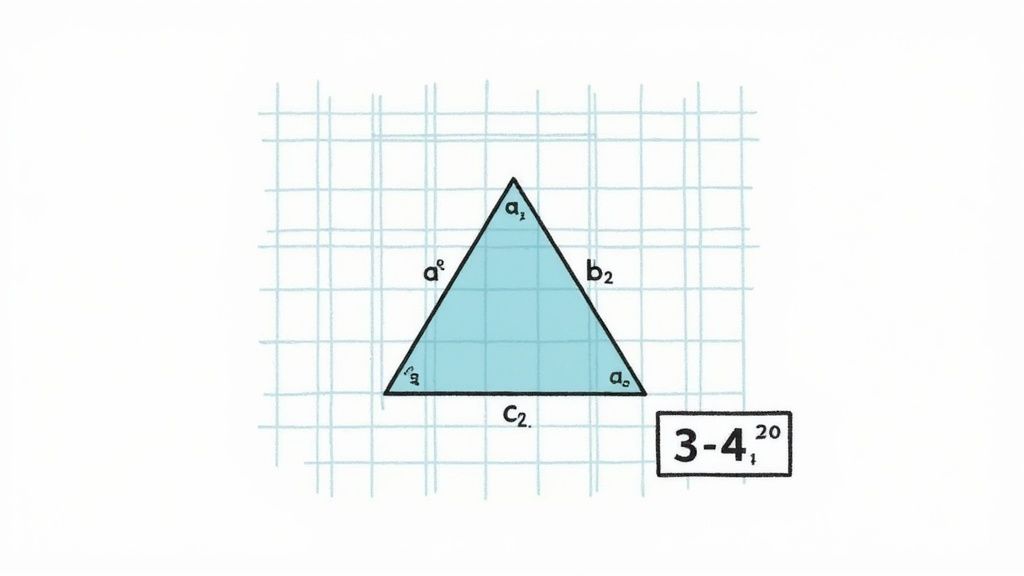
The Pythagorean theorem is a cornerstone of geometry, providing a powerful algebraic link to the properties of right triangles. It states that in any right triangle, the square of the length of the hypotenuse (the side opposite the right angle, labeled c) is equal to the sum of the squares of the lengths of the other two sides (the legs, a and b). This famous formula, a² + b² = c², is essential for solving problems involving distance, navigation, and construction.
Example Problem: Finding the Missing Hypotenuse
Imagine a ladder leaning against a wall. The base of the ladder is 5 feet away from the wall, and the top of the ladder reaches 12 feet up the wall. This scenario creates a right triangle. How long is the ladder itself? This is a classic math problem for 9th graders that the theorem solves directly.
Strategic Breakdown:
The distance from the wall (5 feet) and the height on the wall (12 feet) represent the two legs of the right triangle, a and b. The length of the ladder is the hypotenuse, c, which is the value we need to find. We can plug the known values into the Pythagorean theorem and solve for the unknown.
Step-by-Step Solution:
Identify the variables:
a = 5feetb = 12feetc = ?(the length of the ladder)
Apply the formula: Substitute the values into
a² + b² = c².5² + 12² = c²
Calculate and Solve for c: Square the numbers, add them together, and then find the square root to solve for
c.25 + 144 = c²169 = c²√169 = c13 = c
Solution: The ladder is 13 feet long.
Actionable Takeaways & Key Insights
- Identify the Hypotenuse: The most common mistake is mixing up the legs (
a,b) and the hypotenuse (c). The hypotenuse is always the longest side and is directly opposite the 90-degree angle. - Memorize Common Triples: Knowing common Pythagorean triples like (3, 4, 5), (5, 12, 13), and (8, 15, 17) can save you time on tests. Notice our example used a (5, 12, 13) triangle.
- It's Not Just for Triangles: The Pythagorean theorem is the foundation for the distance formula in coordinate geometry. The formula
d = √((x₂ - x₁)² + (y₂ - y₁)²)is simply the Pythagorean theorem applied to points on a graph.
Pro Tip: When solving for a leg (
aorb) instead of the hypotenuse, you'll need to rearrange the formula toa² = c² - b². This involves subtraction, so make sure you always subtract the square of the known leg from the square of the hypotenuse.
7. Rational Expressions and Equations
Rational expressions are fractions where the numerator and denominator are polynomials. Tackling these problems involves simplifying algebraic fractions and solving equations that contain them. This area of algebra is crucial for modeling complex relationships, such as work rates, average speeds, and concentrations, where variables appear in the denominator.
Example Problem: Solving a Work-Rate Scenario
A classic type of math problem for 9th graders involves work rates. Let's consider a common scenario:
- Person A can paint a fence in 3 hours.
- Person B can paint the same fence in 5 hours.
- How long will it take them to paint the fence together?
Strategic Breakdown:
The key is to think about their work rates, not their times. The rate is the fraction of the job completed per hour. The combined rate is the sum of their individual rates. The variable, let's call it t, will represent the total time they work together. The governing equation is: (Rate of A) + (Rate of B) = (Combined Rate).
Step-by-Step Solution:
Define Individual Rates:
- Person A's rate:
1/3of the fence per hour. - Person B's rate:
1/5of the fence per hour.
- Person A's rate:
Set Up the Equation: Let
tbe the time in hours to complete the job together. Their combined rate is1/t.1/3 + 1/5 = 1/t
Solve the Rational Equation: Find a common denominator for the left side (which is 15) to combine the fractions.
(5/15) + (3/15) = 1/t8/15 = 1/t
Solve for t: Cross-multiply to solve for the variable
t.8t = 15t = 15/8hours
Solution: Working together, they will finish the fence in 15/8 hours, or 1.875 hours (1 hour and 52.5 minutes).
Actionable Takeaways & Key Insights
- Factor First, Always: Before you simplify, add, or subtract any rational expression, factor the numerators and denominators completely. This reveals common factors to cancel and helps you find the least common denominator (LCD).
- Identify Restrictions: Before solving a rational equation, determine which values of the variable would make any denominator zero. These are your "restricted values." If you get one of these values as a solution, it's an extraneous solution and must be discarded.
- Focus on Rates, Not Times: For work problems, always convert the time it takes to do a job into a rate (e.g.,
1 job / x hours). Combining work means adding the rates together.
Pro Tip: When solving rational equations like
1/3 + 1/5 = 1/t, multiply the entire equation by the least common denominator of all terms (in this case,15t). This instantly clears all fractions:(15t)/3 + (15t)/5 = (15t)/t, which simplifies to5t + 3t = 15, making it a much easier linear equation to solve.
8. Sequences and Series (Arithmetic and Geometric)
Sequences are ordered lists of numbers that follow a specific pattern. Arithmetic sequences have a constant difference added between each term, while geometric sequences have a constant ratio multiplied. Understanding these patterns is crucial for everything from calculating compound interest to predicting population growth, and it builds the foundational logic needed for higher-level math like calculus.
Example Problem: Finding a Term in a Geometric Sequence
Consider the following geometric sequence, a common type of math problem for 9th graders:
3, 6, 12, 24, ...
The task is to find the 10th term in this sequence.
Strategic Breakdown:
The first step is to identify the pattern. We need to determine if it's arithmetic (a common difference) or geometric (a common ratio). A quick check shows that 6 - 3 = 3, but 12 - 6 = 6, so it's not arithmetic. Dividing consecutive terms (6 / 3 = 2, 12 / 6 = 2) reveals a constant ratio, confirming it is a geometric sequence.
Step-by-Step Solution:
Identify the First Term (a₁) and Common Ratio (r):
- The first term,
a₁, is3. - The common ratio,
r, is6 / 3 = 2.
- The first term,
Use the Explicit Formula: The formula to find the nth term of a geometric sequence is
aₙ = a₁ * rⁿ⁻¹.- We want to find the 10th term, so
n = 10.
- We want to find the 10th term, so
Substitute and Solve: Plug the values into the formula.
a₁₀ = 3 * (2)¹⁰⁻¹a₁₀ = 3 * (2)⁹a₁₀ = 3 * 512a₁₀ = 1536
Solution: The 10th term in the sequence is 1536.
Actionable Takeaways & Key Insights
- Pattern First, Formula Second: Always determine if the sequence is arithmetic or geometric before you touch a formula. This simple diagnostic step prevents using the wrong tool for the job.
- The Power of
n-1: Remember the exponent isn-1, notn. This is a common mistake because the first term (a₁) doesn't involve a multiplication by the ratioryet. - Visualize the Growth: Geometric sequences represent exponential growth (or decay if
ris between 0 and 1). Recognizing this helps you understand why the numbers grow so quickly, as seen in compound interest or bacterial growth models.
Pro Tip: Before finding a distant term like the 10th, manually calculate the next one or two terms to confirm your common ratio is correct. For example,
24 * 2 = 48, the 5th term, solidifies your understanding of the pattern.
8-Topic Comparison of 9th-Grade Math Problems
| Topic | Implementation complexity | Resource requirements | Expected outcomes | Ideal use cases | Key advantages |
|---|---|---|---|---|---|
| Linear Equations and Systems of Equations | Low–Moderate: substitution, elimination, graphing | Basic algebra skills; paper/graphing tool; calculator optional | Solve single/multi-variable linear problems; find intersections | Break-even analysis, mixing, distance-rate-time | Builds logical reasoning; multiple solution methods |
| Quadratic Equations and Factoring | Moderate: factoring, quadratic formula, completing the square | Memorized formula; graphing tool; practice with factoring | Solve degree‑2 equations; analyze parabolas, vertex/extrema | Projectile motion, optimization, design problems | Reliable formula; reveals maxima/minima; pattern recognition |
| Exponents and Radical Expressions | Low–Moderate: exponent laws and radical simplification | Rule reference chart; factoring skills; calculators for verification | Simplify powers/roots; convert between forms; use scientific notation | Scientific notation, growth/decay, pH, half‑life calculations | Consistent rules; essential for sciences and exponential models |
| Polynomials and Polynomial Operations | Moderate–High: FOIL, long/synthetic division, many-term tracking | Strong algebra skills; paper/visual aids (tiles/area models) | Add/sub/multiply/divide polynomials; understand end behavior | Profit/volume modeling, engineering equations, trajectory analysis | Foundational for calculus; consistent algebraic principles |
| Graphing Linear and Non-Linear Functions | Low–Moderate: plotting, identifying transformations | Graphing software (Desmos/GeoGebra) or graph paper; coordinate knowledge | Visualize functions; identify slope, intercepts, vertex, asymptotes | Data trends, motion graphs, comparing function behaviors | Visual intuition; bridges algebra and geometry; tool-friendly |
| Pythagorean Theorem and Right Triangle Applications | Low: direct formula application (a² + b² = c²) | Basic geometry knowledge; measurement tools | Compute distances; verify right angles; apply triples | Construction, navigation, screen/ladder measurements | Simple, widely applicable; connects algebra and geometry |
| Rational Expressions and Equations | Moderate–High: factoring, common denominators, extraneous checks | Strong factoring and algebra skills; careful bookkeeping | Simplify rational expressions; solve rational equations; identify restrictions | Work-rate problems, segmented speed, chemistry concentrations | Extends fraction rules to polynomials; important for calculus |
| Sequences and Series (Arithmetic and Geometric) | Low–Moderate: pattern identification and formula use; convergence concepts for infinite series | Formula references; tables or graphs for visualization; calculators | Generate terms; compute partial/infinite sums; model growth | Compound interest, payment schedules, population growth | Efficient formulas; develops pattern recognition; broad applications |
Putting It All Together: Your Path to Math Mastery
You have officially journeyed through the core landscape of math problems for 9th graders. From the foundational logic of linear equations to the geometric elegance of the Pythagorean theorem, each section was designed to build not just your knowledge, but your confidence and strategic thinking. The goal was never to simply memorize formulas; it was to understand the why behind the math.
The true key to success lies in recognizing the interconnectedness of these topics. Think of it as learning a language. Linear equations are your basic sentence structure, polynomials are your vocabulary, and graphing is how you tell a story visually. Each concept reinforces the others, creating a powerful, integrated skill set.
Key Strategic Takeaways for 9th Grade Math
As you move forward, keep these core strategies at the forefront of your problem-solving process. They are the universal tools that apply across all the problem types we've explored.
- Deconstruct the Problem: Before you even think about solving, break the problem down. Identify the "givens" (the information you have), the "unknowns" (what you need to find), and the core mathematical concept being tested. This simple act prevents careless errors and clarifies your path.
- Visualize the Concept: Whenever possible, draw a picture. For geometry, this is obvious, but it's just as crucial for algebra. Sketching a graph for a system of equations or a parabola for a quadratic can instantly provide insight that numbers alone cannot.
- Master the Fundamentals: Your ability to solve complex rational equations is directly tied to your fluency in factoring polynomials. Weakness in one area will create challenges in another. Regularly review foundational skills like the order of operations, integer rules, and fraction manipulation.
- Check Your Work Systematically: Don't just glance over your answer. The most effective way to check your work is to plug your solution back into the original equation. For systems of equations, your solution must work in both equations. This disciplined approach is your best defense against simple mistakes.
Turning Practice into Performance
Mastering the types of math problems for 9th graders is less about innate talent and more about consistent, intelligent practice. It’s about building mental muscle memory. The more you engage with these problems, the faster you will recognize patterns and select the most efficient strategy.
The value of this extends far beyond your next quiz or final exam. The logical reasoning, attention to detail, and systematic thinking you develop while solving these problems are skills that are highly valued in every academic and professional field. Whether you pursue science, engineering, finance, or even the arts, the ability to approach a complex problem with a clear, step-by-step strategy will set you apart.
Your journey through 9th-grade math is a pivotal moment. It lays the groundwork for all future STEM-related studies and develops the critical thinking skills necessary for a complex world. Embrace the challenge, learn from your mistakes, and remember that every problem you solve is another step toward becoming a more capable and confident thinker. Keep practicing, stay curious, and you will not only succeed but excel.
Stuck on a tricky step or need a different perspective on one of these math problems for 9th graders? Get instant, step-by-step guidance from Feen AI. Our AI tutor can break down complex concepts and provide the personalized help you need to conquer any challenge, 24/7. Visit Feen AI to transform your study sessions today.
Relevant articles

What is the pythagorean theorem? Learn the a^2 + b^2 = c^2 formula with clear steps, visual proofs, and real-world examples.

Struggling with math? Discover our curated list of math problems for 10th graders, covering Algebra, Geometry, and more with solutions and tips.

Master key concepts with our detailed list of math problems for 7th graders. Includes examples, step-by-step solutions, and study tips for success.