What Is Cellular Respiration A Guide to How Cells Make Energy
Unlock the secrets of cellular energy. This guide explains what is cellular respiration, from glycolysis to ATP production, in simple, easy-to-understand terms.
Cellular respiration is the process every living cell uses to break down nutrients, like sugar, and turn them into a usable form of energy called adenosine triphosphate (ATP). It’s essentially your body's microscopic engine, humming along nonstop to power everything you do—from thinking and blinking to running a marathon.
The Power Plant Inside Every Cell
Picture each of the trillions of cells in your body as a tiny, incredibly efficient power plant. Instead of generating electricity, though, its sole purpose is to churn out ATP, which is the universal energy currency for all life on Earth. Without a steady stream of ATP, cellular functions would screech to a halt, and life simply couldn't exist. This entire energy-generating operation is cellular respiration.
Like any power plant, a cell needs raw materials to get the job done.
- The Primary Fuel: The main fuel is usually glucose, a simple sugar we get from eating carbohydrates.
- The Essential Oxidizer: Oxygen, which we breathe in, is the key ingredient for the most productive part of the process.
- The Final Products: The "exhaust" from this process includes carbon dioxide and water, which you breathe out. But the most important output, by far, is a huge amount of ATP.
Before we dive deep, let's look at the big picture with a quick summary of what goes in and what comes out.
Cellular Respiration At A Glance
This table provides a high-level overview of the key components involved in the entire process of cellular respiration.
| Component | What It Is | Role in Respiration |
|---|---|---|
| Glucose (C₆H₁₂O₆) | A simple sugar | The primary fuel molecule broken down to release energy. |
| Oxygen (O₂) | A gas from the air | The final electron acceptor, essential for maximizing ATP production. |
| Carbon Dioxide (CO₂) | A waste gas | A byproduct of the breakdown of glucose. |
| Water (H₂O) | A common molecule | Another byproduct, formed when oxygen accepts electrons. |
| ATP | Adenosine Triphosphate | The main energy-carrying molecule produced. |
As you can see, it's a straightforward exchange: sugar and oxygen go in, while energy, water, and carbon dioxide come out.
A Look Inside the Energy Factory
This cellular power plant doesn’t just burn glucose in one fiery explosion. That would be incredibly wasteful. Instead, it’s more like a sophisticated, multi-stage assembly line designed to carefully and efficiently extract energy, making sure as little as possible is lost as heat. Each step is a controlled chemical reaction, guided by specific enzymes.
You can learn more about the relationship between photosynthesis and cellular respiration, which are really two sides of the same coin for energy flow on our planet.
The journey to understanding this process has been a long one. It started back in the 1840s, when scientists first noticed tiny, rod-shaped structures inside cells. It wasn't until 1898 that these were officially named mitochondria, a term combining the Greek words for "thread" and "grain." Even then, their crucial role as the central hub for respiration wasn't fully appreciated yet.
At its heart, cellular respiration is the controlled breakdown of glucose using oxygen to release energy. The whole process can be summed up with a single chemical equation: C₆H₁₂O₆ + 6O₂ → 6CO₂ + 6H₂O + ATP.
This simple formula shows that one molecule of glucose combined with six molecules of oxygen yields six molecules of carbon dioxide, six molecules of water, and a whole lot of ATP.
Before we take a detailed tour of each stage of this cellular factory—Glycolysis, the Krebs Cycle, and the Electron Transport Chain—it’s important to have this big-picture view in mind. Each stage builds on the one before it, all working together to turn a single sugar molecule into the very energy that keeps you alive.
The Three Stages Of Cellular Respiration: A Step-By-Step Breakdown
Cellular respiration isn't one single event. It’s more like a highly efficient, three-part assembly line inside our cells, designed to carefully wring every last drop of energy out of a glucose molecule. Each stage happens in a specific part of the cell, uses different ingredients, and produces unique products.
Thinking about it this way makes the whole process much easier to digest. You can see how the product from one step becomes the raw material for the next, creating a smooth, continuous flow of energy production.
This simple diagram captures the essence of it all: glucose and oxygen go in, and vital ATP energy comes out.
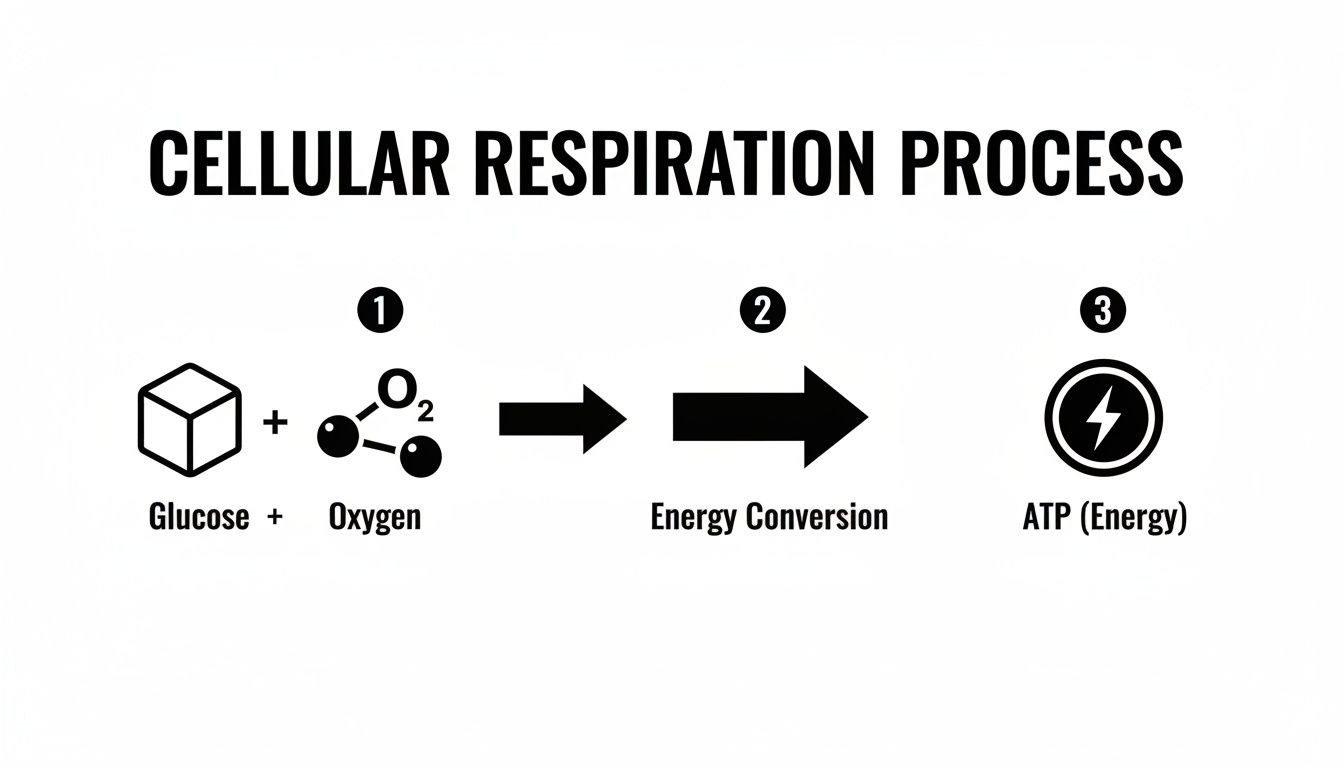
The image drives home the main point: this entire complex pathway has one primary goal—making ATP, the universal energy currency for our cells.
Stage 1: Glycolysis - The Initial Split
Our energy-making journey kicks off with Glycolysis, a name that literally means "sugar splitting." This first step takes place in the cytoplasm, the watery, gel-like fluid that fills the cell. It happens completely outside the mitochondria and, importantly, doesn't require any oxygen. That makes it an anaerobic process.
Here, a single six-carbon glucose molecule gets snapped in half, creating two smaller, three-carbon molecules called pyruvate. The process needs a little kickstart—an investment of two ATP molecules—but it ends up producing four ATP molecules.
This gives us a net gain of two ATP. As a bonus, it also generates two molecules of an energy-rich electron carrier called NADH, which we’ll need later on.
Think of Glycolysis as the prep station in our energy factory. It takes a large log (glucose), splits it into two more manageable pieces of firewood (pyruvate), and creates a couple of small sparks of energy (2 ATP) in the process.
With Glycolysis complete, the two pyruvate molecules are ready for the next stage of the assembly line—but only if oxygen is present. For a much more detailed look at the mechanics, you can explore the topic of Respiration in depth.
Stage 2: The Krebs Cycle - Processing The Fuel
Next up, the two pyruvate molecules are shuttled into the mitochondrial matrix, the very core of the cell's powerhouse. Before they can enter the main event, they go through a quick transition step. Each pyruvate is converted into a new molecule called acetyl-CoA, releasing one molecule of carbon dioxide and generating one more NADH in the process.
This acetyl-CoA is the all-access pass to the second major stage: the Krebs Cycle (also known as the citric acid cycle). The Krebs Cycle is a series of eight chemical reactions that spin like a turbine, methodically breaking down acetyl-CoA to harvest its energy.
For every single turn of this cycle, a few key things are produced:
- ATP Production: One molecule of ATP is made directly.
- Electron Carriers: Three molecules of NADH and one molecule of another carrier, FADH₂, are loaded up with high-energy electrons.
- Waste Removal: Two molecules of carbon dioxide are released as waste.
Remember, one glucose molecule gave us two pyruvates, which means we get two acetyl-CoA molecules. So, for every glucose we started with, the Krebs Cycle has to spin twice. This brings the total yield from this stage (per glucose molecule) to two ATP, six NADH, and two FADH₂, along with four molecules of CO₂. The reactions here are quite intricate; if you want to brush up on the basics, our guide on https://feen.ai/blog/how-to-balance-chemical-equations can help.
Stage 3: The Electron Transport Chain - The Big Payoff
The final stage is where the real magic happens. The Electron Transport Chain (ETC) is located on the inner mitochondrial membrane and is, by far, the most productive part of the process. This is the only stage that directly uses the oxygen we breathe.
All those NADH and FADH₂ molecules produced in the first two stages now make their way to the ETC. They drop off their high-energy electrons at a series of protein complexes embedded in the membrane. It’s like a controlled cascade, with electrons passed down the line from one protein to the next, releasing a little bit of energy at each step.
This released energy is used to pump protons (H⁺ ions) across the inner membrane, creating a powerful electrochemical gradient—imagine water building up behind a dam.
The grand finale involves an incredible molecular machine called ATP synthase. The built-up protons rush back across the membrane, flowing through this enzyme. The sheer force of this flow spins ATP synthase, providing the energy it needs to stick a phosphate group onto ADP, churning out massive amounts of ATP. This is called oxidative phosphorylation.
So what happens to the electrons at the end of the chain? Oxygen, the final electron acceptor, scoops them up. It then combines with protons to form water, the final byproduct. Without oxygen to clear the way, the entire chain would jam, and ATP production would grind to a halt. This is precisely why oxygen is non-negotiable for our survival.
Here’s a quick summary of where everything happens and what it does:
| Stage | Location in the Cell | Primary Function |
|---|---|---|
| Glycolysis | Cytoplasm | Splits one glucose into two pyruvate molecules. |
| Krebs Cycle | Mitochondrial Matrix | Processes pyruvate to generate some ATP and many high-energy electron carriers. |
| Electron Transport Chain | Inner Mitochondrial Membrane | Uses electron carriers and oxygen to produce a large amount of ATP. |
Together, these three stages work in perfect harmony. Glycolysis preps the fuel for the Krebs Cycle, and both of these stages load up the electron carriers needed to power the Electron Transport Chain—the true engine of ATP production in the cell.
How Cells Keep Score Of ATP Production
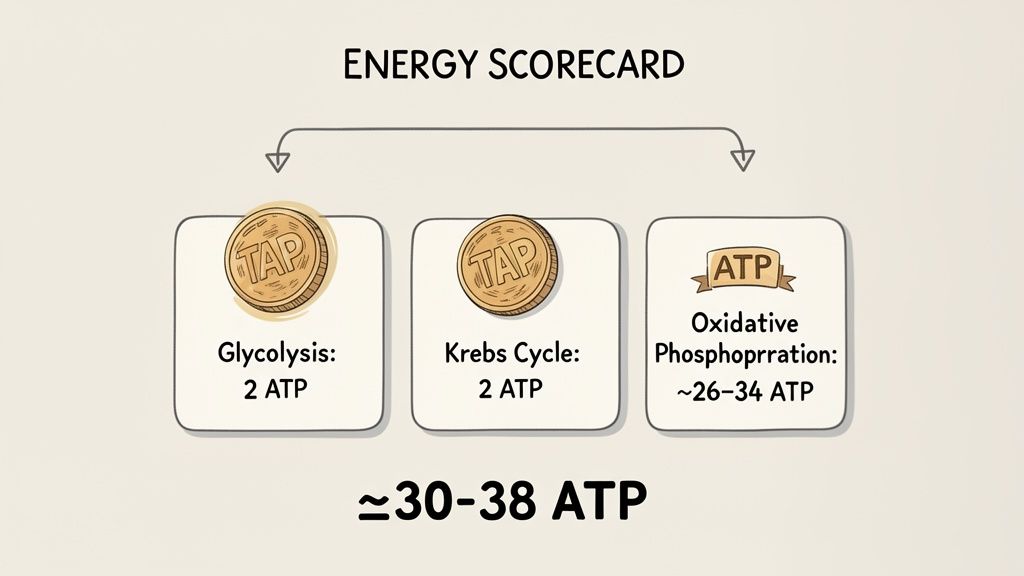
If cellular respiration is the cell's power plant, then ATP is the currency it churns out. But how much energy can a single molecule of glucose actually generate? Keeping track of the ATP yield shows just how remarkably efficient this biological process is. It's not a simple one-to-one trade; instead, energy is captured in small, usable amounts across the different stages.
Think of it like earning an income. Some ATP is made through direct deposits—a small, guaranteed payment. The rest is like a huge investment payoff that comes at the very end. Both are vital for figuring out the final energy budget.
Small Gains: Direct ATP Production
The first way cells make ATP is a process called substrate-level phosphorylation. This is the "direct deposit" method I mentioned. It's a straightforward chemical reaction where an enzyme grabs a phosphate group from a molecule (the substrate) and slaps it directly onto an ADP, creating ATP. Quick and simple.
This direct production happens in two of the main stages:
- Glycolysis: Generates a net gain of 2 ATP molecules.
- The Krebs Cycle: Produces another 2 ATP molecules (one for each turn of the cycle).
That gives us a grand total of just 4 ATP made directly. It's an important start, but it's only a tiny fraction of the energy that was originally in the glucose molecule. The real prize is still locked away in those high-energy electron carriers, NADH and FADH₂.
The Big Jackpot: Oxidative Phosphorylation
The main event for ATP production is oxidative phosphorylation, which happens during the final stage, the Electron Transport Chain. This is where the cell finally cashes in all the NADH and FADH₂ "chips" it's been collecting. These molecules drop off their high-energy electrons, kicking off the chain reaction that powers the ATP synthase enzyme.
Unlike the direct deposit method, this process is indirect and generates a much, much bigger payoff. Each NADH molecule that drops off electrons typically provides enough of a proton-pumping punch to make about 2.5 ATP. FADH₂ gives a slightly smaller return, yielding about 1.5 ATP per molecule.
Generating ATP is a fundamental part of how life works at a cellular level, and it’s deeply connected to how an organism's genetic code gets translated into action. You can learn more about the core processes controlling cellular activity in our guide on what is gene expression.
Tallying The Final Score
So, let's put it all together and see the final count. The table below breaks down where all the energy comes from as one glucose molecule is completely broken down.
ATP Production Scorecard Per Glucose Molecule
| Stage | Direct ATP (Substrate-Level) | NADH Produced | FADH2 Produced | Total ATP Yield (Approx.) |
|---|---|---|---|---|
| Glycolysis | 2 | 2 | 0 | 5-7 |
| Pyruvate Oxidation | 0 | 2 | 0 | 5 |
| Krebs Cycle | 2 | 6 | 2 | 20 |
| Total | 4 | 10 | 2 | 30-32 |
As you can see, the vast majority of the ATP comes from cashing in the NADH and FADH₂ during oxidative phosphorylation. The initial stages are really just prep work for the main event.
In a perfect, theoretical world, one molecule of glucose could yield a maximum of about 38 ATP. However, reality is a bit messier.
You'll often see biology textbooks give a range of 30-32 ATP per glucose molecule. Why isn't it a hard-and-fast number? The process simply isn't 100% efficient. For instance, it costs a little bit of energy to shuttle the NADH made during glycolysis from the cytoplasm into the mitochondria. Think of it as a cellular transport tax.
Plus, the mitochondrial membrane isn't perfectly sealed; some protons can leak back across without going through ATP synthase, slightly reducing the power of the engine. For these reasons, 30-32 ATP is a much more realistic estimate for most eukaryotic cells.
Making Energy When Oxygen Is Scarce
The elegant, high-yield process of aerobic cellular respiration hinges on one critical ingredient: oxygen. It’s the final electron acceptor that keeps the entire Electron Transport Chain humming along, letting our cells churn out ATP. But what happens when oxygen just isn't there?
Think about sprinting for the finish line. Your muscles are firing on all cylinders, using up oxygen faster than your lungs and blood can possibly supply it. In moments like these, your cells don't just give up. They switch to a backup plan—a less efficient but life-saving process called anaerobic respiration.
This emergency mode allows cells to keep producing a small trickle of ATP without any oxygen. It all starts with glycolysis, which, as we’ve seen, doesn't need oxygen to work. Glycolysis breaks a glucose molecule into two pyruvates, netting a quick 2 ATP. The real problem is what to do next, since the Krebs Cycle and the Electron Transport Chain are now offline.
The solution is a clever workaround called fermentation. Its main job isn't actually to make more ATP. Instead, its goal is to recycle the NAD⁺ needed to keep glycolysis running. It does this by taking the pyruvate and using it as a temporary dumping ground for the electrons from NADH. This frees up NAD⁺ molecules to go back and help break down more glucose, ensuring a continuous, albeit small, energy supply.
Lactic Acid Fermentation: A Familiar Burn
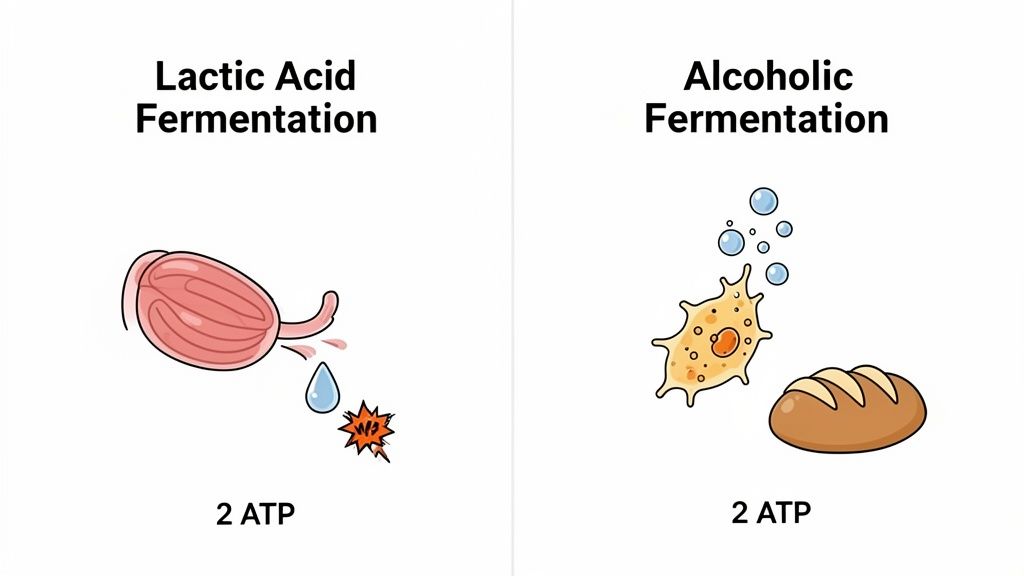
This is the exact pathway your muscle cells use during those short, intense bursts of activity. When you're pushing your physical limits, the demand for ATP goes through the roof. Once the oxygen supply can't keep up, fermentation kicks in to bridge the gap.
In this process, pyruvate from glycolysis grabs the electrons from NADH, and in doing so, transforms into lactic acid. You've probably felt its effects—it's what causes that familiar burning sensation in your muscles during a really tough workout.
Thankfully, this is just a temporary fix. As soon as you slow down and catch your breath, oxygen becomes available again. The lactic acid is then shuttled off to the liver, where it can be converted back into pyruvate and fed into the much more efficient aerobic respiration pathway.
Alcoholic Fermentation: Yeast's Secret Recipe
Another common type of fermentation is alcoholic fermentation, the process used by organisms like yeast and certain bacteria. This pathway is the magic behind baking bread and brewing beer, and it takes a slightly different, two-step route after glycolysis.
- Carbon Dioxide Release: A carbon dioxide molecule is snipped off the pyruvate. This is what creates the bubbles that make bread dough rise and gives beer its fizz.
- Alcohol Production: The remaining two-carbon molecule then accepts electrons from NADH. This reaction produces ethanol (the alcohol in beer and wine) and, crucially, regenerates the NAD⁺.
For both lactic acid and alcoholic fermentation, the final ATP tally is tiny compared to aerobic respiration. The net energy gain is just the 2 ATP produced during glycolysis. All the rest of the glucose molecule's energy stays locked up in the waste products, like lactic acid or ethanol.
This huge difference in energy output really underscores how vital oxygen is for complex life. The evolution of aerobic respiration was a total game-changer. Billions of years ago, Earth's atmosphere had almost no oxygen, and the first single-celled organisms had to rely on these inefficient anaerobic methods. After the Great Oxidation Event flooded the atmosphere with oxygen, aerobic respiration became possible. This new process provided an incredible 18-fold increase in energy efficiency, paving the way for the evolution of larger, more complex life forms. You can dive deeper into the origins of respiration and photosynthesis to explore this pivotal moment in Earth's history.
So, while fermentation is a much less powerful alternative, it remains a critical survival strategy. It allows organisms to thrive in oxygen-poor environments and gives our own cells the burst of energy needed to perform under pressure, proving that even a small energy return is better than none at all.
How Cellular Respiration Powers Your Daily Life
The different stages of cellular respiration can feel a bit like abstract biology, something trapped in textbook diagrams. But in reality, this microscopic process is the silent, tireless engine powering your every thought, movement, and breath. It’s the direct connection between the food on your plate and the life you actually live.
Every single thing you do, from lifting a finger to running a marathon, demands energy in the form of ATP. Your cells are minting this energy currency around the clock. When you launch into an intense workout, your muscle cells' demand for ATP goes through the roof, and the rate of cellular respiration kicks into high gear to keep up.
Even when you're just sitting here reading this, your brain is a massive energy hog. That late-night study session or deep focus at work is fueled by the steady breakdown of glucose, which supplies the ATP your neurons need for concentration, memory, and critical thinking.
Your Body's Internal Furnace
Ever wonder why you feel warm to the touch? A huge part of that is cellular respiration. The process isn't 100% efficient—no energy transfer ever is. In fact, only about 40% of the energy locked away in a glucose molecule gets captured as ATP.
So, where does the other 60% go? It's released as heat. This isn't wasted energy; it's absolutely vital. This heat helps maintain your core body temperature around a stable 37°C (98.6°F), creating the perfect warm environment for all your body's enzymes to do their jobs properly. When you shiver in the cold, it's your muscles contracting rapidly to deliberately speed up cellular respiration and generate more of this life-sustaining heat.
Every bite of food you eat is potential fuel. Cellular respiration is the process that unlocks that potential, converting the chemical energy stored in molecules into the biological energy that defines being alive.
This process hums along in the background 24/7, a constant reminder that even when you're completely still, your body is a buzzing hub of metabolic activity.
It's Not Just About Sugar
While glucose is the classic example of cellular fuel, your body is incredibly resourceful and doesn't just run on one thing. Think of your metabolic pathways less like a single-lane road and more like a busy highway interchange where other fuel sources can merge.
Fats: When you digest fats, they break down into glycerol and fatty acids. Glycerol can be converted to an intermediate that enters glycolysis. Fatty acids are chopped up into two-carbon units to make acetyl-CoA, which jumps straight into the Krebs Cycle. This is why fats are so energy-dense—they provide way more ATP per gram than carbs.
Proteins: Your body prefers to save proteins for building and repairing tissues, but in a pinch, they can be used for fuel. Amino acids have their nitrogen group removed, and the remaining carbon skeletons can be transformed into intermediates that slot into glycolysis or the Krebs Cycle at various points.
This metabolic flexibility is a key survival trait. It ensures that no matter what you eat, your cells can find a way to extract energy and keep the lights on. From the sugar in your morning coffee to the fats in your avocado toast, it all feeds into the same fundamental energy-producing process.
Getting a handle on cellular respiration means understanding the very essence of how your body works. It’s the bridge between nutrition and action, turning the food you eat into the force that lets you experience the world. It’s not just a topic in a biology class; it’s the story of you, being powered one cell at a time.
Got Questions About Cellular Respiration? Let's Clear Things Up.
After digging into a topic as complex as cellular respiration, it's totally normal for a few questions to pop up. Some concepts are just plain tricky. Let's tackle some of the most common ones to make sure you have a rock-solid understanding of this incredible biological engine.
Is Breathing The Same Thing As Cellular Respiration?
This is probably the biggest point of confusion, and it’s a fantastic question. While the two are linked, they are definitely not the same thing.
Think of it like this: Breathing is the big, physical process of getting oxygen into your body and carbon dioxide out. It's all about your lungs doing their job. Cellular respiration, on the other hand, is the chemical reaction happening on a microscopic scale inside your cells. It's what your body actually does with the oxygen once it arrives.
Breathing is the delivery truck that drops off the oxygen. Cellular respiration is the factory that uses that oxygen to burn fuel and produce energy. You can't have one without the other.
Why Do They Call The Mitochondrion The "Powerhouse Of The Cell"?
It's a classic science class nickname, and it's completely earned. While the very first step of respiration (glycolysis) happens out in the cell's cytoplasm, the real energy jackpot is hit inside the mitochondria. This is where the Krebs Cycle and the Electron Transport Chain—the two most productive stages—are located.
Mitochondria are perfectly built for this role. Their inner membrane is folded into structures called cristae, which creates a huge surface area for the countless proteins of the Electron Transport Chain to do their work. This specialized design allows them to crank out the vast majority of the 30-32 ATP molecules generated from just one molecule of glucose. They are, quite literally, the power plants that keep everything running.
Without mitochondria, complex life as we know it would be impossible. Our cells would be stuck making only 2 ATP per glucose molecule through glycolysis, which is not nearly enough to power a multicellular organism.
Do Plants Do Cellular Respiration, Or Just Photosynthesis?
This is a great question that really gets to the core of how energy moves through an ecosystem. The answer is simple: plants do both. It's a common myth that plants just make their food through photosynthesis and then... that's it.
Just like us, plants need a constant supply of ATP to power their own cellular activities—things like growth, repairing damage, and moving nutrients around. They use cellular respiration to break down the glucose they made during photosynthesis, turning that stored fuel into usable energy.
Here's an easy way to keep it straight:
- Photosynthesis: Happens in chloroplasts. It uses sunlight to build glucose (storing energy) and releases oxygen. This only happens when light is available.
- Cellular Respiration: Happens in mitochondria. It breaks down glucose to create ATP (releasing energy) and uses oxygen. This happens 24/7, day and night, in plants just like it does in animals.
What Happens To All The Carbons In The Glucose Molecule?
The original glucose molecule (C₆H₁₂O₆) starts with a backbone of six carbon atoms. As cellular respiration chugs along, these carbons get stripped away and released one by one.
During the prep step between glycolysis and the Krebs Cycle, two carbons are clipped off and released as **carbon dioxide (CO₂) **. The other four carbons enter the Krebs Cycle, and during its spins, they are also released as CO₂. So, by the time the Krebs Cycle is finished, all six carbons from that initial glucose molecule have been completely broken down and are exhaled as a waste product.
Struggling with complex topics like cellular respiration? Feen AI is your go-to homework helper. Just upload a picture of your assignment, and our AI can break down tricky concepts, solve problems step-by-step, and help you master Biology, Chemistry, and more. Get clear explanations instantly at https://feen.ai.
Relevant articles
Discover what is photosynthesis and cellular respiration in this complete guide. Learn the key differences, processes, and why they're vital for life on Earth.