What Is Photosynthesis and Cellular Respiration Explained
Discover what is photosynthesis and cellular respiration in this complete guide. Learn the key differences, processes, and why they're vital for life on Earth.
At the very core of life on Earth are two processes that work in beautiful harmony: one captures and stores energy, while the other releases it for use. Think of it this way: photosynthesis is like a solar-powered factory that builds sugar molecules packed with energy, and cellular respiration is the power plant that breaks down those sugars to fuel the everyday business of living.
The Fundamental Dance of Life and Energy
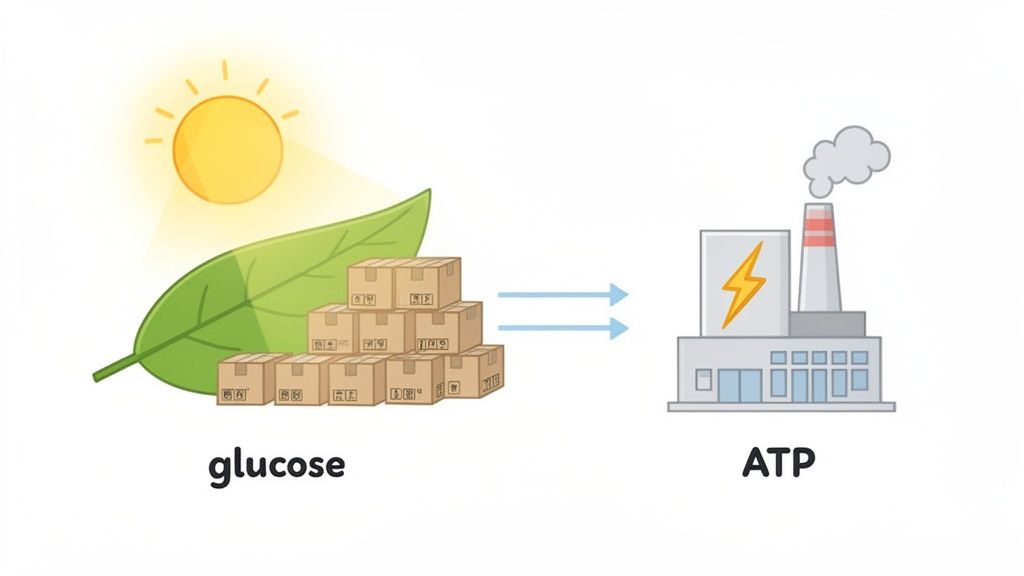
Running through almost every ecosystem is a constant flow of energy. This vital exchange is driven by two elegant and deeply connected biological processes: photosynthesis and cellular respiration. You can think of them as two sides of the same coin, a perfect display of nature's cyclical and efficient design.
One process builds up, and the other breaks down. One stores energy, and the other sets it free. Getting a handle on what photosynthesis and cellular respiration are is all about understanding this essential give-and-take that powers everything from the tiniest microbe to the largest redwood tree.
The Solar-Powered Factory: Photosynthesis
Picture a plant's leaf as a miniature, incredibly sophisticated solar-powered factory. Its main purpose is to catch sunlight, a form of light energy that, while plentiful, can't be used directly by most organisms to power their activities. Through a brilliant series of chemical reactions, this factory transforms that light energy into a stable, storable form of chemical energy.
The factory's raw materials are surprisingly simple and found all around us:
- Carbon dioxide pulled from the air
- Water drawn up from the soil
- Sunlight providing the power
The final product is glucose, a type of sugar molecule that works like a tiny rechargeable battery, holding onto that captured solar energy within its chemical bonds. And as a happy accident for us, the factory releases oxygen into the atmosphere—the very air we need to survive. This entire energy-building process is photosynthesis.
Photosynthesis is an anabolic process, meaning it builds complex molecules to store energy. Cellular respiration is a catabolic process—it breaks down those molecules to release that energy.
The Cellular Power Plant: Respiration
So, what’s the point of a fully charged battery if you can’t tap into its power? This is where cellular respiration enters the picture. Every living thing, including the very plants that made the glucose in the first place, needs a way to unlock the energy stored inside those sugar molecules.
Cellular respiration is the process that methodically breaks down glucose to release its stored chemical energy. In most organisms, this requires the oxygen that photosynthesis produced. The released energy is then transferred to a special molecule called ATP (adenosine triphosphate), which acts as the universal energy currency for all cells.
Think of ATP as the "cash" a cell uses to pay for every single activity, whether it’s contracting a muscle, sending a nerve signal, or building a new protein. Without the constant conversion of glucose into usable ATP, life's most basic functions would come to a screeching halt.
To make these differences crystal clear, here's a quick side-by-side comparison.
Photosynthesis vs Cellular Respiration At a Glance
This table breaks down the key distinctions between these two critical processes, highlighting their opposing yet complementary roles in the cycle of life.
| Feature | Photosynthesis | Cellular Respiration |
|---|---|---|
| Primary Function | To capture and store energy in glucose | To release energy from glucose into ATP |
| Who Does It? | Plants, algae, and some bacteria (autotrophs) | Nearly all living organisms (autotrophs and heterotrophs) |
| Where It Happens | In the chloroplasts | In the cytoplasm and mitochondria |
| Inputs (Reactants) | Carbon Dioxide (CO₂), Water (H₂O), and Light Energy | Glucose (C₆H₁₂O₆) and Oxygen (O₂) |
| Outputs (Products) | Glucose (C₆H₁₂O₆) and Oxygen (O₂) | Carbon Dioxide (CO₂), Water (H₂O), and ATP Energy |
| Energy Transformation | Light energy is converted into chemical energy | Chemical energy in glucose is converted into chemical energy in ATP |
Ultimately, photosynthesis and cellular respiration are locked in a perfect, life-sustaining relationship. One process creates the fuel and the oxygen, while the other uses them to generate the energy that drives the vast and complex machinery of life on Earth.
How Plants Turn Sunshine Into Energy
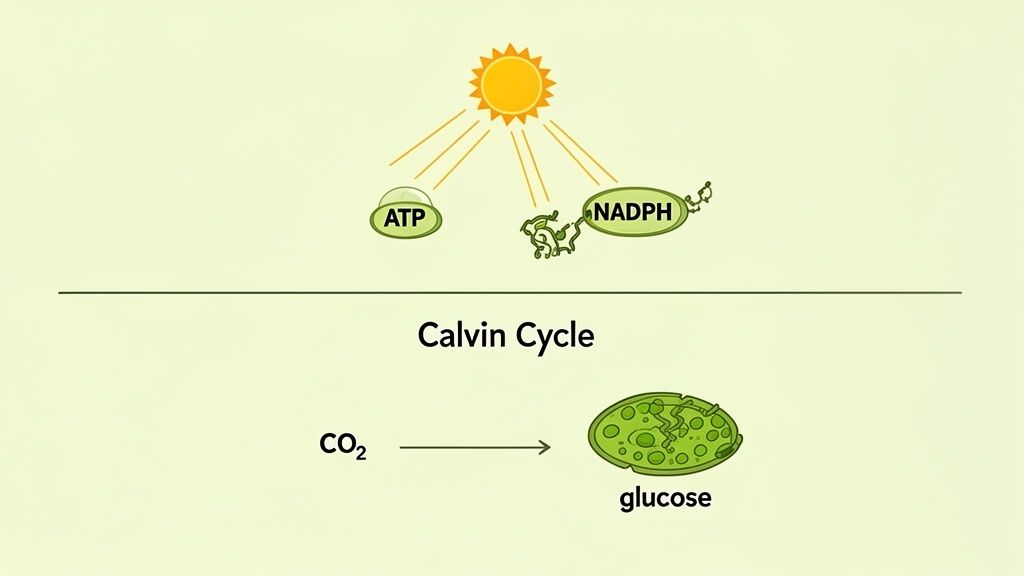
Photosynthesis isn't a single, magical event. It’s actually a sophisticated, two-part process that takes place inside tiny organelles called chloroplasts. You can think of it as a biological assembly line, where each station has a very specific job in turning sunlight into usable chemical energy.
That iconic green color of leaves? It comes from a pigment called chlorophyll, which is the undisputed star of this entire show. Located inside the chloroplasts, chlorophyll’s main job is to soak up energy from sunlight, kicking off the whole production sequence.
To really understand what is photosynthesis and cellular respiration, we first need to see how this initial energy capture works. Let's pull back the curtain on the two main stages of this solar-powered factory.
Stage 1: The Light-Dependent Reactions
The first act is fittingly called the light-dependent reactions. As the name implies, this stage needs a direct supply of sunlight to get going. This part of the assembly line operates in the thylakoid membranes within the chloroplasts—imagine stacks of tiny, energy-hoarding discs.
Here’s a quick rundown of what happens:
- Light Absorption: Chlorophyll grabs photons (particles of light), which gets it all fired up with energy.
- Water Splitting: This captured light energy is immediately put to work splitting water molecules (H₂O) into oxygen, protons, and electrons. This step is huge—it's where the oxygen we breathe comes from! It’s essentially a byproduct.
- Energy Carrier Production: The energy is then packaged into two temporary shuttle molecules: ATP (adenosine triphosphate) and NADPH (nicotinamide adenine dinucleotide phosphate).
Think of ATP and NADPH as rechargeable batteries and delivery trucks. They’ve captured the sun's energy for a short period and are now ready to haul it over to the next stage of the assembly line.
Stage 2: The Calvin Cycle
Next up is the Calvin cycle, which is also known as the light-independent reactions. This process doesn't need sunlight directly, but it’s completely dependent on the ATP and NADPH created in the first stage. This all happens in the stroma, which is the fluid-filled space surrounding the thylakoids.
This is where the real manufacturing begins. The Calvin cycle cashes in the energy from ATP and NADPH to pull carbon dioxide (CO₂) from the atmosphere and convert it into glucose (C₆H₁₂O₆), a stable sugar molecule. This conversion, called carbon fixation, is like using the power from the batteries to assemble a durable, finished product. Glucose is the long-term energy savings account for the plant, ready to be used later or to build other structures like cellulose.
Photosynthesis is, at its core, a process of energy conversion. It transforms fleeting light energy into stable, storable chemical energy locked in the bonds of glucose, laying the foundation for nearly every food chain on Earth.
The Balanced Chemical Equation
When you zoom out and look at both stages together, the whole elegant process of photosynthesis can be captured in a single chemical equation. It neatly lays out all the ingredients (reactants) and the finished products.
The balanced equation for photosynthesis is:
6CO₂ + 6H₂O + Light Energy → C₆H₁₂O₆ + 6O₂
Let’s quickly translate that:
- 6CO₂: Six molecules of carbon dioxide are pulled from the air.
- 6H₂O: Six molecules of water are taken up, usually through the roots.
- Light Energy: The essential power source that gets everything moving.
- C₆H₁₂O₆: One molecule of glucose (sugar) is built to store the energy.
- 6O₂: Six molecules of oxygen are released as a happy byproduct.
This simple formula represents an incredibly complex chain of events that powers not just plants, but nearly all life on our planet. If you're looking to explore this further, you might find some great lesson plans on understanding photosynthesis. Breaking down these steps is a lot like figuring out https://feen.ai/blog/how-to-write-a-lab-report-conclusion by connecting all the parts of your experiment into a cohesive story.
Unlocking Energy with Cellular Respiration
If you think of photosynthesis as the process of a plant cooking a meal (making glucose), then cellular respiration is how we eat that meal. It's the universal process all living things—from bacteria to blue whales—use to break down that glucose and unlock the energy stored inside. This entire operation is about one thing: converting the stable, long-term energy in sugar into ATP (adenosine triphosphate), the ready-to-use "cash" that powers everything a cell does.
This all goes down inside the mitochondria, which have rightfully earned the nickname "powerhouses of the cell." These tiny organelles are where the heavy lifting of energy conversion happens, making sure every part of the cell has the fuel it needs. And just like photosynthesis, cellular respiration has its own chemical equation. Take a look—it might seem oddly familiar.
The balanced equation for aerobic cellular respiration is:
C₆H₁₂O₆ + 6O₂ → 6CO₂ + 6H₂O + ATP (Energy)
Notice anything? It's the exact opposite of the photosynthesis equation. The things respiration needs (glucose and oxygen) are precisely what photosynthesis produces. This isn't a coincidence; it's a perfect illustration of the elegant, cyclical relationship that powers most life on Earth.
Stage 1: Glycolysis
The first step on the journey to release energy from glucose is glycolysis, a word that literally means "sugar splitting." This happens right in the cell's main fluid-filled space, the cytoplasm, completely outside the mitochondria. Crucially, it doesn't need any oxygen to get started.
Here, a single six-carbon glucose molecule is snapped in half, creating two smaller, three-carbon molecules called pyruvate. Think of it like cracking open a walnut. It’s the first essential step, but you haven't gotten all the good stuff out yet. The energy payout here is tiny—a net gain of just 2 ATP molecules. Glycolysis is the warm-up act, preparing the fuel for the main event.
Stage 2: The Krebs Cycle
With the glucose split, the two pyruvate molecules are shuttled inside the mitochondria to enter the second stage: the Krebs cycle (also known as the citric acid cycle). This is where the real demolition begins. In a complex, spinning series of chemical reactions, the pyruvate is systematically dismantled, releasing the energy locked away in its chemical bonds.
The key outputs from the Krebs cycle are:
- The release of carbon dioxide (CO₂) as a waste product. Yes, this is the very same CO₂ you're breathing out right now.
- The production of another small handful of ATP (about 2 more molecules).
- Most importantly, loading up special, high-energy electron carriers called NADH and FADH₂.
The Krebs cycle is like a sophisticated disassembly line. It takes the fuel apart piece by piece and transfers the valuable energy to these molecular "trucks," which will carry it to the final stage.
Stage 3: The Electron Transport Chain
Now for the grand finale. The electron transport chain (ETC) is where the real energy jackpot is won, and it all happens on the folded inner membrane of the mitochondria. All those loaded-up NADH and FADH₂ molecules from the Krebs cycle arrive here and drop off their precious cargo: high-energy electrons.
These electrons are passed down a line of proteins, like a bucket brigade. At each step, they release a little burst of energy, which is used to pump protons across the membrane, building up a powerful electrical gradient. And what's at the end of the line? Oxygen. It's the final electron acceptor, grabbing the spent electrons and combining with protons to form water (H₂O). Without oxygen to clear the way, the whole chain gets backed up and grinds to a halt.
That powerful proton gradient is the key. The protons rush back across the membrane through a remarkable enzyme called ATP synthase, which spins like a water wheel in a dam. This spinning motion is what generates the massive payoff of ATP—the entire point of respiration.
The process is astonishingly efficient. While ideal conditions could theoretically produce up to 38 ATP from one glucose molecule, a living cell typically nets around 29–30 ATP. Compare that to anaerobic processes (without oxygen) like fermentation, which only produce a measly 2 ATP. That makes aerobic respiration over 15 times more efficient and clearly shows why oxygen is a game-changer for complex life. If you're curious about the numbers, you can dive deeper into the fascinating details of cellular respiration energy yields.
Comparing Photosynthesis and Cellular Respiration
While it’s easy to think of photosynthesis and cellular respiration as simple opposites, they’re actually perfect partners in the cycle of life. One builds up energy stores, and the other breaks them down. Understanding exactly how they compare is the key to seeing the elegant, efficient engine that drives nearly all ecosystems on Earth.
Think of it like a biological give-and-take. Photosynthesis produces the essential goods—glucose and oxygen. Cellular respiration then takes those exact goods and uses them to generate the energy currency, ATP, that keeps the whole system running. It's a beautiful closed-loop system where one process's waste is the other's fuel.
Function And Energy Flow
The most fundamental difference between the two boils down to their core purpose. Photosynthesis is all about capturing and storing energy. It takes disorganized light energy from the sun and converts it into stable, chemical energy locked away in the bonds of glucose. It’s like charging a battery for the cell to use later.
On the flip side, cellular respiration is an energy-releasing process. It systematically dismantles that glucose molecule to cash in on its stored energy, converting it into ATP. ATP is the cell's immediate, spendable energy that powers everything from muscle contractions to thinking. This is the step where the battery's power is actually put to use.
Location, Location, Location
Where these processes happen inside a cell is another huge clue about their different jobs.
- Photosynthesis is confined to the chloroplasts found in plant cells and some algae. These specialized organelles are packed with chlorophyll, the green pigment that’s a master at absorbing sunlight.
- Cellular Respiration gets started in the cytoplasm and then moves into the mitochondria of almost all eukaryotic cells—that includes both plants and animals.
This concept map breaks down the main stages of cellular respiration, the process that unlocks the energy from the glucose made during photosynthesis.
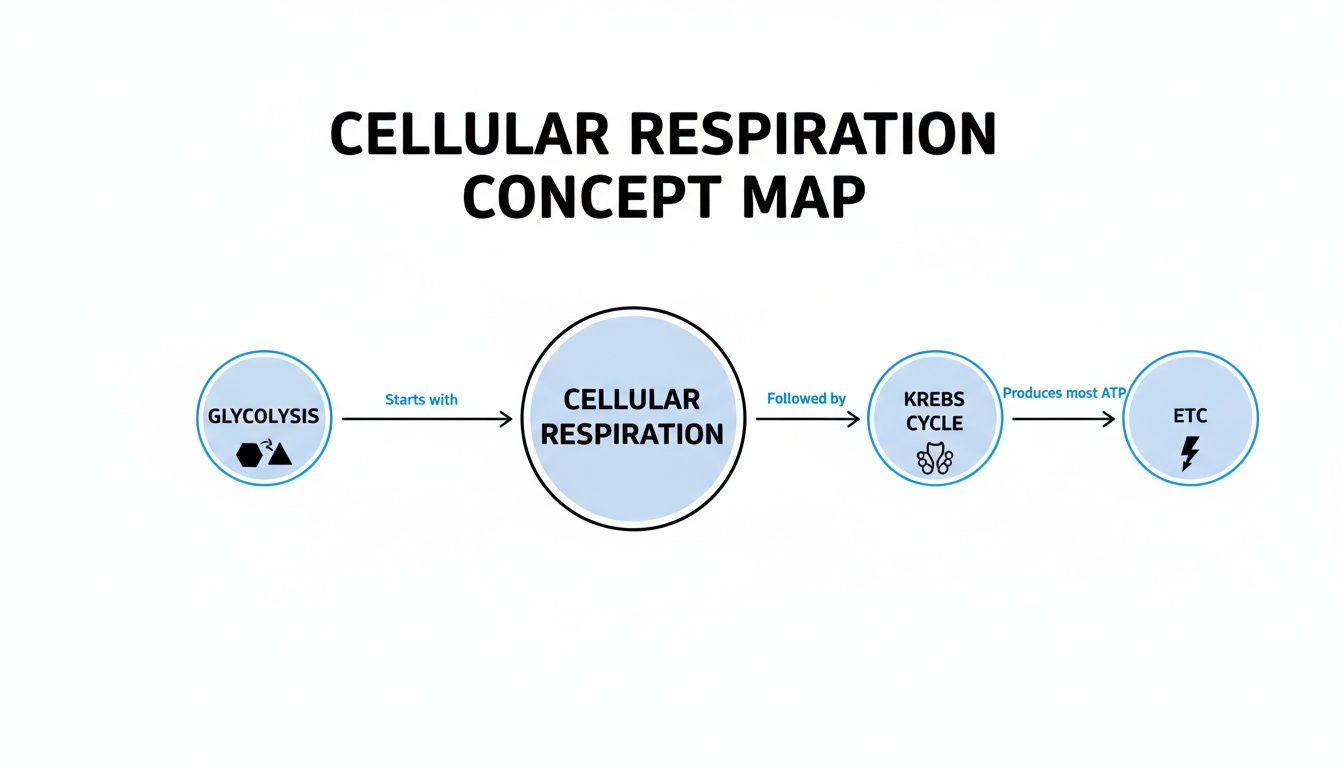
As you can see, it’s a clear pathway from glycolysis to the Krebs cycle and finally to the electron transport chain, which is the real powerhouse for ATP production.
Key Takeaway: The fact that plants have both chloroplasts and mitochondria is a game-changer. It means they can make their own food and then immediately use that food to power their own cells—a self-sufficiency that animals just don't have.
A Detailed Side-By-Side Comparison
To really lock in your understanding, nothing beats a direct, side-by-side comparison. The table below lays out the key differences and similarities, making it a perfect study guide. It highlights their symbiotic relationship, showing how the products of one are the essential starting materials for the other. These processes are directed by a cell's genetic blueprint, which is a whole other fascinating topic. You can learn more about how cells follow these instructions in our guide on what is gene expression.
Detailed Breakdown of Photosynthesis vs Cellular Respiration
| Characteristic | Photosynthesis | Cellular Respiration |
|---|---|---|
| Purpose | Captures and stores energy | Releases stored energy |
| Location | Chloroplasts | Cytoplasm and Mitochondria |
| Reactants (Inputs) | Carbon Dioxide, Water, Light Energy | Glucose, Oxygen |
| Products (Outputs) | Glucose, Oxygen | Carbon Dioxide, Water, ATP |
| Energy Transformation | Light energy to chemical energy (glucose) | Chemical energy (glucose) to chemical energy (ATP) |
| Metabolic Process | Anabolic (builds molecules) | Catabolic (breaks down molecules) |
Seeing it all laid out like this really emphasizes the cyclical nature of these two vital processes. They are two sides of the same coin, constantly exchanging materials to keep the energy flowing through living systems.
How These Tiny Reactions Shape Our World
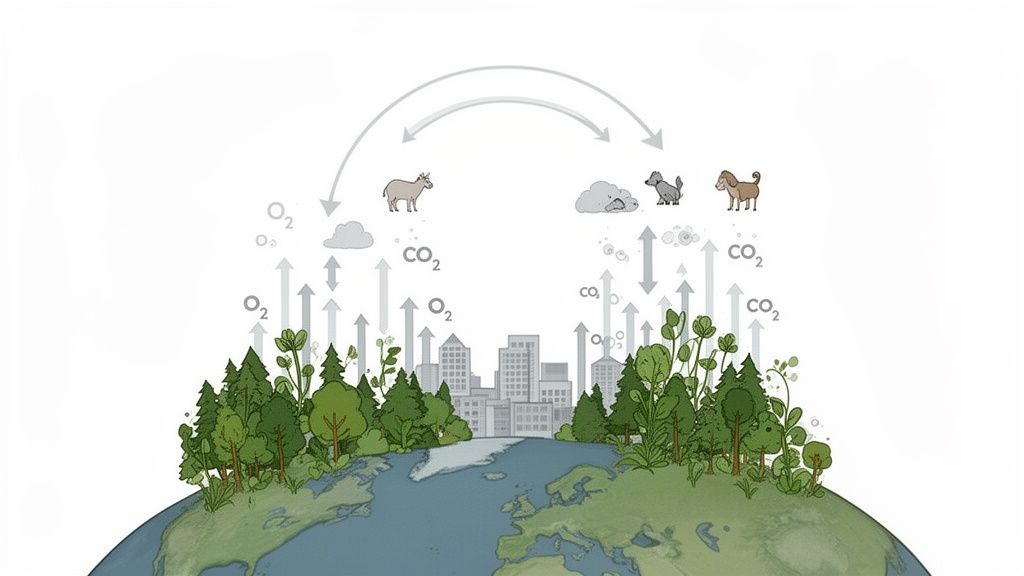
It’s easy to think of photosynthesis and cellular respiration as just microscopic processes happening inside a leaf or a muscle cell. But when you zoom out, you see that their combined power literally shapes life on Earth. These two processes aren't just topics for a biology exam; they are the engines driving global ecosystems and regulating the very air we breathe.
Think of it this way: this elegant partnership forms the foundation of almost every food web on the planet. The organisms that perform photosynthesis—the autotrophs, or producers—are at the bottom of the food pyramid, capturing sunlight and turning it into the organic matter that feeds nearly everything else.
The Foundation of Global Food Webs
Every single meal you eat, whether it’s a salad or a steak, traces its energy back to photosynthesis. A cow eats grass, which got its energy from the sun. We then eat the steak. At every single step, the energy being passed along is the same solar energy that a plant first captured and stored in glucose.
Without this constant input of solar energy, the flow of life would simply stop. Photosynthesis is the ultimate source of the fuel that powers our living world.
Keeping Earth's Atmosphere in Balance
The influence of these processes goes far beyond just food. Photosynthesis and cellular respiration act like a planetary-scale thermostat and air purifier, maintaining the delicate composition of our atmosphere. They are the star players in the oxygen and carbon cycles.
Here’s a quick look at how they keep things stable:
- The Oxygen Cycle: Photosynthesis is responsible for putting virtually all of the breathable oxygen into our atmosphere. Before the first photosynthetic organisms came along, our planet had almost no oxygen. Cellular respiration then uses that oxygen to release energy, completing the cycle.
- The Carbon Cycle: These two processes are also in a constant dance with carbon dioxide. Photosynthesis pulls CO₂ out of the air and locks it into organic molecules. Cellular respiration, along with processes like decomposition, releases that carbon right back into the atmosphere.
This global give-and-take is truly massive. Every year, ecosystems on land exchange an incredible 120 gigatons (Gt) of carbon with the atmosphere. To put that in perspective, about half of all the carbon dioxide plants absorb is quickly sent back through their own respiration, showing just how dynamic this planetary balancing act is. You can dig deeper into these massive carbon exchange findings.
This is the balance that keeps atmospheric gases in a range that supports life as we know it. But this equilibrium is fragile. Human activities like burning fossil fuels and deforestation are throwing a wrench in the works, releasing huge amounts of stored carbon while simultaneously removing the very organisms that can absorb it. This disruption is a major force behind climate change, which makes understanding photosynthesis and cellular respiration more important than ever for our planet’s future.
Got Questions About Photosynthesis and Respiration?
Once you've walked through the steps of photosynthesis and cellular respiration, a few tricky questions always seem to pop up. It's totally normal. These two processes are so intertwined that it can be tough to keep them straight.
Let's clear up some of the most common points of confusion. Think of this as the FAQ section that will help you nail down these concepts for good.
Do Plants Do Both?
Absolutely, and this is probably the biggest misconception out there. Plants perform both photosynthesis and cellular respiration, and here’s the key to understanding why.
Photosynthesis is how a plant makes its food—the sugar, glucose. This can only happen in cells with chloroplasts (mostly in the leaves) and only when the sun is out. It’s the plant’s way of stocking its pantry.
But every single living cell in that plant, from the roots buried in the dark soil to the cells inside the stem, needs energy to stay alive. Cellular respiration is how the plant cashes in that stored food for usable energy (ATP). This happens all the time, 24/7, just like it does in our own bodies.
Think of it this way: A solar-powered factory (the plant) spends all day using sunlight to manufacture energy bars (photosynthesis). But the workers in that factory need to eat those energy bars around the clock to keep the machinery running (cellular respiration).
What if There's No Oxygen for Respiration?
Life doesn't just stop when oxygen runs out. Most organisms have a backup plan called anaerobic respiration, which you probably know better as fermentation. It’s not very efficient, but it’s a lifesaver in a pinch.
Instead of going through the whole shebang—glycolysis, the Krebs cycle, and the electron transport chain—the process just stops after glycolysis. Glycolysis itself doesn't need oxygen and manages to squeeze out a tiny net gain of just 2 ATP from one glucose molecule. It's not much, but it's better than zero.
You see this all the time in two common places:
- Lactic Acid Fermentation: Ever feel that burn in your muscles during a hard workout? Your muscle cells are using up oxygen faster than you can breathe it in. They switch to lactic acid fermentation to keep cranking out ATP. That buildup of lactic acid is what causes the fatigue and soreness.
- Alcoholic Fermentation: Tiny organisms like yeast use a different route. They turn glucose into ethanol (alcohol) and carbon dioxide. This is the magic behind bread making (the CO₂ gas makes the dough rise) and brewing beer and wine.
Fermentation is a survival hack. It's a quick and dirty way to make a little ATP when the high-yield, oxygen-hungry electron transport chain is offline.
Why Are the Chemical Equations Opposites?
Looking at the chemical equations for photosynthesis and respiration side-by-side feels like looking in a mirror. That's no accident—they are two sides of the same coin, creating a beautiful, sustainable cycle of energy and matter on our planet.
Let's line them up:
- Photosynthesis: 6CO₂ + 6H₂O + Light → C₆H₁₂O₆ + 6O₂
- Cellular Respiration: C₆H₁₂O₆ + 6O₂ → 6CO₂ + 6H₂O + ATP
Photosynthesis is an anabolic process. Think "anabolic" = "building." It takes simple little molecules (carbon dioxide and water) and uses energy to build them into a big, complex molecule (glucose). Energy gets stored.
Cellular respiration is a catabolic process. Think "catabolic" = "catastrophe" or breaking down. It takes that big glucose molecule and shatters it to release all the stored energy. The waste products of one process are the exact ingredients the other one needs. It’s the ultimate recycling program.
Where Does the Mass of a Tree Come From?
Here’s a classic riddle: you plant a tiny acorn that weighs a few grams, and over decades it grows into a massive oak tree weighing several tons. Where did all that stuff—the wood, the bark, the leaves—come from?
It wasn't the soil. It wasn't the water. The incredible answer is that most of a tree's mass is pulled straight out of thin air.
The vast majority of a tree's dry weight is built from carbon atoms that the plant harvested from carbon dioxide (CO₂) gas in the atmosphere during photosynthesis. The Calvin cycle "fixes" this gaseous carbon into solid, stable sugar molecules, which then become the building blocks for cellulose, the sturdy material that makes up wood. Water is vital, and the soil provides essential nutrients, but those are just a tiny fraction of the tree's final weight.
Can Animals Photosynthesize?
As a rule, no. The definition of an animal is that it's heterotrophic—we have to eat other things to get our energy. But as with any rule in biology, there are some wonderfully weird exceptions.
Meet the "solar-powered" sea slug, Costasiella kuroshimae. This little guy munches on algae but has a neat trick. It doesn't digest the chloroplasts. Instead, it steals them and embeds them into its own tissues in a process cleverly named kleptoplasty (from the Greek for "stolen organelle").
These stolen chloroplasts keep on photosynthesizing for months, feeding the sea slug directly from sunlight. It's not true photosynthesis since the slug can't make its own chloroplasts, but it's an amazing partnership that blurs the line between animal and plant.
Observing and recording phenomena like this is at the heart of science. If you're documenting your own experiments, knowing the proper biology lab report format is crucial for sharing your findings like a professional.
Relevant articles
Unlock the secrets of cellular energy. This guide explains what is cellular respiration, from glycolysis to ATP production, in simple, easy-to-understand terms.