What is projectile motion in physics: Explained Simply
Discover what is projectile motion in physics, with clear explanations, real-world examples, and quick formulas to master the basics.
Ever tossed a ball to a friend and watched it arc through the air? That curved path is a perfect example of projectile motion. In physics, we define this as the movement of an object that's been thrown or launched, where the only significant force pulling on it is gravity.
Understanding Projectile Motion from the Ground Up
To really get a handle on projectile motion, we start by simplifying the world a little bit. We make two key assumptions that let us focus on the core physics without getting bogged down in messy details.
- We ignore air resistance. For our calculations, we pretend the object is moving in a vacuum. This means no drag is slowing it down.
- Gravity is constant and uniform. We assume the acceleration due to gravity, g, is a steady 9.8 m/s² pulling straight down, no matter how high the object goes.
With those ground rules set, we can unlock the secret to solving any projectile problem: splitting the motion into two completely independent pieces. Think of it like this—the object’s forward movement and its up-and-down movement don't interfere with each other at all.
The Two Independent Components
The trick is to analyze the horizontal and vertical parts of the motion separately. This idea makes the math so much cleaner.
- Horizontal Motion (X-axis): Since we’re ignoring air resistance, there’s nothing to push or pull the object sideways. This means its horizontal velocity never changes. It just cruises along at a constant speed.
- Vertical Motion (Y-axis): This is where gravity comes into play. The object’s vertical velocity is always changing. Gravity constantly pulls it downward, so it slows down on the way up, briefly pauses at the very top of its path, and then speeds up on the way back down.
This brilliant insight—breaking motion into independent horizontal and vertical components—was first worked out by Galileo Galilei way back in the 17th century. He was the one who figured out that projectiles trace a perfect parabola, which completely changed how we think about physics.
This split is the foundation for everything that follows. We can use simple math for the unchanging horizontal part and a standard set of kinematic equations for the vertical part. For a quick reference of these, our physics formulas cheat sheet is a great resource. By tackling each component on its own and then putting them back together, we can pinpoint a projectile's exact location and speed at any moment.
Horizontal vs Vertical Components of Projectile Motion
Let's summarize the key differences in a table. Seeing them side-by-side really helps solidify how these two components operate independently.
| Characteristic | Horizontal Motion (X-axis) | Vertical Motion (Y-axis) |
|---|---|---|
| Velocity | Constant (vx = constant) | Changes due to gravity (vy changes) |
| Acceleration | Zero (ax = 0) | Constant and downward (ay = -g) |
| Governing Factor | Initial horizontal velocity | Initial vertical velocity and gravity |
| Equation | x = vxt | y = v₀yt - ½gt² |
Understanding this table is crucial. It shows that while the object is moving forward at a steady pace, it's also accelerating downward at a constant rate, all at the same time. This is what creates that classic curved trajectory.
Deconstructing the Launch with Velocity Components
To really get a grip on projectile motion, we need to zoom in on the moment an object is launched. Everything starts with an initial velocity—a certain speed at a specific angle. But analyzing that single, angled motion is tricky. The secret is to break it down into two much simpler parts: a horizontal piece and a vertical piece.
Think of it this way: imagine a car driving off a cliff. Its forward motion is one part of the story, and its downward fall is the other. We can analyze them separately. This is the core idea. By splitting the initial velocity into its horizontal and vertical components, we can treat a complex 2D problem as two separate, much easier 1D problems.
This process is called vector decomposition, and it's the first thing you'll do when solving almost any projectile motion problem.
Calculating the Initial Velocity Components
We can pull out our high school trig (SOH CAH TOA) to find these components. If we launch an object with an initial velocity v₀ at an angle θ (theta) above the ground, we can find its horizontal (v₀x) and vertical (v₀y) speeds.
- Horizontal Velocity Component (v₀x): This is the "forward" part of the launch. We find it using: v₀x = v₀ * cos(θ)
- Vertical Velocity Component (v₀y): This is the "upward" part of the launch. We find it using: v₀y = v₀ * sin(θ)
Let's make this real. A cannon fires a ball with an initial velocity of 100 m/s at an angle of 30°.
- Its initial horizontal speed is: v₀x = 100 * cos(30°) ≈ 86.6 m/s
- Its initial vertical speed is: v₀y = 100 * sin(30°) = 50 m/s
These two numbers are our starting point. They tell us exactly how the object begins its journey in each direction.
The Two Different Fates of Motion
Once that cannonball is in the air, its two velocity components go on very different adventures. This is where the physics gets interesting.
The horizontal velocity (vₓ) has it easy. Since we're ignoring air resistance, there's absolutely nothing pushing or pulling the cannonball sideways. That means its horizontal speed never changes. It will travel forward at a constant 86.6 m/s for its entire flight. Simple.
The vertical velocity (vᵧ), on the other hand, is in a constant fight with gravity. It starts with a strong upward push (50 m/s), but gravity immediately starts pulling it back down, slowing its ascent.
Key Takeaway: The beautiful, curved path of a projectile comes from this simple fact: its horizontal speed is constant, while its vertical speed is always changing due to gravity. One part is steady, the other is in freefall.
This diagram shows exactly how we split the motion up. The horizontal side is all about constant velocity, while the vertical side is all about constant acceleration from gravity.
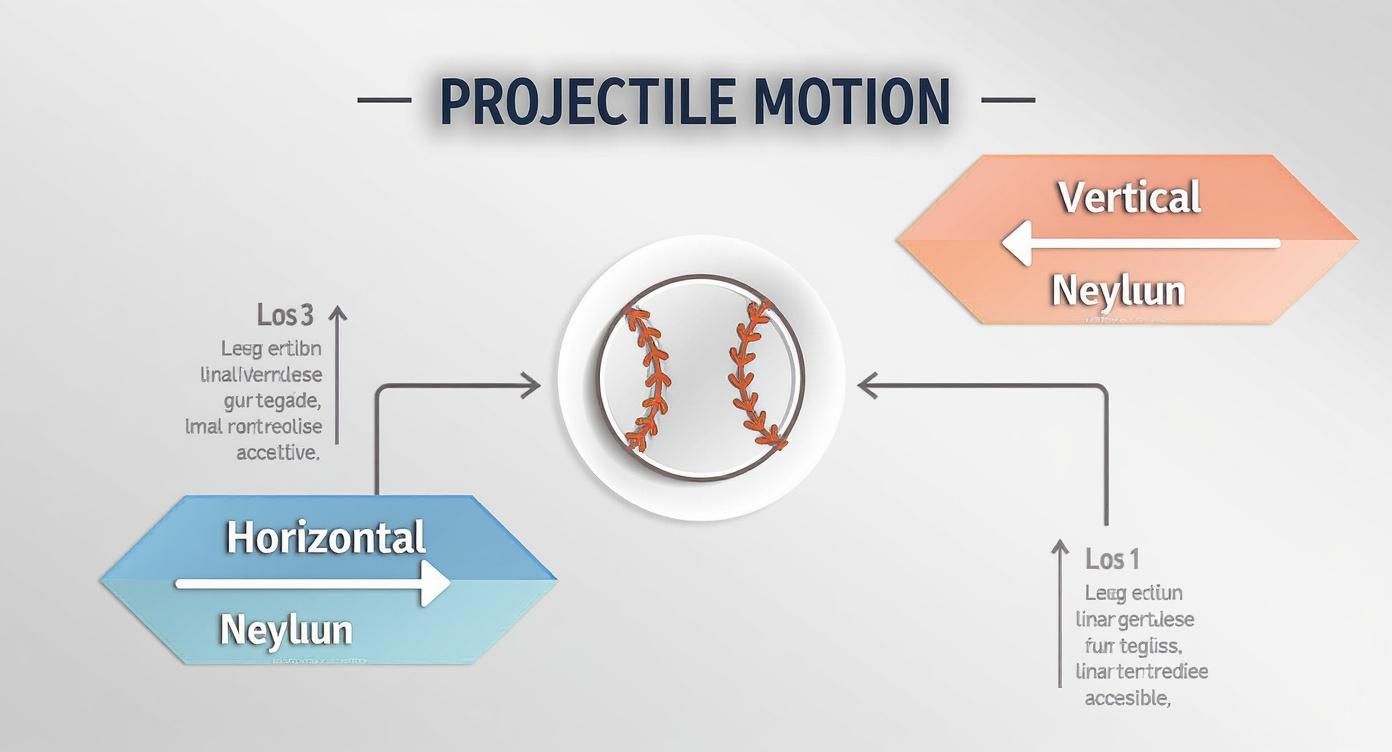
This split is the fundamental concept you need to master. Treat the horizontal and vertical parts as two separate worlds that just happen to share the same clock.
Mapping the Vertical Journey
The vertical velocity's trip is much more dramatic. We can break it into three key phases:
- The Climb: As the object flies upward, gravity works against it. The vertical velocity shrinks every second, losing about 9.8 m/s of speed for every second it's in the air.
- The Peak: For a split second at the very top of its arc (the apex), the object stops moving up. Its vertical velocity is zero. But don't forget, it's still moving forward with its constant horizontal velocity!
- The Fall: After hitting the apex, gravity takes over completely. The object accelerates downward, and its vertical velocity becomes negative (showing its new direction) and gets faster and faster until it hits the ground.
Here’s a cool bit of symmetry: if the object lands at the same height it was launched from, its final vertical velocity will be the exact opposite of what it started with. In our cannonball example, it would land with a vertical velocity of -50 m/s. This predictable pattern is a direct result of gravity's steady hand and is a lifesaver in solving problems.
The Kinematic Equations: Your Physics Toolkit for Flight
Now that we've split the projectile's journey into its horizontal and vertical parts, we can bring in the real workhorses of physics: the kinematic equations. These might seem like a bunch of abstract formulas at first, but think of them as the engine that powers our calculations. They’re what let us predict exactly where an object will be, how fast it will be going, and when it will get there.
These equations answer all the classic questions: How high did the cannonball fly? How long was the football in the air? How far did the golf ball travel? The trick is to apply the right equation to the right dimension—one for the horizontal path, and a few for the vertical one.
The Horizontal Equation: Simple and Straightforward
Let's start with the easy part: the horizontal motion. Since we're assuming there's no air resistance, there's nothing to slow the object down or speed it up horizontally. Its horizontal velocity is constant.
Because of this, we only need one simple formula to track its horizontal position.
- Horizontal Position (x) = v₀x * t
That's it! The horizontal distance it covers (x) is just its initial horizontal speed (v₀x) multiplied by how long it’s been flying (t). This simple, unchanging relationship makes the horizontal side of the problem a breeze.
The Vertical Equations: Taming Gravity
The vertical journey is a different story. It’s a constant battle with gravity, which pulls the object downward with a constant acceleration (g), which is -9.8 m/s². This acceleration means the vertical velocity is always changing, so we need a more powerful set of equations to handle it.
Here are the three essential kinematic equations for the vertical (y-axis) dimension:
- vᵧ = v₀y + aᵧt: This is your go-to for finding the vertical velocity (vᵧ) at any specific moment in time (t). It connects the initial vertical velocity (v₀y) with the acceleration due to gravity (aᵧ).
- y = v₀yt + ½aᵧt²: Need to know the object's height (y) at a certain time? This equation is the one. It calculates vertical displacement based on initial velocity, time, and acceleration.
- vᵧ² = v₀y² + 2aᵧy: This one is special because it relates velocity and displacement without needing to know the time. It’s perfect for situations where you know how high something went and want to find its speed, or the other way around.
Master these few equations, and you can map out a projectile's entire flight path. The secret is to keep the horizontal and vertical calculations separate, only bringing them together through their one shared variable: time (t).
Deriving Key Formulas From the Basics
You could just memorize formulas for things like maximum height or total flight time, but that's a fragile strategy. A much better approach is to understand how to build these formulas yourself from the basic kinematic equations. It solidifies your understanding and gives you the confidence to tackle any problem from the ground up.
Let's walk through how to derive three of the most useful values in projectile motion.
1. Finding the Time to Reach Maximum Height (t_peak)
Think about the very peak of a projectile's arc. For just a split second, as it transitions from moving up to moving down, its vertical velocity is zero (vᵧ = 0). This is a huge clue. We can plug this into our first kinematic equation to find out how long it took to get there.
- Start with the velocity equation: vᵧ = v₀y + aᵧt
- At the peak, vᵧ = 0 and aᵧ = -g: 0 = v₀y + (-g)t_peak
- Now, just solve for t_peak: t_peak = v₀y / g
This elegant little formula tells you the exact time the object spends climbing.
2. Calculating the Total Time of Flight (T)
For any projectile that lands at the same height it was launched from, the journey is perfectly symmetrical. The time it takes to go up is identical to the time it takes to come back down.
This makes finding the total flight time incredibly simple. It's just double the time it took to reach the peak!
- T = 2 * t_peak
- Substitute the formula we just found for t_peak: T = 2 * (v₀y / g)
And there you have it—the projectile’s total "hang time." For more complex problems, like launching something off a cliff, the path isn't symmetrical, and you'll often need to solve a quadratic equation. This is where skills from other areas of math become critical. If you feel rusty, reviewing how to solve calculus problems can build a stronger foundation for these advanced physics scenarios.
3. Determining the Horizontal Range (R)
The range is simply how far the projectile travels horizontally before it lands. We already know that horizontal motion is all about constant velocity, so we can go back to our simple horizontal equation.
- Start with the position equation: R = v₀x * T
- Now, substitute the formula we found for the total time (T): R = v₀x * (2 * v₀y / g)
This final formula is powerful because it ties everything together. It shows how both the initial horizontal and vertical velocities contribute to the final distance the object travels. By understanding where these formulas come from, you're no longer just plugging in numbers—you're thinking like a physicist.
Revealing the Parabolic Path of a Projectile
Have you ever noticed that a basketball shot, a stream of water from a hose, or a cannonball fired into the air all trace the same graceful, curved path? It's a shape we instinctively recognize. That arc isn't random—it's a perfect parabola, and physics gives us the tools to prove it.
This is where we get to the really cool part. We'll take our separate horizontal and vertical motion equations and stitch them together to create a single, elegant formula: the trajectory equation. This powerful equation will show us exactly how a projectile's vertical height (y) depends on its horizontal distance (x), mathematically unlocking the secret of its flight path.
Combining Two Worlds Through Time
So, how do we merge two independent motions? The secret ingredient is time (t). Even though the horizontal and vertical movements don't affect each other, they happen simultaneously. At any given moment, the projectile is at a specific x and y coordinate at the exact same instant in time.
Think of time as the bridge connecting these two separate worlds. By using it as a common link, we can combine our position equations and, quite cleverly, remove t from the final formula altogether.
Deriving the Trajectory Equation Step by Step
Let's start with the two kinematic equations we've been using for position:
- Horizontal Position:
x = v₀ₓ * t - Vertical Position:
y = v₀y * t + ½ * aᵧ * t²
Our mission is to eliminate the time variable, t. The most straightforward way to do that is to solve for t in the simpler horizontal equation.
Isolate Time: Rearranging the horizontal formula gives us
t = x / v₀ₓ. This little expression is incredibly useful—it tells us exactly how much time it takes to cover a horizontal distancex.Substitute Time: Now for the magic. We can plug this expression for
tdirectly into our vertical position equation, replacing everytwe find.y = v₀y * (x / v₀ₓ) + ½ * aᵧ * (x / v₀ₓ)²Simplify the Equation: This looks a bit messy, so let's clean it up. We know that
aᵧis simply-g(the acceleration from gravity), which pulls the object downward.y = (v₀y / v₀ₓ) * x - (g / (2 * v₀ₓ²)) * x²
And there you have it—the trajectory equation. It might seem intimidating at first, but its structure is what tells us the whole story.
The Mathematical Proof of a Parabola: In algebra, the standard form for a downward-opening parabola is
y = Ax - Bx². Our trajectory equation fits this structure perfectly, withA = (v₀y / v₀ₓ)andB = (g / (2 * v₀ₓ²)). This is the mathematical proof that a projectile's path is always a parabola, assuming our basic physics rules apply.
Why This Equation Matters
This isn't just a fancy math trick; the trajectory equation is incredibly practical. Because it connects vertical height (y) directly to horizontal distance (x) without needing to worry about time, it helps engineers, athletes, and designers solve real-world problems.
Ever wonder why a long-jumper or a shot-putter aims for an angle near 45 degrees? This equation explains it. At 45 degrees, the initial horizontal (v₀x) and vertical (v₀y) velocity components are perfectly balanced, optimizing the equation to give the maximum possible range (as long as the launch and landing heights are the same).
This single formula is the key to calculating the arc of a water fountain, designing a safe ski jump, or even programming realistic physics for a video game. It beautifully translates the invisible forces of physics into the visible paths we see all around us.
Putting Theory into Practice with Solved Problems
Knowing the equations is one thing, but the real magic happens when you use them to solve actual problems. This is where we connect the dots between the formulas on the page and what happens in the real world. Let's walk through a clear, step-by-step framework you can lean on for just about any projectile motion puzzle.
This process helps break down intimidating problems into smaller, more manageable pieces, which is a great way to build your confidence. And while projectile motion feels like a modern physics topic, people have been wrestling with these ideas for thousands of years. Early projectile tools, like slings used in ancient Mesopotamia, go back roughly 4,000 years.
What's fascinating is the 3,500-year gap between using projectiles and truly understanding their flight path mathematically. It just goes to show how critical the development of these mathematical methods really was.
Example 1: Firing a Cannon at an Angle
Let's picture a classic scenario: a cannon fires a ball with an initial velocity of 100 m/s at a 30° angle above the horizontal. Our mission is to figure out its maximum height, total flight time, and how far it travels horizontally (its range).
Step 1: What Do We Know and What Do We Need?
First, let's lay out our variables.
- Initial velocity (v₀) = 100 m/s
- Launch angle (θ) = 30°
- Acceleration due to gravity (g) = 9.8 m/s²
- Our goals: Find the maximum height (h), total time (T), and range (R).
Step 2: Deconstruct the Initial Velocity
The secret to solving these problems is to split that angled velocity into its horizontal (x) and vertical (y) components.
- v₀x = v₀ * cos(30°) = 100 * 0.866 = 86.6 m/s
- v₀y = v₀ * sin(30°) = 100 * 0.5 = 50 m/s
Step 3: Solve for Time to Peak and Total Time
Think about the cannonball's arc. Right at the very peak of its flight, its vertical velocity is momentarily zero. That's the key.
- Using vᵧ = v₀y - gt, we can plug in zero for vᵧ: 0 = 50 - 9.8t.
- Solving for t gives us the time it takes to reach the peak: t = 50 / 9.8 ≈ 5.1 seconds.
- Because the trajectory is symmetrical (what goes up must come down), the total time in the air is simply double this value: T = 2 * 5.1 = 10.2 seconds.
Step 4: Calculate Maximum Height and Range
Now that we have our time values, we can find the height and distance.
- Maximum Height (h): We'll use the vertical displacement formula with our time to peak (t = 5.1s).
h = (50)(5.1) - ½(9.8)(5.1)² ≈ 127.5 meters. - Range (R): For the horizontal distance, we just multiply the constant horizontal velocity by the total flight time.
R = (86.6)(10.2) ≈ 883.3 meters.
Example 2: Launching Horizontally from a Cliff
Let's switch things up. A stone is thrown perfectly horizontally at 15 m/s from the top of a 44-meter cliff. How long until it splashes into the water below, and how far from the cliff's base does it land?
Step 1: What Do We Know and What Do We Need?
- Initial horizontal velocity (v₀x) = 15 m/s
- Initial vertical velocity (v₀y) = 0 m/s (This is crucial for horizontal launches!)
- Vertical displacement (y) = -44 m (It's negative because the stone is moving downward.)
- Our goals: Find the time (t) and the horizontal distance (x).
A common mistake here is mixing up the horizontal and vertical information. Always remember: the time it takes for the stone to fall vertically is the exact same amount of time it has to travel horizontally.
Step 2: Solve for Time of Flight
The vertical journey is independent of the horizontal one. We can find the time it takes to fall 44 meters.
- y = v₀yt - ½gt²
- -44 = (0)t - ½(9.8)t²
- -44 = -4.9t²
- Solving for t: t² = 44 / 4.9 ≈ 8.98, which gives us t ≈ 3.0 seconds.
Step 3: Calculate the Horizontal Distance
This is the easy part. Now that we know the flight time, we just plug it into our horizontal distance formula.
- x = v₀x * t
- x = (15 m/s) * (3.0 s) = 45 meters.
So, the stone lands 45 meters away from the base of the cliff.
Seeing these principles in action can make all the difference. For students who want to get their hands dirty, checking out some winning physics projects for a science fair is a fantastic way to solidify these concepts. And if you ever get stuck on a more complex problem, our AI physics solver can provide step-by-step guidance to help you work through it.
Projectile Motion in Sports and Technology

The physics of projectile motion isn't just for exams—it’s the invisible force behind so much of what we see and do. Once you understand the basics, you'll start seeing these elegant arcs everywhere, from a simple game of catch to the cutting edge of digital entertainment.
Think about a basketball player sinking a perfect three-pointer. They aren't consciously plugging numbers into an equation, but their brain is doing the work. It’s an intuitive calculation of the exact initial velocity and launch angle needed to send the ball on its perfect parabolic path straight through the net. The same thing happens when a quarterback launches a Hail Mary pass or a golfer chips a ball onto the green.
More Than Just a Game
While sports provide some of the most obvious examples, the principles of projectile motion are the bedrock for some serious technology and engineering. This is where the textbook concepts really come to life and shape the world around us.
Ballistics and Aerospace: In these fields, precision is everything. Engineers rely on projectile motion equations to plot the trajectory of everything from artillery shells to the critical launch phase of a rocket blasting a satellite into orbit.
Engineering and Design: Ever admired the choreographed arcs of a decorative water fountain? That's pure projectile physics. Engineers meticulously set the water's speed and angle to create those beautiful, predictable patterns.
Entertainment and Simulation: The virtual worlds in video games feel so immersive because their physics engines are built on these exact principles. When your character leaps across a chasm or you toss an object, its movement is governed by the same equations you solve in physics class.
Understanding what is projectile motion in physics means seeing the world with new eyes. It’s about recognizing the hidden parabola in a thrown paper airplane, a diver's graceful leap, or the soaring flight of a soccer ball.
This bridge between theory and practice is what makes physics so powerful. For example, game developers have to master these concepts, and you can even learn how to add physics to Unity VR worlds to build your own realistic simulations.
Ultimately, every jump, throw, and launch—whether in the real world or a virtual one—is a perfect illustration of these fundamental laws of motion in action.
Common Questions About Projectile Motion
As you start wrestling with projectile motion problems, you'll find that a few questions tend to pop up again and again. Getting these sorted out is key to really mastering the topic and avoiding those easy-to-make mistakes on exams. Let's break down some of the most common sticking points.
How Important Is Air Resistance in the Real World?
In pretty much every textbook problem, we pretend air resistance doesn't exist. This isn't because physicists are lazy; it's to simplify the math so we can focus purely on how gravity works. For something dense and slow-moving, like a bowling ball dropped from a few feet, this assumption is actually pretty good.
But out here in the real world? Air resistance (or drag) changes everything. It’s a force that constantly pushes back against the object's movement, slowing it down. Because of drag, a real projectile never follows a perfect parabola. Its actual range and maximum height will always be less than our simplified equations predict. For something light, like a feather, or something moving really fast, like a golf ball, ignoring air resistance gives you a completely wrong answer.
What Changes if a Projectile Is Launched from a Cliff?
Launching something from an elevated position, like a cliff, adds a new wrinkle: the starting height and landing height are different. All the kinematic equations we use still work perfectly, but you have to be careful to plug in the correct initial height.
The real shortcut here, especially for objects launched horizontally, is remembering that the initial vertical velocity (v₀y) is zero. The object isn't moving up or down at the exact moment it leaves the cliff. This little detail makes the vertical motion calculations much simpler.
Naturally, starting from a higher point usually means the object will be in the air longer, which also means it will travel farther horizontally than if it were launched from the ground.
Why Does a 45-Degree Angle Give the Longest Range?
This is a classic. A 45-degree launch angle gives you the maximum possible range because it strikes the perfect balance between the two things that determine how far an object travels: its forward speed and how long it stays in the air.
- Shallow Angles (< 45°): You get a lot of horizontal speed, but the object hits the ground too quickly. Not enough "hang time."
- Steep Angles (> 45°): You get plenty of hang time, but you sacrifice so much horizontal speed that the object doesn't move very far forward.
Right at 45 degrees, you get the best combination of both worlds. Just remember, this neat little rule only works when the launch and landing heights are the same and, you guessed it, we're ignoring air resistance.
Feeling stuck on a tough physics problem or need a concept clarified? Feen AI is your AI-powered study companion. Just upload a photo of your assignment or type in a question to get step-by-step solutions and clear explanations for Physics, Calculus, Chemistry, and more. Get instant help at https://feen.ai.
Relevant articles

What is the difference between speed and velocity? what is the difference between speed and velocity explained in plain terms with helpful examples.

Explore change in momentum, including impulse and the core formula, with clear explanations and practical examples to sharpen problem solving.

Examples of inertia explained through everyday situations and simple physics demos that illustrate Newton's First Law and practical takeaways for students.