How to Understand Calculus A Beginner's Guide
Struggling with how to understand calculus? This guide demystifies limits, derivatives, and integrals with simple analogies and a step-by-step plan.

To really understand calculus, you have to stop seeing it as a long list of formulas and start seeing it as the language of change. It’s all about describing motion, growth, and how things shift from one moment to the next. Getting a handle on it means tying together three big ideas: limits (what happens as you get infinitely close to a value), derivatives (the rate of change at a single instant), and integrals (how things add up over time).
Why Calculus Is Your Secret Superpower

Let’s be real for a second: calculus has a pretty scary reputation. A lot of students think of it as this impossible mountain to climb, the final boss of high school math that only a few geniuses can beat. But what if you looked at it differently? What if calculus wasn't a roadblock but a superpower that lets you see the hidden mechanics of the world?
At its heart, calculus is simply the math of things that don't stand still. It gives us a way to analyze movement, growth, and any dynamic system with pinpoint accuracy. This isn't just some abstract theory for a textbook; it's the engine humming quietly behind so much of modern life.
The Real-World Impact of Calculus
Think about the technology you interact with every single day. That GPS on your phone? It's using calculus to figure out your exact location by calculating the rates of change between you and the satellites orbiting Earth. The stunning graphics in your favorite video games? They depend on derivatives to render realistic light and shadow on curved surfaces. Even the recommendation algorithms that suggest your next binge-watch are built on optimization principles that come straight from calculus.
It’s not just about tech, either. Calculus is the bedrock of tons of high-impact careers. It’s absolutely essential for:
- Engineers who are designing everything from bridges that can handle shifting loads to rockets that need to achieve escape velocity.
- Data Scientists building machine learning models that predict stock market trends or identify diseases from medical scans.
- Medical Professionals who need to understand how drug concentrations in the bloodstream change over time to get the dosage just right.
- Economists modeling complex supply and demand curves to forecast market behavior.
Calculus gives us the framework to not just see change, but to measure it, predict it, and control it. It turns messy, dynamic problems into solvable equations, making it one of the most powerful tools for analysis ever invented.
Addressing the Modern Math Challenge
Getting a solid grasp on these ideas is more important now than ever, especially when you look at the numbers. In 1990, the gap in national math scores between the top and bottom eighth graders was 92 points. By 2022, that gap had ballooned to 109 points. That’s an 18% increase, making it even tougher for today's students to build the foundation needed for calculus.
The result? A shocking 16% of US high school graduates had completed calculus in 2019. These aren't just abstract stats; they represent a real hurdle keeping talented people out of careers in AI, data science, and medicine. If you want to dive deeper, a comprehensive report by CRPE breaks down these trends.
Our mission here is to help you break that cycle. We’re going to show you that calculus is less about memorizing rules and more about building an intuition for how things change. With the right mindset and approach, you can build that solid conceptual foundation and start seeing calculus for what it is: a key that unlocks a world of opportunity.
Building Your Calculus Foundation with Essential Skills
Trying to learn calculus without a solid grip on the math that comes before it is like trying to build a skyscraper on a foundation of sand. It just won't work. Before you even think about limits or derivatives, you need to be absolutely certain your groundwork is solid.
Success in calculus isn't some secret reserved for geniuses. It’s about having the right tools in your toolkit, and those tools are sharpened in algebra, trigonometry, and geometry.
Think of it this way: algebra is the language of calculus. It’s the grammar you'll use to manipulate equations, break down complicated expressions, and actually solve the problems. If you're not fluent in algebra, every single calculus problem becomes a double battle—you're fighting to understand the new concept while simultaneously struggling with the old mechanics.
Mastering Your Algebraic Toolset
If there's one thing you need to own from algebra, it's functions. Seriously. Functions are the absolute heart of everything we're going to study. You need to be completely at ease with:
- Understanding Domain and Range: Knowing what numbers can go into a function and what can come out is fundamental for figuring out limits.
- Function Notation: You're going to see expressions like
f(x+h)everywhere, especially when we start defining derivatives. Getting comfortable with this notation isn't optional. - Graphing Functions: Being able to picture what polynomials, rational functions, and radicals look like gives you a powerful, intuitive feel for how they behave.
Beyond functions, your ability to factor polynomials, solve equations, and simplify those messy-looking complex fractions will be put to the test every single day. These aren't just abstract drills; they're the real-world steps you'll take to chop down big calculus problems into small, solvable pieces.
A great place to start is by sharpening how you study. Our guide on https://feen.ai/blog/how-to-study-math-effectively has a ton of strategies to help lock in these foundational skills.
Why Trigonometry and Geometry Are Crucial
While algebra gives you the language, trigonometry and geometry provide the visual and real-world context. Trigonometry, in particular, is everywhere in calculus. The relationships between angles and sides in triangles are exactly what we need to analyze anything that moves in waves, like sound or alternating current.
You must know the unit circle like the back of your hand. Being able to instantly recall sine, cosine, and tangent values for key angles will save you an incredible amount of time and keep you from making simple mistakes on complex problems.
Geometry gives you the spatial reasoning to wrap your head around concepts like area and volume, which are the main event when we get to integration. A deep understanding of the properties of shapes and the slopes of lines translates directly into understanding derivatives and tangent lines.
It’s not just about math skills, either. The mental horsepower required for calculus is significant. Learning more about understanding your executive functions can make a huge difference in your focus and planning.
Prerequisite Skills and Their Role in Calculus
To make this connection totally clear, let’s map these prerequisite skills directly to the calculus concepts they fuel. This table helps you see why each piece matters. If you spot a weak area now, you can fix it before it becomes a real roadblock.
| Prerequisite Skill | Why It's Essential for Calculus | Calculus Concept It Supports |
|---|---|---|
| Algebraic Manipulation | You'll need to simplify complex fractions and expressions to evaluate limits and find derivatives from their definitions. | Limits & Derivatives |
| Understanding Functions | Calculus is the study of how functions change. Deep knowledge of function behavior is the absolute bedrock. | All Core Concepts |
| The Unit Circle | Many derivative and integral problems involve trigonometric functions. Quick recall of values is essential for efficiency. | Derivatives & Integrals |
| Geometric Formulas | Calculating areas and volumes of basic shapes is the foundation for understanding how integrals find areas under curves. | Integrals & Applications |
Taking the time to go back and strengthen these areas isn't a detour—it's the fastest path to actually succeeding. A solid foundation changes calculus from a scary, intimidating subject into a fascinating extension of the math you already know.
Mastering the Three Pillars of Calculus
Calculus can look like a mountain of complex formulas, but it really just boils down to three big ideas. Once you get a solid feel for these core pillars, the rest of the subject starts to fall into place. The key is to stop thinking of them as separate topics to memorize and start seeing them as interconnected tools for describing a world in motion.
Forget the dry, textbook definitions for a moment. We're going to use simple analogies and real-world situations to build your intuition. Truly learning how to understand calculus is less about memorizing formulas and more about connecting these ideas to things you can actually visualize.
But before we dive in, remember that this journey starts with a solid footing in algebra and trigonometry. They are the launchpad for everything that comes next.
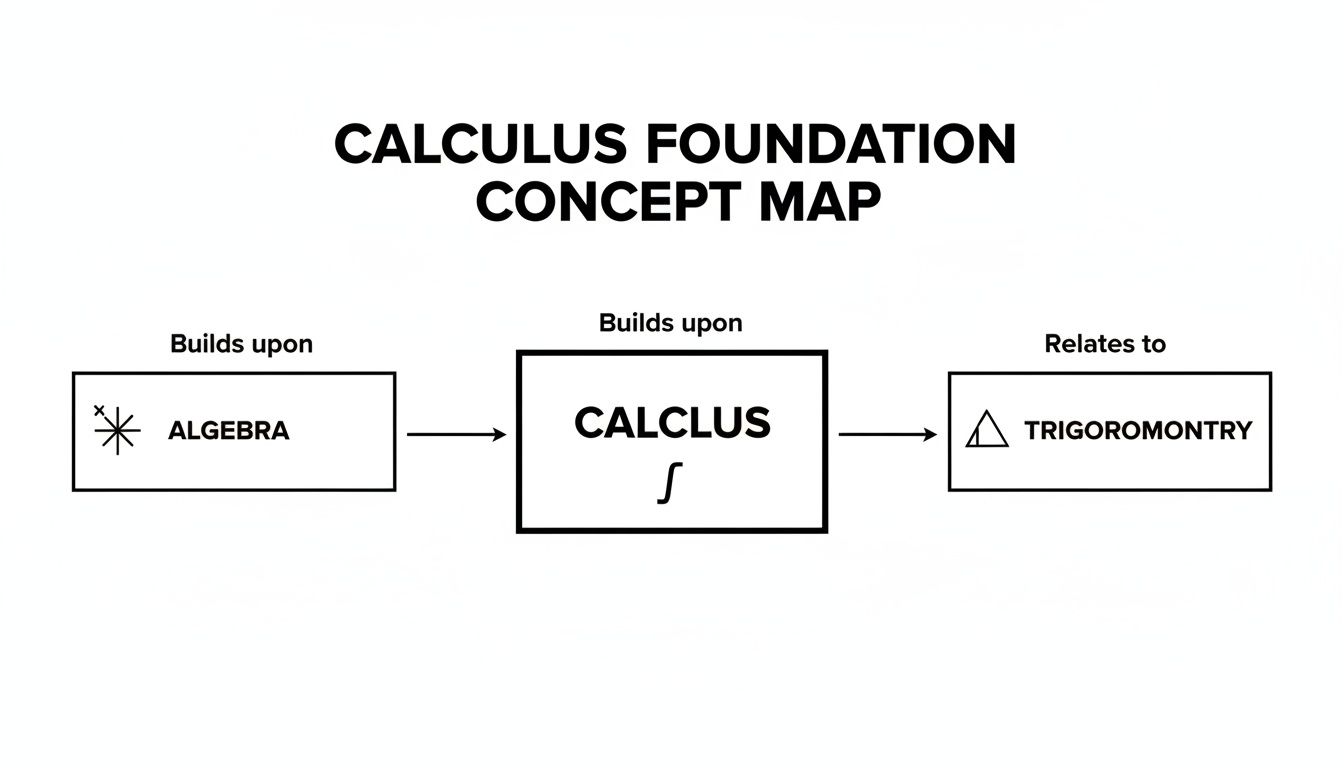
As you can see, a strong grasp of algebra and trig isn't just helpful—it's essential for getting calculus to click.
Pillar 1: The Limit
The concept of a limit is where calculus truly begins. It’s a surprisingly simple but powerful idea that asks a fundamental question: what value does something approach as you get closer and closer to a certain point? Notice the wording—it’s not about what happens at the point, but in the moments leading right up to it.
Imagine standing 10 feet from a wall. Now, walk half the distance to it. You’re 5 feet away. Do it again. You’re now 2.5 feet away. Keep repeating this process—walking half the remaining distance—and you’ll get closer and closer.
- Each step you take shrinks the distance.
- Logically, you will never actually touch the wall by following this rule.
- But we can say with total confidence that the "limit" of your position is the wall itself.
That's a limit in a nutshell. It’s the value that a process is zeroing in on, even if it never technically arrives. This concept is the bedrock of calculus because it lets us analyze what’s happening at infinitely small intervals, which unlocks the next two pillars.
Pillar 2: The Derivative
Next up is the derivative, which is just a fancy term for an instantaneous rate of change. Back in algebra, you learned how to find the slope of a straight line—that’s an average rate of change. Derivatives take this a huge step further by letting us find the slope at a single, precise point on a curvy line.
Think about driving. If you cover 60 miles in one hour, your average speed is 60 mph. Easy enough. But what was your speed at the exact instant you glanced at the speedometer? That’s what a derivative tells you.
Your car’s speedometer isn't calculating an average over your whole trip; it’s measuring your instantaneous speed. It answers the question, "How fast am I going right now?" A derivative does the same thing for any function. It’s a tool for finding the rate of change at one specific moment in time.
This has some incredible applications. With derivatives, we can figure out:
- The exact moment a rocket hits its maximum altitude.
- The rate a company’s profit is growing on one particular day.
- The precise velocity of a falling object an instant before impact.
Pillar 3: The Integral
The third pillar, the integral, is essentially the opposite of the derivative. If derivatives are about breaking things down to find a rate of change, integrals are about building things up to find a total amount. Most commonly, you'll see integration used to find the area under a curve.
Imagine you're trying to find the area of a field. If it's a perfect rectangle, you just multiply length by width. But what if one side of the field is a winding riverbank? Your simple formula won't work anymore.
This is where integrals save the day. The idea is to slice that irregularly shaped field into an infinite number of super-thin rectangles. Each rectangle is so narrow that its top edge is basically a flat line, making its area simple to calculate.
An integral is the tool that adds up the areas of all those microscopic rectangles to give you the total area of the whole shape. It’s a brilliant way to sum up an infinite number of tiny pieces to find the whole.
Key Takeaway:
- Derivatives: Break a curve down to find its slope at a single point.
- Integrals: Build a curve up from infinite slices to find the total area underneath.
This idea of accumulation goes way beyond geometry. Integrals can calculate the total distance a car travels based on its changing speed or find the total volume of an oddly shaped container.
The Fundamental Theorem of Calculus
So, we have derivatives for breaking things down and integrals for building them up. For a long time, these were considered two separate fields of study. The massive breakthrough came with the Fundamental Theorem of Calculus, which proved that differentiation and integration are simply inverse operations.
They undo each other, just like multiplication undoes division.
This is the linchpin that connects all of calculus. It means that if you know how fast something is changing (its derivative), you can work backward to find the total amount you’ve accumulated (its integral). This profound link is what makes calculus such an incredibly powerful and efficient tool for solving problems.
Focusing on these three pillars—and the theorem that ties them all together—is the most important step you can take. When you approach calculus with these core concepts and relatable analogies, it transforms from a jumble of rules into a cohesive and intuitive way of thinking.
Putting Calculus into Practice with Real Examples
Theory is essential, but the real "aha!" moment in calculus comes when you see it solve an actual problem. This is where abstract ideas click into place and become real tools. It's one thing to hear that a derivative finds an instantaneous rate of change; it's another thing entirely to use it to find the exact speed of a falling object a split-second before impact.
These examples are more than just plugging numbers into a formula. They’re designed to help you build a problem-solving intuition. For each one, we'll walk through a simple but powerful process: figure out the goal, pick the right calculus tool for the job, apply the steps, and—most importantly—understand what the answer actually means. This is how you start to think like a mathematician.
Example 1: Using a Derivative to Find Instantaneous Velocity
Let's say a ball is dropped from a tall building. We can describe its height in meters after t seconds with the position function h(t) = 100 - 4.9t². The question is: what is the ball's exact velocity the moment it has been falling for 3 seconds?
We're not looking for the average speed over those three seconds. We want the speed on the speedometer at the precise t = 3 mark. This is a classic job for the derivative.
Step 1: Understand the Goal
We need the instantaneous velocity at t = 3. Since velocity is just the rate of change of position, our first move is to find the derivative of the position function, h(t). This derivative, h'(t), will give us a new function for the velocity.
Step 2: Apply the Right Tool (Find the Derivative)
Using the power rule on h(t) = 100 - 4.9t² is the way to go.
- The derivative of a constant like
100is simply0. - For the
-4.9t²part, we bring the exponent2down to multiply and then reduce the exponent by one:2 * (-4.9) * t^(2-1) = -9.8t.
Putting it together, our velocity function is v(t) = h'(t) = -9.8t. This handy little function can tell us the velocity at any time t.
Step 3: Solve for the Specific Point
Now we just pop t = 3 into our new velocity function:v(3) = -9.8 * 3 = -29.4
Step 4: Interpret the Result
At the exact 3-second mark, the ball is traveling at -29.4 meters per second. Why the negative sign? It's crucial—it tells us the direction is downward, which makes perfect sense for a falling object. We just used a derivative to pinpoint a rate of change at a single instant.
Example 2: Using an Integral to Find Total Area
Now for something different. Imagine a simple curve given by the function f(x) = x². Our mission is to find the exact area of the space underneath this curve, bordered by the x-axis, from x = 0 to x = 2.
This isn't a neat rectangle or triangle, so high school geometry won't cut it. That curved boundary is the problem. This is the perfect scenario for a definite integral, which is a master at summing up an infinite number of tiny slices to find a total.
Step 1: Understand the Goal
We need to calculate the area under f(x) = x² between x = 0 and x = 2. In calculus language, this is written as the definite integral: ∫ from 0 to 2 of x² dx.
Step 2: Apply the Right Tool (Find the Antiderivative)
The Fundamental Theorem of Calculus tells us the first step is to find the antiderivative of x². To do this, we just use the power rule in reverse: add one to the exponent, then divide by that new exponent.
The antiderivative of x² is (x³)/3.
Quick Tip: When you're finding the area with a definite integral, you can forget about adding the "+ C" (the constant of integration). It just cancels out in the next step anyway, so it's a nice little shortcut.
Step 3: Evaluate at the Boundaries
Next, we plug our upper boundary (x = 2) into the antiderivative and subtract what we get when we plug in the lower boundary (x = 0).
- At
x = 2:(2³)/3 = 8/3 - At
x = 0:(0³)/3 = 0
So, the total area is8/3 - 0 = 8/3.
Step 4: Interpret the Result
The total area under the curve y = x² from x = 0 to x = 2 is exactly 8/3 (about 2.67) square units. We used an integral to perfectly measure an awkwardly shaped space—something impossible without calculus.
This process of breaking problems down is the key to success. For more tips on approaching different problems, check out our guide on how to solve calculus problems.
Using Tools to Guide Your Learning
As you get into more complex problems, using a tool to check your work can be a lifesaver. An AI-powered helper can break down a problem just like we did, showing you the "why" behind each step.
This screenshot shows how a tool like Feen AI can walk you through a calculus problem from start to finish.
This kind of guided approach makes sure you don't just get the right answer, but you actually understand the logic behind it, which is what really makes the concepts stick.
Navigating Common Calculus Pitfalls
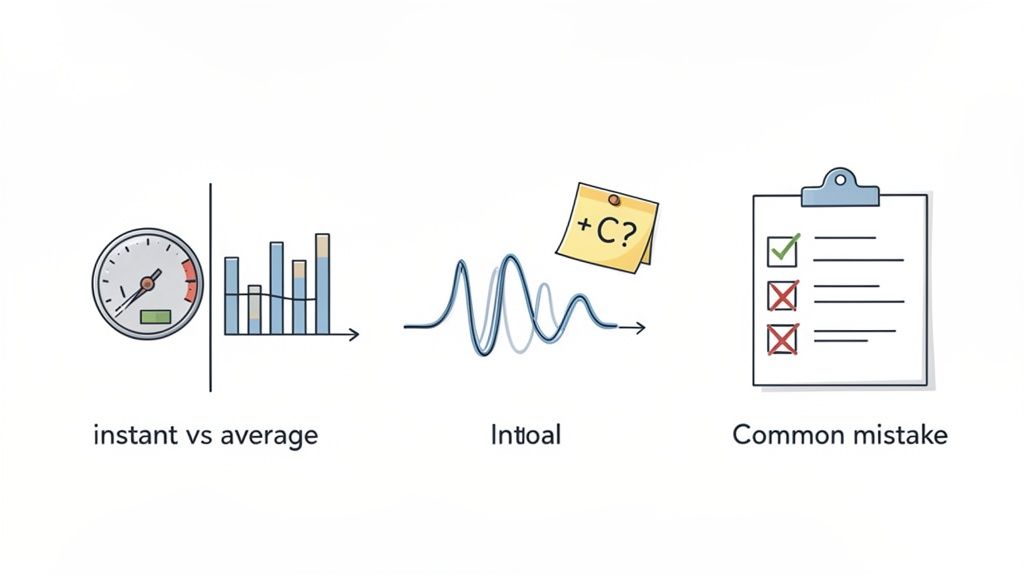
Let's be honest, everyone hits a few roadblocks when learning calculus. It's just part of the journey. Instead of getting frustrated, let's treat these common mistakes as opportunities to really lock in the core ideas.
This is where we'll unpack the most frequent trip-ups, get to the "why" behind them, and give you some simple ways to think so you can avoid them next time. Think of it as getting a heads-up on the tricky parts of the trail so you can navigate them like a pro.
The Infamous Forgotten "+ C"
Ah, the classic mistake. Forgetting the constant of integration, that little "+ C," is probably responsible for more lost points on calculus tests than anything else. It seems so small, but it represents a massive concept.
Think about it this way: when you find the derivative of x² + 5, you get 2x. If you find the derivative of x² - 100, you also get 2x. The derivative of any constant is zero, so that information just disappears during differentiation.
Integration reverses that process. So, when you integrate 2x, how can you possibly know which constant was there to begin with? You can't! That's what the "+ C" is for. It's our honest admission that we don't know the exact starting value, so we account for all possibilities. It represents an entire family of functions, each one a vertical shift of the others, that all share the same derivative.
Visualize it this way: The derivative tells you the slope of the curve at every point, but the "+ C" tells you the curve's starting altitude. Forgetting it is like giving someone directions without mentioning the starting address.
Mixing Up Average vs Instantaneous Rates
Another huge hurdle is getting the average rate of change and the instantaneous rate of change mixed up. They sound related, and they are, but they measure fundamentally different things.
- Average Rate of Change: This is the slope you learned in algebra. It measures the change over a distance, between two separate points. Think of calculating your average speed for an entire 3-hour road trip.
- Instantaneous Rate of Change: This is what the derivative gives you. It's the rate of change at a single, specific moment. It’s your speed the exact instant you glance down at your speedometer.
If this feels confusing, you're not alone. The rapid pace of a single-year calculus course can make it tough to build a deep, intuitive feel for these ideas. Interestingly, in countries like Singapore and Japan, calculus topics are often introduced gradually over several years, giving students more time to absorb them.
Access also plays a role. In the U.S., one study revealed that 38% of students from top socioeconomic backgrounds took calculus in high school, compared to just 7% from the bottom quartile. You can explore more about these global teaching differences and how they impact learning outcomes.
Calculus often introduces concepts that sound alike but mean very different things. Here’s a quick table to help you keep some of the most commonly confused ideas straight.
Confusing Concepts in Calculus Clarified
A side-by-side comparison of common points of confusion in calculus to help you distinguish between similar-sounding ideas.
| Concept 1 | Concept 2 | Key Difference Explained |
|---|---|---|
| Derivative | Integral | The derivative finds the rate of change (slope). The integral finds the accumulation of change (area). They are inverse operations. |
| Indefinite Integral | Definite Integral | An indefinite integral gives you a function (e.g., x² + C). A definite integral gives you a number representing the area between two specific points. |
| Limit | Value of a Function | The limit is what the function approaches as x gets close to a number. The value is what the function actually is at that number. They can be different! |
| Continuity | Differentiability | A function is continuous if you can draw it without lifting your pencil. It's differentiable if it's continuous and has no sharp corners or vertical tangents. |
Keeping these distinctions in mind will help clear up a lot of the fog as you tackle more complex problems.
Common Algebraic and Trigonometric Errors
Very often, the "calculus" mistake you think you made wasn't a calculus mistake at all. It was a slip-up in the foundational algebra or trigonometry that calculus is built on. If those building blocks are shaky, the whole structure will wobble.
You'd be surprised how often mistakes boil down to these basics:
- Improperly simplifying fractions before you even start to evaluate a limit.
- Incorrectly applying exponent rules while using the power rule for derivatives.
- Forgetting a key trigonometric identity that would have made a tough integral much simpler.
The solution isn't glamorous, but it's effective: show every single step of your work. When you rush through the algebra to get to the "calculus part," you're setting a trap for yourself. Be slow, be methodical, and double-check your work. Taking a moment to review those prerequisite skills is one of the best ways to instantly improve your calculus grades.
Your Questions About Learning Calculus Answered
It's natural to have a few questions swirling around as you get started with calculus. Let's clear up some of the most common ones students ask, so you can feel more confident diving in.
How Much Time Should I Spend Studying?
There's no single magic number that works for everyone, but a solid rule of thumb is to spend 1-2 hours studying for every hour you spend in class.
So, if you have three hours of calculus lectures each week, you should block out anywhere from three to six hours of study time. The key here is consistency. A short, focused study session every day will do more for your long-term understanding than one massive cram session before a test. Think of it like building a muscle—a little bit of work each day builds real strength.
Can Online Resources Replace a Teacher?
Online tools are incredibly helpful, but they really can't replace the personalized guidance you get from a great teacher or tutor. A human teacher can catch your specific mistakes, answer your questions on the spot, and explain things in a way that clicks for you.
That said, the smartest approach is to use both. Lean on your teacher for the core lessons and feedback. Then, use online resources as your backup. For example, a good AI to help with homework can be a lifesaver when you're stuck on a problem late at night and need a step-by-step breakdown.
The best approach is a hybrid one. Use your instructor for core concepts and personalized feedback, and leverage online tools for practice, reinforcement, and immediate help when you need it most.
Is Taking Calculus in High School Necessary for College?
This is a big one. The short answer is, it depends on your goals. While under 5% of colleges flat-out require calculus for admission, the story doesn't end there.
A recent survey showed that 89% of college admissions officers see high school calculus as a strong sign that a student is ready for college-level work. Nearly half also noted that skipping it could limit your options for certain majors, especially in science, tech, engineering, and math (STEM).
The tricky part is that access isn't equal for everyone. Only about 35% of high schools with a majority of Black and Latinx students even offer calculus. To help bridge this gap, new courses like AP Precalculus are being introduced to give more students a pathway to higher-level math. For a deeper dive, you can find reports online that break down all the statistics on how calculus affects college readiness.
Feeling overwhelmed? Let Feen AI be your study partner. Get instant, step-by-step explanations for tough calculus problems, summarize dense textbook chapters, and ask unlimited questions to build your confidence. Get started for free at https://feen.ai.
Relevant articles

Struggling with statistics? Learn how to solve probability problems using core concepts, proven techniques, and real-world examples in this practical guide.

Discover the best way to learn calculus with a proven, modern approach. Master core concepts, practice smarter, and use AI tools to conquer calculus for good.

Master how to solve trigonometric identities with clear steps, practical examples, and proven formulas to avoid common pitfalls.