The Best Way to Learn Calculus A Modern Mastery Guide
Discover the best way to learn calculus with a proven, modern approach. Master core concepts, practice smarter, and use AI tools to conquer calculus for good.

The best way to learn calculus isn't about being a "math genius." It's about having a smart plan that combines a rock-solid foundation, a true grasp of the core ideas, focused practice, and the right tools for the job. This approach turns an intimidating subject into a clear, step-by-step journey.
Your Blueprint for Calculus Success
Learning calculus can feel like trying to climb a sheer cliff face without any gear. A lot of guides just throw abstract advice or endless problem sets at you, which often leaves you more confused than when you started.
The reality is, succeeding in calculus isn't about brute force or grinding through busywork. It’s about having a modern, actionable strategy. This guide lays out a framework built on four pillars, designed for efficiency and genuine understanding—not just memorization.
Forget the myth that you're either a "math person" or you're not. That idea holds way too many people back. Instead, think of learning calculus like building a house. You need a solid foundation before you can put up the walls and the roof.
Here are the four pillars of that construction project:
- Pillar 1: Foundation First. We’ll start by making sure you've truly mastered the essential prerequisites. Every calculus problem is built on a bedrock of algebra and trigonometry.
- Pillar 2: Conceptual Intuition. Next, you'll follow a logical roadmap through limits, derivatives, and integrals. The focus here is on understanding the why behind the formulas, not just how to plug in numbers.
- Pillar 3: Deliberate Practice. You'll learn how to practice smarter, not just harder. This means targeting your specific weaknesses instead of wasting hours on concepts you've already got down.
- Pillar 4: AI-Powered Tools. Finally, you'll see how to use intelligent tools like Feen AI to get instant help, break down confusing topics, and stay on track when you get stuck.
This flowchart gives you a bird's-eye view of the entire process, showing how each step builds on the last.
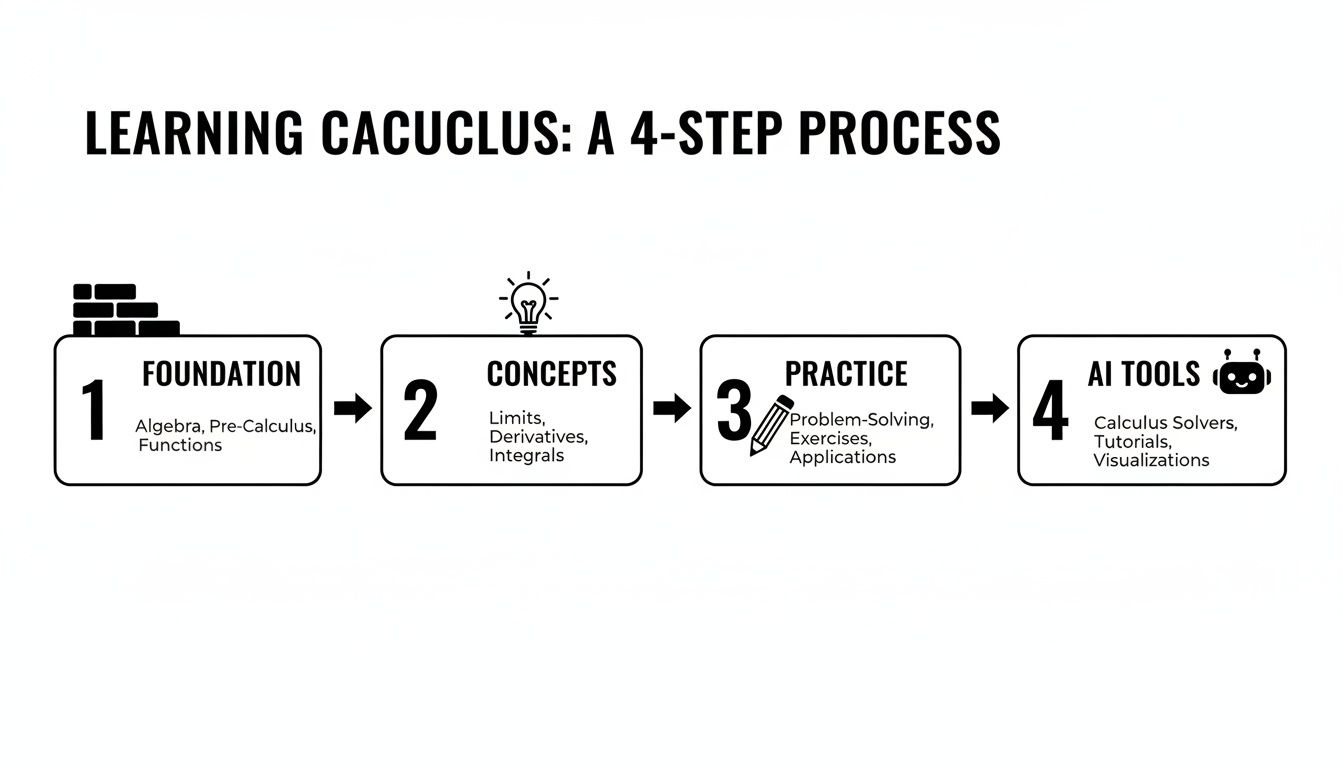
Each stage logically connects to the next, creating a structured and reliable path forward.
This entire method is designed to transform the overwhelming mountain of calculus into a series of smaller, more manageable hills. It gives you a clear plan from day one, helping you build both confidence and competence with every step you take.
Let's start building your blueprint.
The Four Pillars of Effective Calculus Learning
Here's a quick summary of the core strategies we'll be diving into throughout this guide. Think of this as your high-level game plan for conquering calculus efficiently.
| Pillar | Key Focus | Why It Matters |
|---|---|---|
| Foundation First | Mastering algebra and trigonometry. | Without a strong foundation, every calculus problem becomes a struggle. It's the language calculus is written in. |
| Conceptual Intuition | Understanding the why behind the formulas. | Memorization fails under pressure. True understanding lets you solve problems you've never seen before. |
| Deliberate Practice | Targeting weak areas and varied problem types. | Mindless repetition is a waste of time. Focused practice builds skill and confidence where you need it most. |
| AI-Powered Tools | Using AI for instant feedback and clarification. | Modern tools provide a 24/7 tutor, helping you get unstuck fast and reinforcing concepts on your own schedule. |
By internalizing these four pillars, you're not just learning calculus—you're learning how to learn it effectively.
Build an Unshakable Foundation in Prerequisites
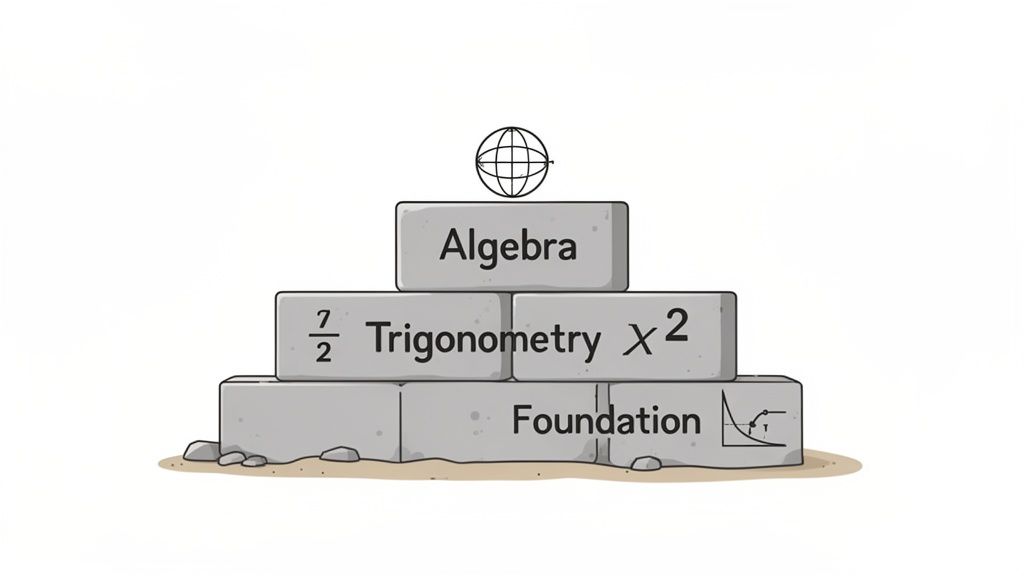
Trying to learn calculus without a solid grasp of algebra and trigonometry is like trying to build a house on a foundation of sand. It's a frustrating, and ultimately futile, effort.
So many students think they're struggling with a calculus concept when the real problem is a shaky prerequisite skill they haven't quite mastered. This is, without a doubt, the single most common mistake I see.
Every new idea in calculus—from finding a limit to calculating a complex integral—assumes you have instant and effortless recall of the math that came before it. If you're spending mental energy trying to remember how to factor a polynomial or recall a trig identity, you'll have less brainpower left to understand the new, more complex calculus concept right in front of you.
Your Prerequisite Self-Assessment Checklist
Before you even think about limits, it's time for an honest look at your skills. Can you confidently say "yes" to these questions? This isn't about judgment; it's about spotting weak spots so you can reinforce them and build a truly strong base.
- Algebraic Manipulation: Can you simplify complex fractions, factor any polynomial, and work with rational expressions and exponents without hesitating?
- Functions: Are you completely comfortable with function notation, compositions like f(g(x)), transformations (shifting and stretching graphs), and finding inverses?
- Trigonometry: Do you know the unit circle by heart? Can you instantly recall the values for sine, cosine, and tangent for key angles and picture their graphs?
- Logarithms and Exponentials: Are the rules of logs and exponents second nature to you?
If you paused on any of these, that’s your starting line. Focusing on these specific areas is the single most effective thing you can do to prepare for calculus.
A common misconception is that you can just "re-learn" algebra on the fly while studying calculus. In practice, this splits your focus and makes both tasks harder. Master the tools before you start building.
How to Shore Up Your Foundation
Pinpointing a weakness is step one; fixing it is step two. To truly succeed in calculus, that unshakable foundation is non-negotiable. Start by exploring resources like free online maths courses to get your skills up to speed.
Don't just redo old homework. Instead, focus on deliberate practice. If simplifying fractions is a weak point, find a worksheet dedicated only to that skill and work through it until the process becomes automatic.
This proactive approach of plugging foundational gaps has a huge impact. One study found that calculus students with weaker precalculus skills who took part in a program with integrated review had an 85% higher odds of passing the course than their peers in traditional settings. Actively fixing these gaps isn't just helpful—it can be the determining factor for your success.
Using AI to Diagnose Foundational Gaps
Sometimes, you don't know what you don't know. You might get a calculus problem wrong and assume you messed up the derivative rule, but the real error was a subtle algebraic mistake in the final step. This is where modern tools can really shine.
An AI homework helper like Feen AI acts as your personal diagnostic tool. When you get a problem wrong, don't just look at the correct answer. Instead, upload a photo of your work.
Here’s how it helps you get to the root of the problem:
- Pinpoints the Exact Error: The AI can analyze your step-by-step work and highlight precisely where you went wrong—whether it was an incorrect derivative or a simple factoring error from algebra.
- Provides Targeted Explanations: Instead of a generic solution, Feen AI can explain the specific prerequisite rule you overlooked. This turns a frustrating mistake into a valuable, targeted learning moment.
- Reinforces Correct Procedures: By seeing your error and the correct underlying principle side-by-side, you reinforce the proper technique, which solidifies those foundational skills for future problems.
This process transforms your homework from a simple measure of correctness into an active tool for diagnosing and fixing the weaknesses in your mathematical foundation. By ensuring your algebra and trigonometry skills are rock-solid, you set the stage for a much smoother and more successful journey through calculus.
Navigate the Core Concepts of Calculus
Alright, with your algebra and trigonometry sharp, you're ready to step into the world of calculus itself. This is where the real fun begins, but it's also where a lot of people get tripped up by trying to memorize formulas without understanding what they actually do.
The key is to treat calculus like a story, where each chapter builds on the last. Don't think of it as a random collection of rules. Think of it as four major ideas, each one answering a fundamental question about how things change.

This map is more than just a sequence—it's a narrative. Limits give us the language to talk about derivatives. Derivatives help us understand their inverse, integrals. And integrals open the door to the wild world of infinite series.
The Big Four Ideas Behind Calculus
Let’s reframe these core topics to get away from the intimidating jargon. If you can grasp the intuitive idea behind each one, you'll always have a mental anchor to return to when a specific problem gets confusing.
- Limits: This is where it all starts. The core idea is about getting infinitely close to something without ever quite touching it. Imagine walking toward a wall by always covering half the remaining distance. You'll get incredibly close, but you’ll never actually reach it. Limits give us the math to talk about that value you're zeroing in on.
- Derivatives: Once you get limits, you can tackle derivatives. A derivative is just a tool for finding the instantaneous rate of change. Think about your car's speedometer—it tells you your speed at that exact moment. That's a derivative. It answers the question, "How fast is this changing right now?"
- Integrals: Integrals are the mirror image of derivatives. They're all about summing up an infinite number of tiny pieces to find a total. Imagine trying to find the area of a bizarre, curvy shape. You could slice it into countless paper-thin rectangles and add up their areas. Integration is the powerful shortcut that does this for you.
- Series: Finally, series explore what happens when you add up an infinite list of numbers. Does the sum just blow up to infinity, or does it actually land on a specific, finite value? This idea is behind everything from how we calculate π to how digital audio files are compressed.
The table below breaks down these core concepts and connects them to tangible, real-world applications. Thinking about calculus this way—as a set of tools for solving real problems—makes it much more intuitive.
Calculus Core Concepts Roadmap
| Concept | Intuitive Idea | Key Application Example |
|---|---|---|
| Limits | Getting infinitely close to a value | Modeling the terminal velocity of a falling object. |
| Derivatives | The exact rate of change at one instant | Calculating a company's marginal cost to produce one more item. |
| Integrals | Adding up infinite tiny pieces to get a whole | Determining the total volume of water in an irregularly shaped reservoir. |
| Series | The sum of an infinite sequence | Approximating complex functions for GPS calculations. |
Seeing the "why" behind each concept helps you build a solid mental framework. Each topic isn't an isolated island but a stepping stone to the next part of the story. For a deeper dive into building this foundation, check out our guide on how to understand calculus.
Move Beyond Rote Memorization
The classic classroom method—listen to a lecture, then struggle through homework—is notoriously inefficient. It’s no wonder that an estimated 80% of U.S. high school students who take calculus end up retaking it in college. They learn the "how" but never truly grasp the "why."
A far better approach is to create a "flipped classroom" for yourself. Faculty surveys point to this strategy—where you engage with the material before tackling problems—as one of the most effective ways to build a deep understanding. You can read more about these educational findings and strategies.
The goal is to move from passive learning (watching someone else do math) to active learning (grappling with the concepts yourself). This is where genuine understanding happens.
You can easily set this up on your own. Before you even open your textbook to a new chapter's problem set, try using a tool like Feen AI. Upload a PDF of the chapter and ask it to summarize the key concepts, define the new terms, or explain the main example in simpler language.
This simple pre-learning step works wonders:
- It Primes Your Brain: You walk into the homework already familiar with the vocabulary and the main ideas. No more cold starts.
- It Builds Confidence: The concepts won't feel totally alien, which immediately lowers the friction and anxiety that can derail a study session.
By taking control of your learning this way, you shift from being a passive student to an active participant. This proactive mindset is the real secret to not just surviving calculus, but actually mastering its powerful ideas.
Practice Smarter with Targeted Problem Solving
One of the biggest mistakes I see students make is trying to brute-force their way through calculus by grinding out hundreds of random textbook problems. It feels like you’re being productive, but it's a fast track to burnout and often just reinforces bad habits.
The secret isn’t the sheer volume of problems you do. It’s the quality and focus you bring to your practice sessions. This is the difference between just getting through homework and engaging in what we call deliberate practice.
Deliberate practice isn't about chasing the right answer. It’s about becoming a detective for your own mistakes and understanding the logic behind the solution.
Did you stumble on an optimization problem? Don’t just redo it until it’s right. Dig deeper. Was the mistake in setting up the primary equation? Did you mess up the derivative? Or was it a simple algebra flub at the very end? Pinpointing the source of the error is infinitely more valuable than just getting it right on the second attempt.
Deconstruct Solved Examples First
Before diving into a fresh set of problems, grab a solved example from your textbook or an online resource. Don't just skim it—deconstruct it.
Try covering up the solution and predicting the next step yourself. Then, uncover it and see how your thinking compares to the author's. Doing this a few times helps your brain start to recognize the patterns and logical flow needed to navigate these problems. You're building a mental model, not just memorizing steps.
Focus Your Effort Where It Counts
As you start working through problems, pay close attention to the ones that give you pause. Those moments of friction are learning gold. They’re a bright, flashing sign pointing directly at a gap in your understanding.
Instead of immediately giving up or peeking at the answer key, spend a few minutes trying to isolate exactly what's tripping you up.
- Is there a specific term you don't fully grasp?
- Are you unsure which theorem or formula is the right tool for the job?
- Are you getting tangled up in a tricky algebraic manipulation?
Once you've isolated the issue, you can get targeted help. This is where AI tools can be a game-changer, acting like a personal tutor that saves you hours of frustration. For instance, a platform like Feen AI can analyze your work, spot recurring struggles—like a weakness with the chain rule or integration by parts—and give you clear, step-by-step guidance. You can see a more detailed walkthrough of this approach in our guide on how to solve calculus problems.
The goal of practice isn't to get a perfect score on your homework. It's to find and fix the weak spots in your understanding before you get to the exam. Every mistake you catch and correct is a point earned on the test.
This focused approach isn't just theory; it’s backed by research. A study at universities in Taiwan used a machine learning model to give students personalized problem recommendations. It found that struggling students, in particular, benefited most from problems that directly targeted their specific weaknesses, such as volume integration. The data showed that this kind of personalized, targeted practice is far more effective than just working through a random list of problems. You can explore more from the full data-driven calculus study.
By practicing smarter, you ensure every study session moves you forward. You stop wasting time on concepts you’ve already mastered and pour your energy into the areas that will give you the biggest return, turning focused effort into real, lasting understanding.
Weave AI Into Your Calculus Workflow
Knowing the theory and grinding through practice problems is the bread and butter of learning calculus. But let's be honest, modern tools can give you a serious edge. Think of an AI assistant less like a cheating device and more like a 24/7 tutor who never gets tired of your questions. It helps you get unstuck, clarifies those murky concepts, and just makes your study sessions more productive.
We’ve all been there: staring at a single problem for 30 minutes, completely stuck and getting more frustrated by the second. Instead of letting that one problem derail your entire night, you can get a targeted hint in seconds. This keeps the momentum going and turns a frustrating roadblock into a genuine learning moment.
From Total Frustration to Instant Clarity
Let's talk about real situations where a tool like Feen AI becomes a lifesaver. These aren't hypotheticals; they're the everyday moments where AI can bridge the gap between confusion and that "aha!" feeling.
- The Impossible Homework Problem: You're wrestling with a nasty integration by parts problem. The algebra is a total mess, and you have no idea where you went wrong. Instead of throwing your notebook across the room, you can just snap a picture of your work and upload it.
- The Beast of a Textbook Chapter: Your professor assigned a 20-page chapter on infinite series that you need to read by tomorrow. Upload the PDF and ask the AI to pull out the key theorems, define the must-know vocabulary, and list the essential formulas. It primes your brain so the actual reading is much less intimidating.
- The "What If" Questions: You get the basic idea but want to poke at it a bit more. You could ask, "What happens to the derivative if I tweak this part of the function?" or "Can you explain the geometric meaning of the cross product a different way?" This is where you build intuition that goes way beyond the textbook.
Here’s a look at how simple it is. You just upload an image of your work and get an immediate, step-by-step breakdown.
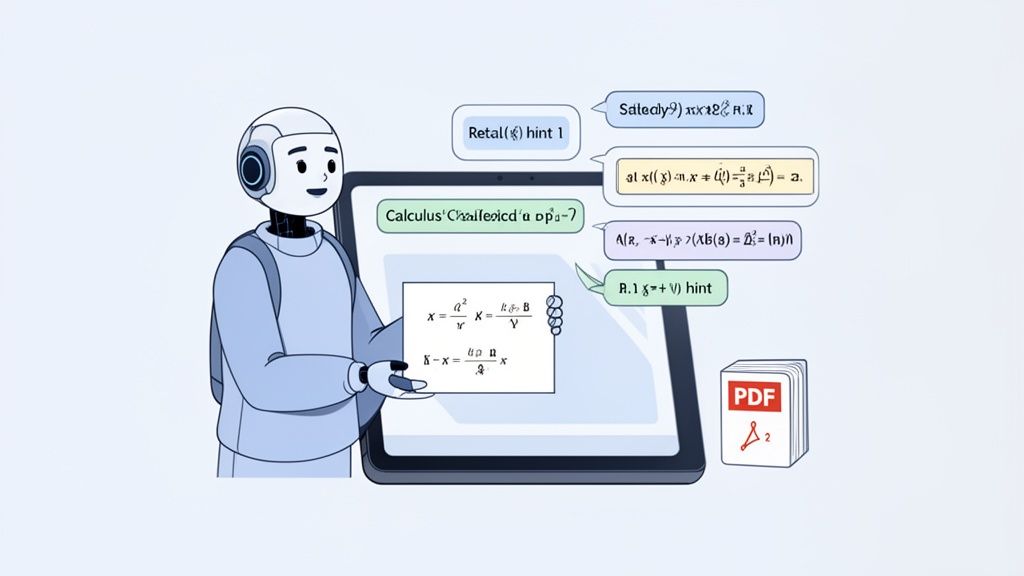
The whole point is to remove the friction. You can go straight from a question to a clear, useful explanation without having to type out complex equations.
Making AI a Natural Part of Your Study Flow
You don't need a complicated new system to do this. It’s really just about building a new habit: when you get stuck, get help. The goal is a seamless workflow where confusion doesn't get to fester.
Don't view AI as a replacement for thinking. View it as a tool to supercharge your thinking. Let it handle the tedious mechanical steps, check your work, and offer clarity so you can focus your brainpower on the why behind the math.
For instance, after you finish a problem set, use an AI tool to check your answers. More importantly, use it to figure out why you got something wrong. Upload a photo of your solution, and it can pinpoint your exact error, whether it was a misapplied formula or a simple algebra slip-up. You can also bring in other tools like an AI Study Assistant to create a more personalized learning path. This kind of immediate, specific feedback is unbelievably effective for locking in concepts.
Practical Tips for Using Your AI Calculus Assistant
To get the most value, you need a strategy. Treat it like a conversation with an expert who is always on call.
- Ask Specific Questions: Instead of a vague "I don't get it," try something direct. "Can you explain step 3 of this solution?" or "Why was the quotient rule the right choice here instead of the product rule?"
- Fill Conceptual Gaps: If a term like "concavity" or "inflection point" feels fuzzy, ask for a simple analogy or a real-world example. Connecting abstract math to something tangible makes it stick.
- Become Your Own Quality Control: Before turning in an assignment, run your solutions past the AI. It's a fantastic way to catch small mistakes and double-check that your logic holds up from start to finish.
By making AI a regular part of your routine, you create a much more active and effective learning process. We dig into even more ways to use this tech in our post on https://feen.ai/blog/ai-powered-study-tools. It’s all about working smarter, not just harder, to finally conquer calculus.
Your Calculus Questions, Answered
If you’re just starting out with calculus, it's completely normal to have questions. You're probably wondering how to tackle it, what pitfalls to avoid, and how to stay on track. Let's dig into some of the most common questions I hear from students, based on years of seeing what works and what doesn't.
How Much Time Should I Really Study Calculus Each Day?
Forget the all-night cram sessions. They just don't work for calculus. True understanding comes from consistency.
I've found the sweet spot for most people is 60-90 minutes of focused study, 4-5 days a week. This rhythm gives your brain time to actually absorb and connect the complex ideas, which is far more effective than trying to brute-force it all at once.
Here’s what a productive 90-minute block could look like:
- Quick Warm-up (15 mins): Re-do a problem from yesterday or skim your last page of notes. This gets your head back in the game.
- New Topic (30 mins): Watch a lecture or read the next section in your textbook. The goal here isn't mastery, it's just to get a solid grasp of the core concept.
- Targeted Practice (45 mins): Now, do practice problems only on the new topic you just covered. This is crucial for cementing the idea before you move on.
And when you get stuck—which you will—don't let it derail your whole session. A quick hint from an AI tool like Feen AI can prevent a simple algebra mistake from costing you 30 minutes of frustration. The goal is active, daily progress.
What's the Single Biggest Mistake People Make Learning Calculus?
Hands down, the biggest mistake is underestimating the prerequisites. Seriously. Jumping into limits and derivatives with a shaky foundation in algebra and trigonometry is like trying to build a house on sand. It's a recipe for disaster.
Every single idea in calculus is built on that foundation. If your brain is spending energy trying to remember a logarithm rule or a trig identity, you have less mental bandwidth left for the actual calculus concept you're trying to learn. This is the root cause of so much frustration—students blame calculus, but the real issue is a rusty toolkit.
Before you even open Chapter 1, be honest with yourself. Are you 100% fluent in functions, factoring, complex fractions, and the unit circle? If there's any hesitation, the single most productive thing you can do is shore up those skills first.
Can I Actually Learn Calculus on My Own?
Absolutely. Self-studying calculus is more possible now than ever, but it demands discipline. You can't just passively watch a bunch of videos and hope it sinks in. You have to be the teacher and the student.
The trick is to create your own structure.
- Pick Your "Textbook": Choose one primary resource to be your guide, whether it's a classic book (like Stewart's) or a well-structured online course. This gives you a logical path to follow.
- Find a Visual Supplement: Use a great YouTube channel like 3Blue1Brown to build intuition. Sometimes seeing an idea explained visually makes all the difference.
- Have a Plan for Getting Unstuck: This is the most critical piece. You need a go-to resource for when you hit a wall. An AI tool like Feen AI is perfect for this—it acts as that on-demand tutor who can give you the push you need to keep moving forward.
How Can I Use Feen AI with My Physical Textbook?
This is one of the best parts—Feen AI was built to bridge the gap between your physical book and getting instant help. You don't have to waste time typing out complicated equations.
Stuck on problem #37 on page 257? Just pull out your phone, snap a clear picture of the problem, and upload it. The AI reads everything—the math, the text, even the diagrams—and gives you a full step-by-step solution.
It's not just for homework problems, either. Try uploading a photo of:
- A confusing diagram from a chapter.
- A paragraph or definition that isn't making sense.
- Your own handwritten work to get it checked.
This simple workflow gets rid of the friction. You get help right where you are, without breaking your study flow to type everything into a computer.
Ready to make your calculus journey smoother and more efficient? Feen AI is like having a 24/7 AI-powered tutor in your pocket, ready to help you get unstuck, understand tough concepts, and check your work in seconds. Stop letting frustrating problems derail your study sessions and start building real momentum. Try Feen AI for free today and see what a smarter way to learn feels like.
Relevant articles

Struggling with how to understand calculus? This guide demystifies limits, derivatives, and integrals with simple analogies and a step-by-step plan.

Learn how to graph linear inequalities with this easy-to-follow guide. Discover how to handle dashed lines, shading, and systems with real-world examples.

Struggling with how to find domain and range? Our guide unpacks the process with clear examples for graphs and equations, making algebra concepts simple.

Learn how to solve word problems in algebra using practical strategies. This guide breaks down the process with real examples and tips to build your confidence.

Discover how to solve systems of linear equations with clear steps, example problems, and practical tips to boost your confidence.

Discover how to study math effectively with proven strategies for active learning, smart practice, and strategic review that build lasting understanding.