8 Crucial Topics: Ultimate Math Problems for 8th Graders
Struggling with middle school math? Master key concepts with our huge list of math problems for 8th graders, complete with answers, worksheets, and tips.
8th grade marks a pivotal moment in any student's mathematical journey, serving as the crucial bridge between foundational arithmetic and advanced high school mathematics. This is the year where abstract concepts truly come to life. Students move beyond basic calculations and begin to explore the "why" behind the numbers, mastering topics that form the bedrock of algebra, geometry, and data analysis. A solid grasp of these principles doesn't just prepare students for Algebra I; it cultivates logical reasoning and systematic problem-solving skills essential for future academic and professional success.
Navigating this transition requires more than just listening in class; it demands focused, high-quality practice. This is precisely why we've created this comprehensive guide. Inside, you will find an extensive collection of math problems for 8th graders, meticulously organized by core topic areas to help students, parents, and educators pinpoint specific concepts for reinforcement.
Our curated listicle covers the most critical areas of the 8th-grade curriculum, including:
- Linear Equations and Systems of Equations
- Exponents and the Pythagorean Theorem
- Functions and an introduction to Polynomials
- Data Analysis and Probability
Each section provides a variety of problems ranging in difficulty, complete with detailed, step-by-step solutions and actionable tips. This resource is designed to be a one-stop-shop for targeted practice, helping to transform challenging concepts into areas of strength and confidence. Let's dive into the problems and build a strong foundation for mathematical success.
1. Linear Equations and Systems of Equations
Linear equations are a cornerstone of 8th-grade math, forming the bridge between concrete arithmetic and abstract algebra. These problems involve finding unknown values in equations that, when graphed, create a straight line. Students learn to manipulate equations to isolate a single variable, understand the concepts of slope and y-intercept, and graph these relationships on a coordinate plane. This foundational skill is crucial for future success in higher-level mathematics and science.
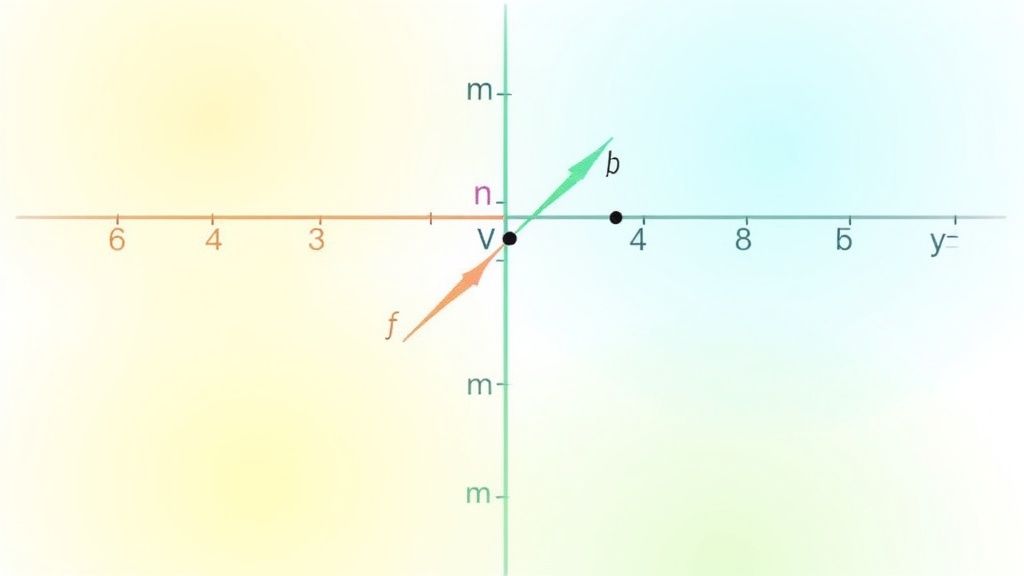
The topic then extends to systems of equations, where students work with two or more linear equations simultaneously. The goal is to find the single coordinate pair (x, y) that satisfies all equations in the system. This is the point where the lines intersect on a graph. Mastering these problems helps develop critical thinking and multi-step problem-solving abilities.
Why It's a Key 8th-Grade Topic
Linear equations are not just abstract exercises; they model countless real-world scenarios. This makes them one of the most practical types of math problems for 8th graders. For example, they can be used to compare cell phone plans to see which is more economical based on usage, or to calculate when two vehicles traveling at different speeds will meet.
Actionable Tips for Parents and Tutors
- Graphing is Your Friend: Always use graph paper for practice. Visually representing an equation helps solidify the connection between the algebraic formula and its geometric meaning.
- Check Every Answer: Instill the habit of substituting the solution back into the original equations. This self-checking technique builds confidence and catches mistakes early.
- Master Multiple Methods: Encourage students to solve systems using graphing, substitution, and elimination. Understanding all three methods provides flexibility and a deeper conceptual grasp. For a detailed guide on these techniques, explore this excellent resource on how to solve systems of linear equations.
- Start Simple, Build Complexity: Begin with single-variable equations, then move to graphing
y = mx + b, and finally introduce systems. This gradual progression prevents students from feeling overwhelmed.
2. Exponents and Powers
Exponents and powers are a fundamental concept in algebra, introducing students to a shorthand for repeated multiplication. An exponent indicates how many times a base number is multiplied by itself. In 8th grade, students move beyond simple calculations and delve into the rules that govern operations with exponents, such as the product, quotient, and power rules. This understanding is essential for working with scientific notation and grasping concepts of exponential growth and decay.
This topic also introduces negative exponents, which represent reciprocals, and the zero exponent rule, where any non-zero base raised to the power of zero equals one. Mastering these properties allows students to simplify complex expressions and solve more advanced algebraic problems efficiently. These skills are a gateway to understanding polynomial functions, logarithms, and other higher-level math topics.
Why It's a Key 8th-Grade Topic
The study of exponents is critical because it describes relationships that are not linear. Many real-world phenomena, from population growth and compound interest to radioactive decay and computer processing power (Moore's Law), follow exponential patterns. Learning to work with these concepts provides students with the tools to model and understand the world in a more sophisticated way, making these some of the most relevant math problems for 8th graders.
Actionable Tips for Parents and Tutors
- Create an Exponent Rule Card: Have the student create a small reference card summarizing the key rules (product, quotient, power, negative, and zero). This visual aid is invaluable during homework and practice.
- Connect to Repeated Multiplication: Initially, always break down exponent problems into their basic multiplication form (e.g., x³ = x * x * x). This reinforces the core concept and helps derive the rules intuitively.
- Practice One Rule at a Time: Focus on mastering one property before combining them. For instance, dedicate a practice session solely to the product rule, then another to the quotient rule, before tackling problems that involve both.
- Use Scientific Notation: Apply exponent skills to real-world scientific data, like the distance to the sun or the size of a molecule. This makes the abstract rules feel more concrete and useful. For a great set of practice problems, check out the resources from Art of Problem Solving (AoPS).
3. Pythagorean Theorem and Right Triangles
The Pythagorean Theorem is a fundamental principle of Euclidean geometry that describes the relationship between the three sides of a right-angled triangle. Stated as the formula a² + b² = c², where 'a' and 'b' are the lengths of the two shorter sides (legs) and 'c' is the length of the longest side (the hypotenuse), this theorem is a powerful tool for indirect measurement and spatial reasoning. Eighth graders learn to apply this formula to find missing side lengths and to verify if a given triangle is a right triangle.
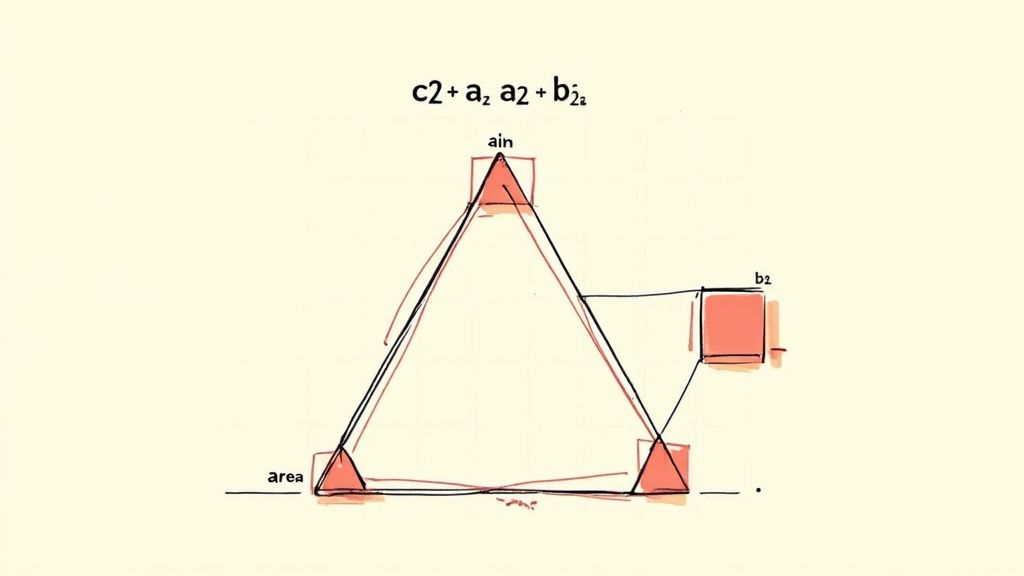
The applications extend beyond simple triangles into more complex geometric problems. Students use the theorem to calculate the distance between two points on a coordinate plane, which lays the groundwork for the distance formula in algebra. It is a critical concept that bridges geometry, algebra, and real-world problem-solving, enhancing a student's ability to think critically about spatial relationships.
Why It's a Key 8th-Grade Topic
The Pythagorean Theorem is one of the most applicable mathematical concepts learned in middle school. These math problems for 8th graders demonstrate how abstract formulas can solve tangible, physical world challenges. For instance, it's used in construction to ensure corners are perfectly square, in navigation to calculate the shortest distance between two points, and even in accident investigation to determine vehicle speeds.
Actionable Tips for Parents and Tutors
- Memorize Common Triples: Encourage students to memorize common Pythagorean triples like (3-4-5), (5-12-13), and (8-15-17). Recognizing these patterns can significantly speed up problem-solving.
- Draw Everything: Visualizing the problem is key. For any word problem, have the student draw a diagram of the right triangle and label the known sides and the unknown side they need to find.
- Connect to the Distance Formula: Explicitly show how the Pythagorean Theorem is the foundation of the distance formula on a coordinate plane. Draw a right triangle using the horizontal and vertical distances between two points to make the connection clear.
- Explore Visual Proofs: Don't just focus on applying the formula. Use online resources or physical cutouts to explore a visual proof of the theorem. Understanding why it works builds a much deeper and more lasting comprehension.
4. Polynomials and Factoring
Polynomials represent a significant step up in algebraic complexity, moving students beyond single-variable linear relationships. These expressions involve variables raised to various non-negative integer powers, such as 3x² + 5x - 2. Eighth graders learn the fundamental operations of adding, subtracting, and multiplying these expressions, which lays the groundwork for understanding more advanced mathematical functions.
The topic then introduces factoring, the process of breaking down a polynomial into its simpler, multiplied components. Students learn various techniques, including finding the greatest common factor (GCF), factoring trinomials, and recognizing special cases like the difference of squares. This skill is the inverse of multiplication and is absolutely essential for solving quadratic equations and simplifying complex algebraic fractions later on.
Why It's a Key 8th-Grade Topic
Working with polynomials is a gateway to higher-level algebra and calculus. These types of math problems for 8th graders help students develop a deeper number sense and pattern recognition. The applications are extensive, from modeling the trajectory of a thrown object in physics to optimizing the area of a garden or maximizing profit in a simple business model. Understanding how to manipulate and factor these expressions is a core skill for any future STEM-related field.
Actionable Tips for Parents and Tutors
- Master One Method at a Time: Factoring can be confusing with its multiple techniques. Ensure the student is confident with one method, like factoring trinomials where
a=1, before introducing more complex scenarios. - Check by Multiplying: The best way to build confidence is to instill the habit of checking answers. After factoring a polynomial, multiply the factors back together to ensure the result is the original expression.
- Use Visual Aids: Algebra tiles or drawing area models can make the abstract concept of polynomial multiplication and factoring more concrete. This visual connection is especially helpful for learners who struggle with abstract symbols.
- Connect Factoring to Solving: Emphasize the "why" behind factoring. Show students how setting a factored expression equal to zero allows them to easily find the solutions (or roots) of an equation, a powerful problem-solving tool. For a deeper dive into these techniques, explore this guide on how to factor polynomials completely.
5. Radicals and Rational Exponents
In 8th grade, students move beyond whole numbers and integers to explore the world of irrational numbers, primarily through radicals (like square roots) and rational exponents. This topic introduces the concept that numbers can exist that cannot be written as simple fractions. Students learn to simplify radicals, perform operations (addition, subtraction, multiplication) with them, and understand the deep connection between a radical expression and an exponent that is a fraction.
This area of mathematics is essential for solving geometric problems, particularly those involving the Pythagorean theorem, and it lays the groundwork for more advanced algebra. Understanding how to manipulate expressions like √12 or 8^(2/3) is a critical skill that unlocks new types of problem-solving. It challenges students to think more abstractly about what a "number" can be.
Why It's a Key 8th-Grade Topic
Radicals and rational exponents are fundamental to algebra and geometry. These concepts appear frequently in real-world applications, such as calculating diagonal lengths in construction, determining distances in physics, and understanding various formulas in engineering and finance. Introducing these math problems for 8th graders prepares them for the non-integer solutions that are common in higher-level science and math courses.
Actionable Tips for Parents and Tutors
- Master Prime Factorization: The key to simplifying radicals is breaking down the number inside the root into its prime factors. Practice this skill relentlessly, as it makes simplifying expressions like √72 much more manageable.
- Visualize on a Number Line: Irrational numbers can feel abstract. Help students estimate the value of radicals (e.g., √10 is a little more than 3) and place them on a number line. This makes their value more concrete.
- Connect Radicals to Exponents: Repeatedly show that √x is the same as x^(1/2) and the cube root of x is x^(1/3). This link is crucial and helps students see that they are two different ways of writing the same mathematical idea.
- Check for Extraneous Solutions: When solving equations involving radicals, it's vital to plug the final answer back into the original equation. Sometimes, the algebraic process produces solutions that do not actually work, and this checking step helps identify them.
6. Functions and Function Notation
The concept of a function is a major leap in an 8th grader's mathematical journey, moving them from specific equations to understanding generalized relationships between variables. A function is a rule that assigns exactly one output for each given input. Students learn to use function notation, such as f(x), which is a powerful way to name a function and describe its output based on an input variable x. This introduces a new level of mathematical language.
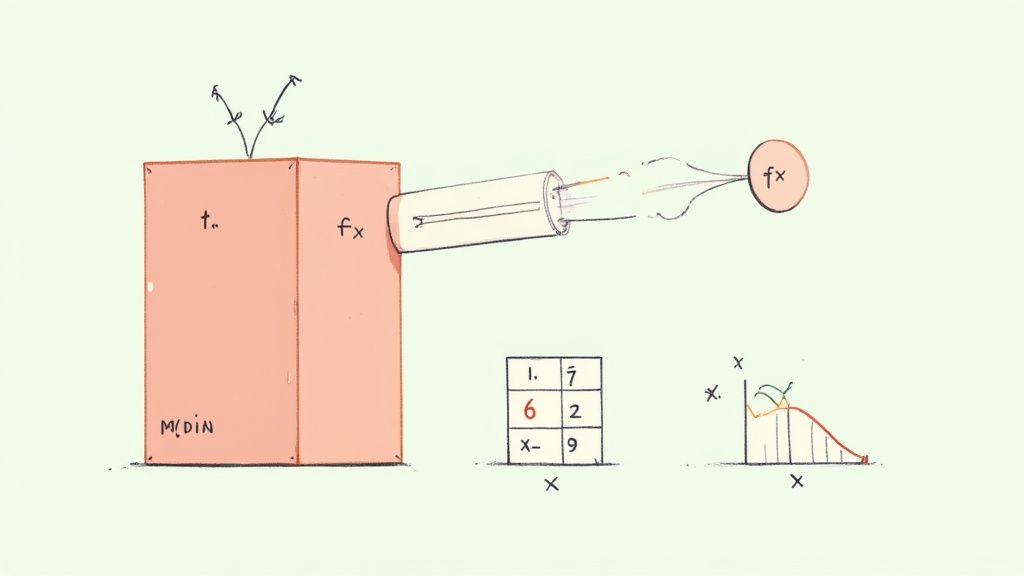
Students explore key aspects like domain (the set of all possible inputs) and range (the set of all possible outputs). They learn to evaluate functions for specific values, create tables of values, and graph the resulting coordinate pairs. This topic bridges the gap between linear equations and the more complex mathematical models they will encounter in high school algebra and beyond.
Why It's a Key 8th-Grade Topic
Functions are the building blocks of higher mathematics and are essential for modeling the world around us. These math problems for 8th graders teach students to see relationships everywhere, from how the temperature changes over time to how the cost of an item depends on the quantity purchased. Understanding functions provides a framework for analyzing data, making predictions, and comprehending cause-and-effect relationships in a quantitative way.
Actionable Tips for Parents and Tutors
- Use the "Function Machine" Metaphor: Initially, describe a function as a machine. You put an input (x) in, the machine performs a rule on it, and a unique output (y or f(x)) comes out. This visual analogy makes the abstract concept more concrete.
- Create Tables of Values: Before graphing, always have students create an input-output table. This reinforces the idea that for every
x, there is a correspondingy, and it provides a set of points to plot, making graphing less intimidating. - Practice Function Evaluation: Repetition is key. Provide numerous simple problems like, "If
f(x) = 2x + 5, findf(3)." This builds fluency and confidence with the new notation. - Connect to the Real World: Constantly link functions to real scenarios. For instance,
C(g) = 3.50gcould represent the cost of buyingggallons of gas. Ask questions like, "What is the cost of 10 gallons?" or "What does C(10) mean?"
7. Quadratic Equations and Parabolas
While linear equations graph as straight lines, quadratic equations introduce students to the elegant curve of the parabola. This topic represents a significant step up in algebraic complexity, involving equations with a variable squared (like x²). Students learn to solve these equations to find their "roots" or x-intercepts, and they explore the graphical properties of parabolas, including the vertex and axis of symmetry. Understanding quadratics is fundamental for later studies in physics, engineering, and advanced algebra.
The curriculum typically covers multiple methods for solving quadratic equations, such as factoring, completing the square, and using the powerful quadratic formula. Each method offers a different perspective on the problem, and mastering them provides students with a versatile toolkit. Graphing parabolas helps visualize the solutions and understand concepts like maximum and minimum values, which have direct real-world applications.
Why It's a Key 8th-Grade Topic
Quadratic equations are essential because they model many natural phenomena that linear equations cannot. These types of math problems for 8th graders describe the trajectory of a thrown ball (projectile motion), the shape of a suspension bridge's cables, or the profit curve for a small business. By learning to find the vertex of a parabola, students can solve optimization problems, such as determining the maximum height of a rocket or the price point that maximizes revenue.
Actionable Tips for Parents and Tutors
- Factoring First: Encourage students to master solving by factoring before moving on to other methods. It builds a strong number sense and is often the quickest way to find a solution.
- Create a Formula Checklist: The quadratic formula has several steps where small errors can occur. Have students create and use a checklist to ensure they correctly identify a, b, and c, substitute them properly, and follow the order of operations.
- Use Graphing Technology: Tools like Desmos or graphing calculators are excellent for visually verifying algebraic solutions. Students can graph the parabola to see the x-intercepts and vertex, confirming the answers they calculated by hand.
- Connect Vertex to Transformations: Help students see the link between the vertex form of a quadratic,
y = a(x - h)² + k, and graph transformations. They can quickly identify how the parabola shifts horizontally (h) and vertically (k) from the parent functiony = x².
8. Data Analysis, Probability, and Statistics
In the 8th grade, students move beyond basic charts to engage with the powerful world of data analysis, probability, and statistics. This field involves collecting, organizing, analyzing, and interpreting numerical data to make predictions and draw informed conclusions. Students learn to work with various data representations like scatter plots, histograms, and box plots, while also calculating descriptive statistics such as mean, median, mode, and range.

The curriculum also introduces fundamental concepts of probability, distinguishing between independent and dependent events and calculating the likelihood of different outcomes. Mastering these skills is essential for developing statistical literacy, which is crucial for navigating a world filled with data, from news reports to marketing claims. This area of study builds a foundation for critical thinking and evidence-based reasoning.
Why It's a Key 8th-Grade Topic
Data analysis is not just for scientists; it's a life skill. Understanding statistics helps students become informed citizens who can critically evaluate information presented in election polling, sports analytics, or public health data. These types of math problems for 8th graders are directly applicable to understanding real-world trends, making them highly engaging and relevant for students preparing for high school and beyond.
Actionable Tips for Parents and Tutors
- Use Real-World Data: Source data from reputable websites like the U.S. Census Bureau or sports statistics sites. Analyzing authentic information makes practice more meaningful and memorable.
- Challenge Media Claims: Find a news article or advertisement that uses statistics. Work together to analyze the data, interpret the graphs, and question whether the claims are fully supported by the evidence.
- Conduct Your Own Experiments: Encourage students to conduct simple surveys or probability experiments, like flipping a coin 100 times or polling friends on a topic. This hands-on practice makes abstract concepts concrete.
- Leverage Technology: Use spreadsheets in Google Sheets or Excel to organize data and create charts. This not only reinforces math skills but also teaches valuable digital literacy. For those interested in a deeper dive, understanding the principles of hypothesis testing in statistics can provide a glimpse into more advanced data analysis.
8-Topic Comparison: 8th Grade Math Problems
| Topic | Implementation complexity | Resource requirements | Expected outcomes | Ideal use cases | Key advantages |
|---|---|---|---|---|---|
| Linear Equations and Systems of Equations | Low–Moderate: procedural methods (substitution, elimination) | Graph paper, basic calculator, stepwise practice | Solve linear equations, graph lines, solve 2-variable systems | Budget comparisons, rate/distance problems, introductory algebra | Foundational skill, visual reinforcement via graphing, high real-world relevance |
| Exponents and Powers | Low–Moderate: rule memorization and application | Reference rule card, scientific calculator, practice problems | Apply exponent rules, use scientific notation, model growth/decay | Population growth, compound interest, scientific notation tasks | Handles very large/small numbers, essential for STEM contexts |
| Pythagorean Theorem and Right Triangles | Low: direct formula application with geometric reasoning | Geometry tools, manipulatives or software (GeoGebra) | Compute missing sides, distance on coordinate plane, 3D diagonals | Construction, navigation/GPS, architecture, geometry problems | Highly visual, strong spatial reasoning, abundant practical uses |
| Polynomials and Factoring | Moderate: multiple factoring techniques and algebraic manipulation | Practice problems, algebra tiles or visual models, optional CAS | Add/multiply polynomials, factor completely, prepare for quadratics | Optimization, quadratic solving, algebra progression | Strengthens algebraic manipulation and pattern recognition, foundation for higher math |
| Radicals and Rational Exponents | Moderate: abstract simplification and rationalization routines | Prime factorization tools, practice sets, calculators | Simplify radicals, convert between radical/exponential forms, solve radical equations | Geometry diagonals, quadratic formula contexts, physics calculations | Complements exponent rules, essential for exact values and algebraic solutions |
| Functions and Function Notation | Moderate–High: abstract concepts and transformations | Graphing tools (Desmos), tables, real-data examples | Interpret f(x), determine domain/range, apply transformations, compose/inverse | Modeling relationships in science/economics, advanced algebra prep | Core mathematical language, transferable abstract reasoning, links graphs and formulas |
| Quadratic Equations and Parabolas | Moderate–High: multiple solution methods and graphical analysis | Graphing calculator/software, practice problems, formula checklist | Solve quadratics, graph parabolas, identify vertex/axis, optimize values | Projectile motion, profit/area optimization, design/engineering problems | Integrates many algebra skills, strong visual-algebra connection, wide applicability |
| Data Analysis, Probability, and Statistics | Moderate: varied representations and probabilistic reasoning | Spreadsheets/graphing tools, real datasets, statistical software | Create/interpret charts, compute descriptive stats, calculate probabilities | Polling, clinical data interpretation, business analytics, media literacy | Highly relevant to everyday decisions, develops critical data literacy and reasoning |
Turn Practice into Progress: Your Next Steps for Math Mastery
Navigating the landscape of 8th-grade math is a significant undertaking, one that builds the critical foundation for all future high school and college-level mathematics. The extensive collection of math problems for 8th graders provided in this guide, spanning from linear equations to data analysis, is more than just a set of exercises. It is a strategic toolkit designed to empower students, parents, and educators to identify strengths, pinpoint areas for growth, and cultivate a deeper, more intuitive understanding of mathematical principles. By engaging with these problems, you’ve taken the first and most important step: transforming passive learning into active, purposeful practice.
The journey, however, doesn’t end with completing a worksheet. The true value lies in how you use this practice to inform your next steps. The goal is to move beyond simple memorization of formulas and develop a resilient, analytical mindset.
From Practice to Proficiency: A Strategic Approach
Mastering 8th-grade math isn’t a sprint; it’s a marathon built on consistent, intelligent effort. The key is to shift from a mindset of "getting the right answer" to "understanding the process." Here’s how to leverage the problems in this article to build lasting proficiency:
- Conduct a Skill Audit: After working through a diverse set of problems, take a moment to categorize them. Which topics felt intuitive (e.g., exponent rules)? Which ones required multiple attempts or a look at the solution (e.g., systems of equations, factoring polynomials)? This simple audit creates a personalized study plan, allowing you to focus your energy where it will have the greatest impact.
- Embrace the "Why": For every problem solved, especially the challenging ones, ask the crucial question: "Why does this method work?" For instance, when solving for x in a linear equation, you aren’t just moving numbers around. You are applying the properties of equality to maintain balance. Understanding the "why" behind the steps makes the knowledge stick and applicable to unfamiliar problems.
- Simulate Test Conditions: Use the timed practice sets to build not just accuracy but also efficiency. Set a timer and work through a mixed set of problems. This exercise helps students manage their time, prioritize questions, and perform better under the pressure of actual exams. It’s about building a calm, confident approach to assessment.
The Bigger Picture: Math as a Life Skill
The concepts covered in 8th-grade math are foundational not just for algebra and geometry, but for everyday critical thinking. Understanding functions helps in recognizing patterns and predicting outcomes, from analyzing a phone plan to projecting business growth. Probability and statistics are the languages of data, essential for making informed decisions in a world saturated with information.
Key Insight: The ultimate goal of working through these math problems for 8th graders is to develop robust analytical reasoning. This skill transcends the classroom, empowering individuals to tackle complex challenges logically and creatively in any field they pursue.
For true math mastery, continuously improving how you approach challenges is essential. It's not just about what you know, but how you think. For a practical guide on building these core cognitive skills, explore how to enhance your problem-solving abilities, as this will serve you well beyond mathematics. The ability to break down a large problem, identify knowns and unknowns, and devise a step-by-step strategy is an invaluable asset for life.
By consistently applying these strategies, you can transform practice from a chore into a powerful engine for progress. Each problem is an opportunity to strengthen your skills, build confidence, and prepare for the exciting mathematical challenges that lie ahead.
When you encounter a particularly tricky problem or need a concept explained in a new way, don't let frustration halt your progress. Feen AI provides instant, step-by-step guidance for complex math problems, helping you understand the process without simply giving you the answer. Upload a photo of your problem and get the support you need to turn every challenge into a learning opportunity at Feen AI.
Relevant articles
Master key concepts with our detailed list of math problems for 7th graders. Includes examples, step-by-step solutions, and study tips for success.
Master core concepts with these essential math problems for 6th graders. Includes free worksheets, solutions, and tips to build confidence and skills.