8 Essential Math Problems for 6th Graders in 2025
Master core concepts with these essential math problems for 6th graders. Includes free worksheets, solutions, and tips to build confidence and skills.
The transition to 6th-grade math marks a significant academic milestone, as students move beyond basic arithmetic to tackle more abstract concepts. This is where foundational skills in ratios, integers, and early algebraic expressions are built, setting the stage for future success in higher-level mathematics. To navigate this crucial year, consistent and targeted practice is key. This guide offers a comprehensive collection of math problems for 6th graders, carefully categorized to reinforce core concepts and build confidence.
We have organized this resource to be as practical as possible. Inside, you'll find a curated roundup of problems covering essential topics like fraction operations, multi-step word problems, and decimal calculations. Each section provides a range of difficulties, from straightforward practice to more complex challenges, ensuring every learner finds the right level of support. For parents seeking to make practice sessions more dynamic, exploring various active learning strategies can significantly boost engagement in problem-solving.
This listicle is more than just a set of questions; it's a complete toolkit for mastering 6th-grade math. Every category includes printable worksheets, detailed answer keys, and step-by-step solutions to clarify complex steps. Our goal is to empower parents, tutors, and students with the resources needed to transform math practice from a challenging chore into an opportunity for genuine understanding and growth.
1. Fraction Operations
Fraction operations are a cornerstone of the 6th-grade math curriculum, building directly upon concepts introduced in earlier grades. These problems require students to add, subtract, multiply, and divide fractions and mixed numbers. Mastering this skill is crucial as it lays the groundwork for understanding ratios, proportions, and algebraic expressions later on. The core challenge often involves finding common denominators for addition and subtraction or simplifying results for multiplication and division.
Why It's a Foundational Skill
A strong command of fractions is essential for practical, real-world math. When students can confidently manipulate fractions, they are better equipped to handle everyday tasks like adjusting a recipe, measuring materials for a project, or even understanding financial concepts like discounts. These math problems for 6th graders push them to think critically about parts of a whole, a skill that translates across many disciplines. For students who need a refresher on the basics before tackling these more complex operations, reviewing foundational fraction concepts can be very helpful. You can find more introductory fraction problems here.
Example Problems & Solutions
- Addition: A baker uses 1 1/2 cups of sugar for a cake and 3/4 of a cup for the frosting. How much sugar is used in total?
- Solution: Convert 1 1/2 to 3/2. Find a common denominator for 3/2 and 3/4, which is 4. This gives 6/4 + 3/4 = 9/4, or 2 1/4 cups.
- Multiplication: If a smoothie recipe calls for 2/3 cup of yogurt per serving, how much yogurt is needed for 4 servings?
- Solution: Multiply 2/3 by 4 (or 4/1). (2 * 4) / (3 * 1) = 8/3, which simplifies to 2 2/3 cups.
2. Ratio and Proportion Problems
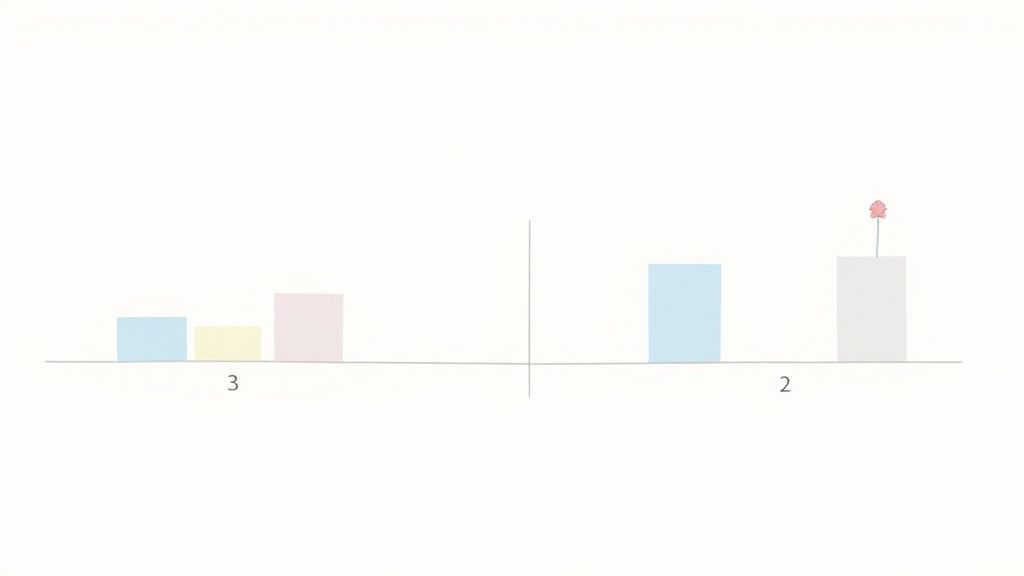
Ratios and proportions are a major leap in 6th-grade math, moving students from concrete arithmetic to more abstract relational thinking. These problems involve comparing quantities and understanding how they scale in relation to each other. Students learn to express relationships as ratios (e.g., 3 boys for every 4 girls) and solve proportions to find unknown quantities when a relationship is maintained (e.g., if a map scale is 1 inch : 10 miles, how many miles do 5 inches represent?).
Why It's a Foundational Skill
Mastering ratios and proportions is critical for understanding a vast range of higher-level math and real-world applications. This concept is the backbone of percentages, rates (like miles per hour), and similarity in geometry. In daily life, it's used for everything from adjusting recipe ingredients and calculating unit prices at the grocery store to understanding map scales and mixing paint colors. These math problems for 6th graders develop proportional reasoning, a sophisticated cognitive skill that is essential for algebra and beyond. Visual aids like ratio tables and bar models are excellent tools for helping students organize their thinking and set up equations correctly.
Example Problems & Solutions
- Ratios: A classroom has 12 boys and 18 girls. What is the ratio of boys to girls in its simplest form?
- Solution: The initial ratio is 12:18. To simplify, find the greatest common divisor of 12 and 18, which is 6. Divide both numbers by 6: 12 ÷ 6 = 2 and 18 ÷ 6 = 3. The simplest ratio is 2:3.
- Proportions: If a car travels 150 miles on 5 gallons of gas, how many gallons are needed to travel 210 miles?
- Solution: Set up a proportion: 150 miles / 5 gallons = 210 miles / x gallons. Cross-multiply to solve: 150 * x = 210 * 5, so 150x = 1050. Divide both sides by 150: x = 7 gallons.
3. Multi-Step Word Problems
Multi-step word problems represent a significant step up in complexity, challenging students to move beyond single-calculation exercises. These problems present real-world scenarios that require students to identify key information, decide on the correct sequence of operations (like addition, subtraction, multiplication, or division), and perform several calculations to arrive at a final answer. The primary difficulty lies in translating the narrative into a structured mathematical plan.
Why It's a Foundational Skill
Mastering multi-step problems is crucial for developing mathematical reasoning and critical thinking. It teaches students how to break down complex challenges into smaller, manageable parts, a skill that is invaluable both in higher-level math and in everyday life. These math problems for 6th graders build resilience and problem-solving stamina, preparing them for algebra and beyond. For a deeper look at tackling these challenges, you can explore strategies on how to solve math problems step-by-step. This skill empowers students to confidently face situations like budgeting for a shopping trip or planning a schedule.
Example Problems & Solutions
- Shopping: Alex wants to buy 3 video games that cost $25.50 each. He has a coupon for $10 off his total purchase. If he pays with a $100 bill, how much change will he get back?
- Solution: First, find the total cost: 3 * $25.50 = $76.50. Then, apply the coupon: $76.50 - $10 = $66.50. Finally, calculate the change: $100 - $66.50 = $33.50.
- Time Management: A field trip bus leaves school at 9:15 AM. The trip to the museum is 1 hour and 30 minutes. The students spend 2 hours and 45 minutes at the museum. What time will they get back to school if the return trip takes the same amount of time?
- Solution: Add travel time and museum time: 1 hr 30 min + 2 hr 45 min + 1 hr 30 min = 5 hours and 45 minutes. Add this to the departure time: 9:15 AM + 5 hours 45 minutes = 3:00 PM.
4. Decimal Operations and Place Value
Decimal operations are a critical area of focus in 6th-grade math, extending students' understanding of place value into the fractional world. These problems involve adding, subtracting, multiplying, and dividing numbers with decimal points. Students must learn to align decimal points correctly, understand how operations affect place value, and apply these skills to solve multi-step problems, particularly those involving real-world contexts like money and measurements.
Why It's a Foundational Skill
Proficiency with decimals is directly applicable to everyday life, making it one of the most practical mathematical skills. From calculating a total bill with tax at a store to understanding sports statistics or managing a budget, decimals are everywhere. These math problems for 6th graders build number sense and precision, which are essential for future success in algebra and science courses where accurate measurements and calculations are paramount. A solid grasp of place value to the thousandths place and beyond ensures students can work with numbers of varying magnitudes confidently.
Example Problems & Solutions
- Subtraction: Your weekly allowance is $15.50. You spend $4.25 on snacks and $7.99 on a movie ticket. How much money do you have left?
- Solution: First, add your expenses: $4.25 + $7.99 = $12.24. Then, subtract this total from your allowance: $15.50 - $12.24 = $3.26. You have $3.26 left.
- Division: A car travels 345.6 miles on 12 gallons of gasoline. How many miles per gallon (MPG) does the car get?
- Solution: Divide the total miles by the number of gallons: 345.6 ÷ 12. Performing the long division gives 28.8 miles per gallon.
5. Area and Perimeter Problems
Area and perimeter problems introduce 6th graders to foundational geometric concepts by having them calculate and compare the measurements of two-dimensional shapes. Students must learn to distinguish between perimeter (the distance around a shape) and area (the space inside it), apply the correct formulas, and understand how these two measurements relate to each other. This topic serves as a critical bridge between arithmetic and geometry, preparing students for more complex spatial reasoning.

Why It's a Foundational Skill
Understanding area and perimeter is vital for countless real-world applications, from home improvement projects to professional design. When students can accurately calculate these values, they are better equipped to solve practical challenges like determining how much fence is needed for a yard (perimeter) or how much paint is needed for a wall (area). These math problems for 6th graders develop spatial awareness and logical thinking, directly addressing the common misconception that a larger perimeter always means a larger area. For more support on this topic, you can explore additional geometry resources on Khan Academy.
Example Problems & Solutions
- Area: A rectangular room is 12 feet long and 10 feet wide. What is the total area of the floor that needs to be carpeted?
- Solution: Use the formula for the area of a rectangle: Area = length × width. Multiply 12 feet by 10 feet to get 120 square feet.
- Perimeter: A rectangular garden has a length of 20 meters and a width of 8 meters. How much fencing is needed to enclose the entire garden?
- Solution: Use the formula for the perimeter of a rectangle: Perimeter = 2 × (length + width). Calculate 2 × (20 + 8) = 2 × 28, which equals 56 meters.
6. Integer and Signed Number Operations
Sixth grade marks a significant conceptual leap as students move beyond positive whole numbers to work with integers, which include both positive and negative numbers. These problems involve adding, subtracting, multiplying, and dividing signed numbers. Mastering this topic is a critical prerequisite for algebra, as it introduces the abstract concept of direction and value on a number line, which is central to understanding variables and equations. The primary challenge lies in grasping the rules for operations, such as how subtracting a negative number is equivalent to adding a positive one.
Why It's a Foundational Skill
Understanding integers is essential for interpreting and solving a wide array of real-world problems. When students can confidently operate with positive and negative numbers, they can easily model situations like temperature changes, financial transactions involving credits and debits, or elevation above and below sea level. These math problems for 6th graders build number sense and prepare them for more complex mathematical reasoning. Visual aids like number lines are invaluable for helping students conceptualize the movement and relationships between signed numbers.
Example Problems & Solutions
- Subtraction: The temperature at noon was 5°F. By evening, it had dropped by 12°F. What was the evening temperature?
- Solution: Start at 5 and subtract 12. 5 - 12 = -7. The evening temperature was -7°F. A number line can be used to visualize moving 12 units to the left from 5.
- Addition: A scuba diver is 15 feet below sea level (-15 ft) and then descends another 20 feet. What is her new depth?
- Solution: Add the two negative values. -15 + (-20) = -35. Her new depth is 35 feet below sea level, or -35 feet.
7. Probability and Data Analysis
Probability and data analysis problems introduce 6th graders to the skills of collecting, organizing, analyzing, and interpreting information. These tasks involve calculating measures of central tendency (mean, median, mode), reading graphs, and understanding basic probability. This area of math helps students make sense of the world around them by using numbers to describe uncertainty and draw conclusions from data sets. The challenge lies in moving from simple calculations to interpreting what the data actually means.
Why It's a Foundational Skill
Understanding data and probability is crucial for navigating modern life. Students equipped with these skills can critically evaluate news reports, understand statistics in sports, and make informed decisions based on evidence. These math problems for 6th graders build a foundation for higher-level statistics and are essential for developing quantitative reasoning. By learning to question data, identify trends, and understand likelihood, students become more discerning consumers of information.
Example Problems & Solutions
- Data Analysis: A student's test scores are 85, 92, 78, 85, and 90. What is the mean and the median of their scores?
- Solution: To find the mean, add the scores (85 + 92 + 78 + 85 + 90 = 430) and divide by the number of scores (5), which is 86. To find the median, first order the scores (78, 85, 85, 90, 92). The median is the middle number, which is 85.
- Probability: What is the theoretical probability of rolling an even number on a standard six-sided die?
- Solution: A standard die has three even numbers (2, 4, 6) and six total possible outcomes. The probability is the number of favorable outcomes divided by the total number of outcomes, which is 3/6 or 1/2.
8. Algebraic Thinking and Expressions
Algebraic thinking marks a significant leap from concrete arithmetic to abstract reasoning. These problems introduce students to the use of variables, the process of writing expressions, and the logic of solving simple equations. Sixth graders learn to translate verbal phrases into symbolic expressions and vice versa, a foundational skill for all future mathematics. This involves understanding that a variable like 'x' represents an unknown quantity and learning how to manipulate expressions based on the order of operations.
Why It's a Foundational Skill
Developing algebraic reasoning early is crucial for success in higher-level math. It teaches students to think systematically, recognize patterns, and generalize relationships. These skills are not just for math class; they are essential for problem-solving in science, computer programming, and finance. These math problems for 6th graders build a bridge to abstract thought, preparing students for more complex algebraic concepts. Understanding how to approach word problems is a key part of this, and students can get strategies for solving algebraic word problems here.
Example Problems & Solutions
- Writing Expressions: A cell phone plan costs $20 per month plus $0.10 for every minute used. Write an expression for the total monthly cost.
- Solution: Let 'm' represent the number of minutes used. The expression is 20 + 0.10m. This demonstrates how a variable can represent a changing quantity.
- Solving Equations: A gym membership costs $25, plus $3 for each visit. If a member paid $43 in one month, how many times did they visit the gym?
- Solution: Set up the equation: 25 + 3v = 43. Subtract 25 from both sides: 3v = 18. Divide by 3: v = 6. The member visited 6 times.
6th Grade Math: 8-Topic Comparison
| Topic | Implementation complexity | Resource requirements | Expected outcomes | Ideal use cases | Key advantages |
|---|---|---|---|---|---|
| Fraction Operations | Medium — routines for common denominators and conversions | Fraction bars, visual models, practice sets | Fluency with parts of wholes; prepares for decimals and ratios | Cooking, measurement, scaling problems | Foundational for algebra and real measurements |
| Ratio and Proportion Problems | Medium — requires proportional reasoning and setup skills | Ratio tables, diagrams, real-world contexts | Ability to scale quantities and compute rates | Maps, recipes, scaling, unit-rate comparisons | Directly applicable to many real problems |
| Multi-Step Word Problems | High — requires synthesis of multiple skills and reading comprehension | Complex problem sets, graphic organizers, timed practice | Higher-order problem solving and persistence | Budgeting, planning, multi-concept scenarios | Builds reasoning and real-world translation skills |
| Decimal Operations and Place Value | Medium — procedural alignment and place-value attention | Place-value charts, money manipulatives, grid paper | Precision with decimals and financial math skills | Shopping, budgeting, measurements, science data | Highly practical for finance and measurements |
| Area and Perimeter Problems | Low–Medium — formula application and decomposition skills | Geoboards, grid paper, measuring tools | Spatial reasoning and correct use of geometric formulas | Design, construction, tiling, landscaping tasks | Concrete visualizable concepts with clear answers |
| Integer and Signed Number Operations | Medium — abstract sign rules and models required | Number lines, two-color counters, contextual examples | Comfort with negatives; foundation for algebra | Temperature, finances, elevation, gains/losses | Essential for algebraic thinking and real contexts |
| Probability and Data Analysis | Medium–High — requires statistical reasoning and interpretation | Real datasets, experiments (dice/spinners), graphing tools | Data literacy, measures of center, probability intuition | Surveys, experiments, sports and weather data | Develops critical thinking about data and uncertainty |
| Algebraic Thinking and Expressions | High — introduces abstract symbols and equation solving | Balance models, algebra tiles, function tables | Translating situations to expressions; basic equation solving | Modeling costs, patterns, simple formulas | Core preparation for all higher-level math |
Supercharge Your Practice: Next Steps for 6th Grade Math Success
Sixth grade math is a pivotal year, acting as a crucial bridge between the concrete arithmetic of elementary school and the abstract thinking required for algebra and higher-level mathematics. The collection of math problems for 6th graders we've explored—from fraction operations and multi-step word problems to algebraic expressions and data analysis—is more than just a checklist of topics. It represents a fundamental toolkit for analytical reasoning and problem-solving.
Mastering these concepts isn't about memorizing formulas; it's about developing mathematical fluency and confidence. Consistent, focused practice with a variety of problem types is the most effective way to build this foundation. By working through the provided worksheets, timed sets, and challenge questions, students don't just find answers; they learn to recognize patterns, apply different strategies, and persevere through complex challenges.
Key Takeaways for Lasting Success
To truly solidify these skills, it's essential to move beyond simple right-or-wrong feedback. The goal is to cultivate deep conceptual understanding. Here are the most important takeaways to focus on:
Verbalize the Process: Encourage your student to explain their thought process out loud as they solve a problem. This technique, known as "thinking aloud," helps them organize their thoughts, identify where they might be going wrong, and reinforce their understanding of each step. It transforms problem-solving from a silent, internal task into an active, engaging one.
Embrace Productive Struggle: It is perfectly normal to get stuck. In fact, these moments are where the most significant learning happens. Instead of immediately providing the solution, guide your student with questions like, "What have you tried so far?" or "What information does the problem give you?" This builds resilience and fosters independent problem-solving skills.
Connect Math to the Real World: The value of mastering ratios, decimals, and area extends far beyond the classroom. Connect these concepts to everyday activities like calculating discounts while shopping, adjusting recipe ingredients, or understanding sports statistics. This makes the math feel relevant and purposeful.
Actionable Next Steps to Keep the Momentum Going
Building a strong academic foundation is about consistent effort, not just during the school year. To prevent learning loss and keep critical thinking skills sharp, it's beneficial to incorporate educational activities into breaks. Beyond specific math practice, consider keeping your child's mind active with an engaging 6th grade summer reading list, which can improve comprehension and analytical skills that are vital for tackling complex word problems.
The journey through 6th grade math sets the stage for future academic achievement. By combining structured practice, a focus on conceptual understanding, and the right support tools, you can empower your student to not only succeed but to develop a genuine appreciation for the power and elegance of mathematics.
Don't let a tough problem derail a study session. Give your student the power of on-demand, step-by-step guidance with Feen AI. Simply snap a photo of any of these math problems for 6th graders, and our AI tutor will provide clear, interactive explanations to build true understanding and confidence. Try Feen AI today and transform math frustration into math mastery.
Relevant articles
Struggling with middle school math? Master key concepts with our huge list of math problems for 8th graders, complete with answers, worksheets, and tips.
Master key concepts with our detailed list of math problems for 7th graders. Includes examples, step-by-step solutions, and study tips for success.
Discover key math problems for 5th graders covering fractions, geometry & more. Includes step-by-step solutions & teaching tips to boost skills.
Discover the best platforms with quality math problems for 3rd graders. Find free worksheets, online games, and challenging problem sets to boost skills.
Discover our comprehensive roundup of math problems for 2nd graders, with free practice sets for addition, word problems, money, and more to boost skills.