8 Types of Math Problems for 5th Graders (With Answers)
Discover key math problems for 5th graders covering fractions, geometry & more. Includes step-by-step solutions & teaching tips to boost skills.
The transition into 5th-grade math marks a crucial academic step, where foundational arithmetic skills evolve into more sophisticated, multi-step problem-solving. This is the year students deepen their understanding of fractions and decimals, master multi-digit multiplication and division, and begin to explore the logical frameworks of geometry and early algebraic thinking. For many young learners, this leap can feel challenging, but with the right resources and practice, it becomes a pivotal moment for building mathematical confidence and critical thinking abilities that will serve them for years to come.
This comprehensive guide is designed to support parents, tutors, and educators in navigating this important stage. We have compiled a curated collection of math problems for 5th graders across eight essential topic areas, from operations with fractions to converting units of measurement. Our goal is to provide more than just a list of questions; we offer a practical toolkit for reinforcing classroom learning at home.
Inside, you will find a structured roundup featuring:
- Targeted Practice Problems: A variety of questions for each core 5th-grade math concept.
- Step-by-Step Solutions: Clear, easy-to-follow explanations that break down the "how" and "why" behind each answer.
- Printable Worksheets: Convenient, print-friendly versions for offline practice sessions.
- Helpful Teaching Tips: Actionable advice to help you guide your student through difficult concepts and foster a positive learning environment.
By working through these examples, students can solidify their skills, identify areas needing more attention, and develop the perseverance needed to tackle complex mathematical challenges. Let's dive into the key problems that define 5th-grade math.
1. Fractions and Decimals
Fifth grade is a pivotal year where students deepen their understanding of fractions and decimals, moving beyond simple identification to complex operations. This category of math problems for 5th graders builds the essential bridge from whole-number arithmetic to the more abstract concepts found in algebra. Mastery here is crucial for future success in mathematics.
These problems focus on the relationship between parts and a whole. Students learn to see fractions and decimals not just as numbers on a page, but as tangible quantities. This foundational understanding is emphasized in curricula like Singapore Math and is a cornerstone of the Common Core State Standards.
Example Problems
To make these concepts concrete, problems are often set in real-world contexts that students can easily visualize.
- Recipe Scaling: A cookie recipe calls for 3/4 cup of flour. If you want to make only half a batch, how much flour do you need?
- Pizza Party: A large pizza has 12 slices. Maria ate 1/4 of the pizza, and Ben ate 1/3. How many slices are left?
- Shopping Math: You buy a candy bar for $1.25 and a drink for $0.75. If you pay with a $5 bill, what fraction of the total bill was the candy bar? Express the change you receive as a decimal.
How to Implement and Teach
Effectively teaching fractions and decimals requires moving from the concrete to the abstract. Start with hands-on tools before introducing symbolic notation.
Teaching Tip: Always connect the concepts. When discussing the decimal 0.5, immediately show its fractional equivalent (1/2) using a model like a shaded circle or a fraction bar. This constant reinforcement helps solidify the link between the two notations.
- Use Visual Aids: Employ manipulatives like fraction circles, bars, and number lines. These tools help students "see" the math, making it less intimidating. For example, use fraction bars to visually demonstrate why 2/3 is greater than 1/2.
- Connect to Money: Decimals are naturally understood in the context of money. Use play money to practice adding and subtracting decimals to the hundredths place.
- Proactively Address Misconceptions: A common error is assuming that a larger denominator means a larger fraction (e.g., thinking 1/8 is bigger than 1/4). Address this directly by using pizza-slicing analogies: "Would you rather have one out of four slices or one out of eight?"
2. Multi-Digit Multiplication and Division
In fifth grade, students move beyond basic multiplication facts and simple division to tackle complex, multi-digit numbers. This set of math problems for 5th graders is designed to build procedural fluency and a deep conceptual understanding of how large numbers are manipulated through multiplication and division. It’s a significant step up from the foundational work done in earlier grades, preparing students for ratios, proportions, and algebraic thinking.
These problems are not just about memorizing algorithms like long division. They are about understanding why these processes work. Curricula such as Eureka Math and Singapore Math heavily emphasize strategies like the area model and partial products to break down complex calculations into more manageable, understandable steps. This focus on place value ensures students are not just getting answers but are truly comprehending the math.
Example Problems
Real-world scenarios make these larger calculations relevant and less intimidating. Students can see the practical application of multiplying and dividing with numbers in the hundreds and thousands.
- Bulk Purchases: A school needs to buy 23 new laptops, each costing $457. What will be the total cost for all the laptops?
- Distribution: A candy factory produces 4,896 lollipops. If they are packaged into boxes of 12, how many full boxes can be made? Are there any lollipops left over?
- Area Calculation: A rectangular community garden is 115 feet long and 45 feet wide. What is the total area of the garden in square feet?
- Rate Problems: If a car travels 396 miles on a full 18-gallon tank of gas, how many miles per gallon does the car get?
How to Implement and Teach
Building confidence with multi-digit operations requires patience and a focus on strategy over speed. Start by reinforcing the underlying concepts of place value.
Teaching Tip: Before teaching the standard algorithm for long division, introduce the partial quotients method. This approach allows students to use friendly multiples (like 10s and 100s) to "chip away" at the dividend, which reinforces number sense and estimation skills.
- Emphasize Place Value: Use area models or partial products for multiplication. This visually breaks down a problem like 45 x 23 into (40 x 20) + (40 x 3) + (5 x 20) + (5 x 3), making the role of each digit clear.
- Use Grid Paper: Providing grid paper helps students keep numbers and columns aligned, which is a common source of errors in both long multiplication and division.
- Estimate First: Encourage students to estimate the answer before they start calculating. For 4,896 ÷ 12, a student might think, "I know 4,800 ÷ 12 is 400." This provides a reasonable target and helps them self-correct if their final answer is way off.
- Connect to Prior Knowledge: These skills are a direct extension of concepts introduced in earlier grades. You can find related practice in our guide covering multiplication and division challenges for 4th graders to help bridge any gaps.
3. Word Problems and Problem-Solving Strategies
By fifth grade, students are expected to move beyond simple calculations and apply their mathematical skills to real-world scenarios. This is where math problems for 5th graders centered on word problems and explicit problem-solving strategies become essential. These problems challenge students to interpret language, identify necessary information, choose the correct operations, and logically structure a solution.
This approach, popularized by figures like George Polya and integrated into curricula like Eureka Math, builds critical thinking and resilience. The focus shifts from just finding the answer to understanding the process, which is a key skill for all future academic and real-life challenges. For a deeper look, you can explore detailed guides on how to solve math problems step by step.
Example Problems
These problems require multiple steps and careful reading, forcing students to think strategically rather than just compute.
- Event Planning: The 5th-grade class is planning a field day. They have a budget of $500. Hot dogs cost $1.50 each, and drinks cost $0.75 each. If all 95 students and 5 teachers attend, and everyone gets one hot dog and one drink, how much money will be left in the budget?
- Travel Scenario: A family is driving 1,200 miles to a vacation spot. On the first day, they drive 1/3 of the total distance. On the second day, they drive 1/2 of the remaining distance. How many miles do they have left to drive on the third day?
- Inventory Management: A bookstore starts the week with 150 copies of a new book. On Monday, they sell 2/5 of their inventory. On Tuesday, they sell 10 more copies than they did on Monday. How many books do they have left to sell?
How to Implement and Teach
Teaching problem-solving is about equipping students with a toolkit of strategies, not just a set of rules to memorize.
Teaching Tip: Emphasize the process over the final answer. Celebrate different, valid approaches to solving the same problem. This fosters a growth mindset, as championed by Jo Boaler, and encourages mathematical creativity.
- Use Explicit Strategies: Introduce a structured approach like Polya's four steps: Understand the problem, Devise a plan, Carry out the plan, and Look back. Encourage students to draw pictures, make a table, or work backward.
- Think-Aloud Modeling: Solve a complex word problem in front of the class, verbalizing every step of your thought process. Explain why you are choosing a particular strategy and how you are checking your work along the way.
- Build Math Vocabulary: Explicitly teach words like "fewer than," "product," "quotient," and "per." Misunderstanding a single term can prevent a student from solving the entire problem correctly.
4. Geometry and Spatial Reasoning
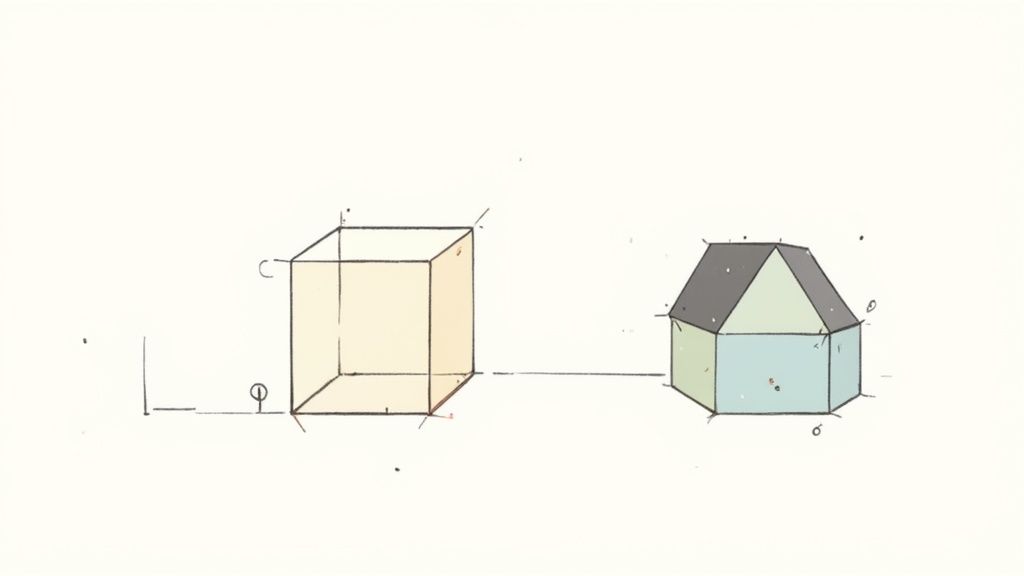
In fifth grade, geometry moves beyond simple shape identification into the realm of spatial reasoning and property analysis. This area of math problems for 5th graders develops critical thinking by asking students to analyze, compare, and manipulate 2D and 3D shapes. Mastering these concepts is fundamental for understanding the physical world and provides a visual foundation for more complex mathematical ideas.
These problems encourage students to think about space, dimension, and properties. Following frameworks like the van Hiele model, the curriculum guides students from recognizing shapes to analyzing their attributes, such as angle types and side lengths. This builds essential measurement literacy and problem-solving skills that apply to both art and science.
Example Problems
Real-world scenarios make geometric concepts tangible and relevant, helping students connect abstract ideas to practical applications.
- Garden Design: You are designing a rectangular garden that is 12 feet long and 8 feet wide. What is its perimeter and area? If you want to build a similar garden with double the perimeter, what could its new dimensions be?
- Building with Nets: A net for a cube has six identical squares. If the side length of one square is 5 cm, what is the surface area of the cube when it is assembled?
- Coordinate Mapping: Plot the following points on a coordinate grid: A(2,1), B(2,5), and C(6,1). Connect the points to form a triangle. What type of triangle is it? Calculate its area.
How to Implement and Teach
An effective approach to teaching geometry involves hands-on exploration that allows students to discover properties for themselves.
Teaching Tip: Combine geometry with art projects. Task students with creating a cityscape using only polygons or designing mosaics with specific angle constraints. This not only reinforces geometric concepts but also boosts creativity and engagement. For an interesting exploration of forms, you might find inspiration in different types of abstract geometric shapes.
- Use Physical Manipulatives: Tools like geoboards, pattern blocks, and 3D solids are indispensable. They allow students to physically construct shapes, test hypotheses about their properties, and visualize concepts like volume and surface area.
- Leverage Technology: Interactive geometry software (like GeoGebra) enables students to manipulate shapes digitally, measure angles precisely, and explore transformations like rotations and reflections in a dynamic way.
- Connect to Architecture: Show examples of local buildings or famous structures and have students identify the geometric shapes and principles used in their design. This makes geometry feel both practical and inspiring.
5. Data Analysis, Graphing, and Probability
In fifth grade, math expands to include the skills needed to interpret the world around us. This category of math problems for 5th graders introduces students to the fundamentals of data science and statistical thinking. They learn to collect, organize, represent, and interpret data, moving from raw numbers to meaningful conclusions.
These problems are critical for developing statistical literacy, an essential skill in an information-rich society. The focus is on turning abstract data sets into visual stories through graphs and charts, and understanding the basics of chance. This aligns with standards from the National Council of Teachers of Mathematics and the Common Core, which emphasize real-world data application.
Example Problems
Practical, engaging scenarios help students see the immediate relevance of data analysis and probability in their daily lives.
- Class Survey: A 5th-grade class surveys its students' favorite ice cream flavors: Chocolate (12 votes), Vanilla (6 votes), Strawberry (5 votes), and Mint (2 votes). Create a bar graph to represent the data and determine what fraction of the class chose Chocolate.
- Weather Watch: The daily high temperatures for a week were: 72°F, 75°F, 68°F, 75°F, 78°F, 80°F, 76°F. What is the mean (average), median, and range of the temperatures?
- Spinner Game: A spinner is divided into 8 equal sections: 4 are red, 3 are blue, and 1 is yellow. What is the probability of the spinner landing on blue? Express your answer as a fraction. Is it more or less likely to land on red than blue?
How to Implement and Teach
Teaching data analysis is most effective when it is interactive and hands-on, allowing students to become data collectors and analysts themselves.
Teaching Tip: Always start with a question. Instead of just presenting a dataset, ask a compelling question like, "What is the most common birth month in our class?" This gives students a purpose for collecting and analyzing the data, making the process more engaging.
- Conduct Physical Experiments: For probability, move beyond worksheets. Use dice, coins, and spinners for students to conduct their own experiments. Have them record their results and compare them to the theoretical probability.
- Use Real-World Data: Connect lessons to current events or student interests. Use sports statistics, population data, or survey results from kid-focused websites to create relevant and compelling math problems for 5th graders.
- Teach Graphing Conventions Explicitly: Insist on proper graphing habits from the start. This includes titles, labeled axes (with units), consistent scales, and a key or legend. These details are crucial for clear communication of data.
6. Factors, Multiples, and Number Theory
Diving into factors, multiples, and basic number theory provides 5th graders with the tools to understand how numbers are constructed and related. This category of math problems for 5th graders moves beyond simple arithmetic to explore the underlying structure of numbers, which is essential for simplifying fractions and grasping algebraic concepts later on.
These problems focus on divisibility, prime and composite numbers, and finding the Greatest Common Factor (GCF) and Least Common Multiple (LCM). Curricula like Eureka Math and the Singapore Math approach emphasize this area as it builds number sense and analytical thinking, allowing students to see patterns and relationships between numbers.
Example Problems
To make these abstract concepts tangible, problems are often framed around grouping, scheduling, and distribution scenarios that require logical reasoning.
- Event Planning: A school is preparing emergency kits. They have 48 water bottles and 36 granola bars to distribute equally among the kits, with nothing left over. What is the greatest number of kits they can prepare? (GCF)
- Scheduling: A red bus and a blue bus both start their routes at 8:00 AM from the same station. The red bus completes its route in 12 minutes, and the blue bus completes its route in 15 minutes. When will they next be at the station at the same time? (LCM)
- Number Puzzles: I am a number between 20 and 30. I am a multiple of 3 and a factor of 48. What number am I?
How to Implement and Teach
Teaching number theory effectively relies on visual and hands-on methods that allow students to discover patterns for themselves.
Teaching Tip: Use factor trees to visually break down composite numbers into their prime factors. This technique makes the concept of prime factorization intuitive and provides a reliable method for finding the GCF and LCM of larger numbers.
- Use Visual Models: Employ arrays and area models to represent factors. For instance, show that the number 12 can be arranged into rectangles of 1x12, 2x6, and 3x4, visually demonstrating its factor pairs.
- Discover Divisibility Rules: Instead of just giving students the rules for divisibility (by 2, 3, 5, 10, etc.), guide them to discover the patterns themselves using a hundreds chart. This inquiry-based approach fosters deeper understanding.
- Connect to Real Scenarios: Constantly link GCF and LCM to real-world situations. GCF is about "grouping" or "sharing" things into the largest possible equal sets, while LCM is about finding a "meeting point" in repeating cycles.
7. Measurement and Unit Conversion
In fifth grade, measurement evolves from simple length and weight to a more complex understanding of systems and conversions. This area of math problems for 5th graders teaches students how to navigate both the U.S. customary system (inches, pounds) and the metric system (meters, grams), and crucially, how to convert between units within each system. It’s a practical skill with immediate real-world applications.
These problems require students to apply multiplication and division with whole numbers, fractions, and decimals, making it a powerful topic for integrating various mathematical concepts. This emphasis on practical application is a key feature in modern curricula like Eureka Math and the Common Core State Standards, which aim to develop fluid and flexible mathematical thinking.
Example Problems
To ground these abstract conversion rules, problems are best presented in contexts that students recognize from their daily lives, sports, or hobbies.
- Recipe Conversion: A recipe for a large batch of soup calls for 3.5 liters of broth. If you want to put the soup into 250-milliliter containers, how many containers will you need?
- Track and Field: A runner completes a 5-kilometer race. How many meters did they run? If a single lap on the track is 400 meters, how many full laps did they complete?
- Home Improvement: A new bookshelf needs to be exactly 3 feet 4 inches long to fit in an alcove. How long is the bookshelf in inches only?
- Science Experiment: A lab procedure requires 2 grams of a chemical. Your scale only measures in milligrams. How many milligrams do you need?
How to Implement and Teach
Teaching measurement and conversion effectively means anchoring the math in physical reality. Students should measure, pour, and weigh objects before focusing on the abstract formulas.
Teaching Tip: Have students create their own reference charts. Rather than just handing them a conversion table, guide them to build one. This act of creation, such as noting that 1 meter = 100 centimeters = 1,000 millimeters, deepens their understanding and ownership of the relationships.
- Use Hands-On Tools: Bring in rulers, meter sticks, measuring cups, and scales. Task students with measuring objects around the classroom. This hands-on practice makes units like centimeters and fluid ounces tangible concepts.
- Connect Conversions to Operations: Explicitly show that converting from a larger unit to a smaller unit involves multiplication (e.g., feet to inches, multiply by 12), while converting from a smaller unit to a larger one involves division (e.g., ounces to pounds, divide by 16).
- Estimate Before Calculating: Encourage students to develop a sense of scale. Before converting 5 feet to inches, ask, "Will the number be bigger or smaller than 5?" This simple step helps them catch errors and reinforces the logic behind the operation.
8. Order of Operations and Algebraic Thinking
In fifth grade, students transition from single-step problems to complex expressions involving multiple operations. This is where the order of operations and foundational algebraic thinking become critical. These math problems for 5th graders are designed to build a systematic approach to solving equations, laying the groundwork for middle school algebra and beyond.
Introducing concepts like PEMDAS (Parentheses, Exponents, Multiplication and Division, Addition and Subtraction) provides students with a reliable framework. This prevents the common confusion that arises when an expression like 3 + 5 x 2 can yield different answers. This structured approach is a key component of frameworks like the Common Core State Standards and Eureka Math, which emphasize procedural fluency alongside conceptual understanding.
Example Problems
These problems often use real-world scenarios to illustrate why a specific sequence of operations is necessary for a correct outcome.
- Financial Calculations: You save $15 each week for 4 weeks. From your savings, you buy a book for $12 and a toy for $8. Write and solve a single expression to show how much money you have left. (e.g., (15 x 4) - (12 + 8))
- Formula-Based Calculations: The formula for the perimeter of a rectangle is P = 2L + 2W. If a field is 50 meters long (L) and 20 meters wide (W), what is its perimeter?
- Pattern Recognition: A pattern starts with the number 5 and follows the rule "multiply by 2, then add 3." What are the next three numbers in the sequence?
How to Implement and Teach
Teaching the order of operations requires making abstract rules feel logical and necessary. Similarly, introducing variables should feel like solving a puzzle rather than memorizing syntax.
Teaching Tip: Emphasize that Multiplication/Division and Addition/Subtraction are "partner" operations performed from left to right. Many students mistakenly believe multiplication always comes before division. Clarifying this is crucial for accuracy.
- Use Mnemonics Wisely: Mnemonics like "Please Excuse My Dear Aunt Sally" (PEMDAS) are effective memory aids. Create a poster in the learning area and have students recite it as they work through problems.
- Connect to Real-World Scenarios: Show why order matters with a simple story: "You earn $10, then you buy a snack for $3 and another for $2. Is that
10 - 3 + 2or10 - (3 + 2)?" This makes the role of parentheses tangible. - Introduce Variables as "Mystery Numbers": Use a box or a question mark (e.g., 5 + ☐ = 12) before introducing letters like 'x'. This helps students grasp the concept of an unknown value without the intimidation of formal algebraic notation. This pre-algebraic step is fundamental to solving complex word problems. Learn more about how to tackle algebraic word problems here.
5th Grade Math: 8-Topic Comparison
| Topic | Implementation complexity | Resource requirements | Expected outcomes | Ideal use cases | Key advantages |
|---|---|---|---|---|---|
| Fractions and Decimals | Medium — abstract concepts and conversions | Manipulatives (fraction bars/circles), visual models, real-world items | Conceptual understanding of parts of wholes; conversion fluency | Introducing fractions/decimals, cooking/measurement contexts, prep for algebra | Builds deep number sense; multiple representations aid diverse learners |
| Multi-Digit Multiplication and Division | Medium–High — multi-step algorithms and place-value focus | Grid paper, manipulatives, calculators for checking, visual area models | Computational fluency with multi-digit operations; estimation skills | Bulk calculations, area/volume problems, procedural fluency practice | Multiple strategies support different learners; strong link to geometry |
| Word Problems and Problem-Solving Strategies | High — requires language comprehension and multi-step reasoning | Rich text problems, teacher modeling, think-alouds, real contexts | Improved reasoning, strategy use, and communication of solutions | Real-world scenarios, cross-curricular tasks, higher-order thinking practice | Develops transferable problem-solving and perseverance |
| Geometry and Spatial Reasoning | Medium — visual-spatial skills and transformations | Tangrams, geoboards, 3D models, GeoGebra or other tech | Spatial visualization, area/volume calculation, shape properties | Design projects, architecture, hands-on geometry lessons | Highly engaging; supports STEM and kinesthetic learners |
| Data Analysis, Graphing, and Probability | Medium — interpretation skills and experimental setup | Graphing tools, spreadsheets, survey tools, manipulatives for experiments | Data literacy: graphing, measures of center, basic probability understanding | Science/society data projects, surveys, interpreting real datasets | Real-world relevance; interdisciplinary and critical thinking benefits |
| Factors, Multiples, and Number Theory | Low–Medium — pattern recognition and procedural practice | Arrays, factor trees, games, manipulatives | Improved number sense, prime/composite identification, GCF/LCM skills | Fraction simplification, scheduling/packing problems, number puzzles | Builds foundation for fractions and efficient computation |
| Measurement and Unit Conversion | Medium — many units and conversion factors | Rulers, scales, measuring cups, reference charts, real objects | Measurement literacy, unit conversion, dimensional reasoning | Cooking, construction, science labs, travel/time calculations | Practical, real-world applications; strengthens magnitude understanding |
| Order of Operations and Algebraic Thinking | Medium–High — rules plus introduction to abstraction | Worksheets, balance models, calculators, symbolic practice | Correct evaluation of expressions, early algebraic reasoning, variable use | Pre-algebra preparation, formula application, symbolic manipulation | Essential foundation for algebra; teaches structured logical rules |
Building Lasting Math Confidence
Navigating the diverse landscape of fifth-grade mathematics is a significant milestone in a student's academic journey. The collection of math problems for 5th graders presented throughout this guide, from mastering multi-digit multiplication to exploring the complexities of geometry and data analysis, serves a purpose far greater than simply preparing for a test. It’s about building a robust foundation of critical thinking, problem-solving, and analytical reasoning that will prove invaluable in middle school, high school, and beyond.
By consistently engaging with these varied problems, students don't just learn formulas; they learn a flexible approach to challenges. They begin to see that a single problem can often be solved in multiple ways, fostering creativity and resilience. This process transforms math from a rigid set of rules into a dynamic and logical puzzle waiting to be solved.
Key Takeaways for Lasting Success
As you move forward, remember these core principles to cultivate a positive and productive math environment:
- Variety is a Superpower: Regularly mix different types of problems. A student who only practices fractions may struggle when faced with a multi-step word problem that incorporates decimals and measurement. The variety builds mental agility and reinforces the interconnectedness of mathematical concepts.
- Process Over Perfection: Shift the focus from just getting the right answer to understanding the process. Encourage students to explain their thinking, draw diagrams, and even articulate where they got stuck. This metacognitive practice is where true, lasting learning happens.
- Real-World Connections: Always strive to connect abstract concepts to tangible, real-world scenarios. Calculating the area of a room before rearranging furniture or using fractions to adjust a recipe makes math relevant and less intimidating. These connections bridge the gap between classroom exercises and practical application.
Actionable Next Steps for Parents and Educators
To continue building on this momentum, consider implementing these strategies. First, establish a consistent but brief daily practice routine. Just 15-20 minutes of focused work on a few well-chosen math problems for 5th graders can be more effective than a single, lengthy session. This approach prevents burnout and helps solidify concepts through regular reinforcement.
Second, embrace technology as a supportive tool, not a crutch. When a student is truly stuck, an AI-powered tool can provide the step-by-step guidance needed to overcome a hurdle without simply giving away the answer. This helps maintain motivation and empowers students to become more independent learners.
Finally, consider creating your own supplementary learning materials. For parents and educators who want to provide more customized visual aids, learning how to edit educational videos for children can be a powerful way to explain difficult concepts. A short, engaging video that walks through a geometry proof or a tricky word problem can make a world of difference for a visual learner, reinforcing key ideas in a format they enjoy.
Ultimately, the goal is to foster an environment where curiosity is encouraged, mistakes are viewed as learning opportunities, and every solved problem is a celebrated victory. This positive reinforcement, combined with consistent practice across the core areas we've covered, will build not just mathematical proficiency, but unshakable confidence that empowers students to tackle any challenge that comes their way.
Is your 5th grader stuck on a tricky math problem? Don't let frustration halt their progress. Get instant, step-by-step homework help with Feen AI by simply snapping a photo of the problem. Try Feen AI today and transform homework hurdles into learning opportunities.
Relevant articles

Tired of the homework battles? Learn how to motivate kids to study with practical strategies that build focus, resilience, and a genuine love for learning.

Discover how to use AI for studying with proven strategies that actually work. Learn to leverage AI study tools to ace exams and understand complex topics.

Discover how AI powered study tools are changing education. Learn how to choose the right AI helper, use it ethically, and study smarter for any subject.
Master key concepts with our detailed list of math problems for 7th graders. Includes examples, step-by-step solutions, and study tips for success.
Master core concepts with these essential math problems for 6th graders. Includes free worksheets, solutions, and tips to build confidence and skills.
Discover the best platforms with quality math problems for 3rd graders. Find free worksheets, online games, and challenging problem sets to boost skills.