The 10 Best Way to Study for Finals: A 2026 Evidence-Based Guide
Unlock the best way to study for finals with 10 evidence-based strategies. Our guide covers everything from active recall to using Feen AI for success.

Finals week often feels like a desperate race against the clock, fueled by caffeine and last-minute cramming sessions that promise more anxiety than comprehension. But what if there was a better, more effective way? The critical difference between just surviving your final exams and truly acing them isn't about studying harder or pulling more all-nighters. It's about studying smarter. The most successful students don't rely on luck; they rely on a strategic system built from proven, evidence-based learning techniques.
This guide is designed to be that system. We are moving beyond the generic, surface-level advice you’ve heard a thousand times and diving deep into the cognitive science of how we actually learn and retain complex information. Forget vague tips like ‘get enough sleep’ or ‘stay organized.’ Instead, we've compiled the 10 best ways to study for finals, breaking down each powerful method into concrete, actionable steps you can implement immediately.
You will learn how to leverage powerful strategies like Active Recall, Interleaving, and the Feynman Technique to build deep, lasting knowledge that sticks long after the exam is over. We'll provide specific examples, show you how to avoid common pitfalls, and demonstrate how to integrate modern tools like Feen AI to enhance your preparation. Whether you're tackling complex calculus problems, memorizing biological pathways, or analyzing dense historical texts, this comprehensive roundup will help you transform your approach from a frantic sprint into a confident, well-paced marathon. Let's get started.
1. Active Recall and Spaced Repetition
The single most effective and evidence-backed technique for finals preparation is the combination of active recall and spaced repetition. Instead of passively re-reading textbooks or highlighting notes, this method forces your brain to actively retrieve information, which strengthens neural connections and embeds knowledge into your long-term memory. It’s the difference between recognizing a concept and truly knowing it.
Spaced repetition complements this by scheduling reviews at increasing intervals. You review material just as you're about to forget it, interrupting the natural "forgetting curve" identified by psychologist Hermann Ebbinghaus. This process makes learning far more efficient than cramming, solidifying your understanding over time. This approach is arguably the best way to study for finals because it builds durable, accessible knowledge.
How to Implement This Strategy
To put this powerful duo into practice, focus on activities that require you to pull information out of your brain without looking at your notes.
- Flashcards (Digital or Physical): Use apps like Anki or Quizlet, which have built-in algorithms for spaced repetition. Create cards with a single question or term on one side and the answer on the other.
- Practice Tests: Don't just read through your study guide. Turn it into a blank practice test and try to answer the questions from memory. Schedule retakes of these tests every few days.
- The Feynman Technique: Try to explain a complex topic in simple terms, as if you were teaching it to someone else. This act of verbal retrieval quickly reveals gaps in your understanding.
Key Insight: The goal isn't just to review information; it's to force a "desirable difficulty" on your brain. The struggle to remember is what makes the memory stronger.
For a deeper dive into one of the most effective memory-enhancing techniques, explore the principles of the spaced repetition study method.
Actionable Tips
- Start Early: This method requires time. Begin creating your study materials and doing your first recall sessions at least three weeks before finals.
- Leverage AI: Use Feen AI to generate practice questions from your lecture notes or PDF textbooks. Paste your content and ask it to create multiple-choice, short-answer, and true/false questions.
- Mix It Up: In a single study session, mix different subjects or topics (a practice called interleaving). This makes retrieval more challenging and effective.
2. Practice Problems and Problem-Solving
For quantitative and technical subjects like math, physics, chemistry, and economics, passive reading is simply not enough. The best way to study for finals in these fields is through deliberate practice. Engaging directly with practice problems builds procedural fluency, helping you move beyond memorizing formulas to understanding how and when to apply them. It’s the active application of theory that forges deep comprehension and exam-day confidence.
This method works by training your brain to recognize problem types and execute the correct sequence of steps to find a solution. Repeatedly working through exercises solidifies the underlying logic, making your response faster and more accurate under pressure. It transitions your knowledge from a fragile, abstract concept into a reliable, practical skill, which is crucial for exams that test application over memorization.
How to Implement This Strategy
To effectively prepare, you must simulate the cognitive demands of the final exam by actively solving problems from various sources.
- Textbook Problem Sets: Don't just do the assigned homework. Go back and work through problems from every chapter that will be on the final, especially the more challenging ones at the end.
- Past Exam Papers: If available, past exams are a goldmine. They give you a direct look at the format, scope, and difficulty you can expect. Treat them like a real test.
- Online Platforms: Use resources like Khan Academy or Chegg for an endless supply of practice questions and worked-out solutions to check your understanding.
Key Insight: Don't just aim to get the right answer. Focus on understanding the process and reasoning behind the solution so you can adapt it to unfamiliar problems on the exam.
For a more detailed guide on mastering this skill, you can learn how to improve your problem-solving skills with structured techniques.
Actionable Tips
- Keep an Error Log: Maintain a notebook where you document every mistake you make on practice problems. Write down the problem, your incorrect solution, and the correct methodology. Review this log regularly.
- Simulate Exam Conditions: Set a timer when working through a set of problems to get used to the time pressure of the actual final.
- Use AI for Guidance: When you're stuck on a difficult problem, upload a screenshot to Feen AI. Ask it to provide a step-by-step breakdown of the solution without giving away the final answer immediately.
3. Elaboration and Explanation Method
Understanding a concept goes beyond memorization; it requires connecting new information to what you already know. The elaboration and explanation method forces this connection by making you articulate concepts in your own words. Often called the Feynman Technique, this approach involves simplifying complex topics to their core components, which reveals the true depth of your comprehension.
This method is powerful because it shifts you from a passive consumer of information to an active creator of knowledge. When you try to teach a concept, you are forced to organize your thoughts, identify logical connections, and pinpoint areas where your understanding is weak. This process of constructing an explanation is one of the most effective ways to build a strong, flexible mental model of the material, making it a cornerstone strategy for how to study for finals.
How to Implement This Strategy
To use elaboration effectively, your goal is to process and re-package information, not just repeat it. The act of simplification and rephrasing is what consolidates learning.
- Teach a Concept: Find a study partner, a friend, or even an empty chair and explain a difficult topic from your class. Pay attention to where you stumble or have to say "it's just a rule."
- Write Simplified Summaries: After reading a chapter, close the book and write a one-paragraph summary in the simplest terms possible. Avoid jargon.
- Create Concept Maps: Visually map out how different ideas connect to each other. Use nodes for concepts and lines with labels to explain the relationships between them.
- Explain Problem Steps Aloud: As you work through a math or science problem, narrate each step and the reason behind it. This verbal processing can help clarify your logic.
Key Insight: If you cannot explain an idea in simple terms, you haven't truly understood it. The struggle to simplify is where the deepest learning happens.
This technique helps you move beyond rote memorization and towards a more profound, integrated understanding of your subjects.
Actionable Tips
- Start with a Blank Slate: Always try to write or speak your explanation without first looking at your notes or textbook. Refer back to the material only to fill in the gaps you discovered.
- Record Yourself: Use your phone to record a 5-minute explanation of a major topic. Listening back is an excellent way to critique your own clarity and accuracy.
- Leverage AI: Paste your written explanation into Feen AI and ask it to "evaluate this explanation for clarity and accuracy" or "rephrase this concept in a different way."
- Use Analogies: Try to connect a new, abstract concept to something concrete you already understand well. For example, explain voltage using an analogy of water pressure.
4. Chunking and Mind Mapping
Your brain can only process a limited amount of information at once, a concept famously explored by cognitive psychologist George A. Miller. The chunking method works around this limitation by breaking down large, intimidating topics into smaller, related groups or "chunks." This strategy makes complex information more digestible and easier to commit to memory.
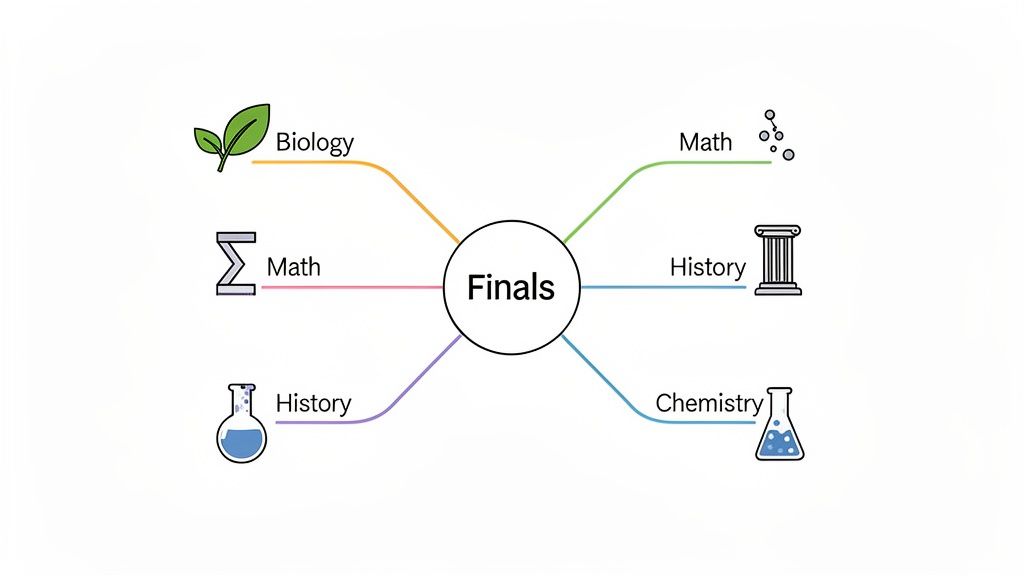
Mind mapping complements this perfectly by organizing those chunks visually. Popularized by Tony Buzan, this technique uses a central idea with branches for related concepts, mirroring how your brain naturally links information. Combining these two techniques is one of the best ways to study for finals because it transforms disorganized notes into a logical, interconnected web of knowledge that is far easier to recall under pressure.
How to Implement This Strategy
To use chunking and mind mapping, shift your focus from memorizing individual facts to understanding relationships and hierarchies within the material. This approach builds a mental framework for your knowledge.
- Mind Maps (Digital or Physical): Start with a central topic (e.g., "The Cold War") and create main branches for key themes (Causes, Key Events, Major Figures, Aftermath). Use tools like MindMeister or XMind to create and edit maps easily.
- Chunk Information Logically: Instead of trying to memorize 20 different chemistry formulas at once, group them into chunks based on their function, such as "Gas Law Formulas" or "Acid-Base Formulas."
- Outline Essays and Concepts: Structure an essay outline by creating chunks for your introduction, main body paragraphs, and conclusion. Each body paragraph becomes a chunk with its own topic sentence and supporting evidence.
Key Insight: Information is retained more effectively when it's organized. Chunking provides the structure, and mind mapping provides the visual map to navigate that structure.
Actionable Tips
- Start Small: Build your mind maps progressively throughout your study period rather than trying to create a massive one right before the exam.
- Use Visual Cues: Incorporate colors, symbols, and images into your mind maps to engage visual memory and make connections more distinct.
- Leverage AI for Chunking: If you have a dense textbook chapter, upload the PDF to Feen AI and ask it to "summarize this content into logical chunks or key thematic sections." This quickly provides a structured outline.
- Keep Chunks Manageable: Aim to group information into chunks of 3-5 items. Any more can lead to cognitive overload and defeat the purpose of the technique.
5. Interleaving and Mixed Practice
While it feels intuitive to master one topic before moving to the next (known as "blocking"), research shows that mixing different subjects or problem types within a single study session is far more effective. This method, called interleaving, forces your brain to constantly switch gears, identify the correct strategy for each problem, and make connections between different concepts. It moves beyond simple memorization to build true problem-solving agility.
Blocking your study, such as doing 50 calculus problems of the same type, creates a false sense of fluency. Interleaving creates a "desirable difficulty" by forcing your brain to work harder to retrieve and apply the right solution, which strengthens long-term retention. For students facing comprehensive exams that cover an entire semester's worth of material, this is one of the best ways to study for finals because it mirrors the mixed-up nature of the test itself.
How to Implement This Strategy
The key to interleaving is to avoid long, repetitive drills of a single concept. Instead, create practice sets that require your brain to be flexible and discriminate between different problem types.
- Mixed Problem Sets: Instead of completing all your integration by parts problems before moving to substitution, create a worksheet that mixes them up randomly. This forces you to identify the problem type first, then apply the solution.
- Topic Rotation: Study chemistry for 30 minutes, then switch to a 30-minute block on biology, followed by physics. This prevents mental fatigue and helps you make cross-curricular connections.
- Historical Themes: When studying for a history final, don't just review one time period chronologically. Instead, answer essay prompts that compare and contrast leadership styles or economic policies across different eras.
Key Insight: Interleaving feels harder and less productive in the moment, but this struggle is precisely what leads to deeper, more durable learning and better performance on the actual exam.
Actionable Tips
- Start Small: Begin by mixing just two related topics, like different types of chemical reactions, before expanding to three or more distinct subjects.
- Generate Mixed Quizzes: Use Feen AI to create practice quizzes from your notes. Ask it to "create a 20-question quiz with a mix of multiple-choice and short-answer questions from Chapter 3, 5, and 8."
- Analyze Your Errors: When you get a mixed problem wrong, ask yourself: Did I misunderstand the concept, or did I apply the wrong strategy? This helps diagnose weaknesses more effectively.
6. The Pomodoro Technique and Strategic Breaks
Maintaining focus over long study sessions is a major challenge during finals, leading to burnout and diminished returns. The Pomodoro Technique provides a structured framework to combat this by breaking work into focused, timed intervals. This time management method, developed by Francesco Cirillo, uses a timer to create 25-minute sprints of deep work followed by short, rejuvenating breaks.
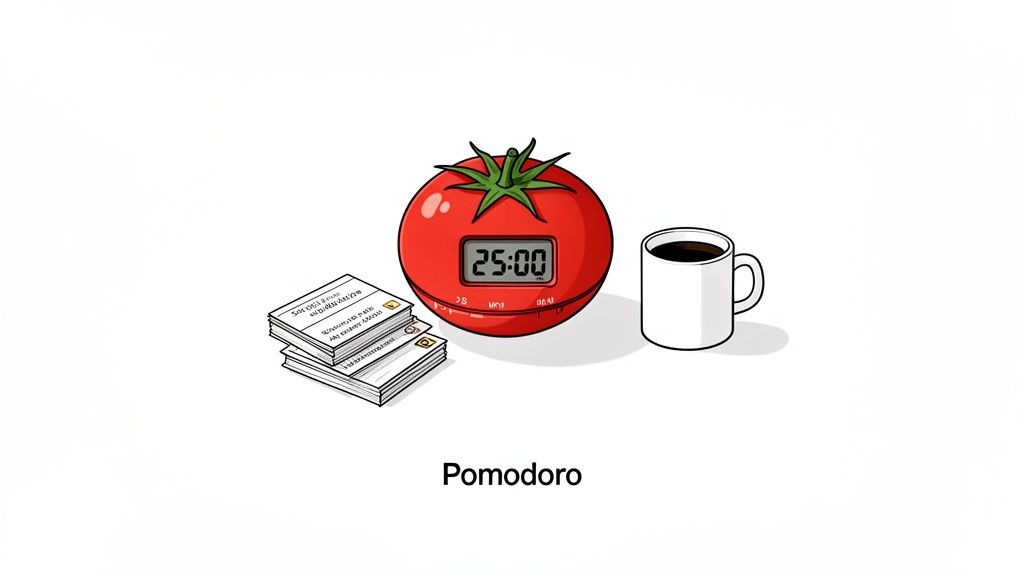
This cyclical approach keeps your mind fresh and engaged, preventing the mental fatigue that often derails marathon study sessions. By making large tasks feel less daunting and building momentum through small, consistent wins, this technique is a powerful tool for overcoming procrastination. It transforms studying from an endless slog into a manageable series of focused bursts, making it one of the best ways to study for finals efficiently.
How to Implement This Strategy
Implementing this technique is straightforward and requires minimal setup. The core idea is to fully commit to a single task during each interval and to respect the break periods as essential recovery time.
- Set Your Timer: Use a physical kitchen timer or a dedicated app like Forest or Be Focused. Set it for 25 minutes and work on a single, pre-defined task without any interruptions.
- Take Short Breaks: When the timer rings, take a mandatory 5-minute break. Step away from your desk, stretch, get some water, or simply rest your eyes.
- Take Longer Breaks: After completing four "pomodoros" (four 25-minute work intervals), take a longer break of 15-30 minutes. This is a chance to fully reset before beginning the next cycle.
Key Insight: The breaks are not optional; they are a critical component of the technique. They prevent burnout and allow your brain to consolidate information, making subsequent study sessions more effective.
For those looking to implement structured study sessions with strategic breaks, you can find a simple guide to the Pomodoro Technique to get started.
Actionable Tips
- Eliminate Distractions: During a 25-minute Pomodoro, your phone should be on silent and out of sight. Close irrelevant browser tabs and disable notifications to maintain deep focus.
- Be Active During Intervals: Use your intervals for active tasks, such as solving a set of practice problems or outlining an essay, rather than passive reading. This maximizes the high-focus window.
- Plan Your Pomodoros: Before you start, list the tasks you need to accomplish and estimate how many pomodoros each will take. This creates a clear roadmap for your study session.
7. Summarization and Note-Taking Systems
Moving beyond simple transcription, a strategic note-taking system transforms lectures and readings into powerful learning tools. The act of organizing and rephrasing information as you receive it helps encode it more deeply. This process forces you to identify main ideas, hierarchies, and connections, creating a structured reference document for later review.
Effective summarization complements this by requiring you to synthesize large volumes of content into concise, high-value formats. Creating a one-page summary for an entire chapter isn't just about making a cheat sheet; it's an active learning exercise that solidifies your grasp of the material. This combination of structured intake and thoughtful synthesis is a highly effective way to study for finals, ensuring you don't just possess notes, but truly understand them.
How to Implement This Strategy
Choose a system that aligns with your course material and personal learning style. The key is to be an active participant, not a passive recorder.
- The Cornell Note-Taking System: Divide your page into three sections: a main area for notes, a smaller column on the left for cues or questions, and a summary section at the bottom. This structure is excellent for post-lecture review and self-quizzing.
- The Outline Method: Organize information hierarchically using main points, sub-points, and further details. This is ideal for lectures that follow a clear, logical structure.
- Concept Mapping: Create a visual diagram that links concepts and ideas. This method is particularly useful for subjects where relationships between topics are more important than linear sequences.
Key Insight: Your notes should not be a word-for-word transcript. They are a personalized, processed version of the information, filtered through your own understanding to make retrieval easier.
For a more comprehensive guide on condensing complex material, you can explore techniques on how to effectively summarize book chapters.
Actionable Tips
- Review and Revise Within 24 Hours: Revisit your notes shortly after taking them to fill in gaps and clarify points while the information is still fresh in your mind.
- Summarize in Your Own Words: When creating summaries, avoid lifting sentences directly from the text. Rephrasing forces you to process the information, which is a crucial step for long-term retention.
- Use AI for Verification: After taking notes on a topic, ask Feen AI to generate a summary of the same concept from your textbook PDF. Compare it with your notes to identify any misunderstandings or missed information.
8. Study Groups and Collaborative Learning
Leveraging the power of social learning can dramatically enhance your finals preparation. Studying with peers introduces new perspectives, reinforces knowledge through teaching, and builds a crucial accountability system. Instead of struggling with difficult concepts alone, collaborative learning allows you to hear alternative explanations and fill knowledge gaps you might not have noticed on your own. This method turns studying from a solitary chore into a dynamic, interactive process.
This approach is effective because explaining a concept to someone else is a powerful form of active recall. It forces you to organize your thoughts coherently and identify the core principles of a topic. Structured group study, where members are prepared and focused, is one of the best ways to study for finals because it combines individual accountability with the benefit of collective brainpower, making complex material more manageable.
How to Implement This Strategy
To make group study productive, it must be structured and goal-oriented. Avoid unstructured hangouts that can easily devolve into social time.
- Structured Problem-Solving Circles: Form a small group (3-5 people) to tackle challenging problem sets or past exam questions together. Work on a problem individually first, then come together to discuss solutions and methods.
- Peer Tutoring Partnerships: Pair up with a classmate. You can divide subjects based on strengths or agree to teach each other every topic, ensuring both of you achieve mastery.
- Online Study Groups: Use platforms like Zoom or Discord to hold regular meetings. Shared screens and digital whiteboards are excellent tools for collaborative note-taking and problem-solving.
Key Insight: The true value of a study group isn't just getting answers; it's the process of arriving at those answers together. Explaining your reasoning to others is one of the most effective ways to solidify your own understanding.
Actionable Tips
- Set a Clear Agenda: Before each meeting, create and share an agenda outlining the specific topics, chapters, or problems you will cover. Stick to it.
- Assign Topics: Assign a different topic or chapter to each member to present to the group. This ensures everyone comes prepared to contribute value.
- Use an AI Mediator: When disagreements or uncertainties arise, use Feen AI to get an objective, data-backed explanation or to verify an answer. This keeps the session moving forward productively.
- Keep it Small: Ideal study groups have 3 to 5 members. This size is large enough for diverse perspectives but small enough to ensure everyone participates.
9. Testing Effect and Practice Exams
One of the most powerful, research-backed study methods is harnessing the "testing effect." This cognitive science principle demonstrates that the act of retrieving information from memory (i.e., taking a test) strengthens long-term learning far more effectively than simply re-reading or reviewing the material. Taking practice exams is the ultimate application of this effect, serving as both a diagnostic tool and a potent study session.
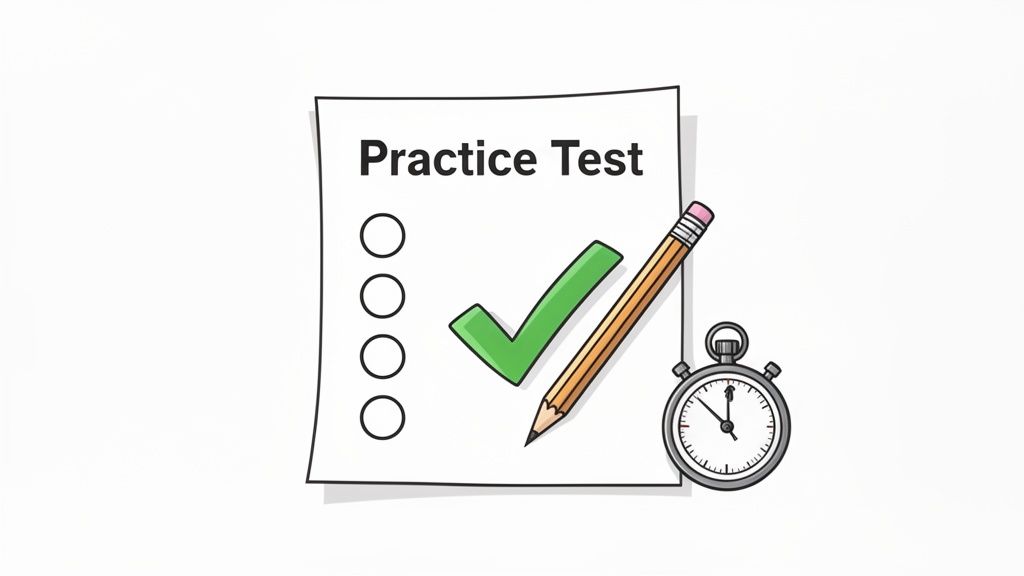
Instead of waiting for the final exam to test your knowledge, you proactively simulate the experience. This approach not only solidifies concepts but also builds mental stamina, reduces exam anxiety, and exposes specific weaknesses before it’s too late. Researchers like Henry Roediger and Jeffrey Karpicke proved that this active retrieval is a cornerstone of an effective study plan, making it a non-negotiable part of preparing for finals.
How to Implement This Strategy
The key is to treat practice tests as serious dress rehearsals, not just casual reviews. The goal is to mimic the pressure and constraints of the real exam to get the most benefit.
- Official Practice Exams: Use past exams provided by your professor or official practice materials for standardized tests (like the SAT, AP, or GRE). These are the gold standard for realism.
- Full-Length Simulations: About one to two weeks before finals, set aside a block of time to take a full-length practice exam under strict, timed conditions. No notes, no phone, just you and the test.
- End-of-Chapter Quizzes: Throughout the semester, treat end-of-chapter quizzes and problem sets as mini-tests. Cover the answers and solve them from memory first.
Key Insight: A practice test is not just a tool for assessment; it is a powerful learning event. The process of struggling to recall an answer is what cements it in your memory.
For those looking to refine their performance under pressure, it's beneficial to learn how to improve your test-taking skills with targeted strategies.
Actionable Tips
- Establish a Baseline: Take your first practice test early on (at least three weeks before the final) to identify your initial strengths and weaknesses. This will guide your entire study plan.
- Simulate Exam Conditions: Find a quiet space and set a timer. Adhering to the real exam's time limits helps you practice pacing and manage stress.
- Analyze Your Mistakes: Immediately after a practice test, review every incorrect answer. Don’t just look at the right answer; understand why you made the mistake and what concept you need to revisit.
- Use AI for Explanations: If you're stuck on why you missed a problem, paste it into Feen AI and ask for a detailed, step-by-step explanation of the correct solution and underlying concept.
10. Metacognition and Error Analysis
Studying smarter, not just harder, hinges on metacognition: the practice of thinking about your own thinking. This strategy involves actively monitoring your level of understanding, identifying knowledge gaps, and adjusting your study plan accordingly. It transforms you from a passive learner into an active strategist who directs their own educational journey, making it a critical component of the best way to study for finals.
Paired with metacognition, error analysis is the process of systematically reviewing your mistakes to understand their root cause. Instead of just noting an answer was wrong, you diagnose why it was wrong. Was it a simple careless mistake, a misunderstanding of a procedure, or a deep conceptual gap? This diagnostic approach ensures you fix the underlying problem rather than just memorizing the correct answer for one specific question.
How to Implement This Strategy
To integrate metacognition and error analysis, you need to build reflection into your study routine. The goal is to create a feedback loop that continually refines your focus.
- Create an Error Log: After a practice test, don't just check your score. Create a log (a simple spreadsheet or notebook) with columns for the question, your incorrect answer, the correct answer, and the "error category" (careless, procedural, or conceptual).
- Rate Your Confidence: As you answer practice questions, rate your confidence in each answer on a scale of 1 to 5. After grading, pay special attention to questions you were confident about but answered incorrectly. These highlight dangerous blind spots.
- Self-Explanation: When solving a problem or reviewing a concept, talk yourself through the steps and reasoning out loud. This verbalization forces you to confront areas where your logic is fuzzy or incomplete.
Key Insight: The most significant learning doesn't happen when you get a question right; it happens when you deeply understand why you got a question wrong and what you need to change.
To get started with a structured way to track and analyze your mistakes, consider using a customizable error log template.
Actionable Tips
- Post-Session Debrief: At the end of each study session, take five minutes to write down what you mastered, what remains confusing, and what you'll focus on next time.
- Diagnose with AI: If you can't figure out why an answer is wrong, ask Feen AI for help. Paste the question, your answer, and the correct answer, and ask it to "explain the conceptual misunderstanding that likely led to my incorrect answer."
- Targeted Reteaching: For every conceptual error you identify, schedule time to go back to foundational materials like textbook chapters or early lectures to rebuild your understanding from the ground up.
Top 10 Study Strategies for Finals — Comparison
| Method | Implementation complexity | Resource requirements | Expected outcomes | Ideal use cases | Key advantages |
|---|---|---|---|---|---|
| Active Recall and Spaced Repetition | Moderate — needs scheduling and card creation | Flashcard app or paper cards, time to generate items | Strong long-term retention, reduced last‑minute cramming | Vocabulary, factual knowledge, formulas, multi-week exam prep | Efficient retention, early gap identification |
| Practice Problems and Problem-Solving | Moderate–High — progressive planning and timed practice | Problem sets, worked solutions, time, diverse question bank | Improved speed, procedural fluency, problem recognition | Math, physics, chemistry, quantitative exams | Builds automaticity and exam readiness |
| Elaboration and Explanation Method | Moderate — requires articulation and reflection | Time, peers/AI for feedback, recording or writing tools | Deeper conceptual understanding, clearer mental models | Complex concepts, teaching, conceptual mastery | Reveals misunderstandings, strengthens comprehension |
| Chunking and Mind Mapping | Moderate — time-consuming initial organization | Paper or mind‑map software, time to identify chunks | Better organization, easier recall via structure | Large subjects, syllabus overviews, visual learners | Clarifies relationships, reduces cognitive overload |
| Interleaving and Mixed Practice | High — careful selection and session design | Diverse problem pool, planning tools, varied materials | Improved transfer, better discrimination between problem types | Mixed-topic exams, applications requiring strategy choice | Enhances transfer and decision-making under variability |
| Pomodoro Technique and Strategic Breaks | Low — simple to implement with discipline | Timer or app, brief planning | Increased focus, sustained study without burnout | Time management, boosting concentration, anxious students | Prevents procrastination, maintains attention |
| Summarization and Note-Taking Systems | Moderate — skill required to synthesize effectively | Note tools/apps or paper, time to review and condense | Concise study materials, improved encoding and review speed | Lectures, dense readings, long-term revision | Creates personalized review aids, promotes active encoding |
| Study Groups and Collaborative Learning | Moderate–High — needs coordination and structure | Peers, meeting platform, agenda/facilitator | Multiple perspectives, accountability, improved explanation skills | Discussion-heavy courses, peer teaching, problem circles | Social motivation, exposes alternative methods |
| Testing Effect and Practice Exams | Moderate — requires sourcing and simulating exams | Past papers/practice tests, timed setting, scoring time | Strong retrieval benefits, exam familiarity, targeted gaps | Final exams, standardized tests, timed performance prep | One of the most effective retention strategies, realistic practice |
| Metacognition and Error Analysis | High — requires consistent reflection and logging | Error logs, time for analysis, honest self-assessment | Targeted study, better strategy selection, reduced repeat errors | Improving study effectiveness, remediating persistent mistakes | Focuses effort on true weaknesses, builds self-regulation |
Your Finals Game Plan: Integrating Strategies for Peak Performance
As we've explored the landscape of high-impact study methods, one core principle has emerged: the best way to study for finals isn't about finding a single, secret technique. Instead, it’s about architecting a personalized and dynamic system built from a toolkit of evidence-based strategies. The journey from feeling overwhelmed by a syllabus to walking into an exam with quiet confidence is paved with intentional, strategic effort, not last-minute, caffeine-fueled desperation.
You now have a powerful arsenal at your disposal. This is not just a list of ten disconnected ideas; it's a collection of interlocking gears. True mastery comes from understanding how these gears work together to create a smooth, efficient, and powerful learning machine.
Synthesizing Your Strategy: From Theory to Action
The most common mistake students make is treating these methods in isolation. They might try the Pomodoro Technique for one session or use active recall flashcards for a single chapter. The real gains, however, are found in the integration.
Consider how these strategies can be layered:
- Foundation: Start with Chunking and Mind Mapping to break down your massive course subjects into manageable, interconnected topics. This creates the structural blueprint for your entire study plan.
- Active Learning Engine: Use Active Recall (via flashcards or self-quizzing) and the Testing Effect (with full-length practice exams) as your primary engine for moving information from short-term to long-term memory.
- Refinement and Fluency: Apply Interleaving and Practice Problems to build true fluency, ensuring you can apply concepts flexibly, not just recognize them in a predictable order. This is what separates a C-level understanding from an A-level mastery.
- Efficiency and Focus: Implement the Pomodoro Technique as your time management framework. These focused bursts of work, followed by strategic breaks, are the perfect containers for sessions dedicated to active recall or problem-solving.
- Deepening Understanding: Weave in the Elaboration and Explanation Method during your study sessions. When you encounter a tough concept, pause and explain it aloud as if to a friend. This forces you to confront gaps in your knowledge.
- Continuous Improvement Loop: Finally, wrap your entire process in Metacognition and Error Analysis. After each practice exam or problem set, don't just check the answers. Ask why you made a mistake. Was it a conceptual error, a careless mistake, or a calculation issue? This diagnostic approach ensures your next study session is even more targeted and effective.
Key Takeaway: The goal is not to "get through" your study material. The goal is to build a system where each technique reinforces the others, creating a feedback loop of understanding, retention, and application.
Your Immediate Next Steps
Feeling motivated is great, but action is what creates results. Don't let this momentum fade. Before you close this article, commit to three small, concrete actions to kickstart your new approach.
- Map One Subject: Choose your most challenging course. Spend the next 25 minutes (a single Pomodoro) creating a high-level mind map of all its major units and concepts. This act alone will reduce feelings of overwhelm and give you a clear visual guide.
- Schedule Your First Three Sessions: Open your calendar and block out three 50-minute study sessions for this week. Label them with a specific goal, such as "Active Recall for Chapter 5" or "Practice Problems for Unit 2."
- Identify Your Weakest Area: Based on your mind map, pinpoint one specific topic that feels fuzzy or intimidating. Make this the focus of your very first scheduled session. Tackling the hardest part first builds incredible momentum.
By shifting your mindset from a passive review to an active, strategic training regimen, you are fundamentally changing the game. You are no longer a victim of the finals calendar; you are the architect of your success. This proactive, integrated approach is, without a doubt, the best way to study for finals because it builds lasting knowledge and unshakeable confidence. You’ve got the tools. Now it's time to build.
Ready to supercharge your study sessions? Feen AI can act as your personal tutor, helping you implement these strategies by explaining complex topics, generating practice problems, and analyzing your errors to pinpoint knowledge gaps. Stop struggling alone and start studying smarter by visiting Feen AI to see how it can transform your finals preparation.
Relevant articles

Master how to study for biology exam with proven methods: active recall, spaced repetition, and practice questions to boost mastery and scores.
Discover how to improve test taking skills with proven strategies. Learn study techniques, anxiety management, and ways to analyze mistakes for better grades.

Learn how to study for chemistry test with a proven strategy. Master concepts, practice problems, and test-day tips to boost your score.
Discover how to study efficiently for exams with proven, science-backed techniques, smarter planning, and tools that boost memory and reduce stress.

Discover how to study a textbook with active recall, smart notes, and proven strategies to boost memory and ace exams.