How to Improve Test Taking Skills and Boost Your Scores
Discover how to improve test taking skills with proven strategies. Learn study techniques, anxiety management, and ways to analyze mistakes for better grades.
To really improve your test-taking skills, you need a game plan that goes way beyond just memorizing facts. It’s about merging smart study habits with even smarter in-exam tactics. This means getting comfortable with powerful techniques like active recall and practice testing, but also learning to keep your cool and manage the clock when the pressure is on. The best, most lasting improvements I've seen in students come from a holistic approach—one that builds up their knowledge, mindset, and strategy all at once.
Building Your Foundation for Exam Success
Let's be clear: scoring well on exams isn't about being a genius. It's about building a reliable system. So many students trip up not because they don't know the material, but because a key part of their preparation is missing. Pulling an all-nighter to cram is a terrible strategy; it just leads to burnout and anxiety, not better grades. Real, sustainable improvement comes from a structured, deliberate approach.
The path to becoming a better test-taker really stands on three pillars: truly understanding the material, having a resilient and positive mindset, and using proven strategies on test day. When you get these three things working together, you create a powerful foundation that will see you through anything from a pop quiz to a high-stakes final exam.
This is the path from preparation to performance. It shows how understanding the content, getting your head in the right space, and using smart strategies are all connected pieces of the puzzle.
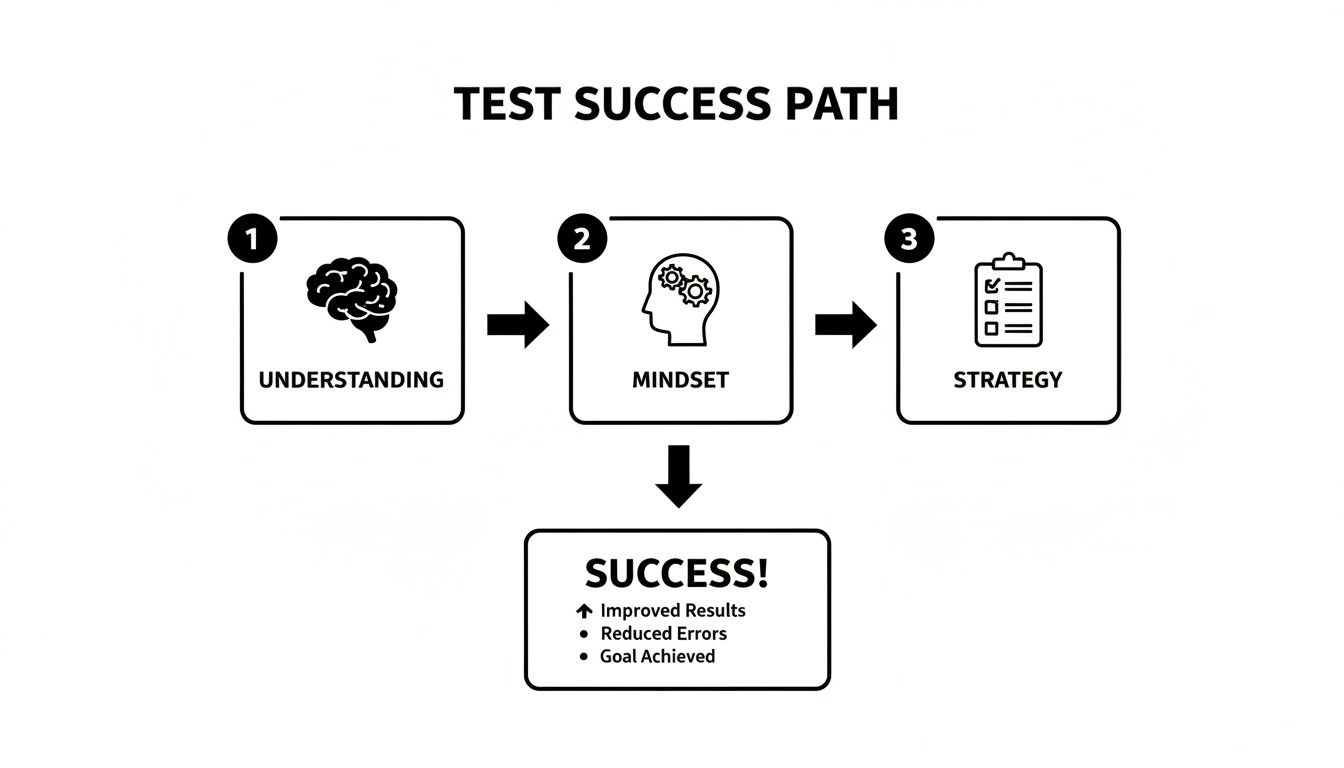
As you can see, knowing your stuff is the first step, but without the right mindset and a solid strategy, it's tough to show what you actually know. This guide is designed to help you build up each of these areas, one by one.
The Three Pillars of Acing Any Test
To give you a clear roadmap for the rest of this guide, let's break down exactly what I mean by these three pillars. Think of this table as the framework for the skills we're about to build. Getting a handle on these components will completely change how you walk into an exam.
| Pillar | What It Involves | Key Actions |
|---|---|---|
| Understanding | Moving beyond rote memorization to truly grasp concepts and how they connect. | Active recall drills, spaced repetition schedules, and creating concept maps. |
| Mindset | Managing test anxiety, building genuine confidence, and shutting down negative self-talk. | Mindfulness exercises, positive affirmations, and visualizing success. |
| Strategy | Applying practical techniques before, during, and after the test to maximize every point. | Simulating exam conditions, analyzing your mistakes, and mastering time management. |
See how they all support each other? When you're well-prepared (Understanding), your confidence gets a natural boost (Mindset). That confidence helps you think clearly and apply your test-day tactics (Strategy). If you neglect one area, the whole structure gets wobbly. A student who knows the material perfectly but is paralyzed by anxiety is at just as much of a disadvantage as a calm student who didn't study.
The goal isn't just to learn facts. It's to build a system that lets you reliably access and apply those facts under pressure. That's the real difference between just studying and truly preparing.
By focusing on this complete system, you'll shift from being a passive learner to an active, strategic test-taker. This guide will walk you through actionable steps to strengthen each pillar, making sure you’re ready for your next test—and every one after that.
For a deeper dive into the habits that build that first pillar, you can learn more about how to study efficiently for exams in our detailed article. Those principles are the perfect starting point for building the "Understanding" foundation of your new system.
Mastering Material with Smarter Study Techniques
If you’re still relying on rereading chapters and highlighting every other sentence, you’re working hard, but you’re not studying smart. That kind of passive learning—just letting information wash over you—is a notoriously poor way to build long-term memory. The real secret to mastering the material is to get active. You need methods that force your brain to engage with the concepts, retrieve them, and connect them.
This simple shift changes studying from a passive chore into an active challenge. Instead of just looking at the answer and nodding along, you're training your brain to actually find the answer on its own. It's this process that builds stronger neural pathways, making the information stick and easier to access when the pressure's on.
Embrace Active Recall
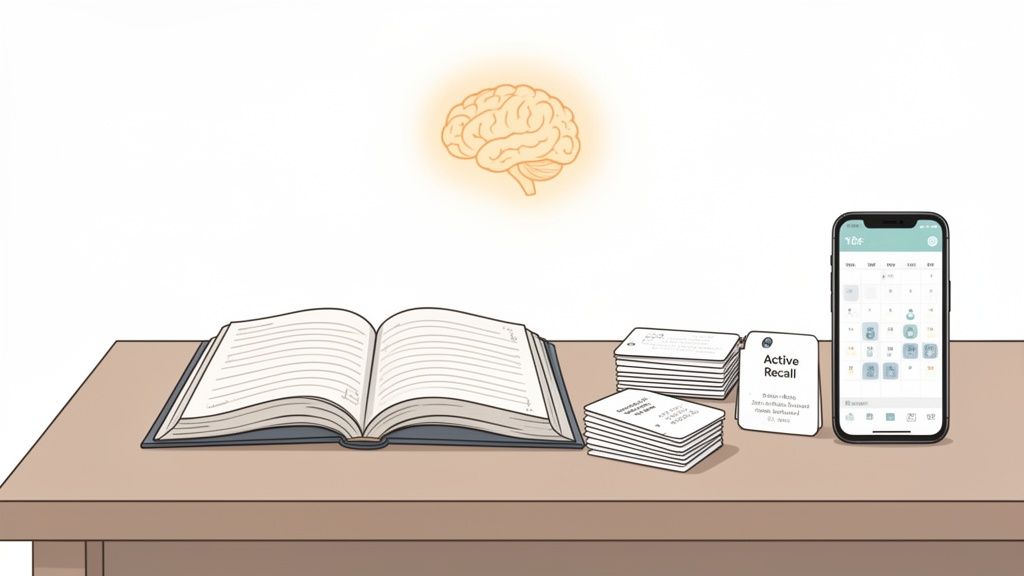
Active recall is exactly what it sounds like: actively pulling information out of your memory. Think of it as a workout for your brain. Instead of rereading a definition, you force your mind to produce it from scratch. This one technique is probably the most powerful way to improve your test scores.
Let's say you just read a section on the causes of the American Revolution. Close the book. Now, try to write down the main points from memory. That simple act of retrieval sends a powerful signal to your brain that this information is important and needs to be kept ready for use.
Don't just recognize the material; recall it. Recognition gives you a false sense of confidence, while active recall proves you actually know it. It’s the difference between seeing a familiar face and remembering their name.
Here are a few practical ways to put active recall to work:
- Flashcards Done Right: Make flashcards with a question on one side and a detailed answer on the other. The magic happens when you say the answer out loud before you flip the card.
- The Feynman Technique: Grab a blank sheet of paper and try to explain a complex topic in the simplest terms you can, as if you were teaching it to a middle schooler. If you get stuck or have to use jargon, you’ve just found a gap in your understanding.
- Self-Quizzing: At the end of every study session, write down a few tough questions about what you just covered. The next day, start by trying to answer them without peeking at your notes.
Implement Spaced Repetition
Once you're using active recall, the next layer is to review that information at just the right time. That’s where spaced repetition comes in. It’s a system where you review material at increasing intervals—tackling difficult concepts more frequently and easier ones less often.
This method takes advantage of a psychological principle called the "spacing effect," which shows we learn much more effectively when our study sessions are spread out. It blows cramming out of the water. For example, reviewing a concept one day, then three days later, then a week later embeds it into your long-term memory far better than looking at it three times in one afternoon.
To really get the most out of your study time, it's worth digging into guides that offer a deeper dive into how to study better in college.
Leverage AI as Your Study Partner
Modern tools can put these classic techniques on steroids. An AI study companion like Feen AI can make active recall and concept checking far more dynamic and interactive. Instead of just working with your own notes, you can turn any study session into a back-and-forth dialogue.
Imagine you're trudging through a dense chapter on cellular respiration. You can ask Feen AI to:
- Generate a Quiz: "Create a 10-question multiple-choice quiz on the Krebs cycle."
- Summarize Key Points: "Summarize this PDF of my lecture notes into five main bullet points."
- Explain a Concept: "Explain the difference between anaerobic and aerobic respiration like I'm 15 years old."
This transforms study time into a conversation, letting you find and fix your knowledge gaps instantly. It’s a fantastic way to make sure you’re not just passively reading, but truly understanding the material. For more ideas on this, check out our guide on https://feen.ai/blog/how-to-take-lecture-notes, which you can then feed to an AI for summarization.
Using Practice Tests to Simulate Real Exam Conditions
Knowing your stuff is only half the battle. The other half is proving it under pressure. This is where practice tests become your secret weapon, but only if you treat them like the real deal. Casually flipping through practice questions won't cut it when the clock is ticking and your grade is on the line.
The whole point is to bridge the gap between how you study and how you'll actually be tested. A realistic simulation isn't just about reviewing material—it’s a workout for your brain. You’re building mental stamina, learning to pace yourself, and getting comfortable with the pressure of a deadline. This kind of training is what makes the difference on test day.
Creating an Authentic Test Environment
To get the most out of your practice, you have to replicate exam conditions as closely as possible. Think of it as a dress rehearsal. The more you sweat in practice, the less you'll bleed in battle.
Here’s how to set the stage for a proper simulation:
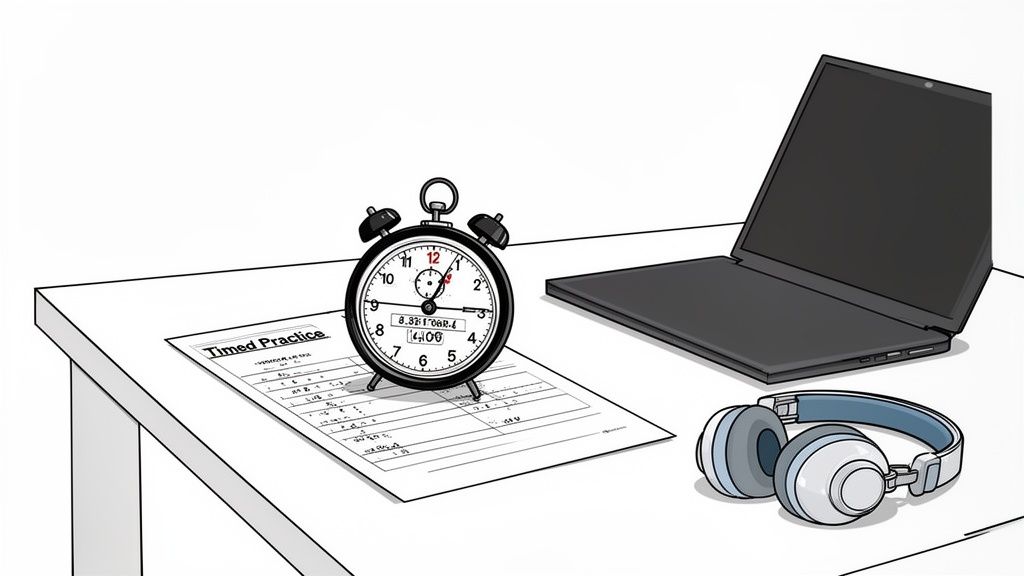
- Set a Strict Timer: This is the most important rule. If the real exam is 90 minutes, you get exactly 90 minutes. When the timer goes off, pens down. This forces you to make smart decisions about where to spend your time.
- Find a Quiet Space: Head to the library or lock yourself in a room where you won't be bothered. That means no music, no phone buzzing, and no one asking you questions. Mimic that sterile, silent testing center vibe.
- Use Only Allowed Materials: If you can't use a calculator or your notes on the real test, then you can't use them now. Stick to the rules to build good habits and avoid leaning on crutches you won't have later.
Adopting an effective practice test strategy can turn these sessions from simple practice into a powerful diagnostic tool, showing you exactly where you need to focus.
The Power of Retrieval Under Pressure
This "dress rehearsal" does more than just get you ready psychologically; it actually strengthens your memory. Practice testing is a potent form of active recall, which science has repeatedly shown locks in knowledge far better than passive rereading.
Students who take practice tests consistently outperform those who just review their notes. In fact, some studies show practice testing can boost long-term retention by a staggering 20-50%.
The single biggest mistake students make is treating practice tests like homework. Resist the urge to check your answers after each question. Complete the entire test under timed conditions first, then review your work.
Why the delay? It’s crucial. It forces you to work through uncertainty and trust your gut, just like you’ll have to in the actual exam. Finishing the whole test before you grade it gives you a true, unvarnished look at your performance and endurance.
Using AI for Infinite Practice Drills
One of the most common frustrations is running out of good practice material. After you've gone through the official tests a couple of times, what's next? This is where an AI study companion like Feen AI completely changes the game.
Instead of being stuck with a finite number of practice exams, you can generate an endless supply of questions tailored to exactly what you need.
Let’s say you’re getting tripped up by derivatives in calculus. You can ask Feen AI to create a 20-question drill focused on just that. Need more reps balancing chemical equations? Generate a whole new set and put yourself on the clock. You can learn more about how to use AI for studying and even turn your own notes into fresh quizzes.
This gives you a limitless well of targeted practice, ensuring you never run out of ways to get sharper.
Dig Into Your Mistakes—That's Where the Real Growth Is
Finishing a practice test feels like the end, but it’s really just the beginning. Your score is just a number. The real gold is buried in the questions you got wrong, and digging into why you got them wrong is how you make genuine progress.
The mindset shift is simple but powerful: treat every mistake like a clue. Instead of getting discouraged by an incorrect answer, get curious. Each one tells a story—maybe about a gap in your knowledge, a momentary lapse in focus, or a flaw in your overall strategy.
Start an Error Log (and Actually Use It)
The best way I’ve found to track these clues is with an error log. This doesn't have to be fancy; a simple spreadsheet or a dedicated notebook works perfectly. The goal is to document every single question you miss on a practice test. I know it sounds tedious, but trust me, this one habit gives you an incredible x-ray of your performance.
For each mistake, you’ll want to log a few key things:
- Question Number: So you can find it again easily.
- The Topic: What specific concept was it testing? (e.g., "Newton's Second Law," "Subject-Verb Agreement").
- Your Answer vs. Correct Answer: A quick note of what you chose versus what was right.
- The Real Reason You Got It Wrong: This is the most crucial part. Be brutally honest with yourself here.
Don't just fix your mistakes; figure out what kind of mistake it was. Understanding the category of your error is the only way to apply the right fix and make sure it doesn't happen again.
Figure Out Your Error Patterns
Most mistakes fall into one of three buckets. When you know which bucket your error belongs to, you know exactly what you need to do to fix it. This is so much more effective than just vaguely "studying more."
1. Simple Slips
These are the absolute worst. You knew the material cold but made a silly mistake—you misread the question, bubbled in the wrong letter, or made a basic calculation error. The fix here isn't about hitting the books; it’s about improving your process. You need to practice slowing down just enough to be deliberate.
2. Content Gaps
This is a straightforward, "I just didn't know that" kind of error. You were missing a key piece of information needed to answer correctly. In a way, these are the best mistakes to find because they give you a crystal-clear action item: go back and review that specific topic until you own it.
3. Strategic Missteps
These are trickier. You knew the content, and you didn't make a careless slip, but you still got the question wrong. Why? Maybe you fell for a classic trap answer, misunderstood a convoluted question, ran out of time, or just got overwhelmed by a multi-step problem. These errors tell you it's time to work on your test-taking strategies.
This kind of structured analysis does more than just fill knowledge gaps—it’s a massive confidence booster. It's been shown that unprepared students can underperform by 15-25% just because of stress. On the flip side, those with a solid preparation plan often see their scores jump by an average of 20%. One study with public health students found that consistent, semester-long learning activities dramatically lowered their anxiety and improved their performance. It's proof that a good plan is the best antidote to test-day nerves. You can discover more insights about this study on test anxiety reduction and performance.
Using AI for a Super-Fast Feedback Loop
Sometimes, you’re just plain stuck. Staring at a complex physics problem with no clue how the textbook arrived at the right answer is frustrating and a waste of time. This is a perfect moment to bring in an AI study companion like Feen AI.
Instead of waiting for a tutor or just giving up, you can get help instantly. Snap a picture of the problem and ask, "Can you show me the step-by-step solution for this?" This creates a powerful, immediate feedback loop that turns a moment of frustration into a learning opportunity. You can essentially give yourself a mini-lesson on every single mistake, which is a surefire way to speed up your improvement.
Conquer Test Anxiety and Build a Winning Mindset
Let's be honest. You can grind through practice tests for weeks and master every study technique in the book, but if your mind turns against you on test day, all that hard work can feel like it was for nothing. Test anxiety is a very real, physical thing. Your heart pounds, your hands get sweaty, and your brain just... freezes. Suddenly, you can't recall information you knew cold just yesterday.
Dealing with the mental game of test-taking isn't just a nice-to-have; it's a core skill. It’s not about pretending the pressure doesn't exist. It's about having a game plan to manage it. By building a simple toolkit of mental strategies, you can walk into that exam room feeling calm, focused, and ready to show what you know. This is often the missing piece for students who study hard but whose scores don't reflect their effort.
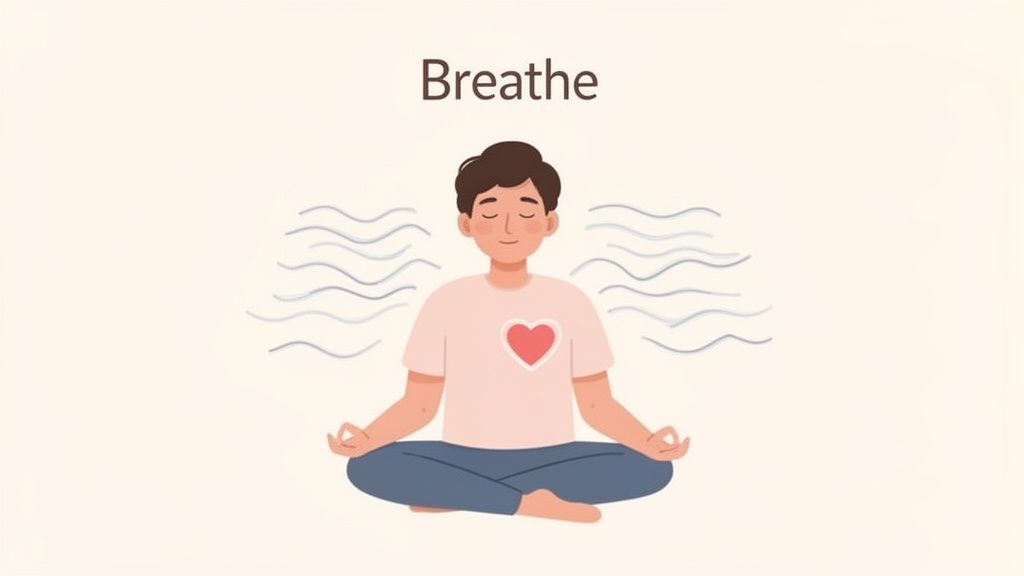
Go from Panic to Poised with Simple Techniques
When you feel that wave of anxiety, it's your nervous system kicking into high gear. The quickest way to get back in the driver's seat is to calm that physical response directly. You don’t need to be a meditation guru; a few simple, targeted exercises can make an incredible difference in just a minute or two.
One of the most effective I've seen is heart-focused breathing. It's incredibly simple, and you can do it right at your desk without anyone even noticing.
- Bring your focus to your heart. You can physically place your hand over your chest or just mentally bring your attention there.
- Breathe slowly and intentionally. Imagine the air flowing in and out through your heart. Try for a smooth five-second inhale and a five-second exhale.
- Tap into a positive feeling. While you're breathing, think of something or someone that makes you genuinely happy or grateful—playing with your dog, a great vacation, a moment you felt proud. Just hold that feeling.
This isn't just about relaxing. This technique helps create a state of coherence, where your heart rhythms, breathing, and brain waves sync up. When you're in this state, your cognitive function actually improves, helping you think more clearly under pressure.
Reframe Negative Thoughts Before They Spiral
Test anxiety isn’t just physical; it's fueled by that nagging inner critic. Thoughts like "I'm going to fail" or "Everyone else is so much smarter" can become a self-fulfilling prophecy if you let them run wild. The trick is to catch them and consciously reframe them.
Your internal monologue sets the stage for your performance. If you tell yourself you're going to struggle, you're making it harder to succeed. Actively choose a more empowering script.
Instead of trying to fight the negative thought, just acknowledge it and then swap it for something more realistic and constructive.
| Instead of Thinking This... | Try Thinking This... |
|---|---|
| "I'm definitely going to fail this test." | "I've prepared for this. I'm ready to do my best." |
| "I'm blanking on everything I studied." | "It's just nerves. I'll take a deep breath and start with a question I feel good about." |
| "I ran out of time on the practice test, so I'll run out of time now." | "I learned from my practice runs. I know how to pace myself, one question at a time." |
This isn't about lying to yourself. Cognitive reframing is about shifting your perspective from one of fear to one of capability. It's a reminder that you're in control and that one test doesn't define your intelligence.
The Real-World Impact of Getting Your Head Right
These mindset strategies are more than just feel-good fluff; they have a measurable impact on academic performance. When your brain isn't busy managing a full-blown stress response, it has more bandwidth for critical thinking and pulling up stored information.
Consider a groundbreaking program where students were taught techniques just like these, including heart-focused breathing, to combat test anxiety. The results were stunning. After just three weeks, students saw a mean gain of 35% in their Math scores and 14% in Reading. Some kids improved by over 75%.
What's really telling is that the school district hadn't seen any significant gains in math for three years prior. It goes to show that focusing on emotional preparedness can be a complete game-changer. You can dig into the specifics and read the full research about these test-taking skill findings.
Your Top Test-Taking Questions, Answered
Even when you've got a solid game plan, certain questions always seem to pop up during crunch time. Let's tackle some of the most common ones I hear from students, with quick, practical advice to back up what we’ve already covered.
What’s the Single Best Thing I Can Do the Night Before a Test?
Hands down, the most powerful thing you can do is stop studying early and get a full night's sleep. I know, I know—the urge to cram is incredibly strong. But the research is overwhelming on this: sleep is when your brain actually cements what you've learned through a process called memory consolidation.
Pulling an all-nighter to review your notes one last time almost always backfires. It spikes your anxiety and leaves you mentally exhausted on test day, making it impossible to recall information you actually know cold. You have to trust the work you've already put in.
My best advice? Make your evening relaxing. Put the books away at a decent hour, do something you enjoy that won't fry your brain, and aim for 7-9 hours of solid sleep. A rested mind will always beat a sleep-deprived one.
How Should I Handle a Question When I Have No Idea What the Answer Is?
First things first: take a breath and don't panic. It’s totally normal to hit a question that makes you draw a blank. The trick is having a system so you don't waste precious time or tank your confidence.
Your first move should always be to skip it and mark it to come back to. Getting stuck on one monster question can completely throw off your rhythm and steal time from easier questions you could have answered. Plus, sometimes another question later in the test will spark a connection and give you a clue.
When you circle back, attack it with the process of elimination:
- Knock out any answers that are obviously wrong. On a multiple-choice question, this alone dramatically improves your odds.
- Scan the question for context clues. Are there any keywords or phrasing that point you in the right direction?
- Make an educated guess if you can get it down to two options. Unless there’s a penalty for wrong answers, never leave it blank.
Is It Better to Study in One Long Marathon Session or in Short Bursts?
The science on this couldn't be clearer: shorter, focused study sessions are far more effective than cramming for hours on end. You might have heard of this as the Pomodoro Technique, and it works because it prevents mental burnout and keeps your concentration sharp.
When you try to study for hours straight, you hit a point of diminishing returns. Your focus drifts, you find yourself just rereading the same paragraph over and over, and you don't actually retain much. Short bursts keep your brain fresh and engaged.
A schedule I’ve seen work wonders is studying for 45-50 minutes, then taking a 10-15 minute break. And I mean a real break—get up, stretch, walk around, do something completely unrelated. This gives your brain the downtime it needs to absorb everything.
What If I’m Always Running Out of Time on Tests?
If you consistently run out of time, it's almost certainly a pacing issue, not a knowledge one. The only way to fix this is to practice with a timer until pacing becomes second nature.
Start by calculating your average time per question. If a test has 60 questions and a 60-minute time limit, you have exactly one minute for each. That number becomes your internal clock.
Try these pacing drills during your practice tests:
- Use a "Two-Pass" System: On your first pass, answer every single question you know immediately. Skip anything that makes you hesitate. This banks easy points and builds momentum.
- Tackle the Marked Questions: On your second pass, go back to the tougher questions you marked. Start with the ones you feel you have the best shot at.
- Know When to Move On: Still stuck after a minute or two? Make your best-educated guess and let it go. It's better to lose one hard question than miss out on five easy ones at the end of the test.
This strategy ensures you at least see every question and have a chance to rack up points on the ones you know, which can make a huge difference in your final score.
Ready to put these strategies into practice? Feen AI can be your ultimate study partner. Use it to generate endless practice questions, get summaries of dense readings, and walk you through step-by-step solutions for your toughest problems. It's time to stop studying harder and start studying smarter. Try Feen AI for free today and see how it can transform your prep.
Relevant articles

Master how to study for biology exam with proven methods: active recall, spaced repetition, and practice questions to boost mastery and scores.

Unlock the best way to study for finals with 10 evidence-based strategies. Our guide covers everything from active recall to using Feen AI for success.
Learn how to take lecture notes effectively with proven strategies. Discover methods that boost retention and turn your notes into powerful study tools.
Struggling to absorb what you read? Learn how to improve comprehension skill with actionable reading strategies and smart tools for real, lasting results.

Learn how to study for chemistry test with a proven strategy. Master concepts, practice problems, and test-day tips to boost your score.
Discover how to study efficiently for exams with proven, science-backed techniques, smarter planning, and tools that boost memory and reduce stress.