Master How to Summarize Book Chapters and Boost Your Learning
Discover how to summarize book chapters effectively. Our guide covers proven methods and smart tools to help you retain more information and study smarter.
To really nail a chapter summary, you have to do two things: first, get a firm grip on the main idea, and second, boil down the key supporting points into your own words. The real objective isn't just to make the text shorter. It's to truly internalize the core message so you can remember it and use it later. This simple shift turns reading from a passive pastime into a powerful learning tool.
Why Summarizing Chapters Is Your Secret Learning Superpower
Let's be real—the idea of summarizing probably brings back memories of tedious school assignments. But what if I told you it's one of the most effective ways to actually understand what you're reading? The magic isn't in just creating a condensed version of the text; it's in the mental workout that happens behind the scenes.
When you force your brain to filter, process, and rephrase complex information, you're building stronger neural connections. This cognitive heavy lifting is the secret to locking in what you've learned. It's the difference between vaguely recalling a concept and being able to confidently explain it to a colleague.
From Passive Reading to Active Skill
Think about walking into a high-stakes meeting and effortlessly pulling out the key insights from a dense industry report you skimmed last week. That's the kind of practical power we're talking about here. This habit transforms reading from a passive activity into a career-boosting skill.
This isn't just for students or professionals, either. The skill is becoming more important in the literary world at large. With the global books market expected to hit $142.72 billion, readers are drowning in choices. A sharp, well-written summary can be the deciding factor, especially with the boom in audiobooks where listeners need to quickly decide if a chapter is worth their commute. If you're curious about these market trends, Mordor Intelligence has some fascinating data.
The act of summarizing forces you to identify the essential ideas and discard the irrelevant. It's an exercise in discernment and clarity that pays dividends far beyond the book you're reading.
The Real Payoff of Summarizing
The benefits go way beyond just remembering things better. When you make summarizing a regular practice, you're building a mental toolkit that sharpens several other skills. You get better at:
- Identifying Core Arguments: You’ll learn to quickly spot an author's main point and separate it from the fluff.
- Improving Critical Analysis: The very act of rephrasing information prompts you to question and evaluate it more deeply.
- Boosting Communication Skills: Being able to break down complicated subjects into clear, concise points is a priceless skill in any field.
Ultimately, learning how to summarize book chapters isn't about creating study notes you'll never look at again. It's about forging a deeper connection with the information, making sure what you learn actually sticks with you for the long haul.
Prepare to Absorb Information Before You Read a Single Word
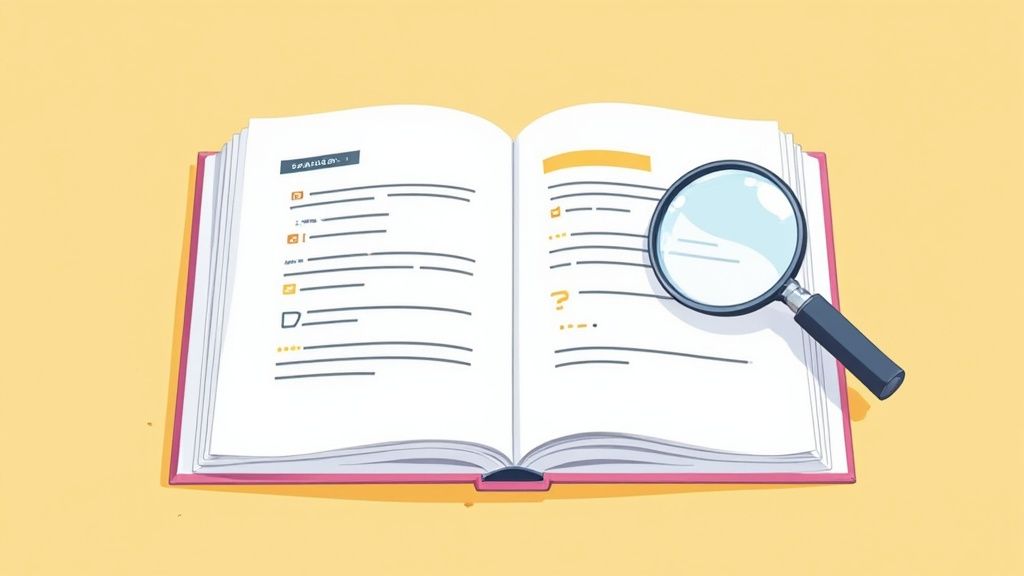
Here’s a secret that great students and voracious readers know: the real work of summarizing a chapter happens before you even read the first sentence. Diving straight into a dense chapter without a plan is like trying to navigate a new city without a map. You'll wander around, but you probably won't get where you need to go efficiently.
A quick pre-reading ritual builds a mental framework, turning your brain into a sponge ready to soak up the important stuff. This isn't just a "nice-to-have" skill; it's essential in a world with so much to read. The global book market is valued at $142.72 billion, and with digital formats exploding, we need strategies to cut through the noise.
Think about it: MIT Press found that open-access books with good summaries saw a fourfold increase in usage. That tells you everything you need to know about how much people value a clear, concise overview. By prepping your mind first, you switch from being a passive reader to an active learner.
Adopt the SQ3R Mindset
One of the most effective pre-reading frameworks I've come across is the SQ3R method. It stands for Survey, Question, Read, Recite, and Review. For our purposes—getting ready to write a killer summary—we'll zero in on the first two steps: Survey and Question. This isn’t just mindless skimming; it's about strategically creating an outline in your head before the details start flooding in.
This approach is incredibly versatile. Whether you're trying to find fresh ways to read novels in order or tackling a heavy textbook, having a structure makes all the difference.
To make it even clearer, here’s a quick breakdown of how this tried-and-true method works.
The SQ3R Method at a Glance
| Phase | Your Action | The Outcome |
|---|---|---|
| Survey | Scan headings, bold text, visuals, and the intro/conclusion. | A high-level mental map of the chapter's structure. |
| Question | Turn each heading and subheading into a "what," "why," or "how" question. | Your brain is primed to actively hunt for answers as you read. |
| Read | Actively read the chapter to find the answers to your questions. | Deeper comprehension and better retention of key information. |
| Recite | After each section, pause and recall the main points in your own words. | You confirm your understanding and lock the concepts into memory. |
| Review | Look over your notes and the chapter to get a bird's-eye view of the material. | The big picture snaps into focus, making summarization easier. |
By focusing on just the "S" and "Q" before you read, you're setting yourself up for a much more productive reading session.
Survey the Chapter Landscape
First things first: give yourself a strict time limit—say, two or three minutes—for a quick reconnaissance mission. You’re not reading paragraphs; you’re scanning for the structural clues the author left for you.
- Headings and Subheadings: These are the road signs telling you where the chapter is going.
- Bolded or Italicized Text: The author is practically shouting, "This is important!" Pay attention to these key terms.
- Images, Charts, and Graphs: Visuals are often cheat sheets that distill complex ideas into a simple format.
- Introduction and Conclusion: Read the very first and very last paragraphs. They typically lay out the chapter's main point and wrap it up with the key takeaway.
This quick scan gives you a high-level map of the content. You’ll know the key landmarks before you even start the journey. This exact technique is a cornerstone of our guide on how to study a textbook effectively.
Turn Headings into Questions
Now, let's make this an active process. Go back to those headings you just scanned and turn them into questions. This simple trick flips a switch in your brain, moving it from passive reception to active investigation.
For instance, a heading like "The Economic Impact of Industrialization" becomes a question: "What was the economic impact of industrialization?"
By creating these questions before you read, you spark your own curiosity. You’re no longer just plowing through text; you’re on a mission to find answers. This makes the information stick and makes writing the summary later feel almost effortless.
Turn Passive Reading into an Active Conversation
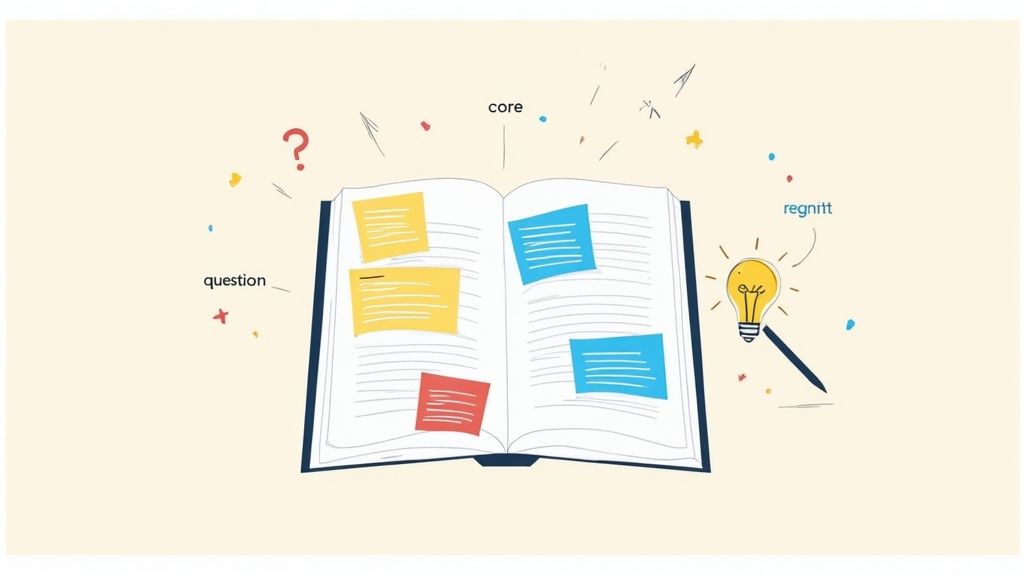
We've all seen it: the textbook page drenched in so much fluorescent yellow that nothing stands out. When you highlight everything, you've really highlighted nothing at all. That’s passive reading, and it creates a dangerous illusion of learning without actually forcing your brain to do the heavy lifting.
The key is to flip the script and turn reading into a dynamic conversation with the author. Active annotation is how you do it. This isn't just about marking up the text; it's about asking questions, making connections, and challenging ideas right there in the margins. You stop being a silent observer and become an active participant—the most crucial step toward writing a summary that actually means something.
Create Your Annotation System
Before you start, you need a simple, consistent system. If it's too complicated, you'll ditch it by page five. The goal is to stick to a few core categories, which works just as well with physical highlighters as it does with digital tags.
A great place to start is by giving each color a specific job:
- Yellow for Core Concepts: Reserve this for the chapter’s thesis statements, main arguments, and foundational ideas. These are the pillars the author is building everything else on.
- Blue for Supporting Evidence: Use this to mark key statistics, specific examples, or data points that back up those core concepts. It helps you see how the author builds their case.
- Red for Questions and Disagreements: This is for anything that confuses you, claims you find a bit thin, or ideas that clash with what you already know.
This isn't just about making the page colorful; it's a mental sorting exercise. This structured approach forces you to categorize information as you read, a skill that pays dividends in academic performance. For a deeper dive, check out our guide on how to improve reading comprehension skills, which expands on these active reading strategies.
Master the Art of Marginalia
Your annotation system isn't just about colors. It’s about the notes you leave for yourself. The margins of a book (or the comment section of a PDF) are your personal space to talk back to the text. This practice, known as marginalia, is where the real lightbulbs go off.
Don't just underline. Scribble your thoughts down as they pop into your head.
- "Is this the main point of this whole section?"
- "This links back to that idea in Chapter 2."
- "Aha! So that's why X leads to Y."
- "Wait, where’s the evidence for this claim?"
Think of these notes as breadcrumbs for your future self. When you come back to summarize the chapter, your marginalia will instantly snap you back into your in-the-moment analysis, making the whole process faster and way more accurate.
Annotation is not about defacing a book; it's about making it your own. It's the visible record of your intellectual journey through the text.
Putting It All into Practice
Let's walk through a quick example. Imagine you're reading a popular science book about cognitive biases and you hit this paragraph:
"The confirmation bias is a powerful mental shortcut where individuals favor information that confirms their preexisting beliefs. For instance, a person who believes a certain political candidate is dishonest will actively seek out news stories highlighting that candidate's perceived flaws while ignoring articles that portray them in a positive light. This selective filtering reinforces their initial opinion, making it resistant to change even when confronted with contradictory evidence."
Here’s how an active reader would attack it:
- Highlight "confirmation bias is a powerful mental shortcut" in yellow (that's the core concept).
- Highlight the political candidate example in blue (clear supporting evidence).
- Scribble in the margin: "So it's like an echo chamber in my own head? How do you fight this?"
With that simple three-step interaction, you’ve already pinpointed the key ingredients for a solid summary: the main idea, the evidence that proves it, and a critical question about its implications. You’re not just reading words on a page anymore—you're dissecting them.
Putting It All Together: A Simple Framework for the Perfect Summary
You've done the heavy lifting—you’ve skimmed the chapter and marked it up with your thoughts. All the raw materials for a killer summary are right there in your notes. Now, it’s time to assemble them into something genuinely useful.
The goal here isn't to create a miniature version of the chapter. We're building a powerful reference tool, one that lets you instantly recall the core message weeks or even months later. Forget long, winding paragraphs. An effective summary follows a simple, repeatable structure that’s both easy to write and incredibly fast to review.
The Three Core Components of a Strong Summary
I like to think of a good summary as having three essential parts. Each one builds on the last to create a complete, crystal-clear picture of the chapter’s argument.
- The Topic Sentence: This is your one-sentence headline. Your mission is to nail the single most important idea the author is trying to get across in the entire chapter.
- The Key Pillars: These are the main supports holding up that topic sentence. Think of them as 3-5 concise bullet points, with each one representing a distinct argument, piece of evidence, or major concept.
- The "So What?" Statement: This is the final, crucial piece. It’s one sentence that connects the chapter's ideas back to the book's larger themes. It answers the question, "Why did this chapter matter?"
This isn’t just some study hack; it's how professionals distill information. The publishing world is even leaning into this kind of clarity. As the digital book market continues to grow—with ebooks and audiobooks seeing climbs of 2.4% and 5.3% respectively—publishers are finding that AI-powered chapter recaps can boost reader engagement by as much as 30%. You can dig into these trends in the AAP StatShot report.
By adopting this framework, you're essentially creating your own professional-grade abstract. You're turning dense information into a format that's immediately useful and easy to remember.
Let's See It in Action: An Example from Atomic Habits
To make this tangible, let's apply the framework to a well-known chapter from James Clear's Atomic Habits. We'll tackle Chapter 5, where he introduces the concept of "Implementation Intentions."
First, we need to boil down the main idea into a single, punchy sentence.
- Topic Sentence: To beat procrastination and actually stick to new habits, you need a specific plan for when and where you'll do the action.
Next, we pull out the main supporting points that explain why this works. These are our key pillars.
- Key Pillars:
- Vague goals like "I'll exercise more" usually fail because there's no clear trigger to start.
- The formula "I will [BEHAVIOR] at [TIME] in [LOCATION]" turns a fuzzy goal into a concrete plan.
- This technique works because you make the decision ahead of time instead of relying on willpower in the moment.
- Studies have shown that people who write down a specific plan are 2-3 times more likely to follow through.
Finally, we connect this strategy back to the book’s central message about building better habits.
- "So What?" Statement: This chapter gives us a practical tool to apply the First Law of Behavior Change—Make It Obvious—proving that clarity is what really drives consistency.
That's it. The entire summary is well under 150 words, yet it perfectly captures the value of the chapter. It's not just a shorter version of the text; it's a functional guide you can actually use to apply the lesson in your own life.
Using AI as Your Smart Study Partner
AI tools are getting incredibly good, but just asking them to do your work for you is a huge missed opportunity. Think of AI less as a shortcut and more as a really smart study partner—a tool that can help you sharpen your own ability to break down and summarize complex chapters.
The real magic isn't in getting an instant answer; it's in using the AI's output to get better at finding those answers yourself.
It all starts with you. First, you have to do the work. Read the chapter, use your annotation system, and write your own summary using the framework we've been talking about. This part is non-negotiable because it’s what actually forces your brain to grapple with the material.
Once you’ve got your draft, it's time to bring in your AI partner.
The Compare and Contrast Method
Take the chapter text (or even a link to it) and feed it into an AI tool. Ask it for a summary, but don't just type "summarize this." That's too generic.
Get specific to get something truly useful. Try a prompt like, "Summarize this text for a college student, focusing on the three main arguments and their supporting evidence."
Here’s a perfect example of someone giving a detailed prompt to get a much more focused summary.
When you tailor your request this way, you're telling the AI to look for the same things you did, which sets up a fantastic basis for comparison.
Now, put your summary right next to the one the AI generated. This is where the real learning kicks in. You can instantly see what you might have missed or which supporting details you didn't emphasize enough.
Did the AI identify a different main theme? Did it organize the key points in a way that makes more sense? This simple act transforms AI from a potential cheat sheet into a personal tutor, giving you immediate feedback on your comprehension. This is exactly how to use AI to help with homework without actually cheating.
This method turns AI into a mirror, reflecting gaps in your own understanding. It’s a low-stakes way to see what you missed and train your brain to catch those key details the first time around.
Finding the Right Tools
The world of AI assistants is exploding. For anyone interested in digging into specific AI tools built for studying and summarizing, you might want to check out platforms like Auralume AI. Many of these offer features designed specifically for academic work.
Ultimately, the goal is to weave AI into your study process, not to let it take over. When you use it as a tool for checking your work and refining your understanding, you stay in control of your own learning. You’re simply using modern tech to get better, faster.
Your Top Chapter Summary Questions, Answered
Even with a great system in place, you're bound to run into a few tricky situations when summarizing chapters. It happens to everyone. Let's walk through some of the most common questions and roadblocks I see, from nailing the perfect length to tackling those chapters that feel like a brick wall of information.
How Long Should My Summary Actually Be?
This is easily the most common question, and for good reason. The honest answer? It depends. But if you're looking for a solid starting point, a good rule of thumb is to aim for roughly 10-15% of the original chapter’s length.
So, if you just read a 20-page chapter, you should be able to distill its core essence into a single, well-organized page. This forces you to be selective and focus only on what truly matters, which is the whole point.
What Do I Do with Super Dense or Technical Chapters?
You know the ones I'm talking about—chapters packed to the brim with jargon, complex theories, or wall-to-wall data. When you hit one of these, trying to summarize everything is a recipe for disaster. You have to shift your focus from the "what" to the "why."
Here's how to adjust your game plan:
- Hunt for the Core Argument: Amidst all the complexity, what is the single most important point the author is trying to make? Find that, and you've found your anchor.
- Isolate and Define Key Terms: Don't get lost in the sea of terminology. Pull out the 3 to 5 most critical terms and write down a simple definition for each in your own words.
- Focus on the Implications: Instead of just copying down data points, explain what they mean. For example, don't just write "Sales decreased by 15%, 22%, and 18%." Instead, write, "The data reveals a consistent downward trend in sales over the last quarter."
This approach helps you rise above the noise. You’re not trying to create a miniature version of the textbook; you’re building a high-level guide to its most important conclusions. That's a summary you can actually use.
The true measure of understanding isn't being able to recite an author's complex sentences. It's being able to explain their core idea to someone else in simple terms.
What If I Can't Figure Out the Main Idea?
It's frustrating, but some chapters just seem to wander without a clear signpost pointing to the main idea. When you feel like you're lost in the weeds, try working backward.
Instead of searching for a thesis statement, look for the most prominent examples, case studies, or statistics. Gather them up and ask yourself a simple question: "What single idea do all these different pieces of evidence point to?"
It's a bit like detective work. The supporting details are often the most obvious clues. By seeing how they fit together, you can piece together the main argument they’re all there to support. It’s a clever way to uncover the chapter’s hidden structure and get your summary back on track.
Feeling buried under dense readings or tricky homework assignments? Feen AI can be a huge help. This AI-powered study tool is great for breaking down complicated chapters, clarifying tough concepts, and even helping you draft initial summaries and essays in seconds. Stop struggling and start understanding. Get homework help now at Feen AI.
Relevant articles
Discover how to improve critical thinking skills with practical exercises, proven frameworks, and strategies for students and professionals.
Struggling to absorb what you read? Learn how to improve comprehension skill with actionable reading strategies and smart tools for real, lasting results.
Discover how to use AI for studying with proven strategies that actually work. Learn to leverage AI study tools to ace exams and understand complex topics.
Discover how to improve comprehension skills with proven reading strategies. Master active reading and note-taking for deeper understanding.
Struggling with hard math problems? Discover proven strategies, practical frameworks, and smart AI tips to conquer complex challenges and boost your skills.
Discover how to study efficiently for exams with proven, science-backed techniques, smarter planning, and tools that boost memory and reduce stress.