How to Find Domain and Range for Any Function
Struggling with how to find domain and range? Our guide unpacks the process with clear examples for graphs and equations, making algebra concepts simple.

Finding the domain and range of a function is all about figuring out its limits. What can you put into it, and what can you get out of it? For any given equation, this boils down to spotting potential mathematical no-nos, like dividing by zero or taking the square root of a negative number. When you're looking at a graph, it's more visual—you're just observing how far the function stretches horizontally and vertically.
Understanding the Fundamentals of Domain and Range
Before we jump into the methods, let's get the core concepts straight. It helps to think of a function as a simple machine. The domain is the complete set of raw materials you're allowed to feed it, while the range is the complete set of finished products it can spit out.
This input-output dynamic is everywhere. A coffee machine's domain might be "coffee grounds and water," and its range would be "hot coffee." It can't accept tea bags (that's outside the domain), and it will never produce a cold soda (that's outside the range). The rules in mathematics are just as clear-cut.
Defining the Core Concepts
Let's break down the official definitions:
- Domain: This is the complete set of all possible input values (usually the x-values) that a function can accept without breaking any math rules. The question to ask is, "What values of x can I legally plug into this function?"
- Range: This is the complete set of all possible output values (usually the y-values or f(x) values) that a function can produce. Here, you're asking, "After plugging in all the valid x-values, what y-values do I get back?"
Getting this distinction right is the most important first step. It's a cornerstone of algebra, with research showing that around 85% of students are introduced to it by age 14. Nailing this concept can improve problem-solving success rates by up to 20% on standardized tests. For a deeper dive, Interactive Mathematics has some great examples.
The Language of Functions
When you find the domain and range, you need a way to write it down. You'll typically use one of two languages: interval notation or set-builder notation.
Interval notation is a kind of shorthand. It uses parentheses () to show that an endpoint isn't included and square brackets [] to show that it is. For example, [0, 5) means "all numbers from 0 up to, but not including, 5."
Set-builder notation is more like a formal description. It looks something like {x | x > 0} and reads as "the set of all numbers x, such that x is greater than zero." You'll need to get comfortable with both to communicate your answers clearly.
This guide gives you the specific framework for domain and range, but for a broader look at problem-solving, check out our guide on how to solve math problems step-by-step.
Key Takeaway: The domain is about what you can put in to a function, and the range is about what you can get out. Every restriction you find, such as avoiding division by zero, directly shapes these sets.
Finding Domain and Range From an Equation
When you're handed a function as an equation, figuring out its domain and range is like being a detective. You're not looking at a picture (like a graph); you're hunting for algebraic clues that reveal the function's limits. The whole game is about figuring out which input values (x-values) are allowed and which ones will cause the function to break.
A great starting point is to assume the domain is everything—all real numbers. From there, your job is to chip away at that assumption by looking for specific restrictions. It’s a process of elimination.
Spotting the Domain Restrictions
Most of the functions you'll come across are pretty straightforward, but a couple of usual suspects are responsible for nearly all domain problems. You just need to know what to look for.
These are the two main culprits that cause trouble:
- Division by Zero: This is the big one. The denominator of a fraction can never, ever be zero.
- Even Roots of Negative Numbers: You can't take the square root (or fourth root, sixth root, etc.) of a negative number in the real number system. The expression inside the radical must be zero or positive.
For example, take a simple function like f(x) = 1 / (x - 3). That denominator, (x - 3), is our red flag. We can't let it equal zero. Solving the quick equation x - 3 = 0 tells us that x cannot be 3. Simple as that. So, the domain is every real number except for 3.
This is the core of the algebraic approach. You have a formula, so you check for these potential pitfalls first.
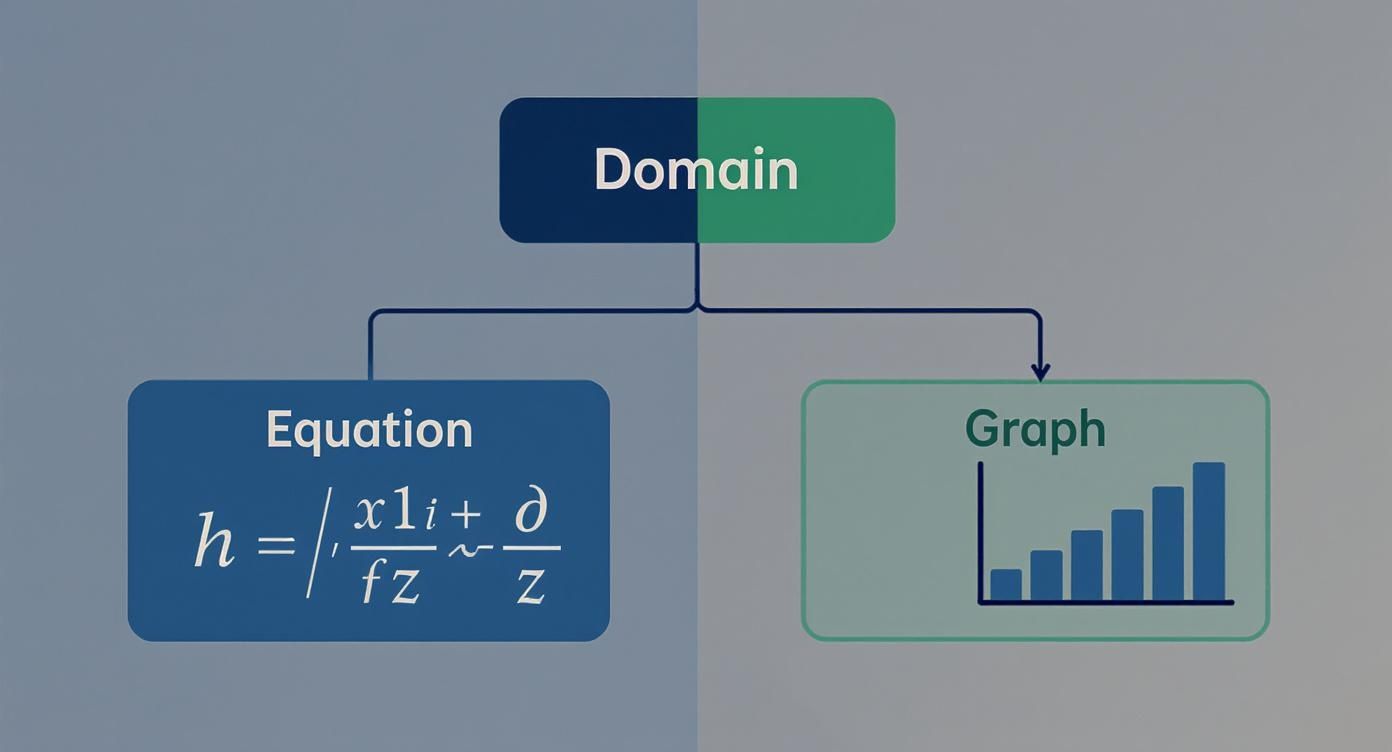
Of course, sometimes there are no restrictions at all. Polynomials, like f(x) = x² + 5x + 6, are your best friends here. No fractions, no square roots—nothing to worry about. Their domain is always all real numbers.
A Method for Finding the Range
Figuring out the range from an equation alone can be a bit more of an art. It’s often the tougher of the two. Instead of looking for what can't happen, you have to think about all the possible output values the function can produce. There's no single magic formula, but different strategies work for different types of functions.
A classic example is a simple quadratic, like g(x) = x² + 4, which graphs as a parabola. The key is to find its vertex. We know that x² can never be negative; its smallest possible value is 0. That means the absolute minimum value of g(x) is 0 + 4 = 4. The function can hit 4 and go up from there, so the range is [4, ∞).
For more complicated functions, you might need to analyze its end behavior or find horizontal asymptotes, which act as boundaries for the range. These techniques dig deeper into the algebraic toolkit you build in pre-calculus and calculus. If you're heading that direction, our guide on how to solve calculus problems can help you build the analytical mindset you'll need.
Pro Tip: If you're really stuck finding the range of a function, try this clever workaround: find the inverse function, f⁻¹(x). The domain of the inverse is the same as the range of the original function, f(x). This can turn a tricky range problem into a much more straightforward domain problem.
Finding Domain and Range from a Graph
Sometimes, staring at an equation feels like trying to solve a puzzle. But when you see that same function as a graph, everything can click into place. Finding the domain and range from a graph is a much more visual, intuitive process—you're basically just looking at the function's footprint on the coordinate plane.
The core idea is simple. Think of the domain as the graph's total width—how far it stretches from left to right along the x-axis. Then, picture the range as its total height—how far it extends up and down the y-axis.
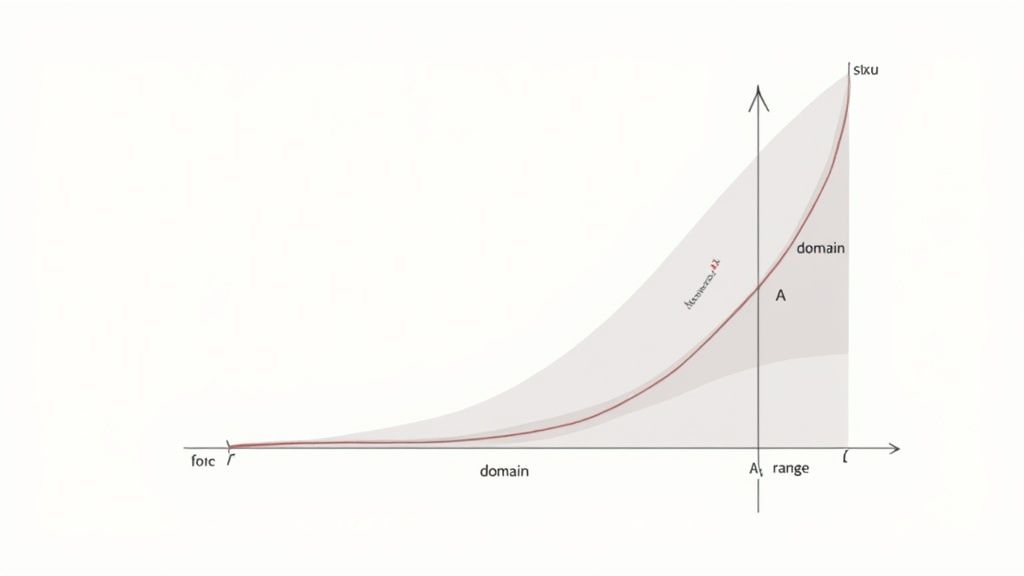
This "shadow" method turns an abstract concept into something you can literally see and trace with your finger.
Reading the Horizontal Spread for Domain
To nail down the domain, let your eyes sweep across the graph from left to right. The main question you're asking is, "For what x-values does this graph actually exist?" You're looking for the starting and ending points of the function along the horizontal axis.
Here are the visual cues to look for:
- Solid Dots: A filled-in circle on the graph means that specific x-value is included. This corresponds to a square bracket
[or]in interval notation. - Open Circles: An empty circle tells you the function gets infinitely close to that point, but the x-value itself is excluded. You'll use parentheses
(or)for this. - Arrows: An arrow pointing left or right means the function keeps going forever in that direction, stretching out towards negative or positive infinity (∞).
A great way to visualize this is to imagine squishing the entire curve flat onto the x-axis. The line segment (or segments) you're left with is the domain.
This isn't just a textbook trick; graphical analysis has been a cornerstone of applied sciences for over a century. Think about a chart showing a company's stock price from 2020 to 2024. The domain would be [2020, 2024], representing the years being analyzed. The range might be [$150, $500], showing the lowest and highest prices reached. You can dive deeper into how these concepts apply in a college algebra context on LibreTexts.
Tracing the Vertical Extent for Range
Finding the range works the same way, but now you're looking vertically. Scan the graph from its lowest point to its highest point to find all the possible y-values the function can hit.
The question to ask now is, "What is the lowest y-value the graph reaches, and what's the highest?"
Pro Tip: Imagine drawing a horizontal line just below the absolute bottom of the graph and another one right above the absolute top. The range is all the y-values between those two lines.
The same visual rules apply. A parabola opening upwards with its vertex at y=2 has a range of [2, ∞), since 2 is the absolute minimum value it can ever produce. Pay close attention to horizontal asymptotes, too—those are lines the graph approaches but never actually touches. If a function has a horizontal asymptote at y=0, then 0 can never be an output, and it won't be part of the range.
Tackling More Advanced Functions
Once you get comfortable with the basics, you'll start running into functions that don't follow the simple rules of polynomials or basic radicals. Functions like piecewise, absolute value, and logarithmic ones have their own unique quirks. They aren't necessarily harder to work with, but they do require you to think a bit differently and often break the problem down into smaller pieces.
Let's start with piecewise functions. Think of them as a team of different specialists, where each "piece" of the function is responsible for a specific interval of x-values. Your job is to figure out what each specialist does and then combine their work to see the whole picture.
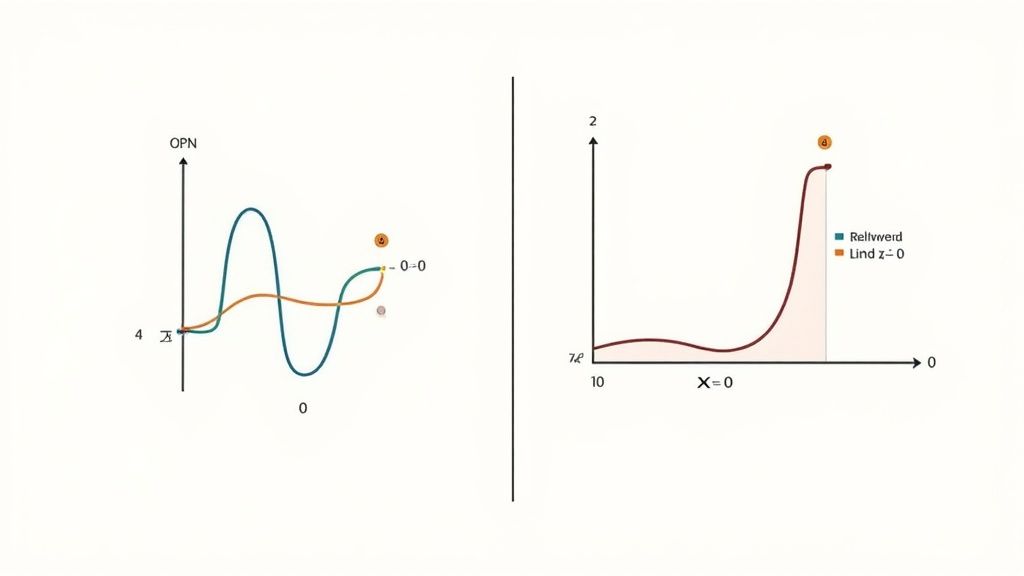
The domain of a piecewise function is usually straightforward—it’s just the combination of all the individual intervals defined for each piece. The range, however, can be a little trickier. You have to look at the output (the y-values) that every single piece produces and then figure out the total vertical span they cover together.
Absolute Value and Logarithmic Functions
Absolute value functions, like ƒ(x) = |x - 2|, are instantly recognizable by their "V" shape on a graph. The expression inside the absolute value bars can be any real number, so the domain is almost always all real numbers, or (−∞, ∞). The range, though, is a different story. Since an absolute value output can never be negative, the range is restricted.
- Domain: Typically, all real numbers.
- Range: Always non-negative values. For ƒ(x) = |x - 2|, the lowest point of the "V" (the vertex) is at y = 0, making the range [0, ∞).
Logarithmic functions bring their own set of rules to the table. The most important rule to remember is that you can't take the log of zero or a negative number. For a function like g(x) = log(x - 4), this means the part inside the parentheses, (x - 4), must be strictly positive.
This single requirement dictates everything about the function's domain.
- Domain: To find it, just set the argument to be greater than zero: x - 4 > 0, which solves to x > 4. So, the domain is (4, ∞).
- Range: Despite the domain restriction, logarithmic functions can produce any real number as an output, from negative to positive infinity. The range is (−∞, ∞).
If you want to dig deeper into the specifics of these functions, our guide on how to solve logarithmic equations is a great next step.
A Quick Note on Precision: The distinction between a function's domain, codomain, and range is a concept that mathematicians clarified back in the 19th century. For example, if you define ƒ(x) = x² and say its domain is only counting numbers {1, 2, 3, ...}, then its range is {1, 4, 9, ...}. But if the domain is all integers, the range becomes {0, 1, 4, ...}. This level of precision is critical in fields like modern cryptography.
Getting a handle on these special cases is all about building confidence. You learn to spot the signature moves of each function type—the sharp "V" of an absolute value or the vertical asymptote of a logarithm—and apply the right rules. Once you can break complex functions down into their core constraints, finding the domain and range becomes a systematic process.
Common Mistakes to Avoid
Even after you get the hang of finding the domain and range, a few common slip-ups can still catch you off guard. Learning the process is one thing, but learning to spot these pitfalls before you make a mistake is what really builds confidence and accuracy.
One of the most frequent mix-ups? Simply confusing the domain with the range. It sounds basic, I know, but when you're in the middle of a problem, it’s surprisingly easy to swap your x-axis analysis with your y-axis analysis. I always tell my students to build a habit: tackle the domain first, focusing only on the horizontal spread. Once that's done, then move on to the range and the vertical spread.
Overlooking Built-In Restrictions
Another big hurdle is forgetting about the built-in rules that govern certain functions. The moment you see a fraction or a square root, a little alarm should go off in your head, signaling you to check for domain restrictions right away.
These are the non-negotiables you should burn into your memory:
- Division by Zero: The denominator of a fraction can never be zero. Your first move should always be to set the entire denominator equal to zero and solve for x. Those are your excluded values.
- Even Roots of Negatives: You can't take the square root (or any even root) of a negative number. Whatever expression is inside the radical has to be greater than or equal to zero. Set it up as an inequality (
≥ 0) and solve.
Ignoring these rules is like trying to build a house on a shaky foundation—no matter how well you do the rest of the work, the whole thing will be flawed.
Pro Tip: A fantastic way to double-check your work is a technique I call 'test pointing.' If you've decided the domain is (2, ∞), pick a test point inside that interval, like x=3, and one outside it, like x=1. The value inside your domain should work perfectly in the function, and the one outside should "break" it (by causing division by zero or a negative under the radical).
Errors in Notation and Graph Interpretation
Getting the right answer often comes down to the final details. A single misplaced bracket can turn a perfectly good concept into a wrong answer. Precision is everything here.
Let's nail down the notation rules one more time:
- Brackets
[]mean the endpoint is included. On a graph, this is a solid dot. In an inequality, it's a ≤ or ≥ sign. - Parentheses
()mean the endpoint is excluded. This corresponds to an open circle on a graph or a <** or **> sign. Remember, infinity (∞) always gets a parenthesis.
When you're looking at a graph, misreading an open or closed circle is an easy mistake to make. An open circle at (3, 5) is a direct instruction: x=3 is out of the domain, and y=5 is out of the range. A solid dot means they’re both in. Think of these visual cues as your roadmap to writing the final answer correctly.
Common Questions About Domain and Range
As you start working with domain and range, a few common questions always seem to pop up. It's completely normal to hit these little roadblocks. Let's tackle some of the most frequent ones I hear from students to help you get unstuck and build your confidence.
Think of this as your go-to FAQ for the tricky bits.
What's the Easiest Way to Find Domain and Range?
Honestly, there isn't one magic bullet—the "easiest" way really depends on what you're given.
When you have a graph: By far, the most intuitive method is visual. For the domain, imagine flattening the entire curve down onto the x-axis. The mark it leaves is your domain. For the range, do the exact same thing, but squish it sideways onto the y-axis. The shadow it casts there represents all possible outputs.
When you have an equation: The best strategy is to look for trouble spots. Start by assuming the domain is "all real numbers," and then hunt for any values that would break the math. The two biggest culprits are division by zero and taking the square root of a negative number. If you can spot those, you're most of the way there.
Can the Domain and Range Actually Be the Same?
Yes, absolutely! This happens more often than you might think.
A perfect example is the simple line f(x) = x. You can put any real number in for x, and you'll get that same number back out. So, both its domain and range are all real numbers. Another great case is the reciprocal function g(x) = 1/x. Here, both the domain and range are all real numbers except for zero.
Does Every Single Function Have a Domain and Range?
Yep, every last one. It's part of the definition of what a function is. A function is just a rule that connects a set of inputs (the domain) to a set of outputs (the range).
The Big Idea: A function can't exist without a domain and a range. The domain tells you what you're allowed to put in, and the range tells you what you can possibly get out. Even something as basic as f(x) = 3 has a domain (all real numbers) and a range (the single number {3}).
How Do Asymptotes Affect Domain and Range?
Asymptotes are a huge clue. These are the invisible lines that a graph gets incredibly close to but never actually crosses, and they set hard limits.
Vertical Asymptotes: These create clear restrictions on the domain. If you see a vertical asymptote at x = c, that means c is a forbidden value for your input. This is common in rational functions where the denominator hits zero at that specific x-value.
Horizontal Asymptotes: These, on the other hand, restrict the range. If there's a horizontal asymptote at y = k, it means the function's output values approach k but might never actually get there. This often means k is excluded from the range.
Hitting a wall with a tough math problem? Feen AI can help. Get clear, step-by-step breakdowns for complex topics in Math, Physics, Chemistry, and more. Just snap a picture of your homework and get the guidance you need to ace it. Give it a try at https://feen.ai.
Relevant articles

Discover the best way to learn calculus with a proven, modern approach. Master core concepts, practice smarter, and use AI tools to conquer calculus for good.

Learn how to graph linear inequalities with this easy-to-follow guide. Discover how to handle dashed lines, shading, and systems with real-world examples.

Learn how to solve word problems in algebra using practical strategies. This guide breaks down the process with real examples and tips to build your confidence.
Discover how to solve systems of linear equations with clear steps, example problems, and practical tips to boost your confidence.

Discover how to study math effectively with proven strategies for active learning, smart practice, and strategic review that build lasting understanding.
Struggling with math? This guide breaks down how to solve math problems step by step using a proven framework, real examples, and modern tools.