How to write research paper outline: A Complete Guide
Learn how to write research paper outline with our guide. Discover formats, structures, and revision tips to build a strong academic blueprint.
A research paper outline is your secret weapon. It’s where you take that big, complex thesis and break it down into a logical hierarchy of main points, supporting arguments, and the evidence you'll use to back it all up. This structured plan, whether you use an alphanumeric or decimal format, is the roadmap that ensures your ideas flow logically before you ever start writing the actual paper. Think of it as the step that turns abstract thoughts into a concrete framework.
Why a Strong Outline Is Your Most Powerful Writing Tool
Let's be honest: many people see outlining as a tedious, skippable chore. But I've learned from years of writing and teaching that it's the single most important step you can take. Your outline isn't just a list; it's the architectural blueprint for your entire argument. It’s what separates a coherent, persuasive paper from a chaotic collection of notes and sources. Without it, you’re basically building a house without a foundation—inviting disorganized arguments, writer's block, and hours of frustrating revisions down the line.
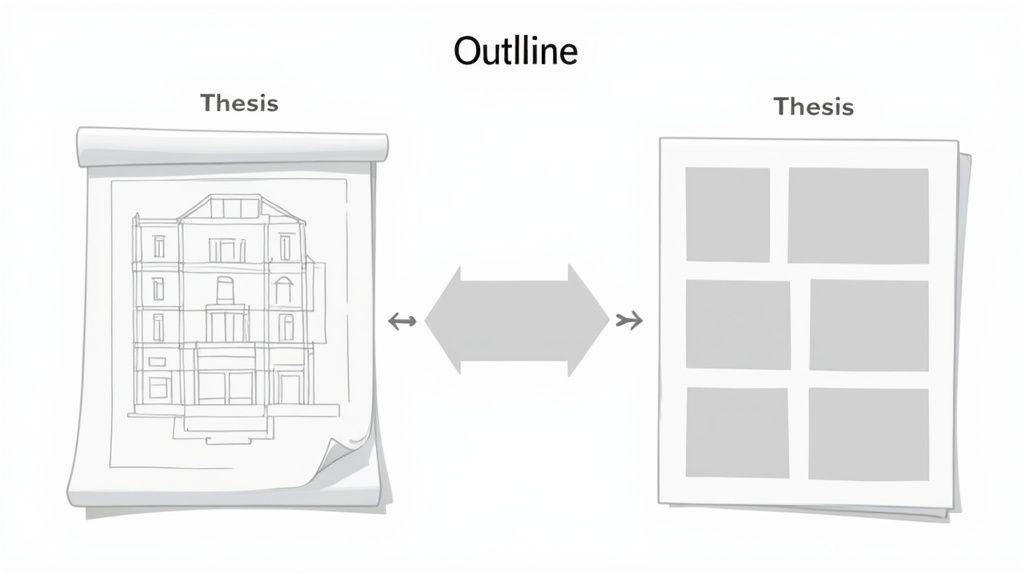
From Chaos to Clarity
Trying to write a research paper without an outline is like trying to explore a new city without a map. Sure, you might get somewhere eventually, but you'll waste a lot of time and energy along the way. A good outline forces you to do the hard thinking upfront.
It makes you:
- Clarify Your Thesis: You have to sharpen your central argument until it's crystal clear and can guide every section of your paper.
- Sequence Your Arguments: It forces you to decide on the most logical flow, ensuring one point builds naturally on the last.
- Identify Gaps Early: You can instantly see where your evidence is weak or an argument needs more support—long before you've wasted time writing paragraphs about it.
This is where the real intellectual work happens. It's the moment you win the battle for a clear, coherent paper.
A Proven Strategy for Efficiency
The practical benefits here are huge. A solid plan stops you from writing yourself into a corner, which is one of the most common pitfalls I see. Instead of realizing halfway through a 20-page draft that a key argument is in the wrong place, you just move a couple of lines in your outline. It's that simple.
An outline is more than a list; it is a tool for critical thinking. It forces you to test the logic of your argument, ensuring that your paper is not just a collection of facts but a compelling and structured narrative that leads your reader to a clear conclusion.
This foresight saves a massive amount of time. In fact, academic productivity studies show that researchers using a detailed outline finish their first drafts 15-25% faster and need 20-35% fewer major revisions. You can read more about these efficiency findings from the National Science Foundation's research data.
Ultimately, outlining is an investment. You put in a little time now to save yourself a lot of time, stress, and anxiety later, and you end up with a much stronger paper. These same planning principles work for other academic writing, too. For more on that, check out our guide on how to write an essay fast.
Choosing the Right Outline Format for Your Research
Not all outlines are created equal, and the format you pick can make or break your writing process. Think of it as choosing the right tool for the job. You wouldn't use a sledgehammer for a delicate sculpture, and you shouldn't cram a complex scientific study into an overly simplistic format. Your goal is to find a structure that fits your topic’s complexity and, just as importantly, your own way of thinking.
Picking the right format is one of the first and most critical steps in building an effective research paper outline. It creates the roadmap you'll follow and helps you sidestep confusion and writer's block down the line. Let's walk through the three most common formats—Alphanumeric, Decimal, and Full-Sentence—using the same research topic to see how each one brings ideas to life differently.
The Classic Alphanumeric Outline
This is the one you probably remember from school. Using a familiar mix of Roman numerals, capital letters, and numbers, the alphanumeric outline creates a clear, logical hierarchy. It’s incredibly intuitive and works beautifully for most papers in the humanities, social sciences, and general academia.
The structure flows naturally like this:
- I. Main Idea
- A. Key Supporting Point
- 1. Specific Detail
- a. Evidence or Example
Let's apply this to a paper on "The Impact of Remote Work on Urban Economies." A small section might look like this:
I. Introduction A. Hook: The unprecedented shift to remote work after 2020 B. Thesis Statement: While remote work offers economic benefits through talent dispersal, it poses significant challenges to urban centers that depend on commuter economies. II. Economic Benefits of a Dispersed Workforce A. Growth in Suburban and Rural Economies 1. Documented increase in local spending 2. Rise in new small business registrations
Its biggest strength is readability. Anyone can glance at it and immediately understand the flow of the argument, making it a fantastic all-around choice.
The Precise Decimal Outline
Working on a highly technical, scientific, or complex paper? The decimal outline is about to become your best friend. It uses a numerical system (1.0, 1.1, 1.1.1) that allows for an almost infinite number of sub-points with perfect clarity. This is why it’s the go-to format in fields like engineering, computer science, and hard sciences where precision is everything.
With the decimal system, cross-referencing different parts of your paper becomes effortless. There's zero ambiguity about where a piece of information belongs.
The real power of the decimal outline is its logical rigor. Every sub-point is clearly nested within its parent topic, making it ideal for papers where the relationships between data points are complex and must be meticulously organized.
Here’s that same remote work topic in a decimal format:
1.0 Introduction 1.1 Background on pre-2020 remote work trends 1.2 Thesis Statement 2.0 Challenges to Urban Commercial Real Estate 2.1 Declining Demand for Office Space 2.1.1 Vacancy rate statistics (2019 vs. 2023) 2.1.2 Impact on municipal property tax revenue 2.2 Collapse of Ancillary Commuter-Based Businesses 2.2.1 Case Study: Downtown restaurants and cafes 2.2.2 Data on public transit ridership decline
This format is less about free-form brainstorming and more about building a systematic, highly organized case.
The Detailed Full-Sentence Outline
If you want to do the heavy lifting upfront, the full-sentence outline is your best bet. Instead of using brief phrases, you write every single point as a complete, well-formed sentence. This takes more time initially, but it’s a game-changer. You’re essentially writing the topic sentences for your entire paper, which makes the actual drafting phase feel like you’re just connecting the dots.
This method forces you to fully articulate your thoughts from the start, which is a great way to spot weak arguments or logical gaps before you've written a single paragraph. While research papers have their own conventions, it can be helpful to see how other complex projects are structured. Looking at a book outline template can offer surprising insights into building a long-form argument.
Here's our example, fully fleshed out:
I. The widespread shift to remote work has fundamentally altered the economic landscape of major American cities. A. Before 2020, daily commuters formed the financial backbone of urban commercial districts. B. My thesis argues that this shift creates a dual impact, simultaneously boosting smaller communities while threatening the economic stability of metropolitan cores. II. The decline in daily commuters has led to a quantifiable reduction in revenue for the urban service sector. A. Financial data shows a significant drop in spending at businesses that traditionally cater to office workers, such as cafes and restaurants. B. Urban public transportation systems have experienced severe ridership and revenue losses, forcing widespread service cuts.
Choosing this format is like creating a detailed architectural blueprint before laying the foundation. It’s perfect for dense, argumentative papers or for team projects where crystal-clear communication is a must.
To make your decision easier, here's a quick side-by-side look at how these three formats stack up.
Comparing Research Paper Outline Formats
| Format Type | Structure Example | Best For | Key Advantage |
|---|---|---|---|
| Alphanumeric | I. > A. > 1. > a. | Most academic papers, especially in humanities and social sciences. | Clarity and Familiarity: Easy to read and universally understood. |
| Decimal | 1.0 > 1.1 > 1.1.1 | Technical, scientific, and complex papers where precision is key. | Logical Precision: Allows for infinite, unambiguous subdivisions. |
| Full-Sentence | I. [Complete sentence] | Complex, argumentative papers and collaborative projects. | Pre-writes the Paper: Forces full idea development early on, making drafting easier. |
Ultimately, the best format is the one that helps you think clearly and organize your ideas most effectively. Don't be afraid to try one and switch if it isn't clicking—the outline is a tool for you, not a rigid set of rules.
Building Your Outline from Thesis to Final Detail
Now that you've picked a format, it's time to get down to business. This is where you transform your cloud of ideas into a solid, workable plan—the actual skeleton that will hold your entire paper together. The starting block for all of this isn't a random list of thoughts; it's the single most important sentence you'll write: your thesis statement.
Think of your thesis as the North Star of your paper. Every single point, argument, and piece of evidence in your outline must point directly back to it. If a point doesn't support or explain your thesis, it doesn't belong. A fuzzy or weak thesis inevitably leads to a rambling outline and a paper that goes nowhere.
If you feel your thesis is a bit shaky, stop right here and fix it. A great thesis is specific, arguable, and makes a clear promise to your reader about what you're going to prove. Having trouble nailing it down? Sometimes an outside perspective or a good tool can break the logjam. You can get some excellent guidance or even spark new ideas with a helpful thesis statement generator to make sure your foundation is rock-solid.
From Research Questions to Main Points
With a strong thesis locked in, your next move is to figure out the major arguments that will prove it. You don't have to pull these out of thin air. In fact, you've probably already done the work—just look at your initial research questions.
Each core question you planned to answer can often be flipped into a main section of your outline.
Let's stick with our topic: "The Impact of Remote Work on Urban Economies." Your research questions might have been:
- How has the rise of remote work impacted commercial real estate in city centers?
- What are the economic consequences for businesses that once relied on daily commuters?
- Are suburban and rural economies seeing any benefits from this shift?
- What long-term policy changes are cities exploring in response to these trends?
See how these naturally become the main pillars of your paper? They are your Roman numerals (I, II, III) or your top-level headings. This approach ensures your paper stays focused and directly answers the very questions that kicked off your research.
Grouping Your Ideas and Evidence
Okay, you have your main sections. Now it's time to fill them in. Go back to your notes, your highlighted articles, and your annotated bibliography. This part is like sorting laundry—start grouping all that information under the appropriate main heading.
As you sort, a natural hierarchy will start to take shape. Some notes will be major supporting arguments (your 'A', 'B', 'C' points), while others will be the nitty-gritty details—the specific stats, quotes, or case studies that back them up (your '1', '2', '3' points). Don't stress about perfect phrasing just yet. The goal is simply to get all your puzzle pieces sorted into the right piles.
An outline is meant to be a living document, not a perfect sculpture on the first try. It’s okay for it to be messy initially. You're bringing order to the chaos of your research, and that often means moving things around until they just click.
This infographic gives you a quick visual for how to choose between the different outline styles.
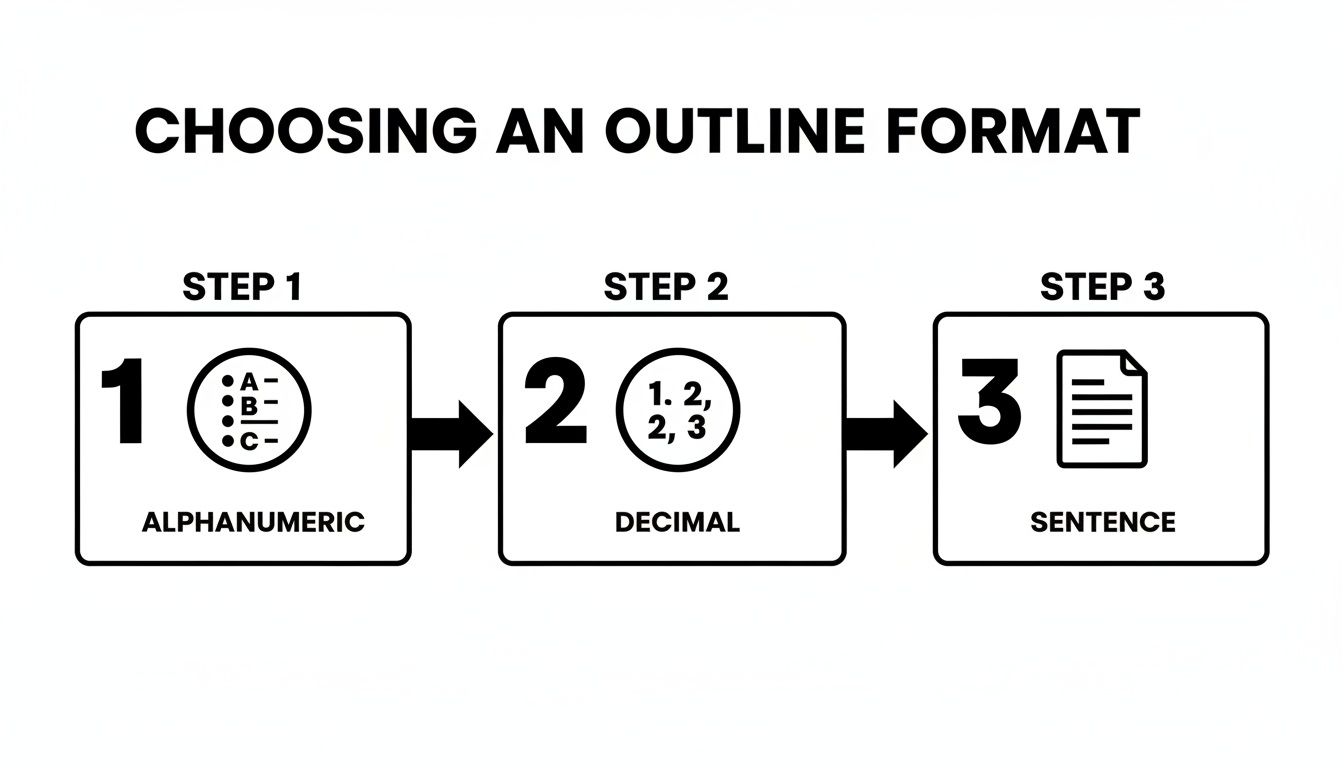
It helps clarify how the format you pick really depends on how complex your paper is and whether you need more structure or more flexibility.
Arranging Arguments for Maximum Impact
Once your ideas are grouped, the last big step is deciding the order. The sequence of your arguments can make or break your paper. You're trying to take your reader on a logical journey, starting with foundational knowledge and building steadily toward your most compelling conclusions.
There are a few classic ways to organize your flow:
- Chronological: Perfect for historical topics or tracing how an idea developed over time. You simply present events as they happened.
- Thematic: A great choice for literature reviews or complex social issues. You group your arguments around recurring themes or concepts.
- Cause and Effect: You start by explaining the causes of something, then dedicate the rest of the paper to exploring its effects.
- Problem-Solution: You first lay out a clear problem, then spend the paper proposing and evaluating potential solutions.
For our remote work paper, a problem-solution structure makes a lot of sense. You could start by detailing the economic challenges cities are facing (the problem), explore the unexpected growth in suburbs (an effect), and then conclude by discussing policy ideas (the solution). This creates a story that’s easy to follow and much more persuasive.
A Practical Example in Action
Let’s see what this looks like on the page, using the classic alphanumeric format. This is how you go from a jumble of notes to a coherent plan.
Thesis Statement: While remote work offers economic benefits through talent dispersal, it poses significant challenges to urban centers that depend on commuter economies, necessitating new models for urban development.
I. Introduction A. Hook: The unprecedented shift to remote work post-2020 B. Background: The traditional role of the central business district C. Thesis Statement (as above)
II. The Economic Disruption in Urban Cores A. Challenge to Commercial Real Estate 1. Data: Increase in office vacancy rates (2019 vs. 2023) 2. Evidence: Quotes from real estate analysts on falling property values B. Impact on Commuter-Reliant Small Businesses 1. Case Study: Downtown cafes and retail shops 2. Statistic: 40% drop in weekday foot traffic in major metro areas
III. The Economic Upside in Suburban and Rural Areas A. Growth of Local Economies 1. Data: Increased local tax revenue in satellite communities 2. Evidence: Rise in new business registrations outside major cities B. Shifts in Residential Real-Estate Demand
This isn't just a list anymore—it's a detailed, logical roadmap. Every point flows from the one before it and works to prove the thesis. This is the kind of detailed outline that makes the actual writing process feel less like a chore and more like you're just connecting the dots.
Tailoring Your Outline to Different Paper Types
Academic writing isn’t a one-size-fits-all game. The way you’d structure a hard-hitting scientific report is worlds away from how you’d build a persuasive essay. Knowing the difference isn't just about following arbitrary rules—it's about presenting your ideas in the most powerful and credible way for your specific field.
This is exactly why a generic outline won't cut it. An outline for an empirical paper will fall flat for a literature review, and vice versa. Each paper type has its own rhythm and set of expectations. When you start with the right blueprint, you signal to your professor or reviewers that you know what you're doing.
Let’s break down how to structure outlines for three of the most common academic papers you'll encounter.
The Empirical Paper: Following the IMRAD Structure
If you're working in the sciences or social sciences and have just finished your own original research—a lab experiment, a survey, or an observational study—then the IMRAD structure is your best friend. It’s the gold standard for a reason.
IMRAD stands for Introduction, Methods, Results, and Discussion. This format is the universal language for presenting research clearly and logically, walking your reader through exactly what you did, why you did it, and what you found.
This visual gives you a great overview of the IMRAD flow.
Think of it as telling the story of your research. Each section has a specific job:
- Introduction: What was the question? Set the stage with background information, pinpoint the gap in current knowledge, and state your specific hypothesis or research question.
- Methods: What did you do? This is your recipe. Detail your research design, participants, materials, and procedures so clearly that another researcher could replicate your study.
- Results: What did you find? Stick to the facts here. Present your findings objectively using data, tables, and figures, without any interpretation just yet.
- Discussion: What does it all mean? Now you can interpret. Connect your results back to your hypothesis, discuss the implications, acknowledge any limitations, and suggest what should be studied next.
The real power of the IMRAD structure is its clarity and widespread acceptance. By using it, you're speaking the established language of empirical research, making it easier for your work to be understood and respected.
Sticking to a recognized structure like this has real-world benefits. One analysis found that manuscripts following a pre-registered outline saw 10–18% higher pass rates at initial review and had 15–25% faster peer-review cycles. You can read more about how structured outlines impact journal submissions on nature.com.
The Thematic Literature Review
Unlike an empirical paper, a literature review doesn't involve new data. Your job is to synthesize and evaluate what other researchers have already published on a topic to identify trends, debates, and gaps.
The biggest mistake you can make is simply summarizing one source after another. A great literature review is organized thematically. Your outline's main sections shouldn't be authors, but the core themes and debates you've uncovered.
Here’s what that looks like in practice:
- Introduction: Kick things off by explaining why the topic matters and defining the scope of your review. Your thesis should offer your unique take on the literature (for example, arguing that there's been a major shift in thinking over the past decade).
- Theme 1: Foundational Theories: Start with the big ideas. Discuss the core theories that underpin the topic and group the key scholars who have contributed to them.
- Theme 2: Key Debates and Controversies: Dive into a major point of disagreement in the field. Lay out the different sides of the argument, citing the researchers who represent each perspective.
- Theme 3: Methodological Approaches: Analyze how others have studied this topic. You could compare and contrast qualitative versus quantitative studies and discuss what each approach has revealed.
- Conclusion: Pull it all together. Summarize the major themes, restate your thesis, and—most importantly—identify the "gap." What questions are still unanswered? Point the way for future research.
The Classic Argumentative Essay
For papers in the humanities and social sciences, your mission is to make a persuasive claim and defend it with sharp reasoning and solid evidence. A strong outline for an argumentative essay is all about building a rock-solid case, one point at a time, while skillfully handling any counterarguments.
This structure is a cornerstone of many writing assignments. For a deeper look, our guide on how to write a literary analysis essay explores these principles in more detail.
Here’s a tried-and-true outline for a killer argumentative essay:
- Introduction: Grab your reader's attention with a hook, provide some brief context, and close with a clear, debatable thesis statement. This is the core of your entire paper.
- Body Paragraph 1 (Your Strongest Point): Lead with a topic sentence that introduces your first supporting argument. Back it up with evidence—quotes, data, examples—and then analyze how that evidence proves your point.
- Body Paragraph 2 (Your Next Point): Do it again, this time with your second argument. Make sure you use a good transition to create a smooth flow from the previous paragraph.
- Addressing the Counterargument: Show your intellectual honesty. Dedicate a paragraph to acknowledging a valid opposing view. Present it fairly, then expertly refute it, explaining why your argument is stronger or more comprehensive.
- Conclusion: Don't just repeat yourself. Rephrase your thesis in a new light, briefly summarize your main points, and end with a "so what?" statement that leaves your reader thinking about the broader significance of your argument.
How to Refine and Stress-Test Your Outline
Your first outline is a fantastic start, but it's just that—a start. Think of it as a rough sketch, not the final blueprint. The real magic happens when you refine and stress-test this plan before you start writing. This is your chance to catch logical flaws, find weak spots in your evidence, and make sure your argument is truly compelling.
It's tempting to see your outline as set in stone, but that's a classic mistake. You need to actively challenge it. Does it actually hold up under scrutiny? Does the narrative flow, or does it jump around? Skipping this step is a recipe for disaster, often leading to massive rewrites later on instead of a simple adjustment now.
A Checklist for Self-Revision
Before you show your outline to anyone, you need to be its toughest critic. This self-revision process is all about interrogating every choice you’ve made. Go through your structure point by point and ask yourself some hard questions.
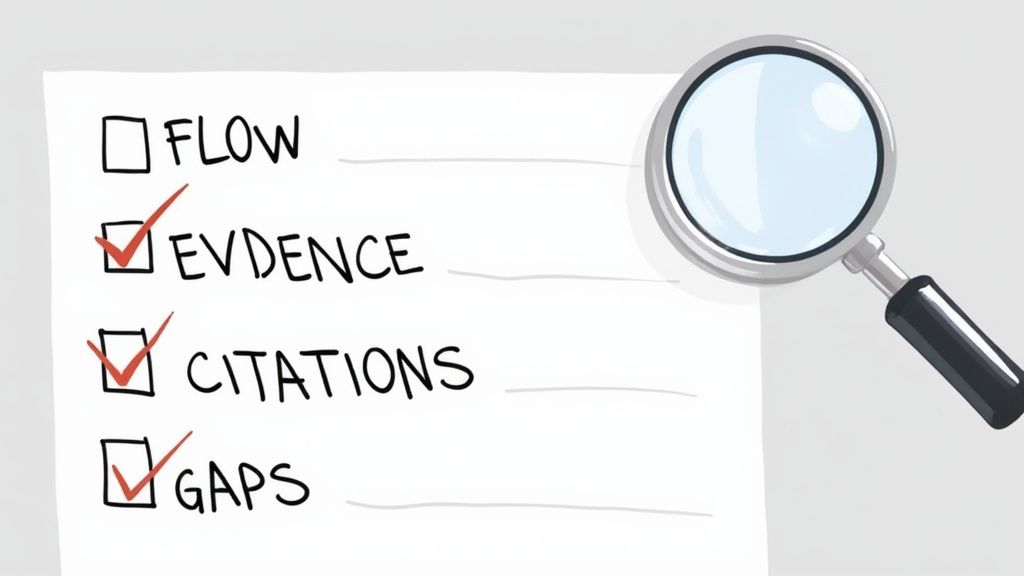
Here’s a practical checklist to get you started:
- Thesis Alignment: Does every single point and sub-point directly support, explain, or defend your thesis? If a section feels like a detour, you either need to tie it back to the main argument or cut it completely.
- Logical Flow: Read only your main section headings (your Roman numerals) out loud. Do they tell a coherent story? Your paper needs a clear beginning, middle, and end, with each section building on the last.
- Evidentiary Support: Look at the specific evidence you've jotted down (stats, quotes, case studies). Do you have enough credible proof for every claim you plan to make? Be honest. If a section is thin on evidence, mark it down for more research.
- Balance and Proportionality: Are your main sections relatively balanced? If one section is a sprawling beast and another is just a couple of bullet points, your argument might feel lopsided. Consider reorganizing, combining, or expanding ideas for better proportion.
The Power of Peer Feedback
Once you’ve done your own rigorous check, it's time for a second opinion. Getting feedback at the outline stage is one of the smartest moves you can make. It’s a low-stakes task for the reviewer but incredibly valuable for you. A fresh pair of eyes can easily spot logical gaps or confusing transitions you’ve become blind to.
Find a trusted classmate, a mentor, or make an appointment at your university's writing center. Don't just hand over the outline and ask, "What do you think?" That's too vague. You need to guide their feedback.
Ask targeted questions to get the most useful feedback. For instance: "Does the argument in Section III seem to logically follow from Section II?" or "Do you see any places where my evidence doesn't seem strong enough to support my claim?"
This approach transforms a generic review into a focused diagnostic session. Seriously, a five-minute conversation about your outline now can save you five hours of painful revisions on a full draft later. It’s this simple act that ensures your final paper is built on a rock-solid foundation.
Common Questions About Research Paper Outlines
Even with a solid plan, you're bound to hit a few snags when you start outlining. I've seen it time and time again. Think of this section as a quick chat with a professor or a writing tutor—we'll tackle the most common hurdles that trip students up. Getting these things straight now will save you a world of frustration later.
The whole point is to turn that feeling of uncertainty into a concrete plan you can actually use. Let's get these questions answered so you can get back to work.
How Detailed Should My Outline Be?
This is the classic "how long is a piece of string?" question. The truth is, the perfect level of detail is a balancing act. It really depends on how complex your paper is and, frankly, how your own brain works.
As a general rule of thumb, aim for enough detail that each bullet point represents a single, distinct idea—something that will likely become its own paragraph in the final paper.
For a standard 10-page paper, a good, solid 1- to 2-page outline is usually the sweet spot. You absolutely need your thesis statement, your main section headings, and at least a couple of sub-points under each one that list the specific evidence or arguments you plan to use. If you opt for a full-sentence outline, you're putting in more work upfront, but it can make the actual writing feel like you're just connecting the dots.
The best outline is the one you will actually use. If it's too skeletal, it won't guide you. If it’s overly detailed, you might feel trapped. Your goal is to find that sweet spot that provides structure without stifling your creativity.
What if My Research Changes After I Make the Outline?
First off, don't panic. This is not only okay, it’s a great sign! It means you're actively engaging with your research. An outline is a roadmap, not a pair of handcuffs. As you dig deeper, you'll uncover new sources and your perspective will sharpen. Your outline should absolutely evolve right along with your thinking.
When you feel your argument starting to shift, here’s what to do:
- Revisit Your Thesis: Does your core argument need an update based on this new information? Always start here, since the thesis is the anchor for everything else.
- Adjust Your Main Points: Don't be afraid to reorganize, add, or even delete entire sections to better support your new-and-improved thesis.
- Update Your Evidence: Swap in the new evidence you've found and get rid of any points that no longer fit.
Trust me on this: it is infinitely easier to move a few lines around on a one-page outline than it is to perform major surgery on a 20-page draft. Embrace the flexibility.
Are There Tools That Can Help Create an Outline?
Absolutely. While you can always get the job done with a simple word processor, there are some great tools out there that can make the process much more intuitive. The key is finding one that clicks with how you think.
- Mind Mapping Software: For the initial brainstorming chaos, tools like Miro or XMind are fantastic. They let you throw ideas down and visually connect them in a non-linear way. This is perfect for exploring relationships between topics before you lock in a rigid structure.
- Dedicated Outliners: Programs like Scrivener, Notion, or OmniOutliner are purpose-built for this. They make it incredibly easy to drag and drop sections, collapse and expand your ideas, and manage a really complex argument without getting lost.
At the end of the day, the best tool is the one that helps you think clearly, whether that's a sophisticated app or just a pen and a legal pad.
Is It Okay to Start Writing Before the Outline Is Perfect?
Yes, but with a big asterisk. You should always have a solid, well-thought-out outline before you try to write the entire paper from start to finish. That said, sometimes the best way to figure out what you really think about a topic is to just start writing about it.
This is called "freewriting," and it can be a powerful tool.
If you hit a wall on a particular section, try writing it out without worrying about perfection. Treat it as an exploration. Once you've gotten your thoughts down and they feel more solid, go back and integrate those fully formed ideas into your outline. You’ll likely need to adjust the overall structure a bit, but that's the point. This technique uses targeted writing to refine your plan, which is a whole lot smarter than writing an entire paper with no plan at all.
Juggling homework, from structuring an outline to tackling tough equations, is a challenge. Feen AI is designed to help you navigate it. You can upload your assignment, ask questions, and get clear, step-by-step guidance in subjects like Math, Chemistry, and Biology, or even get a hand drafting your next essay. Streamline your study sessions and get the support you need at https://feen.ai.
Relevant articles

Learn how to write a strong argumentative essay with our guide. We cover building a thesis, using evidence, and structuring your argument for academic success.
Learn how to write a persuasive essay that wins arguments. Our guide covers crafting a strong thesis, finding solid evidence, and structuring your paper.
Learn how to write a lab report conclusion with a clear structure, real examples, and tips to boost your grade.
Learn how to cite sources in mla with clear examples for books, websites, and more. Write your paper confidently with MLA guidance.
Learn how to write a conclusion paragraph that leaves a lasting impression. Our guide covers proven structures, real examples, and mistakes to avoid.

Struggling with how to write a thesis statement? This guide breaks down the process with real examples and tips to craft a clear, arguable, and strong thesis.