How to Write a Persuasive Essay That Truly Persuades
Learn how to write a persuasive essay that wins arguments. Our guide covers crafting a strong thesis, finding solid evidence, and structuring your paper.
Writing a persuasive essay is all about building a solid, convincing argument that’s backed by real evidence. At its core, it comes down to three things: picking a topic people can actually debate, creating a laser-focused thesis statement, and then defending that thesis with a powerful mix of logical reasoning (logos), emotional connection (pathos), and credible authority (ethos).
If you can get these three pillars right, you’ll have a formula that doesn't just lay out facts but genuinely changes how people think.
What Makes a Persuasive Essay Truly Convincing

Before you even think about outlines and paragraphs, let's get the foundation right. A truly convincing essay isn’t just a laundry list of facts. It’s a carefully woven blend of logic, credibility, and just the right amount of emotional pull. These ideas, first mapped out by Aristotle thousands of years ago, are the invisible engine that makes an argument stick with a reader long after they’ve put the paper down.
Think of it this way: your essay is a one-sided conversation. Since you can’t see your audience, you have to anticipate their doubts, earn their trust from the get-go, and make them feel why your topic matters.
The Three Pillars of Persuasion
At the heart of every great persuasive essay are three classic appeals. The real secret to winning over your reader is learning how to balance them, moving them from a passive observer to someone who actually agrees with you.
Let’s quickly break down Aristotle's three rhetorical appeals. Think of this table as your go-to reference for making sure your argument is balanced and effective.
| Pillar | What It Means | How to Use It in Your Essay |
|---|---|---|
| Logos | The logical appeal—the facts, stats, and evidence. | Use verifiable data, statistics from credible sources, expert testimony, and clear, logical reasoning to build your case. |
| Ethos | The ethical appeal—your credibility and authority. | Cite reputable sources, maintain a fair and knowledgeable tone, and show you understand the issue's complexities. |
| Pathos | The emotional appeal—connecting with the reader. | Use vivid descriptions, personal anecdotes, and stories that make your reader feel the human impact of your argument. |
By weaving these three elements together, you create an argument that is not only smart and trustworthy but also genuinely compelling.
Here’s a more detailed look at how each one works in practice:
Logos (The Logical Appeal): This is the backbone of your argument—the cold, hard evidence. We're talking statistics, data, and verifiable facts. If you're arguing for a four-day school week, you'd bring in data showing improved student attendance or higher test scores from districts that have already made the switch.
Ethos (The Ethical Appeal): This is all about building your credibility. You establish ethos by citing reputable sources, using a fair-minded tone, and acknowledging that the issue is complex. When you quote an educational psychologist or cite a peer-reviewed study, you're signaling to your reader that you’ve done your homework and can be trusted.
Pathos (The Emotional Appeal): This is how you connect with your reader on a human level. A short, powerful anecdote about student burnout or a vivid description of an engaged, well-rested classroom can often hit harder than a dry statistic. Pathos makes your argument feel real and urgent.
A classic mistake I see students make is leaning too heavily on just one of these pillars. An essay built only on logos can feel cold and robotic. One that relies entirely on pathos can seem manipulative or factually weak. The most powerful arguments find that sweet spot where logic, credibility, and emotion work in harmony.
Mastering this skill is more important than ever. After 2020, as education shifted online, the demand for tools to help students write better has exploded. The global essay writing service market jumped from USD 1.97 billion in 2023 and is projected to hit USD 4.35 billion by 2032. This trend is driven by over 19 million students in U.S. colleges alone who are expected to produce compelling, well-argued essays. You can read the full research on the essay writing market to dig deeper into how academic pressures are shaping these trends.
This growth proves a critical point: writing a persuasive essay isn't just a classroom assignment. It’s a fundamental skill for communicating clearly and effectively in any career. By mastering these core concepts, you’re not just preparing for your next paper—you’re learning how to build a case, earn trust, and make your voice heard.
Finding a Topic and Forging a Bulletproof Thesis
The success of your entire persuasive essay hinges on two things: a compelling, debatable topic and a razor-sharp thesis statement. These aren’t just boxes to check off; they’re the engine and the roadmap for your whole argument. Without a solid foundation here, even the most beautifully written essay will fall flat.
A great topic is one you’re genuinely invested in. Forget the tired, overused subjects like school uniforms unless you've got a truly fresh angle. Passion is persuasive, so find something that sparks your curiosity and has more than one legitimate side to it.
Brainstorming a Topic with Potential
Finding the right topic isn’t about a lightning bolt of inspiration. It’s a practical process of exploring and narrowing down. You need an issue that’s not just debatable but also focused enough to tackle effectively in a few pages.
Start by thinking about broad areas that matter to you—current events, campus life, ethical dilemmas in tech, you name it.
- Mind Mapping: Grab a piece of paper and put a central idea in the middle (like "social media"). Now, branch out with related concepts: "mental health," "misinformation," "political discourse," "creator economy." Which of those branches makes you ask the most questions? Follow that curiosity.
- Questioning the Status Quo: Look at your school or community. Is there a rule, policy, or common assumption that just doesn't sit right with you? Asking "Why do we do it this way?" or "Couldn't this be better?" is a fantastic starting point for an argument.
- Exploring Opposing Views: Read some opinion articles on subjects you care about. The moment you find yourself thinking, "No, that's completely wrong," you've struck gold. That disagreement is the perfect soil for your own persuasive essay.
Once you have a general subject, the real work begins: forging it into a powerful, assertive thesis statement. This is where so many writers stumble, but it’s arguably the most important sentence in your entire essay.
Your thesis isn't a question or a simple fact. It's a debatable claim—a specific argument you'll spend the rest of your essay proving. It’s your promise to the reader, laying out exactly what you're going to argue and why it's important.
Crafting a Strong and Debatable Thesis
A weak thesis is mushy and vague. A strong one is specific, takes a firm stance, and can be defended with evidence. It draws a clear line in the sand. Let's see how a basic idea can evolve into a bulletproof thesis.
Weak Thesis (Just an observation): "Social media has negative effects on teenagers."
This is too broad, and frankly, it isn't very debatable. Most people would agree. It gives you nothing specific to prove.
Better Thesis (A specific, arguable claim): "The algorithm-driven nature of platforms like TikTok and Instagram directly contributes to heightened anxiety among teenagers by fostering a culture of relentless social comparison."
Now that is a thesis. It names specific platforms, identifies a cause ("algorithm-driven nature"), and pinpoints a measurable effect ("heightened anxiety"). This is a claim you can actually build an argument around with real evidence.
Let’s try another one.
Weak Thesis (Way too general): "Working from home is a good idea."
What does "good idea" even mean? It's subjective and lacks any real analytical bite. This gives your essay no direction.
Strong Thesis (Assertive and focused): "Companies should permanently adopt a hybrid work model to boost employee productivity, slash operational costs, and promote a healthier work-life balance."
This thesis is a powerhouse. It takes a firm position ("should permanently adopt") and immediately gives the reader your three main points of proof. Your entire essay structure is now clear.
If you're finding it tough to sharpen your main point, a thesis statement generator can be a useful tool to help crystallize your thoughts. Using a tool like Feen AI can help you play with different angles and turn a simple observation into a thesis that will drive your entire essay forward.
Building Your Case with Unshakable Evidence
A persuasive essay without solid evidence is really just a collection of opinions. To genuinely win over your reader, you have to move past "I think" and get to "Here's the proof." This is where you build a foundation of credible, well-chosen facts that give your claims real weight.
Think of yourself as a detective building a case. You wouldn't show up in court with just a hunch, right? You’d come armed with fingerprints, witness statements, and expert analysis. In your essay, that's exactly what evidence does—it provides the logical backbone for your thesis and proves you've done your homework.
Finding Your Arsenal of Facts
Your first move is to gather different kinds of evidence. If you only rely on one type, your argument can feel a little flimsy or one-sided. The trick is to create a powerful mix that makes your case more dynamic and much harder to argue with.
You’ll want to look for a few key types of proof:
- Statistics and Data: Numbers don't lie. Saying "85% of companies with a four-day work week report higher productivity" hits a lot harder than just saying "people work better with a shorter week."
- Expert Testimony: Quoting a recognized authority in the field instantly boosts your credibility. Citing an economist's analysis of a new tax policy shows you’re engaging with the topic on a professional level.
- Anecdotes and Case Studies: These are the real-world stories that make your argument human. A short narrative about a student who finally thrived after their school adopted later start times can make a statistical point feel personal and urgent.
The real skill is knowing when to use each one. A shocking statistic can grab your reader's attention right away, while a well-told story can leave a lasting emotional impact.
Vet Your Sources Like a Pro
Let's be honest: not all evidence is created equal. In an era of non-stop information (and misinformation), knowing how to judge your sources is absolutely critical. A biased, outdated, or just plain wrong source can sink your entire argument.
Before you drop a piece of evidence into your essay, run it through this quick mental checklist:
- Who wrote it? Are they a genuine expert, a respected journalist, or an organization with a known agenda?
- Where was it published? Big difference between a peer-reviewed academic journal and a random blog.
- When was it published? Is the information still relevant? A statistic about social media use from 2010 is practically ancient history.
- Why was it written? Is the goal to inform, persuade, or sell you something? Watch out for loaded language.
Here's a common mistake I see all the time: a student grabs the first statistic that supports their claim without checking where it actually came from. Always try to trace data back to its primary source—the original study or government report—instead of just citing a secondary article that mentioned it.
This level of care matters. Research has shown that persuasive essays demand more depth and careful organization than other kinds of writing. One study, for instance, found that persuasive essays were significantly longer and more structurally complex than other types, requiring much more detailed support from the writer. This really underscores why mastering evidence is so fundamental when you're learning how to write a persuasive essay. You can discover more about how essay genres challenge writers differently by reading the full study.
Strong evidence isn't just about finding facts; it's about choosing the right facts from credible places. Here’s a quick guide to what you should be looking for and where you can find it.
Types of Evidence and Where to Find Them
| Evidence Type | What It Is | Primary Sources |
|---|---|---|
| Statistical | Numerical data, percentages, and findings from studies that provide objective, measurable proof. | Government databases (e.g., U.S. Census Bureau), academic journals, reports from non-partisan research organizations (e.g., Pew Research Center). |
| Testimonial | Direct quotations or summaries of opinions from recognized experts or authorities in a relevant field. | Interviews, scholarly articles, official publications, expert testimony in legal records. |
| Anecdotal | Personal stories, case studies, or specific examples that illustrate a point in a relatable way. | Autobiographies, personal interviews, reputable news articles, documentary films. |
| Analogical | A comparison between two different things to highlight a point of similarity, making a complex idea easier to grasp. | Historical documents, scientific reports, philosophical texts. |
Finding these sources takes a little digging, but having a diverse set of evidence will make your argument incredibly robust and convincing.
Organize Your Evidence for Easy Access
Once you've collected a good stash of facts, quotes, and stories, the last step is to get them organized. Don't just throw everything into one massive document where it'll get lost.
Create a simple system that connects each piece of evidence to the specific point it supports in your outline. A simple table or even a set of digital flashcards can be a lifesaver. For each of your body paragraphs, list the key pieces of proof you plan to use.
When you finally sit down to write, all your best ammo will be right there, ready to go. This prep work not only makes the writing process a whole lot smoother but also guarantees that every single claim you make is backed by undeniable proof.
Structuring Your Argument for Maximum Impact
A brilliant argument can completely fall apart without the right structure. Think of your persuasive essay as a carefully constructed building: your introduction is the foundation, your body paragraphs are the load-bearing walls, and your conclusion is the roof that ties it all together. Without a solid blueprint, the whole thing is at risk of collapse.
This is the point where you shift from just gathering facts to strategically deploying them. We'll walk through how to guide your reader from a compelling opening, through a series of rock-solid points, and on to a conclusion that leaves a lasting impression. Every single part has a specific job to do, and getting the order right is what separates a decent essay from a truly persuasive one.
Crafting an Unforgettable Introduction
Your intro is your first—and sometimes only—chance to hook the reader. It needs to accomplish three things, and fast: grab their attention, provide just enough context, and present your crystal-clear thesis statement.
A common mistake I see is students starting with a dry, generic sentence. Don't do that. You need to open with something that makes your reader sit up and take notice.
- Try a surprising statistic: "What if I told you that over 70% of high school students report feeling regularly disengaged from their classes?"
- Ask a thought-provoking question: "Is it possible the traditional five-day school week is the biggest obstacle to modern learning?"
- Share a quick, powerful anecdote: "For one student in rural Texas, a four-day school week didn't just mean a longer weekend; it meant more time to work and support her family."
After the hook, briefly lay out the necessary background on the topic. Never assume your reader is an expert. Then, cap off your intro with your sharp, debatable thesis. That sentence is the roadmap for the rest of your essay, telling the reader exactly what you intend to prove.
Building Powerhouse Body Paragraphs
Each body paragraph is a mini-argument in support of your main thesis. For them to be truly effective, every single one needs to follow a logical structure. A proven method for this is what's often called the Claim-Evidence-Reasoning model.
- Claim: Start the paragraph with a clear topic sentence. This is the specific point you’re about to prove, and it must directly support a piece of your thesis.
- Evidence: Now, back it up. This is where you bring in the credible evidence you’ve gathered—a statistic, a quote from an expert, a real-world example. You have to show, not just tell.
- Reasoning: This is the most critical part, and it's where most students fall short. You have to explain how your evidence proves your claim. Connect the dots for your reader, analyze the data, and spell out the significance of the proof you've provided.
A body paragraph without reasoning is just a list of facts. It's the analysis—the "why it matters" part—that transforms a simple fact into a persuasive point and truly demonstrates your understanding.
Strong paragraphs don't just happen; they are built on a foundation of carefully found, vetted, and organized proof.
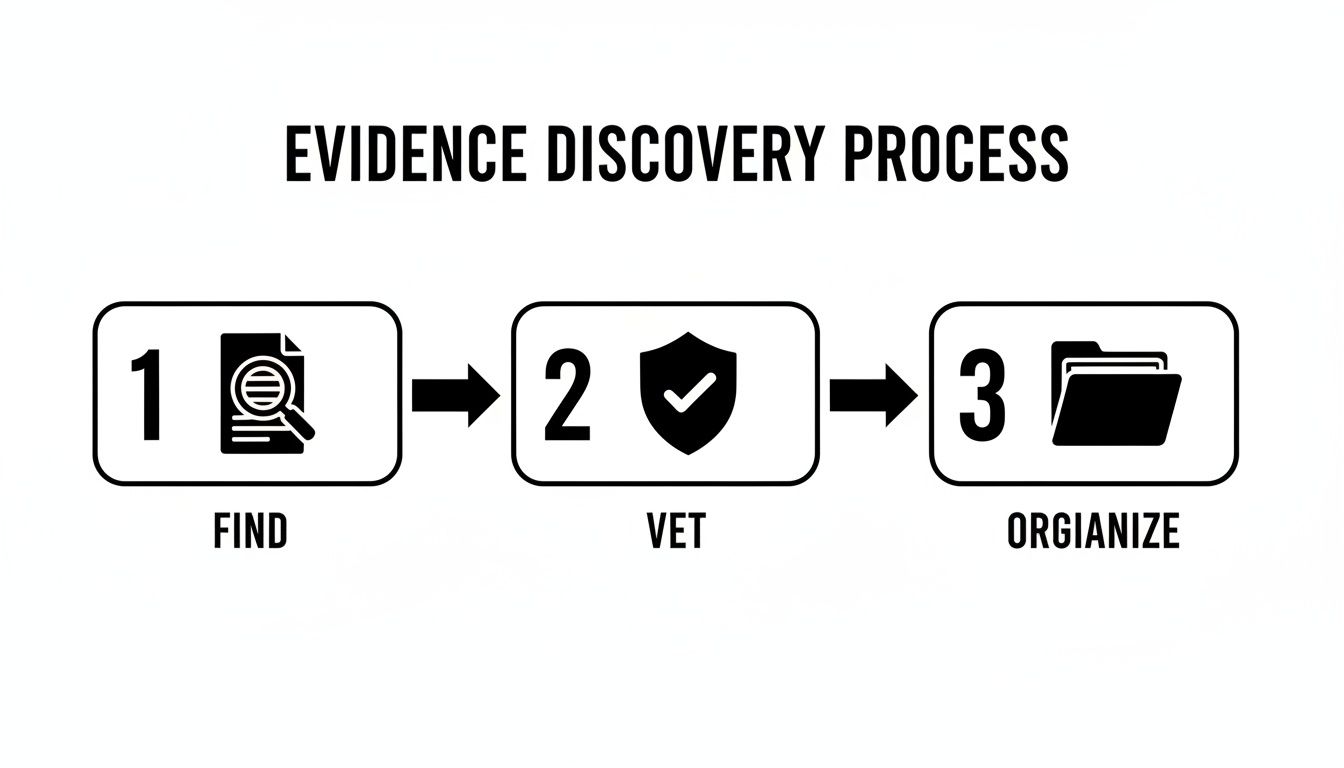
This simple process is the engine that fuels your body paragraphs.
The Art of Acknowledging the Other Side
One of the most powerful moves you can make in a persuasive essay is to address the counterarguments. I know it feels weird to give airtime to the opposing view, but trust me, it actually makes your own position much stronger. It shows your reader you’ve thought about the issue from all angles and aren’t afraid to tackle objections head-on.
This simple act demonstrates your credibility (ethos) and shows you're a fair-minded, rational thinker.
Find a common argument against your thesis and dedicate a paragraph to it. First, state the opposing viewpoint clearly and respectfully. Then, systematically take it apart using logic and evidence. This one-two punch of acknowledging and then dismantling a counterargument can often be the final push that wins over a skeptical reader.
Writing a Conclusion That Resonates
Finally, your conclusion needs to do more than just repeat what you’ve already said. A weak conclusion can make an otherwise strong essay end with a whimper. Your goal is to leave the reader with something to think about, reinforcing why your argument matters.
A powerful conclusion should:
- Restate your thesis in a new way: Don't just copy and paste it from the intro. Rephrase it with the confidence of someone who has just proven their case.
- Briefly summarize your main points: Give your reader a quick, high-level reminder of the logical journey you've just taken them on.
- End with a powerful final thought: This is your "so what?" moment. Why does this argument matter in the bigger picture? You could end with a call to action, a prediction for the future, or a powerful statement that hits home.
Crafting a memorable ending is a skill in itself. For more in-depth strategies, you can learn more about how to write a conclusion paragraph that leaves a lasting impact. By following this structural blueprint, you ensure every part of your essay works together to build a compelling, logical, and ultimately persuasive case.
Polishing Your Prose and Refining Your Tone
You’ve built the scaffolding of your argument, and now it’s time to turn that solid structure into something truly convincing. This is the stage where we move from being an architect to an interior designer. The foundation is strong, but the real work of persuasion happens in the details—the words you choose, the rhythm of your sentences, and the voice you create on the page.
Your tone is everything. In a persuasive essay, you're aiming for a sweet spot: confident but not arrogant, authoritative but not pushy. Think of yourself as a knowledgeable guide leading the reader through a logical journey, not a courtroom lawyer trying to hammer the opposition into submission. If your language is too aggressive, you risk putting the reader on the defensive. But if it's too timid, you’ll sound like you don't even believe your own argument.
Finding the Right Voice
So, how do you strike that perfect balance? It all comes down to careful, deliberate word choice.
A great first step is to scrub your draft of weak, qualifying phrases like "I think," "I believe," or "in my opinion." Your name is on the essay, so the reader already knows these are your thoughts. Stating your claims directly gives them immediate authority.
- Instead of this: "I feel like more schools should probably consider a four-day week."
- Try this: "Implementing a four-day week offers schools a clear path to improving student well-being and academic focus."
See the difference? The second example is direct and confident. It presents the idea as a well-reasoned conclusion, not just a tentative personal feeling. That small shift makes a massive impact on how your reader perceives your argument.
Pro Tip: Your tone becomes naturally persuasive when you let your evidence do the heavy lifting. When you present well-researched points with clarity and conviction, your confidence will shine through without you having to force it.
This is where the magic of language really comes alive. It's a skill that even AI models are now being trained to master. A 2024 study from Anthropic found that AI-generated arguments on complex topics could significantly shift human opinions. Even more impressive? Human-AI collaborations were even more effective, boosting persuasive impact by up to 30%. The models are excellent at layering claims with evidence—a core skill every persuasive writer needs.
Using Persuasive Language Techniques
Beyond just having a confident tone, you can weave specific linguistic tools into your writing to make your points more memorable and engaging. These aren't just tricks; they're classic, proven methods for making an argument stick.
- Rhetorical Questions: Pose questions that make the reader think alongside you. Something like, "Can we really afford to ignore the long-term mental health effects of today's high-pressure school environments?" invites them to become an active participant in your reasoning.
- Vivid Imagery: Don’t just say "pollution is bad." Instead, describe "smog-choked skies" or "plastic-clogged rivers." Painting a picture with your words taps into emotion (pathos) and makes your logical points feel much more urgent.
- Strong Verbs: Hunt down weak, passive verbs and replace them with active, dynamic ones. For example, "The policy slashed emissions" carries far more weight than "emissions were reduced by the policy."
If you're looking to build out your toolkit, our guide on rhetorical device examples is a great place to find more techniques.
Finally, proofread with a specific mission. Don't just scan for typos. Read your entire essay out loud. This is the best way to catch clunky sentences and awkward phrasing that your eyes might miss. Listen for repetitive sentence starters or overused transition words. A tool like Feen AI can be a great final check, helping you spot repetitive language and suggesting more dynamic alternatives to make sure your final draft is as polished as it is powerful.
Got Questions About Persuasive Essays? We've Got Answers.
Even with the best game plan, you're bound to hit a few snags while writing. It happens to everyone. Let's walk through some of the most common questions that come up so you can get unstuck and back to writing.
Persuasive vs. Argumentative: What's the Real Difference?
This is a big one. While they seem similar, the main difference comes down to one thing: emotion.
An argumentative essay is all about the cold, hard facts. It relies almost entirely on logos—logic and evidence—to make its case. A persuasive essay, on the other hand, brings pathos into the mix. It uses emotional appeals to connect with the reader and get them to not just agree, but to care.
Think of it this way: an argumentative essay wins the intellectual debate. A persuasive essay wins hearts and minds.
How Can I Write About a Topic I Don't Agree With?
Believe it or not, you absolutely can. In fact, it's one of the best ways to sharpen your critical thinking skills.
The trick is to remove your personal feelings from the equation. Put on your lawyer hat. Your job isn't to personally believe the argument, but to build the strongest possible case for it using the evidence you can find. Focus on the facts, the logic, and the reasoning.
When you tackle a topic from the opposing side, you're forced to get inside their head and truly understand their arguments. This is an incredibly powerful skill. You learn to see counterarguments coming a mile away because you’ve already explored that perspective yourself.
How Many Sources Is Enough?
There isn’t a magic number, but a great rule of thumb is to find at least one solid source for every major claim you make. For a typical five-paragraph essay, that usually means landing somewhere between three to five credible sources.
But remember, quality always beats quantity. Two well-researched academic articles are worth more than ten sketchy blog posts. And as technology becomes more integrated into our work, it’s worth thinking about the implications of AI on essay writing and what it means for the whole process.
Ready to take your ideas from a simple prompt to a polished draft? Feen AI can help you structure your arguments, summarize dense research, and get your writing just right. Stop staring at a blank page and start building a great essay. Try Feen AI today and see how much easier your next assignment can be.
Relevant articles
Learn how to write a strong argumentative essay with our guide. We cover building a thesis, using evidence, and structuring your argument for academic success.
Learn how to write a lab report conclusion with a clear structure, real examples, and tips to boost your grade.
Learn how to cite sources in mla with clear examples for books, websites, and more. Write your paper confidently with MLA guidance.
Learn how to write a conclusion paragraph that leaves a lasting impression. Our guide covers proven structures, real examples, and mistakes to avoid.

Struggling with how to write a thesis statement? This guide breaks down the process with real examples and tips to craft a clear, arguable, and strong thesis.
Learn how to write research paper outline with our guide. Discover formats, structures, and revision tips to build a strong academic blueprint.