How to Write a Conclusion Paragraph That Ends with Impact
Learn how to write a conclusion paragraph that leaves a lasting impression. Our guide covers proven structures, real examples, and mistakes to avoid.
A powerful conclusion isn't just about wrapping things up. It's your last chance to drive your point home. The goal is to revisit your thesis with fresh eyes, pull your main arguments together to show why they matter, and leave your reader with a final, memorable thought that answers the big "So what?" question.
Think of it as the closing argument in a trial—it’s your final opportunity to prove the value of your essay and make a lasting impression.
Why a Strong Conclusion Matters More Than You Think

Let's be real. After spending hours, maybe even days, wrestling with an introduction and crafting body paragraphs, the conclusion can feel like one last chore. It’s tempting to rush it, but that's a huge mistake. Your conclusion is the very last thing your audience reads, which makes it one of the most powerful parts of your entire paper. It’s what sticks.
More than anything, a conclusion must answer the unspoken question in every reader's mind: "So what?" Why should they care about what they just read? A great conclusion provides that crucial context, elevating a good essay into a truly memorable one.
The Three Core Jobs of Every Conclusion
Every effective conclusion has three distinct jobs to do. Nail these, and your writing will feel complete, confident, and authoritative.
- Revisit Your Thesis: This doesn't mean copying and pasting. You need to rephrase your original thesis statement, but this time with the added confidence and insight you’ve built throughout the essay.
- Synthesize Your Main Points: Don't just list what you've already said. The key here is to synthesize—weave your main arguments together to show how they connect and collectively prove your thesis. It’s about showing the bigger picture.
- Deliver a Memorable Final Thought: This is your mic drop moment. You want to end with a powerful statement, a thought-provoking question, or a final takeaway that gives the reader something to chew on. Using persuasive language or exploring different rhetorical device examples can make this last sentence unforgettable.
Did you know that 75% of readers remember the conclusion of an essay more than the body? A 2019 cognitive psychology study found this is because the conclusion finally provides the context and meaning they’ve been looking for. What’s more, a separate analysis of 10,000 student essays revealed that papers with weak conclusions scored, on average, 40% lower grades. Discover more insights about these findings here.
To really understand how these pieces fit together, let's break down the anatomy of a solid conclusion.
Anatomy of an Effective Conclusion Paragraph
This table breaks down the three core components every strong conclusion needs, explaining the purpose and providing a quick example for each.
| Component | Purpose | Quick Example |
|---|---|---|
| Revisit Thesis | Restate your main argument in a fresh, more confident way. | "Ultimately, the novel's central theme of betrayal is not just a plot device, but a profound commentary on human nature." |
| Synthesize Points | Briefly connect your main arguments to show how they prove your thesis. | "By analyzing the protagonist’s actions, the recurring symbolism, and the tragic climax, it becomes clear..." |
| Final Thought | Offer a broader implication, a call to action, or a thought-provoking final statement. | "This timeless story serves as a stark reminder that the consequences of our choices ripple far beyond ourselves." |
Seeing the structure laid out like this makes it much easier to build your own. Each part has a specific role, and when they work together, they create a conclusion that's much more than the sum of its parts.
Crafting Your Conclusion from the Ground Up
Building a conclusion that really lands isn't just about tacking on a few sentences at the end. It's a thoughtful process, a deliberate construction that moves from a familiar idea to a powerful final thought. Let's break down how to assemble a conclusion paragraph, piece by piece, so it feels both natural and truly memorable.
The first move is to revisit your thesis, but with a critical twist—you absolutely cannot repeat it word-for-word. Think of it as showing growth. You’ve just spent an entire essay proving your point, so your restated thesis should reflect this new depth and confidence.
Restate Your Thesis with Fresh Language
Instead of just copying and pasting your thesis from the introduction, rephrase it with stronger, more decisive language. You’re no longer just proposing an idea; you’re confirming it based on the evidence you've presented. This shows the reader you’ve successfully completed the intellectual journey you set out on.
For example, if your original thesis was:
- "This essay will argue that social media platforms have a negative effect on the mental health of teenagers."
A much stronger, restated version for your conclusion could be:
- "Ultimately, the evidence confirms that the constant connectivity of social media platforms significantly contributes to a decline in teenage mental well-being."
See the difference? The first is a promise; the second is a confident declaration.
Weave Your Main Arguments Together
Next up is the art of synthesis. This is where you briefly connect your main arguments, showing how they work together to support your thesis. The key is not to just list them out again. Instead, show the relationship between them and how they build a cohesive, undeniable case.
This is also the perfect spot to use transition words that signal you're wrapping things up without leaning on the tired "In conclusion." Phrases like "Ultimately," "Therefore," or "Taken together" guide the reader smoothly into your final thoughts. You can find a whole range of good transition words for conclusions to keep your writing from sounding stale.
Did you know that a well-crafted conclusion paragraph typically makes up about 5% of your essay's total word count? A 2022 study analyzed over 500 undergraduate essays and found that those with structured conclusions—rephrasing the thesis, summarizing key points, and ending with a reflective statement—scored 28% higher on average in coherence and persuasiveness.
The goal here is to create a seamless summary that reminds the reader of the logical journey they've just taken through your essay.
Deliver the Final, Memorable Clincher
Your final sentence is the "clincher"—it's your last chance to make a lasting impression. It should be the most powerful line in your conclusion, leaving your reader with something to chew on long after they've put your paper down.
Here are a few effective strategies I've seen work well:
- Ask a Provocative Question: Leave them thinking with a rhetorical question that points to the broader implications of your topic.
- Propose a Call to Action: Suggest a concrete step the reader can take. This is incredibly effective in persuasive or argumentative essays.
- Offer a Broader Insight: Zoom out and connect your specific topic to a larger human experience or a future possibility. This is how you answer the "So what?" question one last time.
This final sentence is what elevates your conclusion from a simple summary to a truly impactful statement. To really polish this skill, check out these 4 tips on writing a good conclusion that can help make your final paragraph unforgettable.
Adapting Your Conclusion for Different Essay Types
You can't use the same exact formula for every conclusion. A powerful ending for a fiery argumentative essay will feel completely out of place in a detailed research paper. While the core ingredients—restating your thesis and summarizing your points—are always on the menu, the final impression you leave has to match the specific goal of your essay.
Getting this right is a real game-changer. It’s the difference between a generic wrap-up and a powerful finale that proves you understood the assignment.
In fact, one meta-analysis of over 2,000 academic papers found that tailoring the conclusion to the specific essay type boosted overall grades by an impressive 22%. The study pointed out that while technical reports need direct, no-fluff summaries, argumentative essays get a huge lift from a well-placed emotional appeal or a call to action. You can dig into more strategies for writing effective conclusions here.
This visual guide breaks down the three essential steps that form the backbone of almost any strong conclusion.
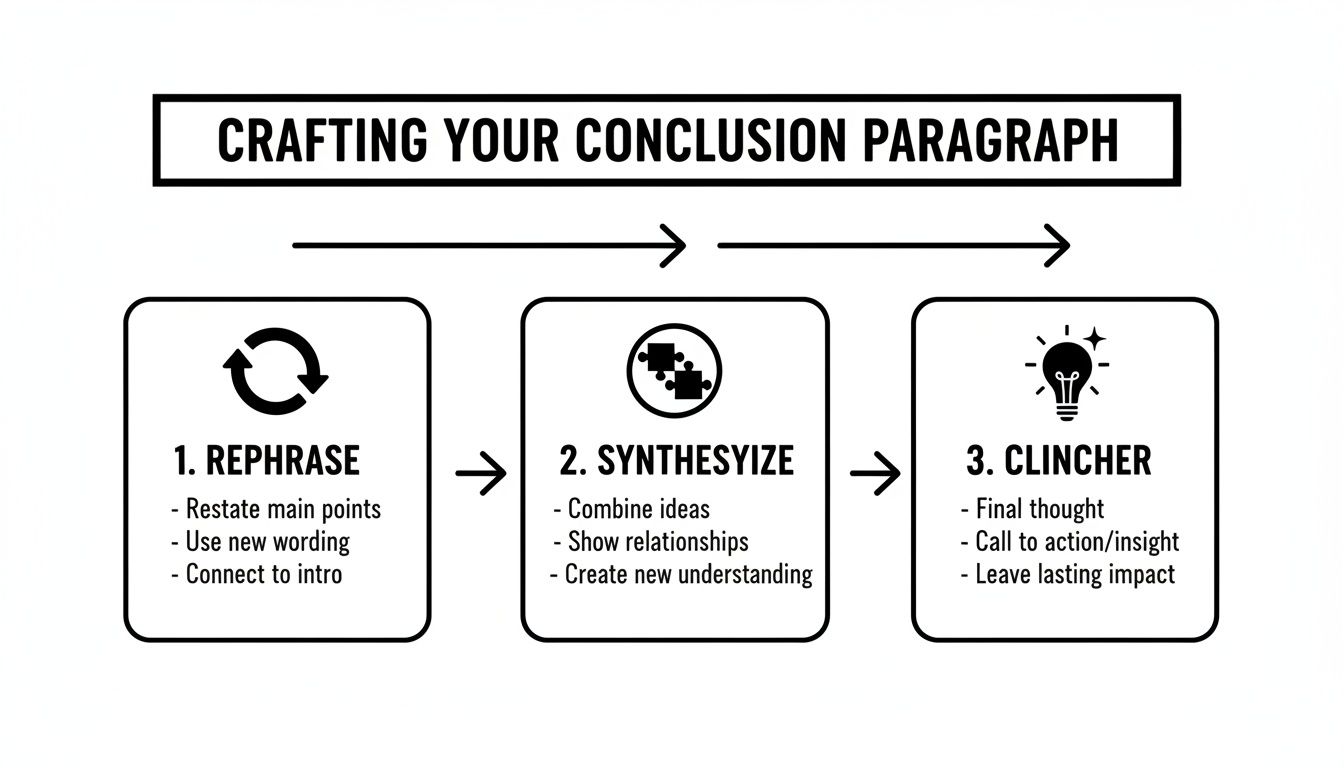
As you can see, it’s a simple progression: remind the reader of your main point, connect the dots from your body paragraphs, and then leave them with something memorable.
Let's see how this structure flexes for different kinds of essays.
The Argumentative Essay Conclusion
For an argumentative essay, your conclusion is your mic-drop moment. You’re not just summarizing here; you're driving your point home and aiming to persuade. After you’ve pulled all your evidence together, your final sentence should be a powerful call to action, a thought-provoking question, or a vivid picture of what the future looks like if your argument is followed.
Let's Break Down an Example:
"Ultimately, the evidence overwhelmingly shows that community gardens do more than just produce food; they cultivate stronger, healthier neighborhoods. By transforming neglected urban spaces into vibrant hubs of connection and providing access to fresh produce, these gardens directly combat social isolation and food insecurity. Therefore, it is not enough to simply acknowledge their benefits; residents must urge their city councils to allocate dedicated funding and land for these vital community projects."
- Restated Thesis: Community gardens build stronger, healthier neighborhoods.
- Synthesis of Points: They achieve this by transforming spaces, fostering connection, and providing healthy food.
- The Clincher: A direct call to action—telling residents to lobby their city council for funding.
The Analytical Essay Conclusion
When you're writing an analytical essay—like for a literature class or a film study—your conclusion needs to offer a fresh insight. You've spent the whole paper taking something apart to see how it works; now, you have to put it back together and reveal a deeper meaning the reader might have missed.
Your goal is to elevate the conversation, not just repeat your points. The best analytical conclusions connect your specific analysis to a broader theme, a cultural idea, or a universal human experience.
Here’s How It Looks in Practice:
"In the end, The Great Gatsby's recurring green light is more than just a symbol of unattainable desire; it is a poignant reflection of the American Dream itself. Fitzgerald masterfully uses this distant beacon to illustrate how the dream is often more about the pursuit than the prize, forever just beyond our grasp. The novel's tragic conclusion suggests that this idealized vision, while beautiful from afar, can ultimately lead to disillusionment and ruin, a timeless commentary on the nature of aspiration."
- Restated Thesis: The green light reflects the flawed concept of the American Dream.
- Synthesis of Points: It represents the endless pursuit, not the actual achievement, which leads to tragedy.
- The Clincher: A "so what?" insight that connects the symbol to the universal theme of human aspiration.
4 Common Mistakes That Can Ruin Your Conclusion
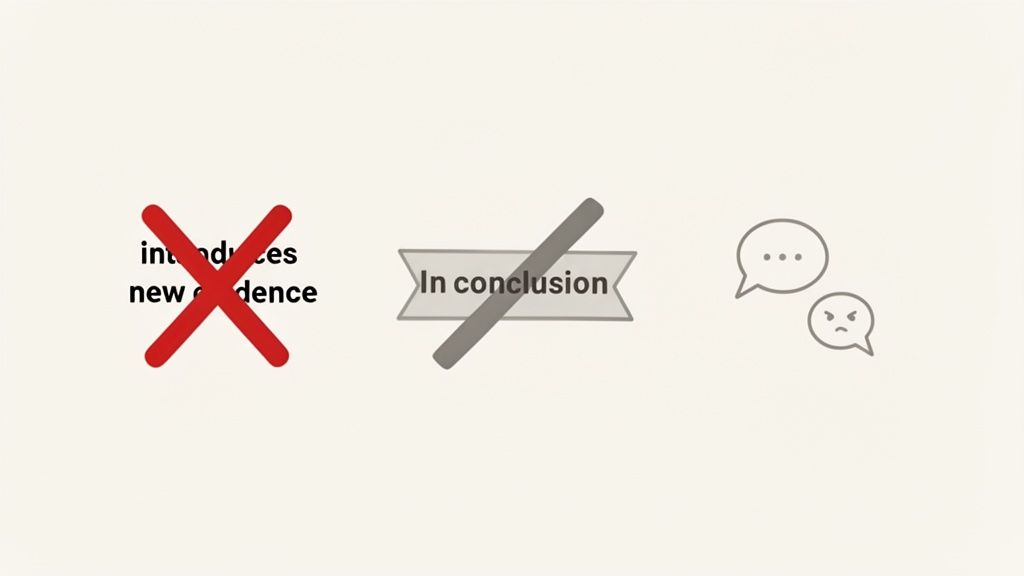
Even a powerful, well-argued essay can stumble right at the finish line. A weak conclusion can unfortunately undo a lot of your hard work, leaving your reader feeling underwhelmed or, even worse, confused. Learning what not to do is just as important as knowing the right steps to take.
Thankfully, most of the common mistakes are easy to spot and fix. Once you know what to look for, you can make sure your final paragraph packs the punch it deserves.
1. Dropping in New Evidence or Ideas
This is probably the biggest and most jarring mistake you can make. Your conclusion is for wrapping things up, not for introducing a brand-new point, a surprising statistic, or a quote you forgot to use earlier. When you do this, you shatter the logical flow you’ve built and leave the reader hanging.
Think of it like a lawyer in a courtroom. They wouldn’t present a shocking new piece of evidence during their closing argument. It’s unprofessional and confusing. Your body paragraphs are where you present your evidence; the conclusion is where you explain its final significance.
Key Takeaway: Your conclusion needs to feel like a satisfying end, not a cliffhanger. Your job is to close the case, using only the information you’ve already discussed.
2. Using Clichéd Transition Phrases
We’ve all seen them, and we’ve all been tempted to use them. But certain phrases are a dead giveaway that you're just trying to get the essay done. They feel robotic and tell your reader you’re simply checking a box.
Here are a few of the usual suspects:
- "In conclusion..."
- "To summarize..."
- "As you can see..."
- "In the final analysis..."
Sure, they aren't technically wrong, but they're weak. They add nothing. A truly strong conclusion doesn’t need a signpost telling you it's the end. It should flow so naturally from your final body paragraph that the reader feels the essay is drawing to a close. Let your confident synthesis of ideas do the talking.
3. Just Rewriting the Introduction
Another common pitfall is treating the conclusion like a simple copy-and-paste job of the introduction, just with a few words swapped out. While you absolutely need to revisit your thesis, you shouldn't just repeat your opening statements verbatim. This makes the entire paper feel redundant and shows you haven't really moved your thinking forward.
Your conclusion should show the reader that the journey through your essay was worthwhile. You've presented evidence, you've developed your points—so your restated thesis should sound more authoritative and insightful than it did at the start. It's the "Aha!" moment, not just a reminder of the initial "Here's what I'll argue."
4. Apologizing for Your Argument
Finally, never, ever undermine your own work. It’s tempting to hedge your bets with phrases like, "I may not be an expert, but..." or "This is just one perspective..." but doing so completely deflates your authority.
You’ve done the research and laid out your case. Stand behind it. Present your conclusion with the confidence it deserves.
Using AI to Polish Your Final Paragraph
Even the most seasoned writers can use a second pair of eyes. Once you’ve drafted your conclusion, an AI writing assistant like Feen AI can step in as your personal editor, helping you find weak spots and punch up your language. It's best to think of it less as a ghostwriter and more as a coach that helps refine your ideas.
Don't just copy and paste what an AI spits out. Instead, use it as a tool to see your own writing from a different perspective. It can be the thing that takes your conclusion from "good enough" to truly great by giving you targeted feedback, making sure your final words really land.
Prompts to Perfect Your Conclusion
Getting useful feedback from AI all comes down to asking the right questions. If you give it vague requests, you'll get generic, unhelpful results. You need to be specific and give it the right context to get the most out of it.
Here are a few real-world prompts you can tweak for your own essay:
- For Better Synthesis: "Here’s my conclusion and my main arguments. Can you help me tie these points together more effectively? Also, suggest a stronger transition from my original thesis."
- For Sharper Word Choice: "Please review my final paragraph for repetitive words. Can you suggest three more sophisticated synonyms for [insert word] that fit an academic tone?"
- For a More Powerful Ending: "I want my last sentence to be more memorable. Here's my conclusion. Brainstorm three alternative final sentences that hint at a broader implication or ask a really compelling question."
Commands like these tell the AI exactly what you need, forcing it to give you focused, practical advice.
By treating AI as a collaborator, you stay in the driver's seat. The goal isn’t to have it write for you, but to help you write better. For students who want to make sure their AI-assisted work sounds completely authentic, learning about making AI-generated text undetectable can be incredibly useful.
This kind of smart tech use is just one of many AI-powered study tools students have access to now. Feen AI can help you rephrase your thesis with more confidence, boil down complex ideas into a tight summary, and make sure you end your essay with a bang.
Answering Your Questions About Writing Conclusions
Even with a solid plan, a few questions always seem to pop up when it's time to write the conclusion. It's the part of the paper where those "what if" scenarios can feel a little daunting. Let's clear up some of the most common sticking points so you can write your final paragraph with total confidence.
Think of this as your quick-reference guide for handling those tricky details.
How Long Should a Conclusion Be?
A good rule of thumb is to aim for your conclusion to be about 5-10% of your total word count. This keeps everything in proportion.
For a short 500-word essay, that means you're looking at a concise paragraph of about 3 to 5 sentences. But if you’re wrapping up a 2,000-word research paper, you’ll need a more developed conclusion of around 100-200 words to do your argument justice. The key is to be thorough without rambling on.
Can I Ask a Question in My Conclusion?
Yes, but with a big asterisk. A well-crafted rhetorical question can be incredibly powerful, shifting the focus to the reader and leaving them with something to ponder.
For instance, an essay on environmental policy could end with something like, "If we fail to act now, what kind of world will we leave for the next generation?" It works because it forces the reader to reflect on the evidence you've already laid out.
What you don't want to do is ask a question that you were supposed to answer in the essay. Your conclusion should be a final, confident statement, not a moment of uncertainty.
Expert Tip: Don't confuse a conclusion with a summary. A summary just restates your points ("I discussed X, then Y"). A conclusion synthesizes them to answer the all-important "So what?" question, driving home why your argument matters.
Is It Ever Okay to Introduce New Information?
This one is pretty clear-cut: no. You should never introduce new evidence, data, or arguments in your conclusion. It’s one of the fastest ways to confuse your reader and undermine your credibility right at the finish line. All your supporting evidence belongs in the body paragraphs.
The only real exception is when you’re pointing toward the future. It’s perfectly fine, especially in research papers, to suggest areas for future study or think about the broader implications of your findings. This isn’t introducing new evidence—it’s offering a final, forward-looking analysis based on the work you've already done.
Feeling more confident about your conclusion? That's just the start. With Feen AI, you can get instant help with everything from brainstorming your thesis to polishing your final draft. Let our AI homework helper make your next essay your best one yet.
Relevant articles
Learn how to write a strong argumentative essay with our guide. We cover building a thesis, using evidence, and structuring your argument for academic success.
Learn how to write a persuasive essay that wins arguments. Our guide covers crafting a strong thesis, finding solid evidence, and structuring your paper.
Learn how to write a lab report conclusion with a clear structure, real examples, and tips to boost your grade.
Learn how to cite sources in mla with clear examples for books, websites, and more. Write your paper confidently with MLA guidance.

Struggling with how to write a thesis statement? This guide breaks down the process with real examples and tips to craft a clear, arguable, and strong thesis.
Learn how to write research paper outline with our guide. Discover formats, structures, and revision tips to build a strong academic blueprint.