How to Take Lecture Notes That Actually Work
Learn how to take lecture notes effectively with proven strategies. Discover methods that boost retention and turn your notes into powerful study tools.

Taking great lecture notes isn't a one-shot deal; it's a three-part process. It starts with preparation before you even walk into the classroom, continues with active engagement during the lecture, and finishes with review afterward. The real secret isn't about writing down every single word. It's about strategically capturing the big ideas and connecting the dots to make studying later on a whole lot easier.
Why Most Lecture Notes Fail and How to Fix It
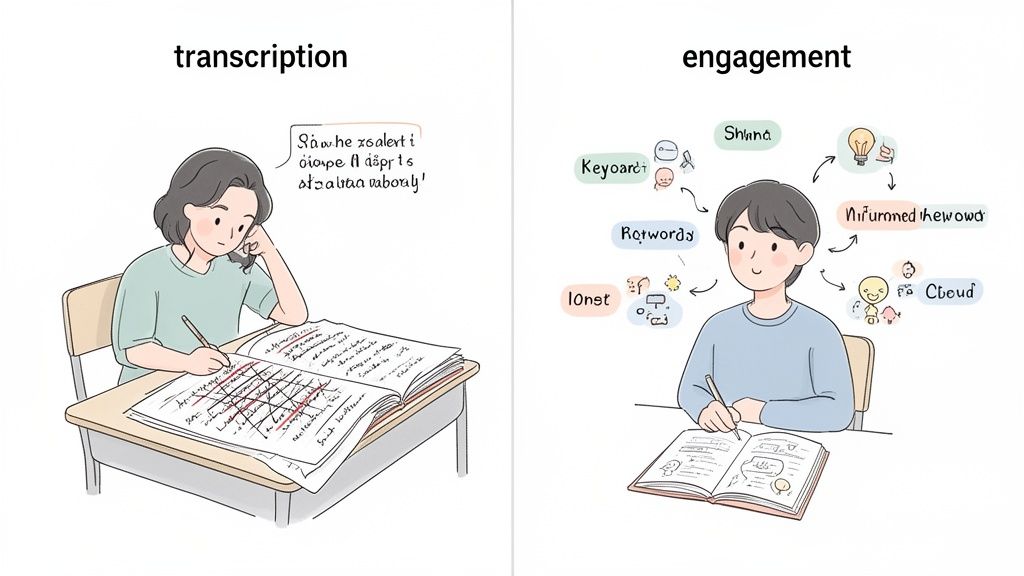
Let’s be honest. We've all been there: frantically trying to transcribe everything the professor says. It’s a losing battle that turns you into a passive court reporter instead of an active learner. When you’re just focused on speed, the actual meaning behind the words flies right over your head.
This is exactly why so many students end up with pages of messy, disorganized text that are almost useless when it’s time to prep for an exam. The core problem? Mistaking transcription for learning.
Effective note-taking is a skill you build, not just something you do. It’s all about shifting your mindset from simply recording information to actually processing it in real time. This means actively listening for main ideas, picking out the key supporting details, and spotting the connections between different concepts. Your goal is to create a powerful study tool, not a perfect script of the lecture.
When you engage with the material this way, you don't just improve your understanding on the spot—you make future review sessions far more productive. This isn't just a hunch; it's an approach backed by some serious academic findings on how we learn best.
Different Strokes for Different Folks: Finding Your Method
There’s no single "best" way to take notes. What works for a history class might not be the right fit for organic chemistry. And the method your friend swears by might not click with how your brain works. The key is to find a system that aligns with both the subject matter and your personal learning style.
Pro Tip: Don't be afraid to experiment. Try a new method for a week. If it feels clunky or isn't helping you recall information, switch it up. The goal is to find what makes you an active, engaged learner, not a passive one.
To get a better handle on your options, let's explore five popular note-taking methods. Each has its own strengths, so you can pick the right tool for the job. You can find more strategies for active learning in our guide on how to improve reading comprehension skills.
A Quick Guide to Note-Taking Methods
Before we dive into the nitty-gritty of each strategy, here's a quick look at the options. This table should help you figure out which method might fit your learning style and the subjects you're tackling this semester.
| Method | Best For | Key Benefit |
|---|---|---|
| Cornell | All subjects, especially content-heavy courses | Organizes notes for easy summarizing and review |
| Outline | Structured, organized lectures | Creates a clear, hierarchical view of topics |
| Mapping | Visually-oriented learners and complex topics | Shows relationships between concepts visually |
| Charting | Information with categories (e.g., history, science) | Compares and contrasts key information efficiently |
| Sentence | Fast-paced lectures where structure is secondary | Captures a high volume of information quickly |
Choosing a structured approach like one of these really pays off. It's not just about staying organized; it's about fundamentally changing how you learn.
The proof is in the numbers. Research shows that an overwhelming 87.6% of students agree that summarizing concepts in their notes directly improves their academic achievement. In one striking study, implementing structured note-taking in a physics course caused failure rates to plummet from 14.3% to just 4.6%. That's a massive difference, and it highlights just how much of an impact the right system can have on your grades. You can learn more about the findings on student achievement from this research.
Get Ready Before the Lecture Even Begins
Great lecture notes don't just happen. The real work starts before you even walk into the classroom. Showing up cold is a recipe for disaster; you'll spend the first ten minutes just trying to figure out what's going on while the professor is already deep into the core concepts.
Don't worry, this isn't about cramming for hours beforehand. All it takes is 5-10 minutes to prime your brain. This tiny bit of prep work makes a world of difference. It shifts you from being a passive listener to an active participant, ready to connect new ideas to what you already know.
Do a Quick Skim of the Reading
One of the best things you can do is a quick pass over any assigned readings. I'm not talking about a deep, detailed study. Just a skim. Look at the headings, subheadings, any bolded words, and the summary at the end of the chapter.
This simple action gives you a massive leg up:
- You'll know the lingo: Key terms won't sound foreign when your professor says them.
- You'll have a roadmap: You’ll have a basic sense of the topic's structure, which helps you follow the lecture's flow.
- You'll form questions early: You might spot a concept that doesn't quite click, which you can then listen for clarification on during the lecture.
Think of it like glancing at a map before you start a road trip. You're not memorizing every single turn, but you know the general direction and the major highways. This simple prep frees up so much mental energy during the actual lecture, so you can focus on understanding the why behind the concepts, not just the what.
Glance Over Your Last Set of Notes
Right before class starts, take literally two minutes and read your notes from the last lecture. This is a game-changer for building context. Most courses are designed so that one lecture builds directly on the last. A quick review connects the dots.
This habit is a form of mini-spaced repetition. By revisiting the material, you're telling your brain, "Hey, this is important!" which is crucial for moving knowledge from short-term to long-term memory. It turns a series of disconnected lectures into one coherent story.
Finally, get your gear in order. Whether you're using a trusty notebook or a laptop, get your page or document set up. Write the date, course name, and lecture topic at the top. If the slides are available beforehand, you can even pre-load the main headings. This removes any little barriers and lets you start capturing ideas the second the professor begins.
Finding the Right Note-Taking Method for You
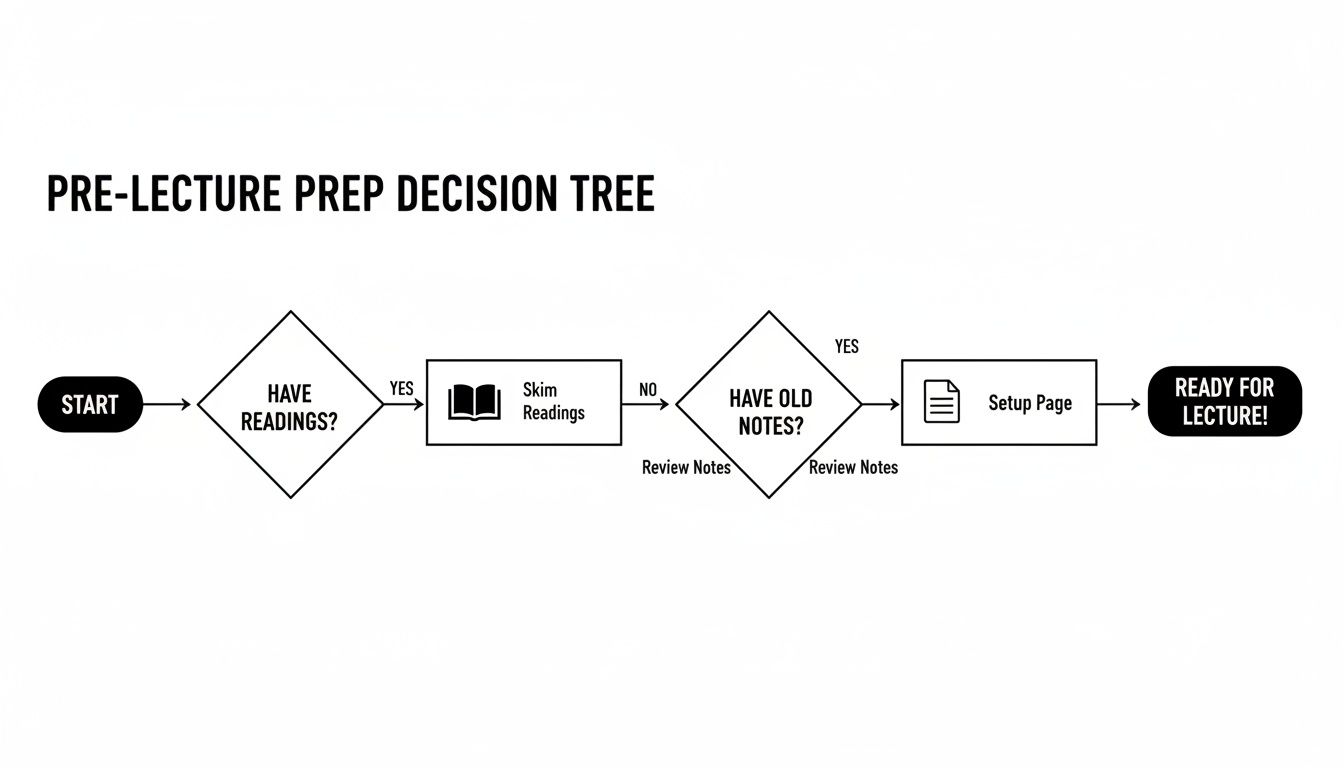
So you’ve done your prep work and you’re walking into the lecture hall ready to go. Now for the most important part: actually capturing what the professor says. But what's the best way to do that?
Truthfully, there’s no single "best" way to take lecture notes. The ideal method really depends on the class, the professor’s teaching style, and, most importantly, how your own brain works.
The goal is to find a system that helps you think about the information as you hear it, not just mindlessly transcribe it. Let’s walk through five powerful methods. You'll likely find that one or two of these become your go-to systems for different subjects.
The Cornell Method: Structured for Review
Developed at Cornell University, this method is an absolute powerhouse for making your notes work for you long after the lecture is over. It cleverly divides your page into three sections, turning a simple sheet of paper into a powerful study tool.
I find it’s especially effective for those dense, content-heavy courses where you know you'll need to quiz yourself later.
Here’s the setup:
- Main Notes (Right Column): This is the biggest section. During the lecture, just take notes here however you feel comfortable—outlines, short sentences, whatever works. Your main goal is capturing the core ideas, examples, and key details from the professor.
- Cues (Left Column): Leave about a 2.5-inch margin on the left side of the page. Soon after the lecture, go back through your main notes and pull out keywords, main ideas, or even potential exam questions. Jot these down in the left column. This is an active recall step, and it's critical.
- Summary (Bottom Section): Leave the bottom two inches of the page blank. Within 24 hours, force yourself to write a one or two-sentence summary of that page’s notes. This simple act makes you synthesize the information and see the big picture.
When it’s time to study, you just cover the main notes section on the right and use the cues on the left to test yourself. It’s a built-in study system, and it works wonders for long-term memory.
The Outline Method: For Logical Flow
If your professor presents information in a highly structured, linear way, the Outline Method will feel like second nature. It organizes the lecture into a clear hierarchy, making the relationships between topics immediately obvious.
This approach is a lifesaver in subjects like history or literature, where lectures often follow a clear chronological or thematic progression.
The structure is created with simple indentation:
- Main Topic: Starts at the far left.
- Subtopic: Indented once.
- Supporting Detail: Indented again.
- Specific Example: Indented even further.
- Supporting Detail: Indented again.
- Subtopic: Indented once.
With this format, you can see the skeleton of the entire lecture at a glance. It’s incredibly easy to distinguish the foundational concepts from the smaller, supporting details.
The Mind Mapping Method: For Visual Thinkers
Do you think more in pictures and connections than in lists? If so, you should give mind mapping a try. This method ditches the linear, top-to-bottom format for a more creative, visual approach. It's fantastic for brainstorming or for lectures on complex topics where ideas connect in messy, non-linear ways—think philosophy or systems biology.
You start with the main idea in the center of the page. From there, you draw branches out to related subtopics, which then branch out again into finer details. Feel free to use colors, quick sketches, and keywords to build a web of interconnected knowledge.
The real magic of mind mapping is that it mimics how our brains actually work. You're not just creating a list; you're building a visual representation of how different ideas relate to one another, which can spark a much deeper level of understanding.
The Charting Method: For Comparing Information
Some lectures are built entirely around comparisons. Maybe it’s a political science course contrasting different systems of government, or a biology class breaking down the differences between mitosis and meiosis. When you know you’ll be comparing and contrasting, the Charting Method is your most efficient option.
You can often set this up before class even starts. Just draw a table with columns for the categories you expect the professor to cover. For example, in a history class on ancient civilizations, your columns might be "Government," "Religion," "Key Inventions," and "Decline."
As the lecture goes on, you simply fill in the rows for each civilization. This keeps the information incredibly organized and makes it a breeze to review and spot patterns later.
The Sentence Method: For Fast-Paced Lectures
We've all had that professor who talks a mile a minute. When you can barely keep up, the Sentence Method is your lifeline. The rule is incredibly simple: write every new concept, fact, or topic on a new line. Don't worry about outlining or structure.
Just focus on capturing each distinct piece of information as its own short sentence or phrase. I like to number each line to keep things somewhat orderly. This method can feel a bit chaotic in the moment, but it's brilliant for ensuring you don't miss anything crucial in a rapid-fire lecture.
The act of writing itself cements the information. One study found that even when students watched sped-up lectures, the physical act of taking notes boosted their memory, allowing them to perform just as well as those who watched at a normal speed but took no notes.
You'll definitely need to spend some time after class organizing these scattered thoughts into a more coherent format, but at least you’ll have all the raw material to work with.
Digital vs. Handwritten Notes: Which Is Better?
This is the classic debate, and honestly, there's no single right answer. Both have real advantages. Sometimes, your tools matter just as much as your technique; for many people, finding great pens to write with makes the physical process of note-taking more engaging.
Let's break down the pros and cons:
- Handwritten Notes: The act of writing by hand is slower, which forces your brain to process and summarize information on the fly. This has been shown to boost conceptual understanding. It’s also undeniably better for drawing diagrams, chemical structures, or math equations.
- Digital Notes: Typing is fast—no question about it. Digital notes are also searchable, easy to edit, and simple to organize into folders. You can also drop in links, images, and audio clips. If you work with digital course materials, our guide on how to go about adding comments to PDFs can be a huge help.
Many students find a hybrid approach is the perfect solution. Using a tablet and a stylus gives you the memory benefits of handwriting combined with the powerful organization of digital tools. At the end of the day, the best method is the one that keeps you engaged and helps you learn.
Turning Your Notes Into a Powerful Study Asset
The lecture's over. You've got pages of notes sitting in front of you. It’s so tempting to just close the notebook and move on with your day, but honestly, the most important part of the whole process is just getting started. What you do in the next few hours decides whether those notes become a forgotten relic or the key to acing your exams.
That brief window of time right after class is pure gold. The information is still fresh, and the context is still clear in your mind. If you want to fight off the natural forgetting process and actually move what you’ve learned into long-term memory, this is your moment.
The Golden 24-Hour Rule
Memory fades, and it fades fast. Researchers call it the "forgetting curve"—without any reinforcement, you can lose a huge chunk of what you heard in class within just one day. The simplest, most effective way to combat this is to review your notes within 24 hours.
This isn't about a marathon study session. A quick 10-15 minute pass is all it takes to make a massive difference. Your goal here is to clean up, clarify, and consolidate.
- Tidy Up: Fix your typos, write out weird abbreviations you used, and neaten up any scribbles. If a concept felt shaky, mark it with a star or question mark to follow up on later.
- Fill in the Gaps: Jot down any extra examples or connections you remember the professor making that you didn't have time to capture in the moment.
- Spotlight the Big Ideas: Grab a highlighter or a different colored pen and pull out the main-stage ideas, definitions, and formulas. This makes it so much easier to scan your notes when you're cramming later.
Think of this first review as your first, most critical repetition. It sends a strong signal to your brain: "Hey, this stuff is important. Don't delete it."
Summarize to Synthesize
One of the best things you can do after a lecture is to summarize. This is where you shift from just passively rereading to actively processing the material. The challenge is to take an hour-long lecture and boil it down to its absolute essence.
Try writing a one- or two-sentence summary at the bottom of each page of notes, just like the summary section in the Cornell Method. It forces you to ask yourself, "What was the single most important takeaway here?" This is where real understanding starts to click into place.
When you distill a long list of details into a few core sentences, you're building a mental framework. It’s way easier to recall all the smaller facts later on because they now have a logical home to belong to.
As your notes become a more effective study tool, they play a huge role in your academic performance, something you can keep an eye on with good student progress tracking.
Implement Spaced Repetition
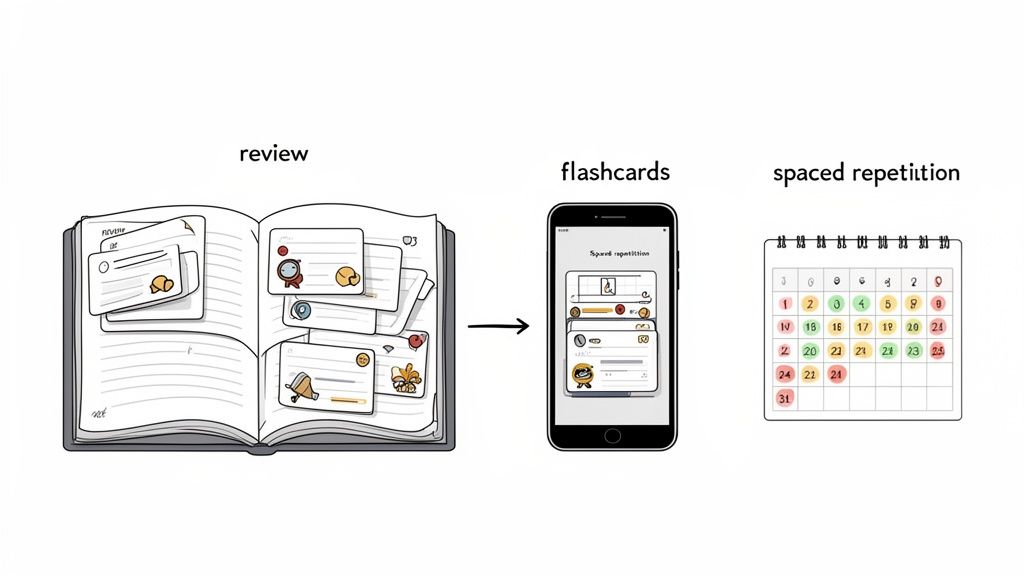
Looking at your notes once isn't going to cut it. To really master the material, you need to revisit it at strategic, increasing intervals. This is the whole idea behind spaced repetition, a learning technique that is scientifically proven to cement information in your long-term memory.
Your schedule doesn't need to be complex. Here’s a simple but powerful plan:
- Review 1: Within 24 hours.
- Review 2: About 3 days later.
- Review 3: A week later.
- Review 4: Two weeks after that, then maybe once a month until the exam.
Each of these reviews can be short and sweet. You’re just re-engaging with the material, keeping those neural pathways firing.
Let AI Supercharge Your Study Sessions
This is where today’s tech really changes the game. It used to be a massive chore to turn your messy handwritten notes into useful study aids. Now, AI can handle the grunt work for you.
Tools like Feen AI let you just snap a photo of your notes or upload a PDF. From there, you can do some pretty cool things:
- Get Instant Summaries: Ask it to whip up a quick, concise summary of the entire lecture.
- Create Flashcards: Have the AI automatically pull out key terms and concepts and format them into digital flashcards.
- Draft Practice Questions: Tell it to generate potential exam questions based on your notes so you can test yourself.
This approach makes reviewing an active, engaging process. Instead of just staring at the same page over and over, you’re interacting with the material in new ways, which is far more effective for deep learning. You can learn more about this strategy in our guide on how to https://feen.ai/blog/summarize-book-chapters.
Common Note-Taking Pitfalls and How to Sidestep Them
Even with a great system in place, it's incredibly easy to slip into bad habits that sabotage your efforts. Knowing what these common mistakes are is half the battle; the other half is actively avoiding them. The good news is that most students run into the same handful of issues, and a few small adjustments can make a world of difference.
One of the biggest issues I see is what I call the "transcription trap." This is that knee-jerk reaction to write down every single word the professor says. It feels productive, I get it. Your fingers are flying across the keyboard or the page. But in reality, you've just turned yourself into a passive recorder. Your brain is so busy just trying to keep up that you're not actually processing what any of it means.
When you do this, you end up with a huge block of text that's just a less accurate, less organized version of a lecture recording. Instead of trying to be a human stenographer, your goal is to actively listen for the big ideas, the key examples, and the connections between concepts. This shift in mindset—from simply recording to actively interpreting—is the single most important skill for effective note-taking.
Falling for the Transcription Trap
The problem with transcribing is simple: you're not learning, you're just typing. You completely miss the professor's tone, the emphasis they place on certain words, and the subtle links between different topics. When it's time to study, you're forced to learn the material for the very first time because you never really engaged with it during the lecture.
The Fix: Capture concepts, not sentences.
- Listen for the Signposts: Professors constantly give you clues. Pay close attention to phrases like, "The most important thing to remember is..." or "This results in three main consequences." Those are your signals to write.
- Embrace Keywords and Phrases: Instead of writing "The mitochondria is the powerhouse of the cell, responsible for generating most of the cell's supply of adenosine triphosphate (ATP)," just jot down: Mitochondria -> powerhouse -> makes ATP. You get the same information in a fraction of the time.
- Develop Your Own Shorthand: Create abbreviations for common terms. Simple things like "w/" for with and "b/c" for because, along with course-specific shortcuts, will free up valuable mental bandwidth.
Your real goal isn't to create a perfect script of the lecture. It's to build a personalized roadmap that traces your understanding of it. Your notes should be a reflection of your own thought process.
Creating Overly Complex Systems
Another classic mistake is getting too ambitious with your system. You start the semester with a gorgeous, seven-color highlighting key, a dozen custom symbols, and a rigid formatting structure. It looks amazing on day one, but by week three, keeping up with it feels like a full-time job.
When your system is too complicated, you'll eventually just give up on it. Your focus shifts from learning the material to just maintaining the format, which completely defeats the purpose.
The Fix: Keep it simple and consistent.
- Pick a Minimalist Color Code: Stick to 2-3 colors, max. For instance: yellow for key terms, pink for questions you have, and blue for the main ideas. That's it.
- Prioritize Function Over Form: Your notes do not need to be pretty enough for social media. They need to work for you. A page of messy but useful notes is infinitely better than a beautiful but empty one.
- Use a Consistent Layout: Whether you land on the Cornell Method or a basic outline, try to stick with it for the whole lecture. Consistency makes your notes predictable, which makes reviewing them later much, much easier.
By steering clear of these common traps, you can ensure the effort you put into taking notes actually translates into better understanding and retention. It’s not about having perfect notes; it’s about having effective ones that help you learn.
Your Note-Taking Questions, Answered
Even when you've got a great system, you're going to hit a wall. Every lecture is different, every professor has their own style, and sometimes you just need to adapt on the fly. Let's tackle some of the most common questions students run into when trying to take better notes.
Think of this as your go-to guide for those tricky moments in class. A small tweak in your approach can often make a huge difference.
How Do I Take Notes When a Professor Talks Too Fast?
We've all been there: the professor who speaks at a blistering pace. The first thing you need to do is change your mindset. Your goal is no longer to capture everything. That's a surefire path to frustration and falling behind. Instead, your mission is to capture what’s most important.
This is where the Sentence Method really shines. Just focus on getting one core idea per line. Forget about perfect grammar or complete sentences. The priority is getting the concept down before the professor moves on.
Here are a few other tricks I've seen work wonders:
- Create a personal shorthand. For common terms, come up with abbreviations. In a psychology class, "cog" can be "cognitive" and "beh" can stand in for "behavioral." Those saved seconds add up.
- Leave gaps on purpose. If you miss something, don't freeze. Just leave a space in your notes and keep moving forward. You can always fill it in later by asking a friend, checking the textbook, or looking at the lecture slides.
- Listen for trigger phrases. Professors often signal what's important. When you hear things like, "The main takeaway is..." or "This is crucial because...", that's your cue to start writing.
Even partial notes are incredibly valuable. They act as a roadmap you can use after class to fill in the details from other sources, giving you a complete picture without all the in-class stress.
What’s the Best Way to Organize Digital Notes?
When you’re taking notes digitally, organization is everything. Without a system, your files will quickly spiral into a chaotic mess, and you'll lose the biggest benefit of digital notes: searchability.
I always recommend starting with a simple folder structure in your app of choice, whether it's Notion, OneNote, or Evernote. Create a master folder for the semester, and within that, a separate notebook or folder for each class (e.g., ‘BIOL 201’, ‘HIST 110’).
From there, get into the habit of using a consistent naming convention for every note. A simple format like "Date – Lecture Topic" (e.g., "10.28 – The French Revolution Part 1") works perfectly. It keeps everything chronological and makes it easy to find what you're looking for at a glance.
Pro Tip: Use tags to take your organization to the next level. Tagging notes with keywords like #Exam1, #KeyConcept, or #Chapter5 lets you pull up related information from across all your lectures instantly. This is an absolute game-changer when it's time to study.
This kind of structured approach means you can find exactly what you need in seconds, turning your notes into a powerful, connected knowledge base.
Is It Better to Take Notes on a Laptop or By Hand?
There’s no one-size-fits-all answer here. The best choice really boils down to your own learning style, the class you're in, and what feels most comfortable for you. Both methods have real, research-backed advantages.
Typing is fast, no question. That’s a huge help in a fast-paced lecture. It also makes it simple to edit, organize, and search your notes later. On the other hand, multiple studies have shown that the physical act of writing by hand can improve memory and comprehension. It forces your brain to process and summarize information on the spot, rather than just mindlessly transcribing what you hear.
Here’s a quick breakdown to help you decide:
| Method | Best For | Main Advantage | Potential Downside |
|---|---|---|---|
| By Hand | STEM, diagrams, visual learners | Better memory retention | Slower, harder to organize |
| Laptop | Fast lectures, humanities | Speed and organization | Encourages transcription |
A great middle ground is using a tablet and stylus. This hybrid approach gives you the brain-boosting benefits of handwriting but keeps your notes digital, searchable, and easy to back up. For many students, it really is the best of both worlds.
Feeling buried under dense lecture material? Feen AI can help you dig your way out. Just upload a picture of your notes or a course PDF, and our AI can whip up summaries, create flashcards, and answer your specific questions. Stop struggling and start understanding. Get instant homework help and clarity at https://feen.ai.
Relevant articles

Discover how to improve test taking skills with proven strategies. Learn study techniques, anxiety management, and ways to analyze mistakes for better grades.

Struggling to absorb what you read? Learn how to improve comprehension skill with actionable reading strategies and smart tools for real, lasting results.

Learn how to solve word problems in algebra using practical strategies. This guide breaks down the process with real examples and tips to build your confidence.

Learn how to summarize a book with our guide for students. Master practical note-taking and writing techniques to capture the core ideas of any text.