How to Write a Strong Argumentative Essay That Stands Out
Learn how to write a strong argumentative essay with our guide. We cover building a thesis, using evidence, and structuring your argument for academic success.
Think of yourself as a lawyer building a case. Your mission isn't just to share an opinion; it's to construct a rock-solid argument, backed by irrefutable evidence, that persuades your reader—the jury—to see things your way. A strong argumentative essay requires a clear, debatable thesis, defended with sharp reasoning and credible proof.
This means careful planning, methodical writing, and a whole lot of revision.
Laying the Groundwork for a Powerful Argument
Before you even think about writing, you have to get the fundamentals right. An argumentative essay isn't a diary entry or a shouting match. It's a structured, intellectual exercise where you guide the reader through a logical journey to your conclusion. You aren't just presenting a viewpoint; you're building a case for it, brick by brick.
This kind of writing is a staple in academia, and for good reason. It’s the most requested academic paper type, making up a staggering 32% of all essay orders placed worldwide. That popularity isn't random; it's because these essays are the ultimate test of your critical thinking skills.
What Professors Really Look For
When your instructor gives you this assignment, they're looking for a specific set of skills. They want to know if you can:
- Make a debatable claim: Can you go beyond a simple fact and take a specific stance that someone could reasonably disagree with?
- Back it up with evidence: Are you digging up and using credible sources—think statistics, expert analysis, or scholarly articles—to support your points?
- Think logically: Do you connect your evidence to your main claim clearly, without jumping to conclusions or making errors in reasoning?
- Handle the opposition: Can you fairly represent opposing viewpoints and then explain precisely why your own position holds more weight?
At its core, this is about starting a conversation with your reader. You have to anticipate their questions, address their potential doubts, and walk them through your thought process one step at a time.
A great argumentative essay doesn't just tell the reader what to think; it shows them how to think through a complex issue, using evidence as a guide.
To get started on the right foot, let’s map out the journey ahead.
Roadmap to a Winning Argumentative Essay
This table breaks down the essential stages for crafting a compelling argumentative essay, from the initial spark of an idea to the final, polished paper you'll be proud to submit.
| Stage | Core Objective | Your Main Focus |
|---|---|---|
| Planning & Research | To build a strong foundation | Choosing a debatable topic, crafting a solid thesis, and gathering credible evidence. |
| Outlining | To structure your argument logically | Mapping out your introduction, body paragraphs (with topic sentences), and conclusion. |
| Drafting | To get your ideas onto the page | Writing the first full version of your essay, focusing on developing your arguments. |
| Revising & Editing | To refine and polish your work | Checking for clarity, logic, and strength of evidence; proofreading for errors. |
Following these stages will keep you organized and ensure every part of your essay works together to support your main point.
To really elevate your writing, it helps to understand the art of persuasion itself. A deep dive into what rhetoric in writing is will give you the tools—like ethos, pathos, and logos—to make strategic choices with your language. It's the secret to moving beyond simply stating facts and truly convincing your audience.
Forging a Thesis That Commands Attention
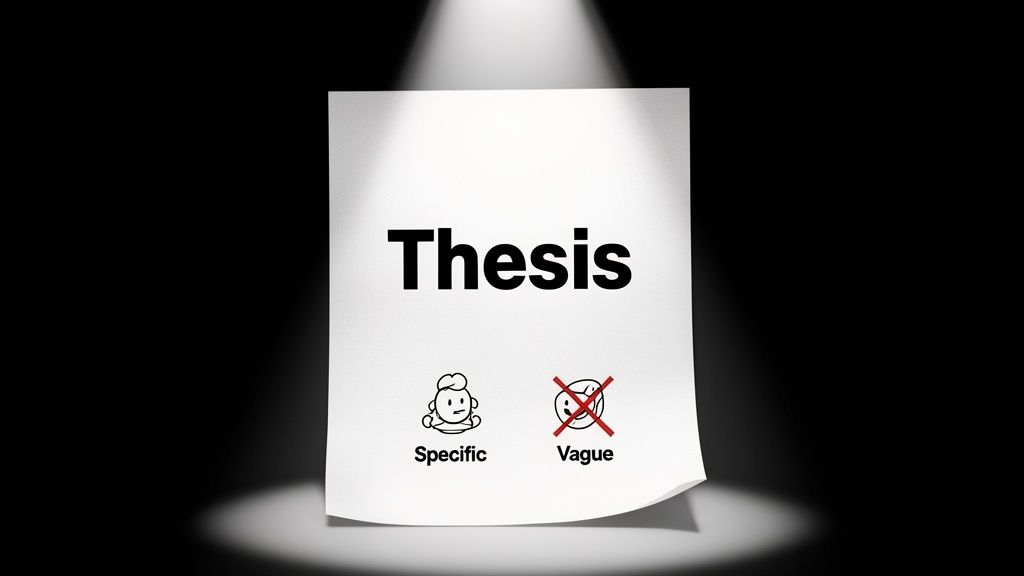
Your thesis statement isn't just a sentence; it's the heart of your entire essay. Think of it as a bold promise you make to your reader—a clear, confident declaration of the argument you're about to prove. A wobbly thesis leads to a paper that meanders aimlessly, but a strong one is your roadmap, giving every paragraph a clear purpose.
The key is that your thesis must be debatable. It has to be a claim someone could reasonably argue against. "Pollution is bad," for example, is a fact. Nobody's debating that. But a statement like, "A federal carbon tax is the most effective policy for curbing industrial pollution," is a different story. Now you've got a real argument on your hands—one that demands proof.
Of course, to get to your powerful thesis, you first need to pull the reader in. Learning how to write a hook that grabs attention from the get-go is critical. A good introduction builds momentum that crescendos with your thesis, making it land with maximum impact.
The Anatomy of a Strong Thesis
A truly powerful thesis stands on three legs. If any of them are missing, your entire argument will feel shaky from the start.
Here's what it needs to be:
- Specific: Don't just say, "Social media is harmful." That's way too broad. Pinpoint the problem. Try this instead: "The algorithmic-driven feeds on platforms like TikTok and Instagram directly contribute to a measurable decline in teenage attention spans." See the difference? Now you have a specific cause and effect to prove.
- Arguable: You need to take a firm position. You aren't just announcing your topic; you're making a claim that you're ready to defend against other viewpoints.
- Defensible: Can you actually back it up? If you can't find credible data, expert analysis, or scholarly articles to support your claim, you might be on thin ice. Your thesis needs to be grounded in reality, not just speculation.
Before you lock it in, give your thesis a quick stress test. Ask yourself: Can I easily come up with three or four solid points, each backed by different evidence, to support this exact sentence? If you're struggling, it’s a sign your thesis needs more work. For a deeper dive, our complete guide on how to write a thesis statement has more advanced strategies.
Common Thesis Traps to Avoid
Even seasoned writers can stumble into a few common traps that weaken their thesis. Be on the lookout for these.
The most obvious mistake is simply announcing your intentions—"In this essay, I will discuss the pros and cons of remote work." Instead, just state your argument directly. Another pitfall is framing your thesis as a question. Your role is to provide the answer, not to ask the reader to find it.
Key Takeaway: Your thesis is the engine, not just a decoration. A vague or factual statement gives you no fuel, leaving your essay stalled. A specific, debatable claim, however, gives you a clear destination and the power to get there, setting you up for a truly persuasive paper.
Finding and Integrating Compelling Evidence
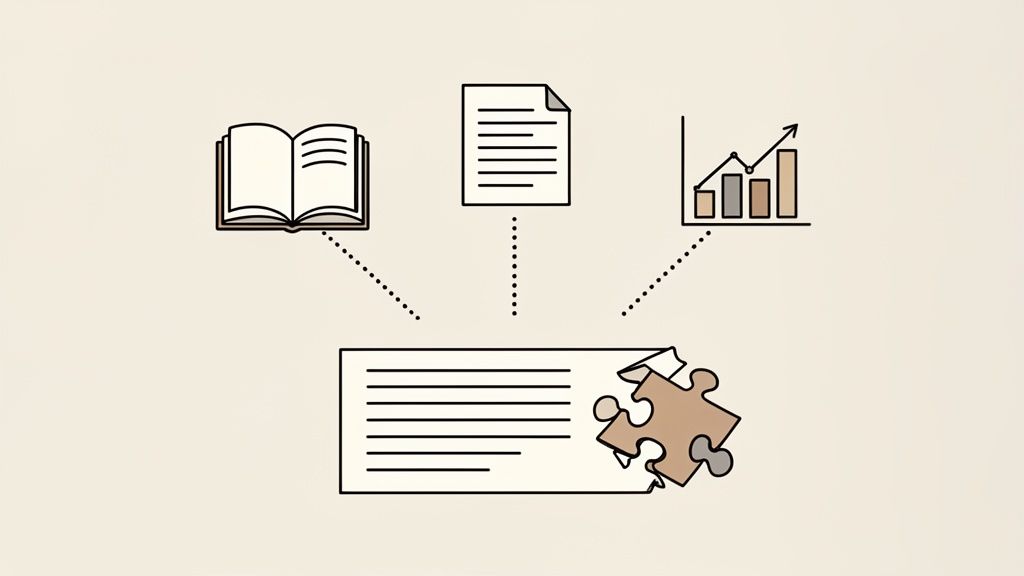
An argument without solid proof is just an opinion. The best way to think about it is like a court case: your claim is the accusation, and your evidence is everything you bring to the table—the expert testimony, the DNA, the paper trail—that convinces the jury.
This is where the real work of persuasion happens. Finding the right evidence and weaving it skillfully into your essay is what elevates a simple claim into a powerful, convincing argument.
Primary vs. Secondary Sources
First, you need to know what you're looking for. Evidence generally falls into two camps: primary and secondary sources. Knowing the difference is crucial for building a rock-solid case.
Primary sources are the raw materials. They’re firsthand accounts, original data, or the actual subject of your analysis. Think of things like historical diaries, a scientist's lab notes, the text of a law, or the novel you’re writing about. They let you get your hands dirty with the source material directly.
Secondary sources, on the other hand, are one step removed. They analyze, interpret, or discuss those primary sources. This includes a historian’s book about a war, a literary critic’s article about a novel, or a scientific review that synthesizes findings from many studies. They provide crucial context and expert perspectives.
- Use primary sources to present the core proof you’ll be analyzing yourself. A direct quote from a historical figure is a great example.
- Use secondary sources to back up your interpretation, show how your idea fits into the larger academic conversation, or bring in an expert’s opinion to support your own.
The strongest essays almost always blend the two. You might quote a key passage from a Supreme Court decision (primary) and then cite a legal scholar’s analysis of that same passage (secondary) to reinforce your point.
Locating High-Quality Evidence
Forget random Google searches. Your best starting points are your school’s library and its online academic databases. Platforms like Google Scholar, JSTOR, and ProQuest are goldmines for peer-reviewed articles, which means experts have already vetted them for quality and accuracy.
When you find a source, don’t just grab it and run. You need to put on your detective hat and vet it for quality.
Ask yourself these questions:
- Who’s the author? Do they have credentials in this field? An article on climate change by a climatologist is more credible than one from a random blogger.
- Where was it published? A peer-reviewed academic journal carries a lot more weight than a website funded by a company with a clear agenda.
- Is it biased? Look for the author's purpose. Are they trying to inform, or are they trying to sell you something or push a specific political viewpoint?
- Is it current? For fast-moving fields like technology or medicine, a five-year-old source might be ancient history. For topics in the humanities, older foundational texts are often essential.
This isn’t just a hoop to jump through; it's a fundamental academic skill. If you want to dive deeper, our guide on how to improve critical thinking skills can help you sharpen these instincts.
Integrating Evidence Seamlessly
One of the most common mistakes I see is the "quote bomb"—a quote just dropped into a paragraph with no introduction or explanation. It leaves the reader wondering, "Okay, so what?"
Never just drop evidence and walk away. A great piece of evidence needs to be properly framed. A good rule of thumb is the "introduce, present, analyze" model.
- Introduce: Give some context. Who said this? In what context? For example, "As historian Jane Doe argues in her seminal work..."
- Present: Deliver the quote, statistic, or piece of data clearly.
- Analyze: This is the most important part. Connect the dots for your reader. Explain why this evidence proves your point and how it ties back to your main thesis. Don't assume they see the connection—spell it out for them.
When you carefully select, frame, and analyze your proof, you transform your personal opinions into well-supported, persuasive arguments.
Building a Logical and Persuasive Structure
A powerful argument isn't just about having great evidence; it needs a rock-solid structure. The way you organize your ideas can be just as convincing as the ideas themselves. Without a logical framework, even your most brilliant points will get lost, leaving your reader more confused than persuaded.
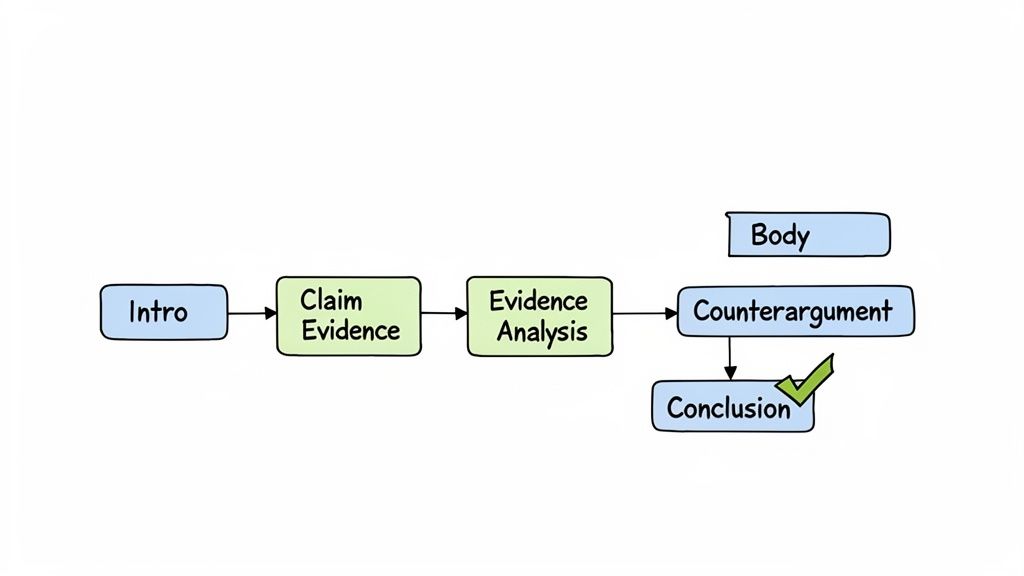
Think of your essay's structure like a blueprint for a house. Your introduction lays the foundation. Each body paragraph is a sturdy pillar holding up your main claim. And the conclusion? That's the roof that ties it all together into a complete, sound structure. This approach ensures every part of your essay has a clear job to do.
Crafting Cohesive Body Paragraphs
Every body paragraph needs to act like a mini-argument on its own. It should champion one specific point that directly supports your main thesis. Don't rush this part—a well-built paragraph is methodical and incredibly effective.
For each paragraph to land its punch, it needs three core elements:
- Claim: Kick things off with a strong topic sentence. This is the main point of the paragraph, acting as a mini-thesis for that specific section.
- Evidence: Back up your claim with the proof you've gathered. This could be anything from a compelling statistic to a direct quote from an expert or data from a research study.
- Analysis: This is where the magic happens. Don't just drop a quote and run. You have to explain how the evidence proves your claim. Connect the dots for the reader and show them why this piece of proof matters.
Structuring each paragraph this way makes your logic easy to follow, guiding your reader step-by-step until your conclusion feels not just right, but inevitable. Weaving in different types of evidence is also a fantastic opportunity to use various rhetorical device examples to make your argument more memorable.
The Art of the Counterargument
Want to know one of the most powerful moves you can make in an argumentative essay? Address the opposition head-on. A counterargument is any point someone with an opposing view might make against your position. Bringing it up doesn't weaken your essay—it actually makes it much, much stronger.
When you introduce and then refute a counterargument, you're signaling to your reader that you’ve thought about the topic from every angle. It shows intellectual honesty. It proves you aren't afraid of the other side because you have the logic and evidence to dismantle their points.
Addressing a counterargument isn't a sign of weakness; it's a display of confidence. It tells your reader, "I understand the other side, and here’s precisely why my position is stronger."
Let's say you're arguing for a city-wide composting program. A common counterargument is the high initial cost. You should introduce this concern fairly, then hit back with evidence showing the long-term economic benefits, like reduced landfill fees. This proactive move neutralizes objections before your reader can even fully form them.
The skill of crafting such nuanced arguments is highly sought after. In fact, the global market for essay writing services hit USD 1.97 billion in 2023 and is projected to climb to USD 4.35 billion by 2032. This isn't just about getting essays done; it reflects a worldwide recognition that expert guidance is a key part of developing these high-level academic skills.
Revising Your Draft From Good to Great
Think of your first draft as a block of marble. All the right material is there, but it's not a sculpture yet. The revision process is how you chisel that raw material into a powerful, persuasive argument. This is so much more than just a quick spell-check; it’s a methodical teardown and rebuild of your work.
Jumping straight into fixing commas is a classic mistake. You need a game plan. By tackling the big problems first and working your way down to the details, you ensure your final essay isn't just clean, but truly convincing.
Start With a Big-Picture Review
Before you get lost in the weeds of word choice, take a giant step back. Look at your essay from a distance, focusing on its core structure and logic. This is what we call a "macro-level" revision, and it’s where the most important changes happen.
It’s time to be your own toughest critic. Print out your draft and grab a pen, then ask yourself these hard questions:
- Does my thesis still hold up? After writing the whole essay, is this really the argument I made? Does every single paragraph serve this central claim?
- Is the flow logical? Try reading only the first sentence of each paragraph, one after another. Does it sound like a coherent, persuasive story, or a jumbled mess of ideas?
- Is my evidence truly compelling? Have I actually proven my points with credible facts, data, or expert testimony? Or am I just stating my opinions a little louder?
One of the best tricks I've learned is to read the entire essay out loud. You’ll be shocked at how quickly awkward sentences and logical leaps become obvious when you hear them. Your ears will catch what your eyes miss.
Key Insight: Don't waste time polishing sentences in a paragraph that might get cut. The goal of this first pass is to make sure your essay's skeleton is solid. A weak foundation means the whole thing will crumble, no matter how pretty the words are.
Fine-Tune Your Paragraphs and Transitions
Okay, your overall structure is solid. Now it’s time to zoom in a bit and put each paragraph under the microscope. Every paragraph needs to function like a mini-argument, with a clear point, strong proof, and sharp analysis.
Look at your topic sentences first. Are they just vague statements, or do they make a specific, provable claim? A good topic sentence is a signpost for your reader, telling them exactly what that paragraph will accomplish.
Then, focus on the transitions between paragraphs. Your essay shouldn't feel like a list of disconnected points. Use transitional words and phrases to create a seamless flow, guiding your reader from one idea to the next without any jarring jumps.
Polish at the Sentence Level
Now, and only now, are you ready to sweat the small stuff. This final stage is all about refining your language to make it as clear, concise, and impactful as possible. It's the final polish that makes your argument shine.
Go through your draft one last time with a focus on sentence-level craft:
- Slash wordiness: Hunt down and destroy phrases like "due to the fact that" (use "because") or "in order to" (use "to").
- Activate your verbs: Replace weak, passive verbs with strong, active ones. Instead of "The bill was passed by the Senate," write "The Senate passed the bill." It’s more direct and authoritative.
- Vary your rhythm: Read your work for sentence flow. A long string of short, simple sentences can sound childish, while too many long, complex ones can confuse the reader. Mix it up.
This is where you make every single word count. After putting your draft through this rigorous process, you’ll have an essay that’s not just good enough—it’ll be genuinely persuasive.
Answering Your Top Questions About Argumentative Essays
Even with the best game plan, a few questions always seem to come up when you’re wrestling with an argumentative essay. Let's tackle some of the most common ones I hear from students. Getting these cleared up can give you a huge confidence boost.
Is This an Argumentative or a Persuasive Essay?
It’s easy to mix these two up, and a lot of people use the terms interchangeably. But they’re actually playing different games. While both want to win the reader over, they use completely different strategies.
Think of a persuasive essay as an appeal to the heart. It often leans heavily on emotional language (pathos) and the writer's personal conviction. An argumentative essay, on the other hand, is all about appealing to the brain. It builds its entire case on cold, hard logic (logos) and evidence you can check. You need facts, statistics, and expert opinions to back up every claim.
The biggest difference? A true argumentative essay must bring up the other side's point of view and show why it falls short. This proves you've looked at the issue from all angles.
How Many Sources Do I Really Need?
This is the classic "it depends" question. The number of sources you need is directly tied to the essay's length and complexity. For a high school paper, you might be fine with 3-5 solid sources. But if you're writing a university-level research paper, that number could easily jump to 10 or more.
Here's the golden rule I always tell my students: quality beats quantity, every single time. A few really strong, credible sources are worth more than a dozen weak or irrelevant ones.
When in doubt, check your assignment sheet. If your instructor hasn't given a specific number, a good rule of thumb is to have at least one or two distinct pieces of evidence for each major point you make.
Your sources aren't just a checklist to complete. You need to weave them into your argument. Each one should have a job to do—whether it's laying down foundational facts, offering an expert's take, or presenting a counterargument you're about to tear down.
What if I Can't Find a Counterargument?
If you’re struggling to find a counterargument, stop and take a step back. This is a huge red flag that your thesis might not be an argument at all. A truly debatable topic has to have a reasonable "other side." If it doesn't, you're probably just stating a fact.
For example, "climate change is real" isn't an argument for an essay; it's a statement of scientific consensus. A real argument would be something like, "The most effective government strategy to fight climate change is implementing a carbon tax." Now that's a position people can—and do—reasonably disagree with.
To find those counter-positions, try a little strategic Googling with phrases like:
- "Criticism of [your thesis idea]"
- "Alternative perspectives on [your topic]"
- "Arguments against [your position]"
Don't be afraid of what you find. Acknowledging the opposition isn’t a sign of weakness—it’s what makes your argument truly powerful. When you can look a counterargument in the eye and logically dismantle it, you show your reader you've done the work and your position is the most sound.
Feeling stuck on your homework or need to make sense of a difficult topic? Feen AI can help. Get instant, clear explanations for complex subjects and turn your essay prompts into well-structured drafts. Try it now and make your study sessions more effective at https://feen.ai.
Relevant articles
Learn how to write a persuasive essay that wins arguments. Our guide covers crafting a strong thesis, finding solid evidence, and structuring your paper.
Learn how to write a lab report conclusion with a clear structure, real examples, and tips to boost your grade.

Learn how to cite sources in mla with clear examples for books, websites, and more. Write your paper confidently with MLA guidance.
Learn how to write a conclusion paragraph that leaves a lasting impression. Our guide covers proven structures, real examples, and mistakes to avoid.

Struggling with how to write a thesis statement? This guide breaks down the process with real examples and tips to craft a clear, arguable, and strong thesis.
Learn how to write research paper outline with our guide. Discover formats, structures, and revision tips to build a strong academic blueprint.