How to Study for Physics Exam: Master It with Active Learning
Learn how to study for physics exam effectively with proven strategies, active learning, and smart practice that go beyond memorization.
The single most effective change you can make to how you study for physics is to stop passively rereading your notes and start actively solving problems and explaining concepts. It's a simple shift in mindset with huge results. This means your time should be spent on practice exams, teaching the material to yourself or a friend, and digging into every single mistake to find out where you went wrong.
Recognizing a formula on a sheet is easy. Applying it correctly under pressure is what gets you the grade.
Move Beyond Memorization with Active Learning
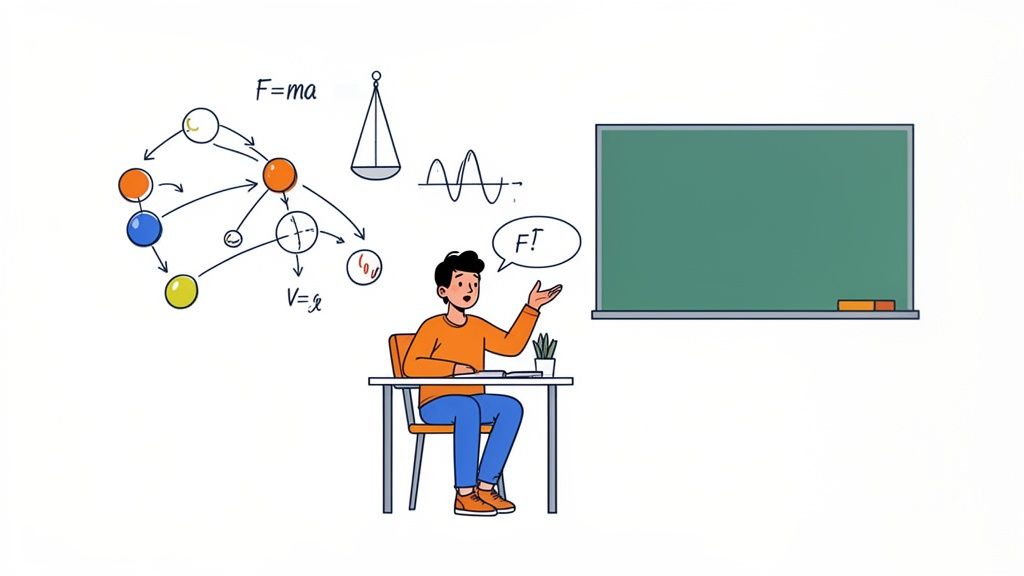
We've all been there—spending hours rereading a chapter, convinced we've got it down, only to blank out during the exam. That's the classic trap of passive learning. Your brain gets good at recognizing information, like a familiar equation, but it hasn't built the deeper connections needed to tackle a problem you've never seen before.
Active learning is about getting your hands dirty. It forces you to engage with the material, turning abstract ideas into tools you can actually use. You're not just watching someone else build a table; you're picking up the hammer and nails and building it yourself.
The data confirms this approach works. A comprehensive three-year study of over 1,270 students revealed a stark difference: those scoring above 92% on exams consistently used active-learning techniques. Meanwhile, students scoring below 80% were still stuck on passive methods like rereading notes without truly understanding them.
Embrace the Feynman Technique
One of the best active learning strategies comes from the brilliant physicist Richard Feynman. Its power is in its simplicity.
Here's how you do it:
- Pick a topic. Start with something specific, like Newton's Second Law or Snell's Law.
- Teach it out loud. Grab a whiteboard or a blank piece of paper and explain the concept as if you were teaching it to someone in high school. No jargon, just simple language.
- Find your weak spots. The moment you hesitate, get stuck, or have to use a fuzzy term, you've found a gap in your knowledge. This is the whole point of the exercise.
- Go back and learn it. Hit the books or your notes to fill that specific gap. Then, try the explanation again until it's seamless and clear.
This method is brutally effective at showing you the difference between what you think you know and what you actually know. When you can explain a complex idea from beginning to end in simple terms, you own it.
Create Concept Maps to Visualize Connections
Physics isn't a random collection of formulas; it's a web of interconnected ideas. Concept mapping is a fantastic way to see these relationships visually, turning your linear notes into something far more powerful.
Start with a big idea, like "Electromagnetism," in the center of a page. From there, branch out to related concepts like "Electric Fields," "Magnetic Fields," "Maxwell's Equations," and "Electromagnetic Waves." Keep going—under each of those, add more details, key equations, and real-world examples.
Key Takeaway: A concept map does more than just organize what you know. It forces you to think about how different principles are linked. You might draw a line connecting Faraday's Law of Induction to Lenz's Law, realizing how one explains the direction and cause of the other.
This process builds a robust mental model of the subject. It’s a core skill for anyone looking for tips on how to study efficiently for exams. When a tough problem pops up on the test, you can navigate this mental map to find the right path forward, instead of just frantically scrolling through a list of equations in your head.
Design a Study Schedule That Prevents Burnout
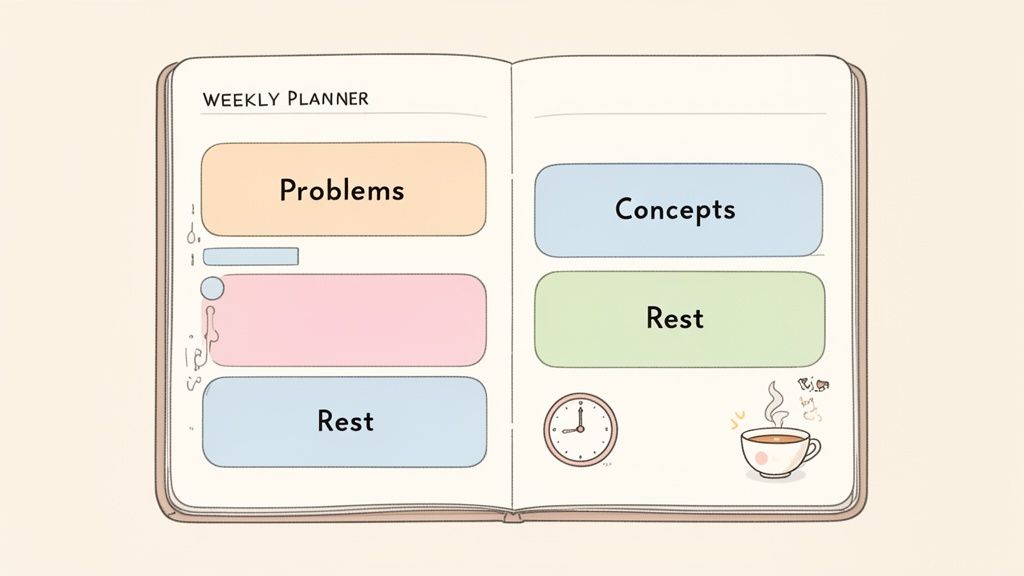
One of the biggest mistakes I see students make is equating more hours with better results. That’s a fast track to all-nighters, exhaustion, and getting less and less out of each study session. A smart study schedule isn't about cramming; it’s your game plan for consistent, deep learning that won't leave you feeling fried.
The only good plan is one you’ll actually stick with—something that balances intense focus with the downtime your brain desperately needs to process everything. A solid schedule is your best defense against feeling overwhelmed, but it's also smart to know how to recover from burnout effectively just in case it happens.
Diagnose Your Weakest Topics First
Before you can schedule anything, you need to know what you’re up against. Your syllabus is the perfect tool for this. Go through it, topic by topic, and give yourself an honest rating. A simple green, yellow, and red system works wonders.
- Green: You’ve got this. You can explain the concepts and knock out problems without much trouble.
- Yellow: You get the general idea, but you stumble when the problems get tricky.
- Red: These topics feel like a foreign language.
This quick audit gives you an instant priority list. Your "red" topics need to be tackled early and often, not crammed the night before the exam.
Pro Tip: Don’t just go by gut feeling. Dig out your old quizzes and homework. The questions you got wrong are a brutally honest roadmap pointing directly to your knowledge gaps.
The Power of Spaced Repetition and Interleaving
Your brain simply isn't built to absorb an entire semester's worth of thermodynamics in a single, eight-hour marathon session. The real secret to making things stick lies in two powerful techniques: spaced repetition and interleaving.
Spaced repetition is just a fancy way of saying you should review topics in shorter bursts over time. Instead of trying to master kinematics for six hours on a Monday, you might spend 90 minutes on it Monday, another 60 on Wednesday, and a final 30-minute review on Friday. This process forces your brain to recall the information, strengthening the neural pathways and moving it into your long-term memory.
Interleaving is about mixing things up. Instead of grinding through 20 momentum problems in a row, try a more varied approach during your study block:
- Solve one momentum problem.
- Switch gears and tackle a question on rotational dynamics.
- Now, work through an optics problem.
- Circle back to a different kind of momentum problem.
I know, this feels way harder at the moment. But it’s incredibly effective because it forces your brain to actively choose the right problem-solving strategy from scratch every single time—which is exactly what you have to do on an exam. It stops you from going on mental autopilot.
Building Your Two-Week Pre-Exam Schedule
Let’s pull these ideas together into a concrete plan. Here’s a sample schedule for the two weeks leading up to your exam, designed to keep you focused and prevent that dreaded burnout.
| Day of the Week | Morning Session (90 min) | Afternoon Session (90 min) | Evening (30-45 min) |
|---|---|---|---|
| Monday | "Red Topic" Deep Dive | Interleaved Problem Practice | Review "Red Topic" Concepts |
| Tuesday | "Yellow Topic" Practice | Past Quiz/Homework Review | Quick Formula Sheet Review |
| Wednesday | "Red Topic" Follow-Up | Interleaved Problem Practice | Feynman Technique on a Concept |
| Thursday | "Yellow Topic" Practice | "Green Topic" Quick Review | Rest or Light Activity |
| Friday | Timed Mini-Practice Test | Grade & Analyze Mistakes | Review Incorrect Problems |
| Saturday | Full-Length Timed Exam | Rest and Recharge | No Studying |
| Sunday | Light Concept Review | Plan for the Coming Week | Rest and Recharge |
This structure bakes in variety, forces you to confront your weak spots, and—most critically—schedules rest. Your brain does its most important work consolidating memories when you’re not studying. Sleep, good food, and actual breaks are non-negotiable parts of a successful study plan. Tweak the topics and times to fit your life, but stick to the core principles: diagnose, practice with variety, and rest.
Master Problem-Solving with Practice and Past Exams
If there's one golden rule for studying physics, it’s this: you must do practice problems. Physics isn't a spectator sport. It's easy to trick yourself into a false sense of confidence by watching your professor solve an example or by simply rereading a problem in the textbook.
True understanding is forged when you're staring at a blank page and have to build the solution from scratch. It’s in that struggle that real learning happens—forcing you to recall concepts, choose the right equations, and nail the execution. Every problem you solve is a rep that builds your intellectual muscle.
The data backs this up, too. Research consistently shows that after you’ve got the foundational math down, working through supplemental materials like old exams is the single strongest predictor of success. One study even found that course grades climbed significantly with the number of practice problems students did, leading to gains of up to 0.65 grade points.
Treat Past Exams Like a Dress Rehearsal
Your professor’s old exams are pure gold. They are a direct window into what your instructor considers important, the style of questions they prefer, and the level of difficulty to expect. Don’t just casually scroll through them—use them strategically.
- Simulate Exam Conditions: Set a timer for the actual length of the test. Put your notes away, silence your phone, and tackle the entire thing in one focused session. This builds stamina and hones your time management skills under pressure.
- Spot High-Frequency Topics: After a few exams, you'll start to see patterns. Does every test have a question on conservation of energy? Is projectile motion a recurring theme? These are your high-priority topics for review.
- Master the Format: You'll quickly get a feel for the mix of multiple-choice, short-answer, and long-form derivation problems. Knowing the layout ahead of time eliminates surprises, freeing up valuable mental energy on exam day to just focus on the physics.
A Three-Step System for Analyzing Your Mistakes
Getting a problem wrong isn’t a failure; it’s an incredible learning opportunity. But just glancing at the correct answer and thinking, "Oh, right," is a total waste. You need a system to deconstruct your errors so you never make them again.
Key Insight: Your goal isn't just to solve the problem in front of you. It's to understand your mistake so deeply that you can solve any similar problem in the future.
When you miss one, don't just move on. Dig in with this process:
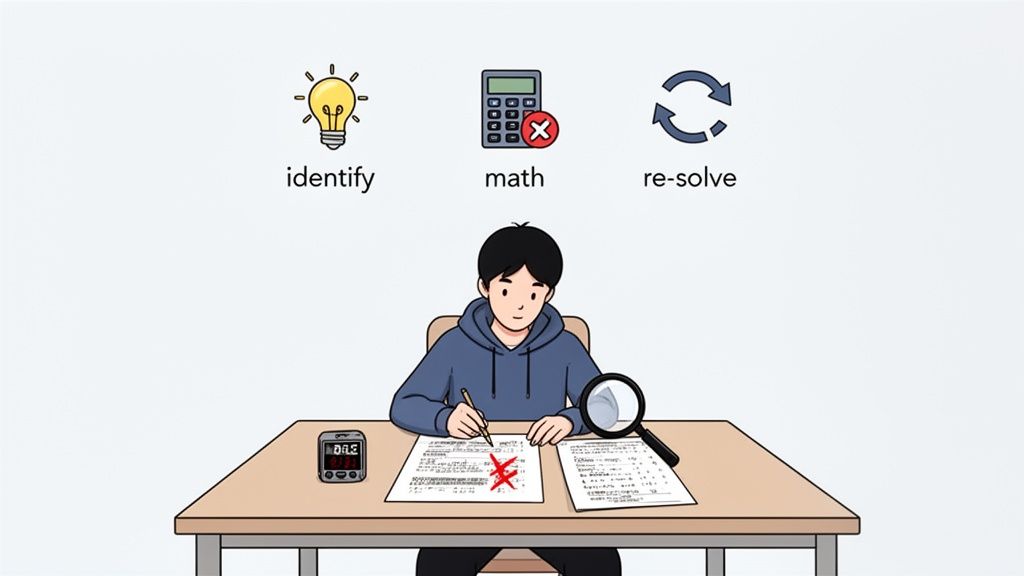
- Identify the Conceptual Error: Did you fundamentally misunderstand the physics? Maybe you applied a conservation of momentum equation where external forces were acting. Pinpoint the exact principle you misapplied.
- Pinpoint the Execution Mistake: If your concept was solid, where did the execution fall apart? Common culprits are sign errors, calculator typos, or forgetting to convert units (like from centimeters to meters). I always recommend keeping a running list of your personal “common slip-ups.”
- Re-Solve It Fresh the Next Day: Once you've analyzed the error, put the problem away. The next day, grab a blank sheet of paper and solve it again from scratch. If you can do it correctly without peeking at the solution, you’ve truly cemented the lesson.
This kind of active, deep practice is what separates students who get by from those who truly excel. It's about quality, not just quantity.
Effective vs Ineffective Problem Practice
Here’s a quick comparison of what productive practice looks like versus the passive habits that hold students back.
| Strategy | Ineffective Habit (Passive) | Effective Habit (Active) |
|---|---|---|
| Initial Attempt | Look at the solution as soon as you get stuck. | Struggle with the problem for a set time (e.g., 10-15 min) before seeking help. |
| Reviewing Errors | Glance at the correct answer and move on. | Follow the 3-step system: identify the concept/execution error and re-solve later. |
| Using Resources | Work with the formula sheet open from the start. | Try to recall formulas from memory first, only using the sheet to check. |
| Timing | Work through problems without a timer. | Simulate exam conditions by timing your practice sets. |
| Problem Selection | Only do the assigned homework problems. | Seek out extra problems from past exams and other textbooks. |
Adopting the habits on the right is what transforms practice from a chore into a powerful learning tool.
For an even more robust review, make sure you have a solid grasp of the fundamental equations you're using. Our comprehensive physics formulas cheat sheet can be a fantastic resource for quickly referencing the tools of the trade as you analyze your work. This systematic approach transforms every wrong answer from a lost point into a permanent gain in your understanding.
Use AI Tools to Deepen Your Understanding
We’ve all been there. It’s 1 AM, you’re staring at a problem set, and you’re completely stuck on a single derivation. In the past, your only real options were to give up for the night, wait for office hours, or text a classmate and hope they were still awake. But today, you have a powerful new tool in your arsenal that can act as a personalized, on-demand physics tutor.
Let me be clear: this isn't about finding shortcuts or getting answers without learning. It's about getting unstuck faster. Think of modern AI tools as a way to get instant, step-by-step guidance that turns those moments of pure frustration into productive learning opportunities. They help you understand the process, not just the final solution.
And this approach works. A collaborative study found that when AI-generated hints were embedded into physics homework, a whopping 88% of students actually used them. That kind of adoption rate tells you students are more than ready to use this technology to get a better handle on tough subjects.
Transform Problems from Roadblocks to Learning Moments
Imagine you’re grinding through a complex electromagnetism problem from your textbook. You hit a wall. You just can’t see how the professor got from one line of the derivation to the next. This is exactly where a tool like Feen AI can be a total game-changer.
Instead of just Googling for the final answer (we've all done it), you can use the AI to dissect the specific part that's tripping you up.
Here's a simple, practical way to do it:
- Snap a photo. Grab a clear picture of the problem or derivation, right from your textbook or notes.
- Upload and ask. Drag that image straight into the chat.
- Be specific. Ask a really targeted question. Something like, "Can you explain how to get from step 3 to step 4? I'm lost on the vector calculus being used here."
It’s incredibly straightforward. Here’s a look at how you can just drag a file or start typing a question in Feen AI.
The clean interface removes any friction between having a question and getting a clear explanation. That immediate feedback loop is what’s so crucial. It keeps your study session moving and prevents one hard problem from completely derailing your night.
Interview a Concept Until It Clicks
Let’s face it, some physics concepts are just plain weird. Things like entropy, wave-particle duality, or gauge symmetries can feel incredibly abstract and counterintuitive. Just reading the textbook definition over and over again usually doesn't make it any clearer. This is where you can use an AI chat tool to "interview" the concept.
Treat it like a real conversation. You're not just asking for a static definition; you’re probing for a deeper understanding with a series of follow-up questions.
Pro Tip: I've found it's best to start with a broad prompt and then drill down into the specifics. This conversational method is a lot like having a one-on-one tutoring session where you guide the explanation toward what's confusing you.
For example, you could kick things off with: "Explain the concept of Lenz's Law in simple terms."
After you get the initial explanation, you can start digging deeper:
- "Okay, but why does the induced current have to oppose the change in magnetic flux? What would happen if it didn't?"
- "Can you give me a real-world example of Lenz's Law in action, besides the classic falling magnet in a copper tube?"
- "How does this connect back to the principle of conservation of energy?"
This whole process forces you to actively engage with the material. By asking a series of targeted questions, you build a layered understanding from the ground up, connecting abstract principles to concrete examples and other core physics concepts. You can discover more active learning strategies and find extra tips on how to use AI for studying in our detailed guide. It's a technique that transforms passive reading into a dynamic dialogue, making sure the concept actually sticks.
Your Final Week and Exam Day Game Plan
The last week before a big physics exam isn't the time to cram new topics. If you're trying to learn quantum tunneling or fluid dynamics from scratch with days to go, you're setting yourself up for a rough time. This week is all about one thing: consolidation. It's about sharpening what you already know, reviewing strategically, and getting your head in the right space.
Your goal is to walk into that exam room feeling calm and confident, not flustered. You've put in the hours solving problems and wrestling with concepts. Now, it's time for the final tune-up, not a full engine rebuild.
Create Your Master Review Sheets
All those notes scattered across notebooks and textbook margins? It's time to bring them together. Your mission is to distill everything into two powerful, high-impact documents: a master formula sheet and a one-page concept summary.
- The Master Formula Sheet: Sift through every chapter and pull out every key equation. But don't just list them blindly. Next to each one, add a quick note on when and why it's used. For instance, beside the conservation of momentum equation, you might jot down, "Use for collisions/explosions when no external net force is present." This context is everything.
- The Concept Summary: This is your bird's-eye view of the entire course. On a single page, use whatever works for you—diagrams, flowcharts, mind maps—to connect the big ideas. Show how Newton's laws are the foundation for work and energy, or map out how electricity and magnetism are really just two sides of the same coin.
These two sheets will become your go-to study tools for the final few days. They let you scan the entire course in minutes, reinforcing the connections that matter most.
The Final Dress Rehearsal
Set aside time for one final, full-length, timed practice test about three to four days before the real thing. This is non-negotiable. Think of it as your dress rehearsal, and it’s absolutely critical for a few reasons.
First, it’s your last shot to nail down your pacing. Are you burning too much time on low-value multiple-choice questions? Now is when you correct that habit. Second, it gets you used to the mental grind of a long exam, building the stamina to stay focused until the very end.
Key Takeaway: After grading this last practice exam, your analysis should focus purely on "silly mistakes." Did you have a calculation error? Misread the question? Flip a sign? Those are the things to fix now. Trying to re-learn a major concept at this stage will just create panic. Focus on execution.
This timeline shows how you can turn moments of being stuck into real understanding, often with a little help.
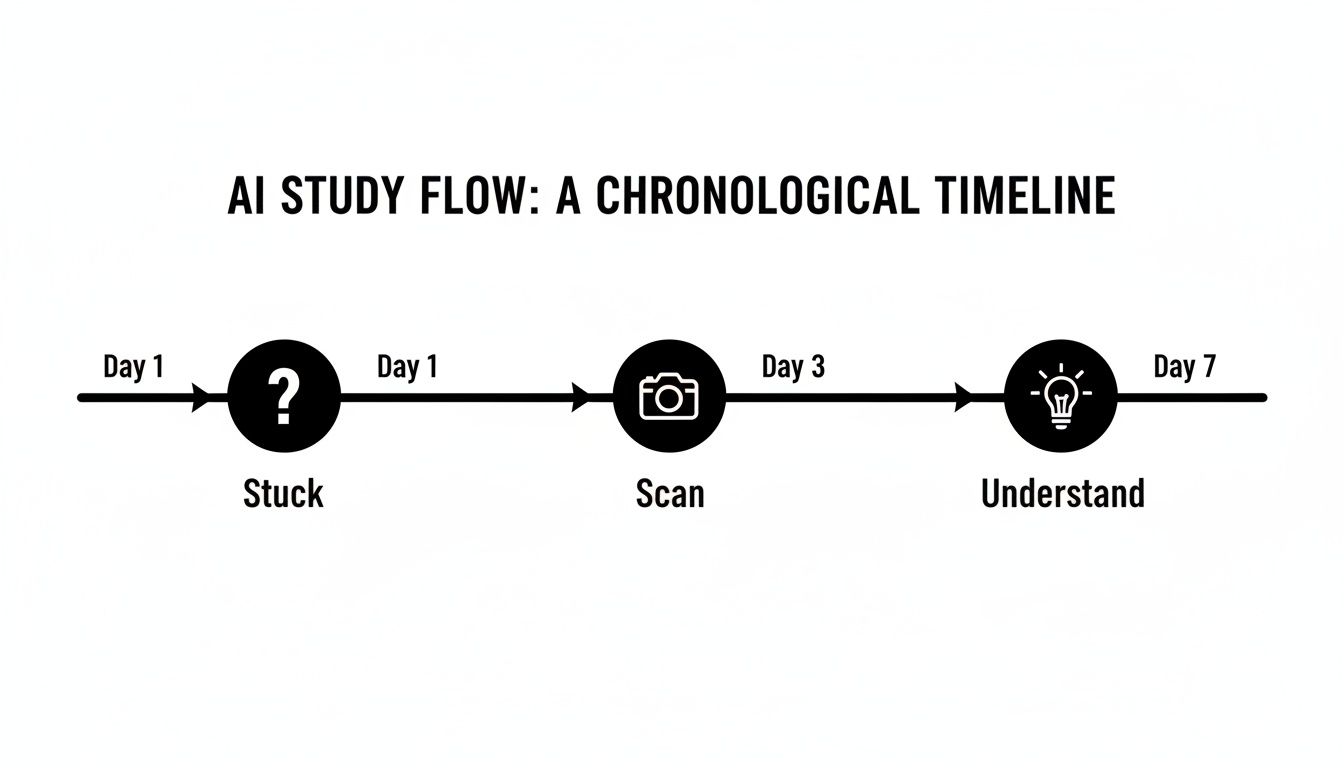
The real insight here is that getting un-stuck quickly is the key to maintaining momentum and making your study sessions count.
To help you structure this crucial week, here’s a day-by-day countdown you can follow.
Your Final 7-Day Physics Exam Countdown
This checklist is designed to guide your final week, making sure you cover all your bases without burning out right before the finish line.
| Day | Focus Area | Key Actions |
|---|---|---|
| 7 | Weakness Triage | Review past quizzes and homework. Identify 2-3 core concepts that are still shaky and prioritize them. |
| 6 | Targeted Practice | Solve 5-7 difficult problems related to yesterday's weak areas. Use active learning methods to check your work. |
| 5 | Concept Consolidation | Create your master formula sheet and one-page concept summary. Review them until you see the connections. |
| 4 | Full Practice Exam | Take a full, timed practice exam under realistic conditions. No interruptions. No extra time. |
| 3 | Analyze & Refine | Grade your practice exam. Focus only on fixing silly mistakes (calculation errors, misreading questions). |
| 2 | Light Review | Skim your master sheets and glance over corrected practice exam problems. No heavy problem-solving. |
| 1 | Rest & Prepare | Do a final 15-20 minute review in the morning, then put the books away. Pack your bag. Relax. Get a good night's sleep. |
This schedule ensures you peak at the right time, walking into the exam prepared and rested.
Your Exam Day Checklist
The morning of the test should be calm and routine. Getting everything ready the night before is the best way to eliminate any chance of last-minute panic.
The Night Before:
- Pack your bag: Make sure you have at least two approved calculators (with fresh batteries!), a few pens and pencils, and your student ID.
- Double-check the exam location and time.
- Lay out your clothes. Comfort is key.
- Set your alarm, and maybe a backup, just in case.
- Do one last, light 15-20 minute scan of your master sheets, then close your books for good. Your brain needs downtime to consolidate everything.
The Morning Of:
- Eat a solid breakfast with protein and complex carbs to fuel your brain. Skip the sugary stuff that will lead to a crash.
- Get to campus early. Rushing creates stress you don't need.
- Find a quiet spot to sit for a few minutes before you head in. Avoid those frantic group cram sessions outside the exam hall; they almost always do more harm than good by fueling anxiety.
Mental blocks are real, and your mindset matters just as much as your knowledge. It’s worth looking into some strategies for managing overthinking and anxiety before you walk in. Sometimes, just taking a few slow, deep breaths is enough to lower your heart rate, clear your head, and get you ready to focus completely on the physics.
A Few Common Questions About Studying for Physics Exams
Even with a solid plan, you're bound to have some nagging questions. It's totally normal. These are the little things that can make a huge difference, but they often don't get covered in class. So, I’ve pulled together some of the most common questions I hear from students gearing up for a big physics test.
Think of this as your quick-hit guide for those practical, "what-if" scenarios. From how long to study to what to do when your mind goes blank, here are some straight-up answers to help you feel more confident.
How Many Hours a Day Should I Actually Study?
Look, there's no single magic number here. But if I had to give you a rule of thumb, it’s this: consistency beats cramming every single time. Try to block out a focused 60-90 minutes for physics each day leading up to the exam. A daily session is so much more effective than a monster 7-hour slog over the weekend.
Why? Because your brain needs time to digest the information. This daily practice helps move concepts from your short-term to your long-term memory, which is exactly what you want. It also keeps you from burning out. If you're wrestling with a particularly nasty topic like electromagnetism, you might even split that time up—maybe 45 minutes in the morning and another 45 at night.
My Two Cents: The quality of your study time is what really moves the needle. Ninety minutes of actively wrestling with problems is worth way more than four hours of just staring at your notes with your phone buzzing next to you.
What Do I Do If I Completely Blank on an Exam Problem?
First things first: take a breath. Don't panic. It happens to the best of us. The worst thing you can do is stare at the question, letting the anxiety build while the clock ticks down.
Instead, have a game plan. Here’s what I recommend:
- Tag it and move on. Seriously. Don't let one hard problem sink your whole exam. Go secure all the points you know you can get on the other questions first.
- Scribble down what you know. Before you jump to the next problem, quickly jot down any formulas or principles that feel relevant. Sometimes just writing the tools down on the page jogs your memory.
- Come back with fresh eyes. After you've made a pass through the rest of the test, return to the problem you marked. You’d be surprised how often your brain makes a connection in the background while you were busy with something else.
If you’re still stuck when you come back, switch gears to damage control. How can you get partial credit? Write down everything you know. Draw the free-body diagram. Show your setup. Proving you understand the underlying physics can often save you a few crucial points, even without a final answer.
Should I Study Alone or With a Group?
Honestly? You need to do both. They serve completely different purposes, and you'll be stronger for it.
| Study Mode | This Is For... | The Big Payoff |
|---|---|---|
| Solo Study | Getting your hands dirty, deep focus, and finding your own weak spots. | It gives you the quiet time you need to really grapple with a tough problem until it clicks. |
| Group Study | Explaining ideas out loud, seeing other approaches, and catching mistakes. | When you have to teach a concept to someone else, you find out what you really know. Plus, your friends will see things you missed. |
Here’s a workflow that works wonders: try to solve the practice problems by yourself first. Really give it a shot. Then, get together with a small group—2 or 3 people is perfect—to go over your answers. You can debate the tricky spots, teach each other, and see different ways to attack the same problem. That one-two punch of solo work followed by group review is incredibly effective.
And for those times you’re studying alone and hit a wall, Feen AI can be a lifesaver. It’s like having a 24/7 tutor. Just snap a picture of the problem, and you’ll get a step-by-step walkthrough that actually helps you understand how to solve it, not just what the final answer is. You can check out Feen AI here.
Relevant articles

Struggling with what is momentum and impulse? This guide uses clear analogies and real-world examples to explain these core physics concepts simply.