How to Prepare for Organic Chemistry Without Burning Out
Discover how to prepare for organic chemistry using proven strategies. Our guide breaks down the essential study methods and tools you need to succeed in Orgo.

To truly prepare for organic chemistry, you need to change your entire approach. Forget about cramming and rote memorization—that won't work here. Your success depends on mastering key general chemistry concepts before you even walk into the first lecture and committing to a routine of active, consistent practice. Think of it less like a science class and more like learning a new language.
Why Organic Chemistry Feels Like a Different Language
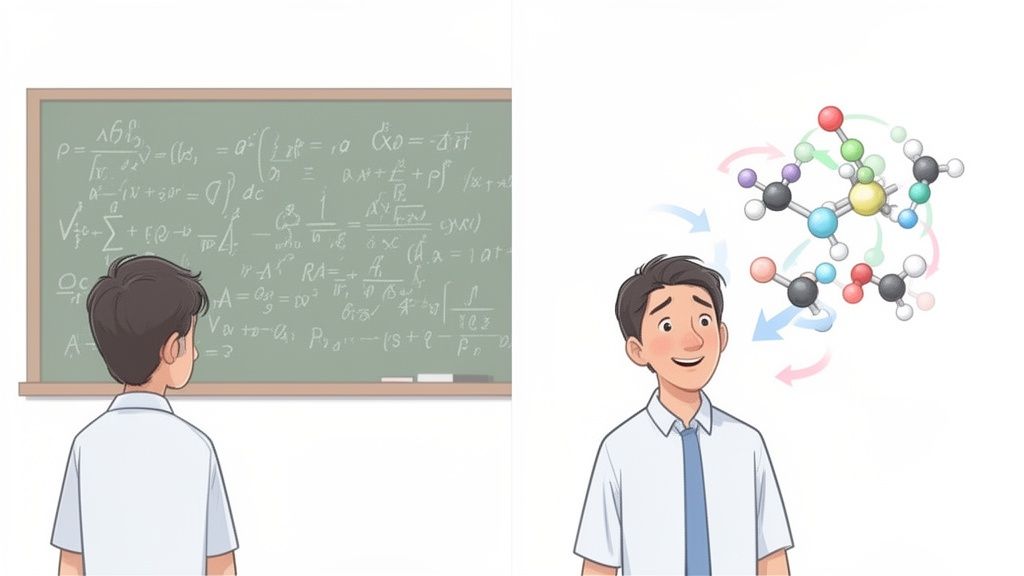
Let's be honest: organic chemistry, or "Orgo," has a terrifying reputation for a reason. It's the quintessential 'weed-out' course, particularly for pre-med students. But its difficulty isn't about impossible complexity. The real reason so many sharp students get tripped up is the complete mental shift the subject requires.
General chemistry is largely quantitative. You solve problems by plugging numbers into formulas. Orgo, on the other hand, is qualitative and intensely visual. You'll spend your time picturing molecules in three-dimensional space, figuring out how they’ll twist and turn to interact, and mapping out multi-step reaction pathways. It's far more about logic and interpretation than it is about calculation.
The Numbers Tell the Story
This isn't just a feeling; the data backs it up. Organic chemistry is known for high failure rates, often estimated to be between 25-50% nationwide. In one infamous case at a California university, a professor's class had a jaw-dropping 63% failure rate, a number so high it sparked a significant campus reaction. You can read the full story about the student backlash and petitions here.
I'm not sharing these stats to intimidate you, but to set the stage properly. Trying to brute-force memorize every reaction is a recipe for disaster and burnout. Success comes from a deeper place: understanding the core principles that dictate why and how these reactions happen in the first place.
The key takeaway is this: you cannot approach Orgo with the same study habits that got you through general chemistry. It requires a new way of thinking, focusing on patterns, spatial relationships, and the flow of electrons.
A New Way of Thinking
Imagine you're learning a new language. You could try memorizing a list of phrases, which might help you order a coffee. But what happens when someone asks you a question you haven't memorized? You're stuck.
In Orgo, the "grammar" is a set of fundamental principles. Once you get these down, you can navigate any situation. This core grammar includes:
- Electronegativity and Polarity: Knowing where the electrons are hanging out in a molecule.
- Acid-Base Principles: Finding the acidic and basic spots is a roadmap for predicting reactions.
- Stereochemistry: Seeing how a molecule's 3D shape changes everything about its behavior.
- Resonance and Stability: Understanding why some arrangements are rock-solid and others are ready to react.
When you master these rules, you can start to "speak" the language of organic chemistry. You’ll be able to look at two molecules and make an educated guess about what will happen, instead of frantically flipping through flashcards for an exact match. This is what it means to prepare for organic chemistry—you're preparing to learn its language from the ground up.
Laying the Groundwork Before You Even Walk In
Let me be blunt: walking into your first organic chemistry lecture without a rock-solid grasp of certain general chemistry concepts is a recipe for disaster. It’s like trying to build a house while the concrete foundation is still wet. You’ll be trying to learn your first reaction mechanism while still fumbling with how to draw a proper Lewis structure, and you’ll fall behind fast.
The best-prepared students I've seen all do the same thing: they treat the weeks before class as a critical review period. This isn't about getting a head start on Orgo material. It's about making your Gen Chem knowledge so second-nature that you free up precious mental bandwidth for the new, complex puzzles organic chemistry will throw at you.
What to Actually Focus On From General Chemistry
Look, not everything from Gen Chem is equally important for Orgo. Your time is valuable. The key is to zero in on the handful of concepts that are the absolute bedrock of everything you'll do in the coming year. Without a solid grip on these, you'll be constantly playing catch-up.
These topics are the "grammar" of organic chemistry. You can't write a coherent sentence without knowing what a noun or verb is. In the same way, you simply can't understand why reactions happen without fluency in these core areas:
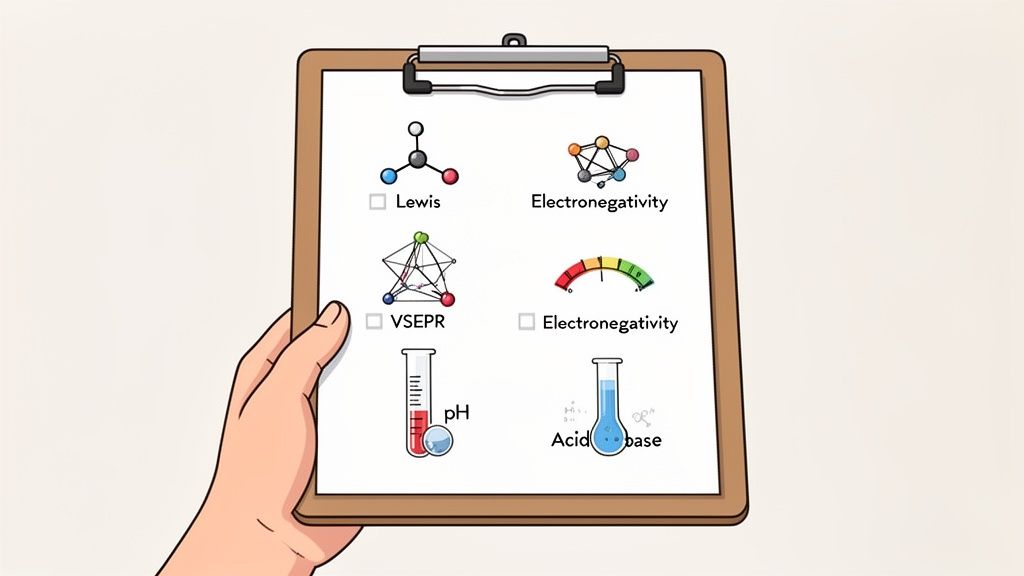
Lewis Structures & Formal Charge: You need to be able to draw these quickly and accurately, without even thinking about it. This is the starting point for determining a molecule's shape, polarity, and ultimate reactivity. It's non-negotiable.
VSEPR Theory & Hybridization: Organic chemistry is a 3D world. A deep, intuitive understanding of VSEPR lets you visualize molecular geometry (tetrahedral, trigonal planar, etc.), which is the entire basis for a huge topic called stereochemistry.
Electronegativity & Polarity: The story of almost every organic reaction is about electrons moving from an electron-rich spot to an electron-poor one. Recognizing dipoles and knowing electronegativity trends tells you exactly where the action is going to happen.
Acid-Base Chemistry: I'm not talking about simple pH calculations. You need to live and breathe pKa, conjugate acids/bases, and what makes an acid strong (think induction and resonance). So many Orgo reactions are just acid-base reactions in disguise.
If there's one thing to master, it's resonance. A shaky grasp of resonance is one of the single biggest predictors of a student struggling in Orgo I. It’s not just a topic in one chapter; it’s a fundamental principle that explains stability and reactivity across the entire course.
To help you focus your review, here’s a quick checklist of the must-know concepts and why they matter so much.
General Chemistry Concepts to Master for Orgo Success
| Gen Chem Concept | Why It's Critical for Orgo | Example Application in Orgo |
|---|---|---|
| Lewis Structures | Forms the basis for visualizing molecules and electron placement. | Drawing the starting materials for a Diels-Alder reaction to see electron flow. |
| Formal Charge | Helps identify reactive centers (carbocations, carbanions). | Calculating the formal charge on a carbon atom in a reaction intermediate. |
| VSEPR & Geometry | Determines the 3D shape of molecules, which affects reactivity and properties. | Predicting the tetrahedral geometry of methane (CH₄). |
| Hybridization (sp, sp², sp³) | Explains bonding and molecular shape in organic compounds. | Identifying the sp² hybridization of carbons in benzene. |
| Electronegativity & Polarity | Predicts how electrons are shared, creating dipoles that drive reactions. | Understanding why the C=O bond in a ketone is a site for nucleophilic attack. |
| Acid-Base Theories (pKa) | Many organic reactions are fundamentally acid-base steps. | Comparing the acidity of an alcohol vs. a carboxylic acid using their pKa values. |
| Resonance | Crucial for understanding the stability of molecules and reaction intermediates. | Drawing resonance structures to explain the stability of the carboxylate anion. |
Don't just read through old notes. The only way to know if you've truly mastered these is to actively solve problems from your old Gen Chem textbook until it feels boringly easy.
Your Actionable Pre-Study Plan
Want a structured approach? Dedicate about an hour a day for two to three weeks before the semester kicks off. It's a small investment with a massive payoff. Here’s a simple but powerful checklist:
- Re-learn Lewis Structures: Seriously. Draw at least 20 different molecules, including ions and compounds with formal charges. Focus on speed and accuracy.
- Master VSEPR: For every Lewis structure you draw, predict its electronic and molecular geometry. Then, label the hybridization (sp, sp², sp³) of each central atom.
- Drill Electronegativity: Grab a handful of molecules and rank their bonds by polarity (e.g., C-H vs. C-O vs. O-H). Draw the dipole moments.
- Deep Dive into Acids & Bases: Work through acid-base problems. Can you explain why one proton is more acidic than another using ARIO (Atom, Resonance, Induction, Orbital)? If not, you're not ready.
For a deeper look at effective learning habits, check out this guide on the best way to study chemistry.
You can also use modern tools to supercharge this review. Let's say you're stuck on a tricky formal charge problem from your old textbook. Instead of stewing in confusion, you can use a tool like Feen AI. Just snap a picture of the problem, and it can give you a step-by-step walkthrough. This kind of immediate feedback is way more effective than waiting a week for office hours.
By putting in this work now, you’ll transform your first day of Orgo from an overwhelming flood of new information into a confident, manageable first step.
Mastering the Visual Language of Orgo
Think of organic chemistry less as a subject and more as a new language—a visual one. You don't get fluent by memorizing vocabulary lists; you get fluent by drawing, interpreting, and mentally spinning molecules until it becomes second nature. This is where you learn the grammar of Orgo, the skills that let you look at a molecule's structure and immediately understand the story it tells.
Getting this down early is a huge predictor of success. Studies have shown that students who don't get a solid grip on these visual skills at the start often struggle later on. For some, this can create a persistent grade gap. Research has even highlighted that women and students from underrepresented backgrounds can face an amplified "risk spike" of dropping out during their first Orgo course compared to their experience in general chemistry. You can explore the research on these academic challenges here. Nailing the visual language from day one builds the confidence you need to tackle the tougher stuff head-on.
From Names to Structures: Nomenclature Essentials
Your first step toward fluency is learning IUPAC nomenclature. It’s the universal, systematic way to name organic compounds, and frankly, it's non-negotiable. Being able to translate a name like "(S)-4-bromo-3-methylpentan-2-ol" into a precise drawing—and go the other way around—is a core skill you'll use every single day.
Don't just cram this for one test and forget it. Weave nomenclature practice into everything you do. When you're studying alkenes, name every isomer you see. When you're working on alcohol reactions, name every single molecule in the problem set. This constant practice is what makes it stick.
Get comfortable with these key parts:
- Parent Chain: Finding the longest carbon chain that holds the main functional group.
- Functional Groups: Knowing your alcohols, ketones, and carboxylic acids and how they change the end of a molecule's name.
- Substituents: Spotting, naming, and numbering all the branches hanging off the main chain.
- Stereochemistry: Using prefixes like (R)/(S) and E/Z to describe the exact 3D layout of the atoms.
The Art of Skeletal Structures
No seasoned chemist draws out every single carbon and hydrogen. It's way too slow and makes everything look cluttered. Instead, we speak the language of skeletal structures, those clean line-angle drawings where every corner and endpoint is a carbon, and the hydrogens are just implied.
This isn't just about drawing faster; it's about seeing more clearly. A good skeletal structure helps you instantly spot the important parts of a molecule—the reactive sites, the functional groups, and the carbon backbone. For example, drawing cyclohexane as a flat hexagon is quick, but drawing its 3D "chair" conformation is what actually shows you why it's so stable and how it reacts.
Think of skeletal structures as a kind of shorthand. They strip away the noise so you can focus on what really matters. The goal is to glance at a complex line drawing and instantly "see" all the atoms and bonds that aren't explicitly drawn.
Visualizing Molecules in Three Dimensions
This is the first big hurdle for a lot of students. Molecules aren't flat cartoons; they are real, 3D objects that tumble and twist in space. Being able to mentally rotate these shapes in your head is absolutely essential for understanding a huge topic called stereochemistry.
Stereochemistry is all about how atoms are arranged in 3D space. It explains how two molecules can have the exact same formula and connections but be completely different compounds because they're non-superimposable mirror images of each other. We call these enantiomers, and they're a massive deal in biology and medicine.
Putting It All Together: A Practical Example
Let's take 2-butanol. The second carbon atom in its chain is attached to four different things: a hydrogen (-H), a hydroxyl group (-OH), a methyl group (-CH₃), and an ethyl group (-CH₂CH₃). This makes it a chiral molecule.
Now, picture this:
- You build a physical model of 2-butanol.
- Then, you build a second model that is its perfect mirror image.
- You'll quickly find that no matter how you twist or turn that second model, you can never get it to look exactly like the first one.
These two molecules are enantiomers, labeled (R)-2-butanol and (S)-2-butanol. This isn't just some abstract puzzle. In the real world, one enantiomer might be a powerful drug, while its mirror image could be totally useless or even dangerous.
The absolute best way to get good at this is to get a molecular model kit. Seriously. Holding the models in your hands and physically turning them is the fastest way to build your 3D intuition. Practice translating your physical models into 2D drawings using dashes (for atoms going back, into the page) and wedges (for atoms coming forward, out of the page).
Once you're good with that, you can start working with more abstract tools like Newman projections, which let you look straight down a carbon-carbon bond to see how the molecule's rotation affects its stability. Gaining this kind of visual fluency is what separates the students who truly understand organic chemistry from those who are just trying to memorize it.
How to Practice for Orgo Without Memorizing
If there's one secret to surviving organic chemistry, it’s this: you absolutely cannot memorize your way to an A. Success isn't about having a photographic memory for hundreds of reactions. It's about building the mental muscle to solve problems, and the only way to do that is through active, consistent practice.
This means shifting your focus from what happens in a reaction to why it happens. It requires a daily routine, not a last-minute cram session. The goal is to train your brain to see the underlying patterns and principles, turning abstract theory into a practical, problem-solving skill you can actually use.
From Basic Mechanisms to Complex Puzzles
You wouldn't try to run a marathon without starting with shorter distances first. The same logic applies here. You have to build your problem-solving stamina in Orgo by mastering the fundamentals before layering on more complexity.
Your practice should naturally progress through these stages:
- Reaction Mechanisms: This is ground zero. Start by mastering the "arrow-pushing" for individual reactions. Don't just copy it from the book. Draw it from memory, multiple times, explaining out loud what each arrow means and why those electrons are moving.
- Multi-Step Synthesis: Once individual mechanisms feel comfortable, you're ready for synthesis problems. These are the classic puzzles: you’re given a starting material and a final product, and you have to map out the steps to get from A to B. This is where you really start thinking like a chemist, combining reactions strategically.
- Spectroscopy Puzzles: The final layer is integrating spectroscopy (IR, NMR, Mass Spec). Here, you get raw data and have to deduce the structure of an unknown molecule. This combines everything—pattern recognition, logical deduction, and your knowledge of how a molecule's structure shows up in the data.
This flow is key. You can't do synthesis without knowing your reactions, and you can't interpret spectra without understanding structure.
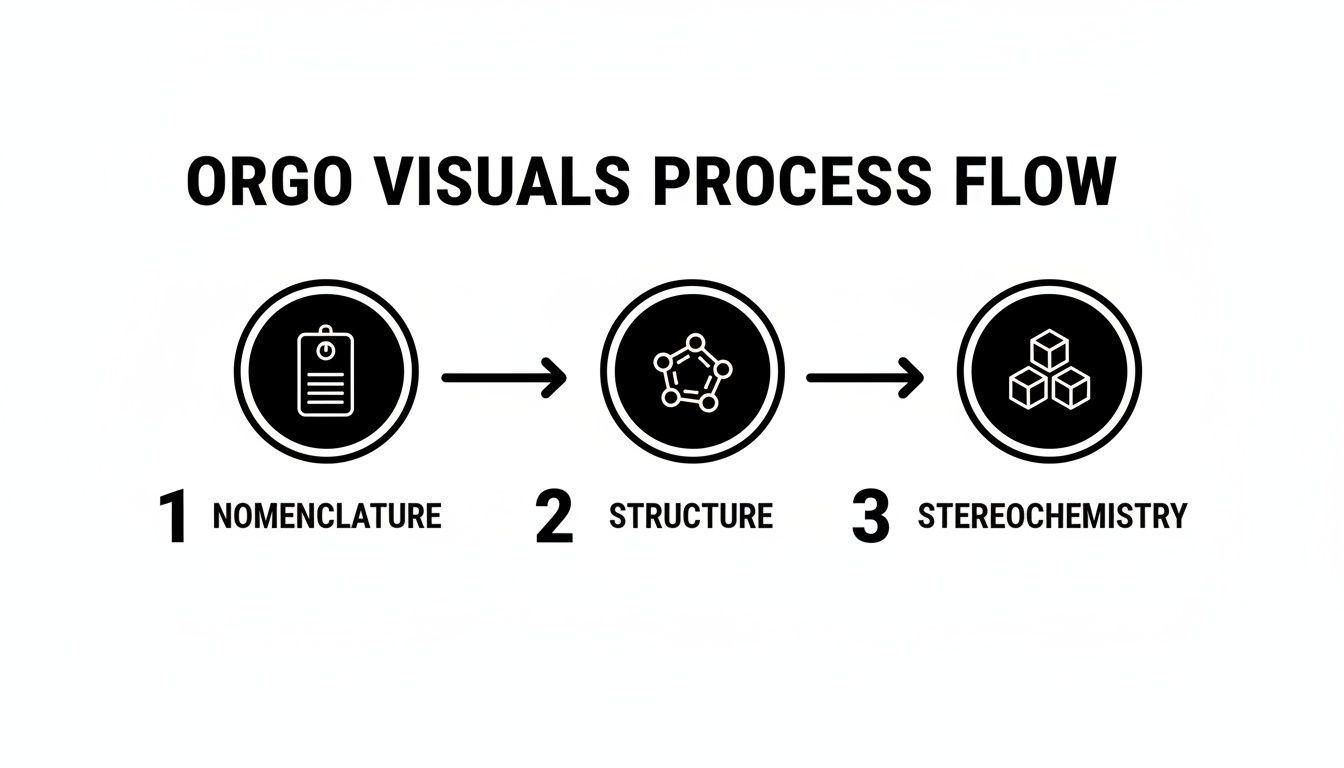
As you can see, everything builds on the foundation. A shaky foundation in nomenclature or structure means the whole thing will eventually come crumbling down.
Consistency Over Cramming: A Sample Weekly Schedule
The biggest mistake students make is underestimating the time commitment. The nationwide failure rate for Orgo hovers between 25-50%, a statistic driven more by poor study habits than the inherent difficulty of the material. Trying to cram is a recipe for disaster.
Your goal should be to touch organic chemistry in some meaningful way every single day. Even 30-45 minutes of focused problem-solving is far more effective than a five-hour panic session on Sunday night.
Here’s a look at a balanced weekly schedule that actually works:
| Day | Activity | Time Allotment | Focus |
|---|---|---|---|
| Mon/Wed/Fri | Pre- & Post-Lecture Review | 30 min before, 60 min after | Prime your brain for new topics, then immediately solve problems related to that day's lecture to lock it in. |
| Tue/Thu | Textbook & Problem Sets | 90-120 min | Work through assigned end-of-chapter problems. Don't touch the solutions manual until you've genuinely struggled. |
| Saturday | Cumulative Review & Quiz Prep | 2-3 hours | Review all the week's topics. Create a "mock quiz" for yourself with problems from different chapters to test your recall. |
| Sunday | Rest & Light Review | 30 min | Skim your notes from the week, identify confusing areas, and prep questions for office hours. |
This schedule forces active problem-solving, not passive reading. For more general advice on building these kinds of habits, check out our guide on how to study efficiently for exams.
How to Actually Solve Problems
How you attack problems is just as important as how many you do. Avoid the trap of just hunting for the right answer. Instead, get analytical with every single problem.
- Identify the "Why": Before putting pen to paper, ask yourself: What concept is this question testing? What functional groups are involved? Where are the likely reactive sites?
- Talk it Through: Seriously, explain the steps out loud as if you were teaching a friend. This forces you to articulate your logic and immediately reveals any gaps in your understanding.
- Analyze Your Mistakes: Getting a problem wrong is a learning opportunity. Don't just correct it and move on. Write down why you got it wrong. Was it a forgotten rule? A misidentified reagent? A simple stereochemistry error? This "mistake journal" will become your most valuable study tool.
This kind of deliberate practice turns homework from a chore into a targeted training session, building the intuition you need to nail your exams.
Building Your Organic Chemistry Study Toolkit
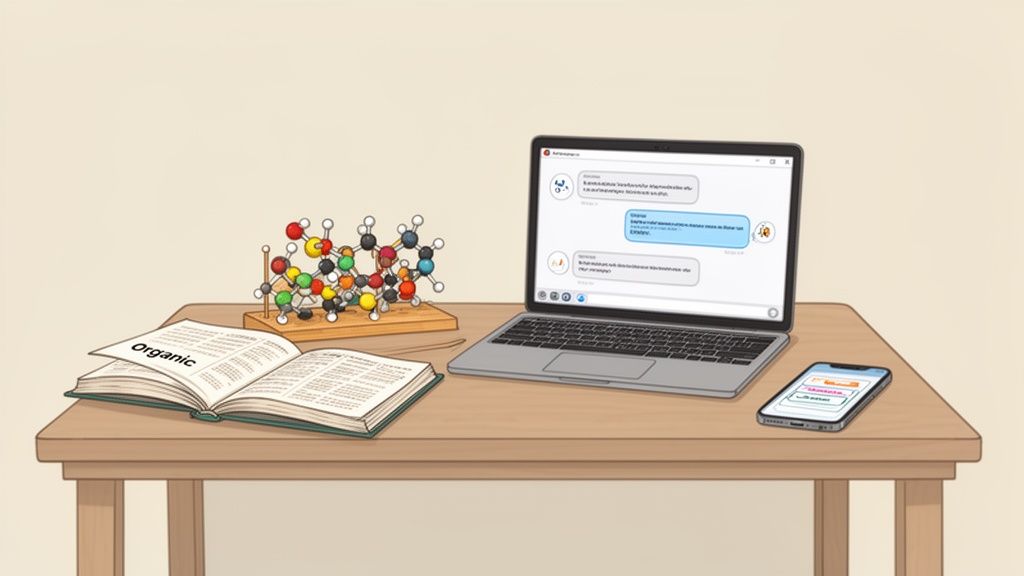
Let's be real: no one should go into organic chemistry alone. Just like a chemist needs the right lab equipment, you need a solid set of study tools to get through this course. Putting together your toolkit from day one gives you the support you need to handle tough problems and stay on track when the going gets tough.
This isn't just about buying whatever textbook is on the syllabus. It's about building a complete learning ecosystem that blends trusted, old-school resources with the best of modern tech. That combination gives you a rock-solid foundation while also letting you learn and solve problems in smarter, more efficient ways.
Core Physical and Textual Resources
Some study tools are classics for a good reason. They offer a hands-on, focused way to learn that you just can't get from a screen. Make these two items the absolute cornerstones of your setup.
A Quality Molecular Model Kit: Seriously, this is the single most important physical tool you will buy. Organic chemistry is a 3D subject, and trying to visualize complex stereochemistry or chair conformations on a flat page is where so many students stumble. Being able to physically hold a molecule, twist its bonds, and see how it moves will build your intuition faster than anything else.
A Supplemental Textbook: Your assigned textbook is your main guide, but having a second perspective is a game-changer. I always recommend Organic Chemistry as a Second Language by David R. Klein. It's a classic because it’s brilliant at breaking down tricky concepts into simple, clear explanations. It’s the perfect companion to a denser, more formal primary text.
Having multiple ways to understand a concept is crucial. If your professor's explanation doesn't click, and the main textbook feels confusing, having a third resource like Klein's book can be the key to a breakthrough.
To keep everything straight—from problem sets to lab reports—a dedicated planning tool is a lifesaver. Using an academic day planner helps you block out specific time for practice, reading, and lab prep, which is essential for managing the heavy workload.
Integrating Modern Technology into Your Workflow
While the classic tools are fundamental, ignoring technology means you're leaving a massive advantage on the table. The right digital tools can give you instant feedback, demystify confusing steps, and help you study more actively.
Your goal here is to find tools that don't just hand you the answers, but actually help you understand the process.
Online Problem Banks: Websites like ChemDoodle and the resource pages from various universities have huge libraries of practice problems. The only way to master O-Chem is through consistent problem-solving, and these sites ensure you’ll never run out of material.
AI-Powered Study Assistants: This is where studying gets a serious upgrade. Picture this: it’s 1 AM, you’re stuck on a brutal multi-step synthesis problem, and office hours are days away. Instead of giving up, you can use a tool like Feen AI. Just snap a picture of the problem, and it can give you a guided walkthrough that explains the logic behind every single step.
For instance, you could upload a confusing prompt for an upcoming lab report. The AI can help you structure your introduction, outline the procedure, and pinpoint the key theories you need to hit on. It doesn't write it for you; it acts as an intelligent guide to help you organize your thoughts and get past that initial writer's block. For more ideas like this, check out our comprehensive https://feen.ai/blog/organic-chemistry-study-guide.
By thoughtfully combining physical models, clear textbooks, and smart technology, you create a personalized toolkit that supports every part of your learning journey.
Answering Your Biggest Orgo Questions
Even with the best study plan, it's natural to feel a bit intimidated by organic chemistry. It has a certain reputation, after all. Let's clear the air and tackle some of the most common worries so you can walk into that first class feeling ready, not rattled.
So, How Much Math Are We Talking About?
This is where you can breathe a huge sigh of relief. Organic chemistry is not a math-heavy course. Forget the endless calculations for gas laws, thermodynamics, and equilibria from general chemistry. Orgo is a visual, conceptual game.
You’ll see almost no formulas. The most intense math you'll likely face is some simple addition and subtraction for calculating formal charges. The real work is in logic, 3D visualization, and spotting patterns—skills that have nothing to do with algebra. If complex equations were your least favorite part of Gen Chem, you might find Orgo is a much better fit.
Do I Just Have to Memorize Everything?
Absolutely not. This is easily the biggest myth about organic chemistry and the #1 reason students hit a wall. If you try to memorize every single reaction as a separate fact, you're setting yourself up for failure. It’s an impossible and frustrating task.
Instead, think of it like learning a language. You don't get fluent by memorizing the dictionary; you learn the grammar and sentence structure. In Orgo, that "grammar" is all about understanding the core principles:
- Electron Flow: Figure out where the electrons are and where they want to go.
- Stability: Understand why one molecule is more stable than another.
- Reactivity: Learn to spot the parts of a molecule that are ripe for attack.
Once you grasp these rules, you can start predicting outcomes for reactions you've never seen before.
The goal isn’t to memorize a massive list of reactions. It's to understand the fundamental patterns of how molecules behave so you can reason your way through any new problem you face. It’s a much smarter—and less stressful—way to learn.
What’s a Realistic Time Commitment for Studying?
Honestly? It’s a lot. But it’s more about consistency than sheer volume. The classic rule of thumb is to plan for two to three hours of study time for every one hour you spend in lecture. If you're in a standard 3-credit class, that means you should be blocking out at least 6-9 hours per week for Orgo. And that doesn't even include lab work or official homework assignments.
The key, though, is how you use that time. A five-hour cram session on a Sunday is nowhere near as effective as spending one solid hour working through problems every single day. The material is cumulative in a way few other courses are. Fall behind one week, and the concepts for the next week will feel like they’re in a different language.
Can I Do Well If I Didn't Ace General Chemistry?
Yes, without a doubt. A solid Gen Chem foundation helps, but success in Orgo relies on a totally different set of skills. I've seen many students who struggled with the heavy math in Gen Chem absolutely thrive in organic chemistry because their strengths were in visualization and puzzle-solving.
The trick is to be realistic about your Gen Chem weak spots. Before the semester starts, make it your mission to master Lewis structures, VSEPR theory, acid-base chemistry, and resonance. Your command of those specific topics is way more important than what your final Gen Chem grade was.
Staring at a brutal synthesis problem or a confusing spectroscopy graph? Let Feen AI be your 24/7 study partner. Just snap a photo of any question, and you'll get clear, step-by-step explanations that actually help you learn the why behind the answer. Try Feen AI today and start turning those tough topics into your strengths.
Recent articles

What is the difference between mitosis and meiosis? This guide provides a clear comparison of purpose, stages, and outcomes for students and curious minds.

What is the difference between speed and velocity? what is the difference between speed and velocity explained in plain terms with helpful examples.

Learn how to solve inequalities step by step. This guide covers linear, absolute value, and quadratic inequalities with clear examples and real-world tips.

Struggling with homework? This guide shows you how to convert units in chemistry with dimensional analysis. Master moles, grams, concentration, and more.

Struggling with 'what is conservation of energy'? This guide breaks down the core law with simple analogies, worked examples, and real-world applications.

Discover what is dimensional analysis in chemistry and master the factor-label method with clear, step-by-step examples.